The Same Concrete
TAM-RWR.1-07 · The Reshaped World, Arc 1: The Built World After Work · The Approximate Mind
The Reshaped World, Part 1-07 of 7. Arc capstone. Six essays described an American condition. This essay asks whether it is one.
Njeri spent a day walking Detroit before the conference began.
She had been invited to present research on infrastructure investment patterns across sub-Saharan Africa, South Asia, and Southeast Asia, a decade of work on how capital flows into and out of built environments in the developing world. She arrived a day early because she wanted to see the city she had read about in reports she had been using as comparison cases for years.
She brought her camera. She takes photographs the way some researchers take notes: not to illustrate arguments she has already made but to ask questions she has not yet formulated.
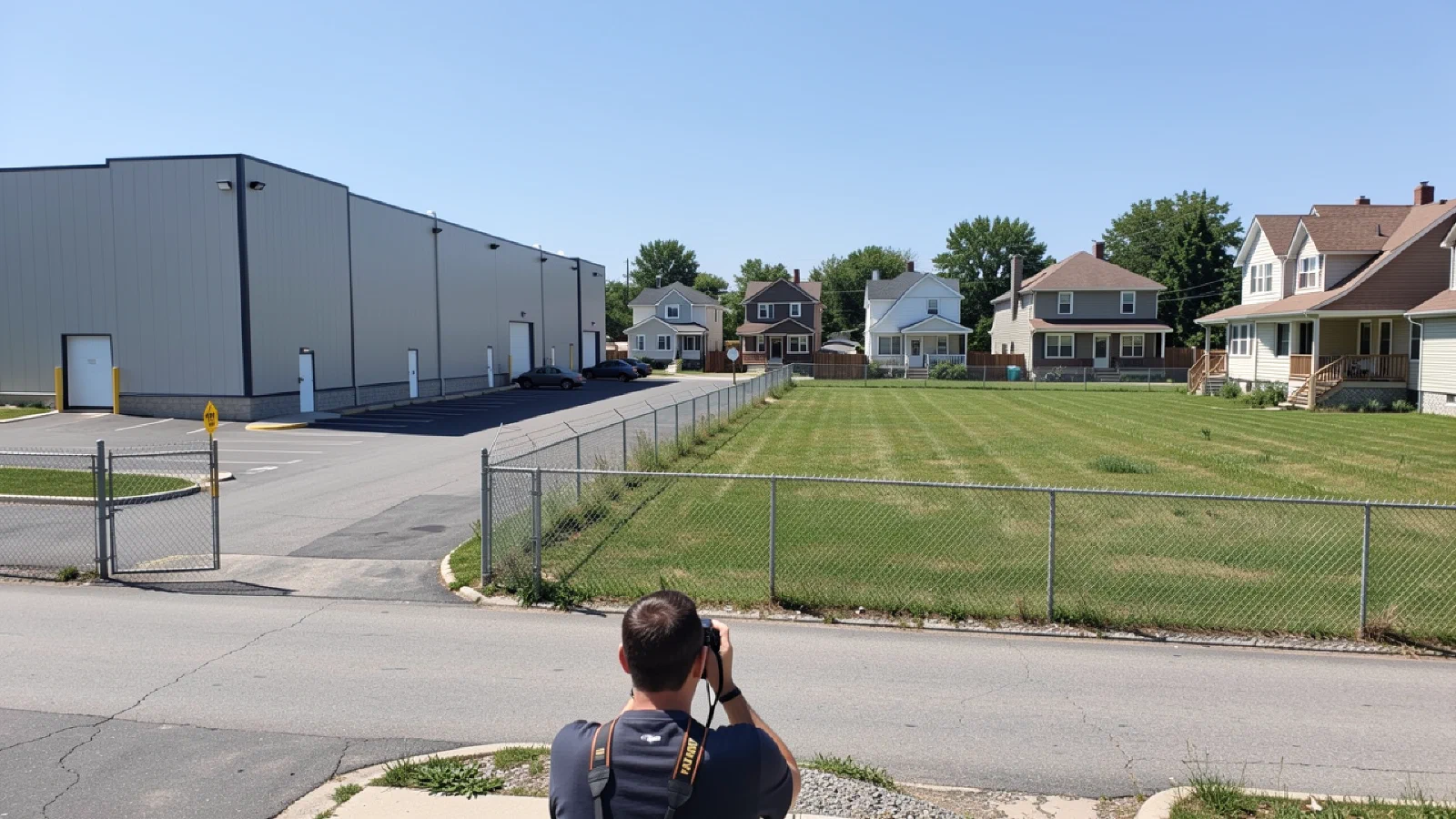
One photograph stopped her for a long time before she took it. A fully automated logistics facility, recently built, no parking lot to speak of, surrounded by a neighborhood where vacant lots and maintained houses existed in proportions that told a specific story about where the investment had gone and where it had not. The facility was operational. The neighborhood was present. They had no visible relationship to each other.
She took the photograph. She put it in the folder she uses for things she does not yet understand.
What the Arc Has Built#
The six preceding essays have been building an argument about the American built environment.
The argument began with Diane’s city: the place where economic volume disappeared rather than relocated, leaving infrastructure built for a population that is not returning. It moved to Sandra’s checklist: the physical discontinuity between what automation displaces and what it builds in place of what it displaces, in different locations, serving different purposes, connected to the surrounding community only by a property tax bill. It moved to Marcus’s Sunday notebook: the city stripped of its labor-organizing function, asked for the first time to justify itself on the basis of what people choose rather than what work requires. It moved to Renee’s map: the enclave that has been operating the exit-voice mechanism for fifty years, not as a future scenario but as an existing condition. It moved to Elena’s spreadsheet: the income floor that cannot purchase residential options in the places where economic opportunity exists, and can purchase them in the places the market has already identified as dangerous.
And it moved to Valeria’s maintenance deferral log: forty-seven pages recording what the city cannot afford, accumulating interest. The floor is real. What it is the floor of is the question nobody is asking.
The American argument is complete at this point. Two built worlds inside a single political unit: one maintained, chosen, privately supplemented, serving those whose income is not contingent on the automated displacement; one inherited, deteriorating, publicly funded at declining levels, serving those who are. The exit-voice cycle connecting them, self-reinforcing in the direction of further divergence.
This essay’s question is whether that argument is American.
The Same Photograph#
At the conference, Njeri showed the photograph.
She showed it not as evidence for a point she was making about Detroit specifically, but as a question about the pattern she had been tracing for ten years across different contexts. She asked the audience what city it was before she told them.
Someone said Lagos.
She said: yes, that is why I brought it.
The logistics facility, the vacant lots, the maintained houses in unequal proportion: this spatial configuration is not uniquely American. It is the physical expression of a specific relationship between automated capital and the communities adjacent to it, and that relationship produces the same visual regardless of the continent, because the economic logic that produces it is the same economic logic everywhere.
In Lagos, the walled compound adjacent to the informal settlement. In Manila, the private city within the city, with its own governance and its own infrastructure and its own rules about who enters. In São Paulo, the gated condominium development with private security and private streets and private maintenance, surrounded by the public city that maintains none of these things at that standard. In Bangladesh, the special economic zone operating under different labor law, different environmental regulation, different infrastructure investment, different governance than the garment district it abuts.
These are not the same political phenomenon. They do not have the same historical origins. They are not expressions of the same cultural tradition or the same specific political failure.
They are expressions of the same economic logic: capital sufficient to exit the shared environment builds a private alternative, sorts access to it by price, and the sorting produces a built environment that is physically recognizable across contexts that are otherwise completely different.
The Global South’s Specific Position#
The six American essays describe a condition that developed over sixty years: the manufacturing base automated, the economic volume declined, the exit-voice cycle operated, the infrastructure diverged. The sequence had time to unfold gradually enough that each stage could be addressed, at least in principle, before the next stage made intervention more difficult.
The Global South does not have sixty years.
The industrial city infrastructure being built right now in Lagos, Dhaka, Kinshasa, Manila, and hundreds of smaller cities across the developing world is being built at the moment that infrastructure is becoming economically obsolete in the places that pioneered it. The factories are being built. The distribution centers are being built. The urban labor markets are forming around the expectation of sustained industrial employment. The transit systems are being planned for the labor movement those labor markets will require.
At the same time, the automated replacement infrastructure is also arriving. The automated warehouse that does not need the labor pool. The data center that needs power and connectivity and nothing the surrounding community provides. The logistics system that concentrates its efficiency gains in global capital rather than distributing them through local employment.
The Vietnamese planner who visited Diane’s city and said “we understand the risk, we are not aware of a better option” was right on both counts. The risk is real. The alternative is not obvious. But the timeline is compressed in a way that does not permit the gradual recognition that allowed some American cities to respond, inadequately but at least eventually, to the first stages of the sequence.
The developing world is building the infrastructure of the economic city at the moment the economic logic that makes that infrastructure viable is being dismantled by the same global capital flows that are funding the construction. The destination is reorganizing as the travelers are in transit, and the travelers are moving faster than the destination is recognizable from a distance.
Where the Surplus Goes#
The automated replacement infrastructure in the Global South raises a question the American essays held at the national scale but that becomes more pointed internationally: whose warehouses, whose data centers, whose logistics infrastructure is being built, and where does the surplus go?
The automated distribution facility built on the edge of a Kenyan city by a global logistics company generates economic activity. The question is which activity flows into the local economy and which flows out of it. The employment, minimal by design, flows in: the handful of operational roles, the construction workforce during the build phase. The productivity surplus, the reason the facility was built, flows to the shareholders of the global logistics company, which is not a Kenyan company and whose shareholders are not, on average, Kenyan.
This is not a new dynamic. The colonial extraction economy operated a version of it for centuries. What is new is the speed and the completeness of the automated facility’s economic self-containment. The colonial enterprise at least required significant local labor, which meant a significant portion of the economic activity had to remain in the local labor market to function. The automated facility requires so little local labor that even this attenuated local benefit is minimal.
The replacement infrastructure and the communities near it are in the same spatial relationship as Sandra’s cold storage facility and the food distribution workers in the communities around it: proximate in geography, disconnected in economics.
The Political Unit That Would Need to Act#
The six preceding essays named the mechanism at different scales: volume reduction, physical discontinuity, the remainder city, the enclave already operating, the spatial arithmetic of the floor, the maintenance deferral log that knows what the city cannot afford. Together they describe the exit-voice cycle in its full expression. The cycle has a correction condition: an intervention by a political unit with the authority and constituency to reverse the incentive structure, to make exit from shared infrastructure more costly and investment in shared infrastructure more beneficial.
At the American scale, that political unit exists in principle. The federal government has the authority and has historically used it to compel investment in shared infrastructure. Its constituency is increasingly organized around the preferences of those who have most successfully exited the shared systems.
At the global scale, the political unit that would need to act does not have a clear institutional home.
National governments are competing with each other for the automated infrastructure investment, which means they are offering tax incentives and regulatory accommodations that further reduce the local economic benefit of the facilities they are trying to attract. The race to the bottom in corporate taxation and labor regulation is a collective action problem that no individual national government can solve by acting alone, and most cannot afford to solve by refusing to participate.
Regional bodies, the African Union, ASEAN, the European Union, have limited enforcement capacity on the questions that matter most here: where the surplus from automated infrastructure flows, what conditions can be imposed on foreign capital investment, how the exit-voice cycle operating across national borders can be interrupted.
International institutions, the World Bank, the International Monetary Fund, the World Trade Organization, were designed for a configuration of global capital that preceded the current automation wave and do not have the mandate or the mechanism to address the specific questions the automation wave raises about where economic activity happens and where its benefits land.
I wonder whether this is a permanent institutional gap or a temporary one that the scale of the problem will eventually force to close. The gap between the scale of the mechanism and the scale of the political unit capable of addressing it is not a new problem in economic history. But the speed at which the mechanism is now operating may not permit the slow institutional adaptation that has historically closed such gaps.
The photograph sits in a folder labeled everywhere. The folder is getting larger.
What the Concrete Records#
The discovery that the arc of six essays earns, visible only from the elevation of all six together, is this: the two built worlds are not a transitional condition between two equilibria. They are the equilibrium, and they are the same equilibrium everywhere.
In Detroit and in Lagos. In Diane’s Carolinas mill town and in the Dhaka garment district. In the American suburb whose transit is contracting and in the Indonesian city building transit for a labor market that is automating as the transit is being planned.
The concrete does not sort itself. It records what the economic system has already sorted. And the economic system sorting it is the same economic system everywhere, operating through the same mechanism everywhere, producing the same physical expression everywhere, in different materials and at different speeds but toward the same destination.
The built world is not the problem. It is the record.
The problem is the economic system producing the sorting. The record is the concrete, which is honest in a way that the political conversation around it rarely is, because the concrete cannot say what it was designed to do. It can only show what it does.
Njeri returns to Nairobi after the conference. She has a new research proposal she is drafting, connecting the infrastructure investment patterns she has been studying in sub-Saharan Africa to the disinvestment patterns she walked through in Detroit. Her colleagues find the comparison interesting and slightly unusual. She shows them the photograph.
She asks them what city it is.
Two of them say Lagos before she tells them it is Detroit.
She sends the photograph to a colleague in Manila. He says it could be the road to Cavite.
She files it in the folder labeled everywhere, and begins the proposal, and does not yet know where it will lead, only that the photograph keeps asking its question and the question is not a local one.
References#
Global Capital and Infrastructure
Davis, Mike. Planet of Slums. Verso, 2006.
Graham, Stephen, and Simon Marvin. Splintering Urbanism: Networked Infrastructures, Technological Mobilities and the Urban Condition. Routledge, 2001.
Harvey, David. The Limits to Capital. Blackwell, 1982.
Premature Deindustrialization and the Global South
Diao, Xinshen, et al. “The Future of African Manufacturing in the Age of Robotics.” Journal of African Economies, vol. 28, no. 1, 2019, pp. 1–14.
Rodrik, Dani. “Premature Deindustrialization.” Journal of Economic Growth, vol. 21, no. 1, 2016, pp. 1–33.
World Bank. World Development Report 2019: The Changing Nature of Work. World Bank, 2019.
Global Enclave Urbanism
Bélanger, Pierre. “Landscape as Infrastructure.” Bracket, vol. 1, 2010, pp. 122–131.
Goldblum, Charles, and Tai-Chee Wong. “Growth, Crisis and Spatial Change: A Study of Shophouse Conversion in Inner Kuala Lumpur, Malaysia.” Land Use Policy, vol. 17, no. 2, 2000, pp. 159–170.
Soja, Edward W. Postmetropolis: Critical Studies of Cities and Regions. Blackwell, 2000.
Automation and Global Labor
Acemoglu, Daron, and Pascual Restrepo. “Robots and Jobs: Evidence from US Labor Markets.” Journal of Political Economy, vol. 128, no. 6, 2020, pp. 2188–2244.
International Labour Organization. World Employment and Social Outlook 2019: The Changing Nature of Work. ILO, 2019.
International Political Economy and Institutional Gaps
Rodrik, Dani. The Globalization Paradox: Democracy and the Future of the World Economy. Norton, 2011.
Stiglitz, Joseph E. Globalization and Its Discontents. Norton, 2002.
Zucman, Gabriel. The Hidden Wealth of Nations: The Scourge of Tax Havens. Translated by Teresa Lavender Fagan, University of Chicago Press, 2015.
How this essay connects to others across The Approximate Mind.
- Davis, Mike. Planet of Slums. Verso, 2006.
- Graham, Stephen, and Simon Marvin. Splintering Urbanism: Networked Infrastructures, Technological Mobilities and the Urban Condition. Routledge, 2001.
- Harvey, David. The Limits to Capital. Blackwell, 1982.
- Diao, Xinshen, et al. “The Future of African Manufacturing in the Age of Robotics.” Journal of African Economies, vol. 28, no. 1, 2019, pp. 1–14.
- Rodrik, Dani. “Premature Deindustrialization.” Journal of Economic Growth, vol. 21, no. 1, 2016, pp. 1–33.
- World Bank. World Development Report 2019: The Changing Nature of Work. World Bank, 2019.
- Bélanger, Pierre. “Landscape as Infrastructure.” Bracket, vol. 1, 2010, pp. 122–131.
- Goldblum, Charles, and Tai-Chee Wong. “Growth, Crisis and Spatial Change: A Study of Shophouse Conversion in Inner Kuala Lumpur, Malaysia.” Land Use Policy, vol. 17, no. 2, 2000, pp. 159–170.
- Soja, Edward W. Postmetropolis: Critical Studies of Cities and Regions. Blackwell, 2000.
- Acemoglu, Daron, and Pascual Restrepo. “Robots and Jobs: Evidence from US Labor Markets.” Journal of Political Economy, vol. 128, no. 6, 2020, pp. 2188–2244.
- International Labour Organization. World Employment and Social Outlook 2019: The Changing Nature of Work. ILO, 2019.
- Rodrik, Dani. The Globalization Paradox: Democracy and the Future of the World Economy. Norton, 2011.
- Stiglitz, Joseph E. Globalization and Its Discontents. Norton, 2002.
- Zucman, Gabriel. The Hidden Wealth of Nations: The Scourge of Tax Havens. Translated by Teresa Lavender Fagan, University of Chicago Press, 2015.