The Replacement
TAM-RWR.1-02 · The Reshaped World, Arc 1: The Built World After Work · The Approximate Mind
The Reshaped World, Part 1-02 of 7. The previous essay asked what happens to the built environment when economic volume disappears. This essay asks what gets built in its place, and where.
Sandra has a checklist she uses when she is assessing a site for a client. She has been doing site selection for logistics infrastructure for seventeen years, and the checklist has evolved with the work. The current version has nineteen items. She still has the 2015 version in a folder somewhere on her laptop.
In 2015, labor pool was item two.
In the current version, it is item eleven.
What Changed in the Checklist#
The displacement of labor pool from near the top of site selection criteria to somewhere in the middle is not a small administrative adjustment. It reflects a fundamental change in what the facilities she is placing actually require. A large distribution center in 2015 needed to be within reasonable commuting distance of a workforce: ideally fifty thousand working-age adults within forty-five minutes, with a secondary labor market reachable within an hour. The site had to work for people, which meant it had to be accessible, lit for shift changes at three in the morning, designed with break rooms and parking and HVAC calibrated for human comfort through twelve-hour shifts.
A large automated distribution center in 2025 needs power, connectivity, structural load capacity, and cheap land.
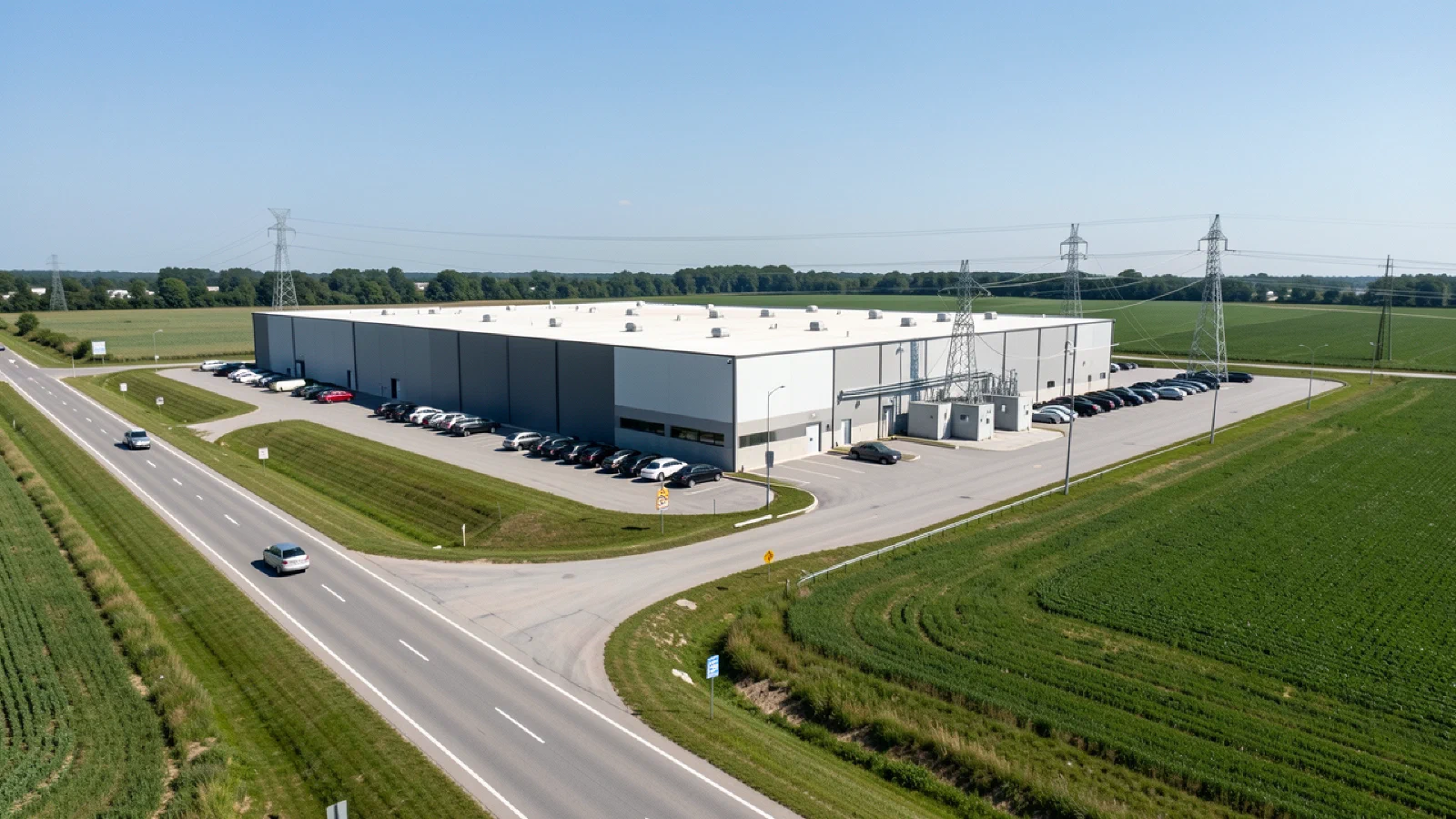
The people who still work in these facilities, and there are always some, need to get there somehow. But the site logic no longer centers on them. It centers on what the machines require: reliable high-voltage grid access, fiber infrastructure for the sensor and control networks, floor loading capacity measured in tons per square foot, ceiling heights that allow the vertical storage systems to operate at full extension. These requirements point toward a different geography than human-labor requirements did. They point toward the rural edge of metropolitan areas, toward former agricultural land near interstate intersections, toward industrial parks built for a kind of facility that did not yet exist when the parks were platted.
The new infrastructure is not the old infrastructure adapted. It is a different physical form, built to different specifications, in different places, for purposes that have less in common with what preceded them than the shared industry category suggests.
This distinction gets lost in most discussions of automation’s built environment effects, because those discussions tend to focus on the displacement: how many workers were replaced, what the unemployment numbers show, what happens to the people. These are the right questions. They are not the only questions. The other question is what gets built, and whether its presence in a place does anything for that place.
The Geographic Logic of Machines#
Spend a day with Sandra on a site assessment and you will notice something that took her several years to articulate.
The automated facilities she places are, with some variation, being built in places where the displaced workers are not.
This is not an accident or an oversight. It is the outcome of a rational optimization process. Human-labor infrastructure needed to be near labor, which meant it needed to be near where people lived and could get to work. Automated infrastructure needs to be near power and land, which means it gravitates toward the cheap periphery of metropolitan areas, toward rural corridors with transmission infrastructure, toward places selected for their grid access and land costs rather than their population.
The result is a spatial mismatch that is easy to overlook in sector-level analysis but that becomes visible the moment you put it on a map. The communities whose workforces staffed the facilities that automated are in one set of places. The facilities being built to replace them, economically if not functionally, are in another set of places. The workers do not live where the new facilities are being built. The new facilities do not need them to.
Sandra has started thinking about this as a structural feature rather than a temporary friction. The site criteria for automated infrastructure will not drift back toward labor pool proximity when the labor market tightens, because the whole point of the automation is to remove the dependency on the labor market. The site logic and the workforce geography have decoupled, and there is no mechanism internal to the economics of site selection that would reconnect them.
What fills the item-eleven slot in her current checklist, the labor pool consideration, is mostly a compliance question: can she demonstrate, if asked, that the site is accessible to some reasonable number of working-age adults, for the handful of operational roles the facility actually requires. It is not a constraint that shapes the site decision the way it used to. It is a box that can be checked after the real constraints have been satisfied.
Three Sectors, Three Discontinuities#
The discontinuity between human-labor and automated infrastructure shows up differently by sector, but the direction is consistent across them.
In warehouse and logistics, the change is most visible and furthest along. The shift from a distribution center employing six hundred people to one employing forty is accompanied by a change in building typology: taller ceilings, heavier floors, no loading dock configuration designed for human hand-staging, power infrastructure sized for charging systems rather than break room appliances. The building that results is not the same building with fewer people in it. It is a different building, built for a different operational logic. Data centers follow an even more extreme version of the same logic: enormous power draw, intensive cooling infrastructure, minimal human presence, a site profile that favors proximity to transmission lines and cheap land over proximity to anything a person might need. Communities compete aggressively to attract them on the promise of tax revenue and a handful of operational jobs. What arrives is a building that employs twelve people, consumes the power of a small city, and has no relationship to the surrounding community beyond the property tax bill.
In agriculture, the transition is slower and more varied, but the direction is the same. The automated greenhouse or the drone-managed field has different spatial requirements than the labor-intensive version: sensor networks, power for climate control systems, equipment that requires road access calibrated for machinery rather than people. The seasonal labor camp that housed hundreds of workers during harvest has no equivalent in the automated model. The land use changes with the labor requirement.
In construction, the automation is earlier-stage but following the same pattern. As prefabrication and automated assembly expand, the work migrates from the site to the factory, and the factory has site requirements that favor industrial land near transportation nodes rather than presence in the communities where construction is happening. The job on the building site becomes the job in the fabrication facility thirty miles away, and then it becomes the job running the system that runs the fabrication facility, and at each step the workforce shrinks and the geographic logic shifts.
Each sector’s automated replacement has different physical requirements, but none of them resemble the human-labor version in the ways that connect a facility to its surrounding community. The economic activity is still happening. The jobs, the ancillary services, the tax base, the downstream commercial ecosystem: these are the connections that don’t transfer.
What the New Facilities Look Like#
Sandra spends a fair amount of time thinking about visibility, which is not a typical item on a site selection checklist but which she has come to believe matters more than the field recognizes.
Most people have never seen a large automated logistics facility operating at capacity. They have seen news coverage of Amazon warehouses, which tends to focus on the human workers rather than on the scale of automation surrounding them. They have seen the exteriors of data centers, which are deliberately unmarked and architecturally indistinguishable from any other large commercial building. The visual identity of the new infrastructure is intentionally minimal: no signage explaining what happens inside, no architectural gesture toward the surrounding landscape, no public-facing design because there is no public-facing function.
This invisibility is not conspiratorial. It is rational. These facilities are not community assets in the sense that a factory that employed six hundred people was a community asset, and they have no reason to present themselves as such. They are infrastructure nodes, pieces of a larger network, and their relationship to the places they sit in is transactional: they use the land, consume the power, and pay the property taxes.
The property taxes are real and they are not trivial. Sandra’s clients are aware that large facilities generate significant local tax revenue, and some communities have actively courted them on that basis. The tax revenue lands in the municipality’s general fund and can in principle support services for the people who live in the area. Whether it does depends on decisions made well downstream of the site selection process.
I wonder whether the communities whose economic base is being replaced by automated infrastructure will capture enough of the replacement’s economic activity to offset what the replacement displaced. The tax revenue is real, but it is a different kind of economic presence than employment. It does not generate the downstream commercial ecosystem, the lunch spots and the service providers and the school enrollment, that human-employing facilities generated. It is income without multiplier. It arrives as a budget line item rather than as embedded economic circulation, and it is easier to lose in the next assessment negotiation than a functioning local economy.
This is not a question Sandra is asked to answer. It is not in the checklist.
The Site Assessment That Doesn’t Fit the Checklist#
She is currently assessing three candidate sites for a fully automated cold storage facility. The client is a regional food distributor expanding its automated capacity. The facility will handle a volume of product currently moving through three human-staffed distribution operations. The transition to full automation at the new site will, over a three-to-five year period, eliminate the need for approximately four hundred positions across those three operations.
The top three candidate sites are all within twenty miles of communities where food distribution is a significant employment sector.
This fact is not in the checklist. It cannot be derived from any of the nineteen items Sandra works through when she assesses a site. The checklist asks about power, connectivity, floor loading, ceiling height, land cost, proximity to transportation corridors, environmental compliance, and eight other factors. It does not ask about the relationship between the facility being assessed and the economic ecosystem of the communities within its radius.
Sandra is not being negligent. Her job is to find the optimal site for her client’s facility by the criteria her client cares about. Her client does not have the communities within twenty miles on their list of stakeholders in the site decision. The affected communities are not parties to the transaction.
The cold storage facility will be built somewhere in the range she has identified. It will be well-built, efficiently operated, economically rational, and geographically disconnected from the economic consequences of its own existence in ways that no party in the transaction is required to calculate or disclose.
The checklist will be complete.
References#
Logistics and Warehouse Automation
Autor, David H., and Anna Salomons. “Is Automation Labor-Displacing? Productivity Growth, Employment, and the Labor Share.” Brookings Papers on Economic Activity, Spring 2018, pp. 1–87.
Manyika, James, et al. A Future That Works: Automation, Employment, and Productivity. McKinsey Global Institute, 2017.
Sasser, W. Earl, and Cynthia Beath. “Amazon’s Approach to Automation.” Harvard Business School Case 9-621-009, 2020.
Geographic Sorting and Spatial Mismatch
Autor, David H. “Work of the Past, Work of the Future.” AEA Papers and Proceedings, vol. 109, 2019, pp. 1–32.
Kain, John F. “Housing Segregation, Negro Employment, and Metropolitan Decentralization.” Quarterly Journal of Economics, vol. 82, no. 2, 1968, pp. 175–197.
Muro, Mark, et al. Automation and Artificial Intelligence: How Machines Are Affecting People and Places. Brookings Institution, 2019.
Industrial Site Selection and Location Theory
Blair, John P. Local Economic Development: Analysis, Practices, and Globalization. Sage, 1995.
Glaeser, Edward L., and Joshua D. Gottlieb. “The Economics of Place-Making Policies.” Brookings Papers on Economic Activity, Spring 2008, pp. 155–239.
Weber, Alfred. Theory of the Location of Industries. University of Chicago Press, 1929.
Agricultural Automation
Fuglie, Keith, et al. “Agricultural Research Investment and Policy Reform in High-Income Countries.” Economic Research Report 297, USDA Economic Research Service, 2022.
International Labour Organization. The Future of Work in Agriculture. ILO, 2019.
Tax Revenue and Economic Development
Greenstone, Michael, et al. “Do Incentives for Economic Development Work? Evidence from the Midwestern Governors’ Regional Competitiveness Initiative.” Working Paper, University of Chicago, 2021.
Moretti, Enrico, and Daniel J. Wilson. “The Effect of State Taxes on the Geographical Location of Top Earners: Evidence from Star Scientists.” American Economic Review, vol. 107, no. 7, 2017, pp. 1858–1903.
How this essay connects to others across The Approximate Mind.
- Autor, David H., and Anna Salomons. “Is Automation Labor-Displacing? Productivity Growth, Employment, and the Labor Share.” Brookings Papers on Economic Activity, Spring 2018, pp. 1–87.
- Manyika, James, et al. A Future That Works: Automation, Employment, and Productivity. McKinsey Global Institute, 2017.
- Sasser, W. Earl, and Cynthia Beath. “Amazon’s Approach to Automation.” Harvard Business School Case 9-621-009, 2020.
- Autor, David H. “Work of the Past, Work of the Future.” AEA Papers and Proceedings, vol. 109, 2019, pp. 1–32.
- Kain, John F. “Housing Segregation, Negro Employment, and Metropolitan Decentralization.” Quarterly Journal of Economics, vol. 82, no. 2, 1968, pp. 175–197.
- Muro, Mark, et al. Automation and Artificial Intelligence: How Machines Are Affecting People and Places. Brookings Institution, 2019.
- Blair, John P. Local Economic Development: Analysis, Practices, and Globalization. Sage, 1995.
- Glaeser, Edward L., and Joshua D. Gottlieb. “The Economics of Place-Making Policies.” Brookings Papers on Economic Activity, Spring 2008, pp. 155–239.
- Weber, Alfred. Theory of the Location of Industries. University of Chicago Press, 1929.
- Fuglie, Keith, et al. “Agricultural Research Investment and Policy Reform in High-Income Countries.” Economic Research Report 297, USDA Economic Research Service, 2022.
- International Labour Organization. The Future of Work in Agriculture. ILO, 2019.
- Greenstone, Michael, et al. “Do Incentives for Economic Development Work? Evidence from the Midwestern Governors’ Regional Competitiveness Initiative.” Working Paper, University of Chicago, 2021.
- Moretti, Enrico, and Daniel J. Wilson. “The Effect of State Taxes on the Geographical Location of Top Earners: Evidence from Star Scientists.” American Economic Review, vol. 107, no. 7, 2017, pp. 1858–1903.