The Remainder
TAM-RWR.1-03 · The Reshaped World, Arc 1: The Built World After Work · The Approximate Mind
The Reshaped World, Part 1-03 of 7. The previous essays asked where the work went and what got built in its place. This essay asks what is left of the city when neither answer is “here.”
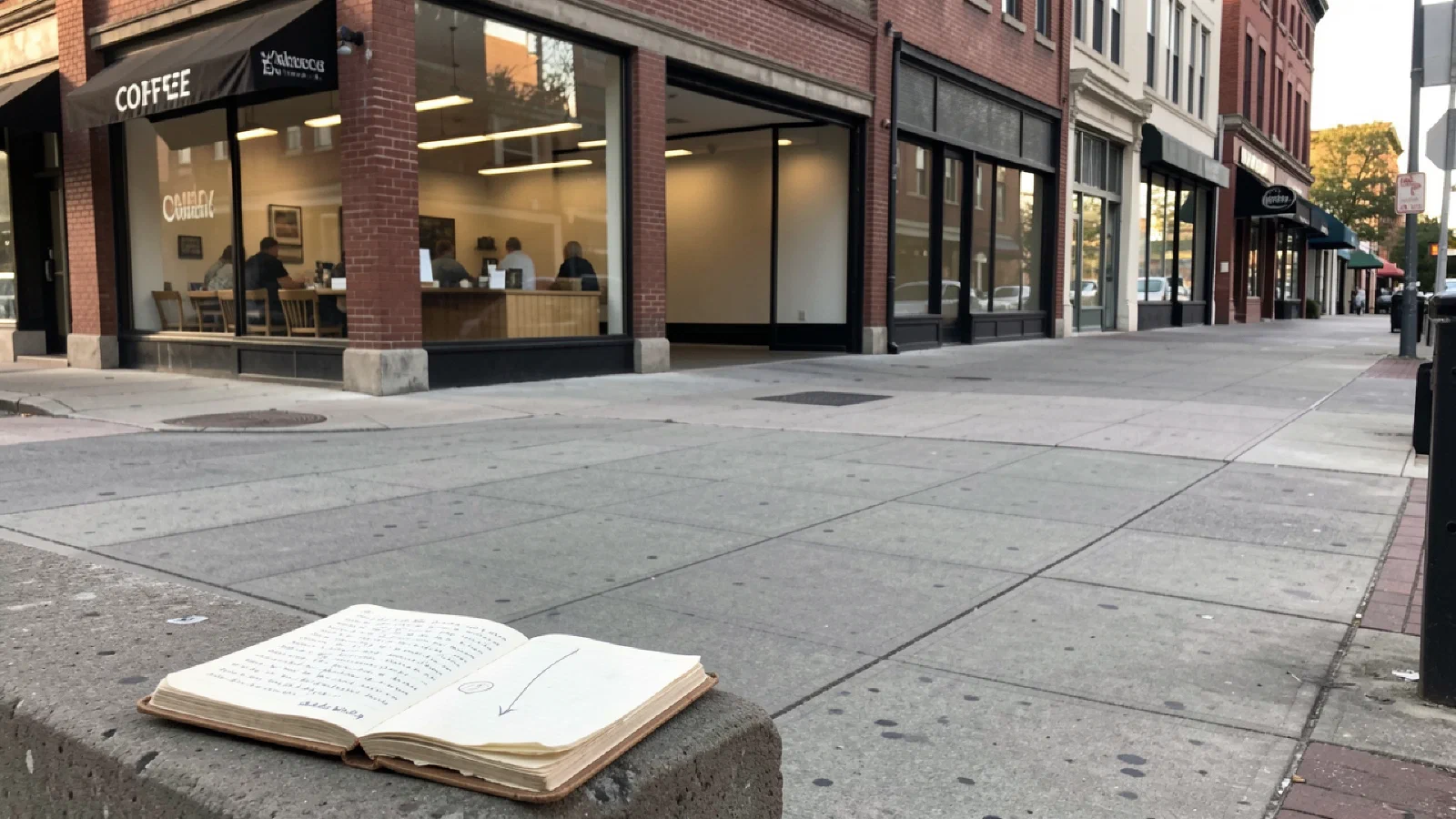
Marcus has been walking the same route every Sunday morning for eleven years. Two miles, roughly rectangular, through the commercial corridor of a mid-sized city where he has spent his career converting underused buildings into things that work. He carries a small notebook. He records which storefronts are occupied and which are not.
Eleven years of Sunday notes.
He started the route when he was trying to understand a pattern he had noticed in his own projects: some conversions held, and some didn’t, and the difference didn’t map cleanly onto the variables he had been trained to think mattered. Location, square footage, renovation quality, lease terms: these were all relevant, but they didn’t explain the divergence he was watching. He thought if he paid attention to the street long enough, the pattern would name itself.
He is still waiting, but he has a theory.
The Subsidy Nobody Noticed#
Cities have never had to answer a question they are being asked now: what are you for when you are not concentrating workers?
This sounds like an abstract philosophical question. It has a concrete financial answer, and the answer is uncomfortable. The social city, the restaurants, the bars, the bookstores, the theaters, the coffee shops, the incidental retail that makes a city feel like a city, was never self-sustaining in the way its participants experienced it. It was downstream of the economic city. The lunch crowd funded the restaurant. The commuter volume funded the transit that made the neighborhood accessible. The office buildings populated the streets that made walking feel natural and the sidewalk café financially viable. The social infrastructure of cities was subsidized by the concentration of workers who needed to be fed, housed, serviced, and entertained near where they worked.
The subsidy was invisible because the two cities were always present at the same time.
Nobody experienced the lunch crowd as an economic subsidy to the dinner crowd. They experienced it as a busy street. Nobody calculated that the commuter transit that justified the density also justified the gallery that required foot traffic to survive. The economic city and the social city were co-present, and their mutual dependence was felt as vitality rather than analyzed as a financial relationship.
When the economic subsidy withdraws, the social city has to justify itself on its own terms, at the cost structure the economic city built and left behind. The rent that made sense when the building served a thousand workers a day does not make sense when the building serves three hundred people who choose to be there. The transit subsidy that made sense when it moved commuters does not make sense when it moves people running optional errands. The city that was built to concentrate workers is expensive. The city built for chosen sociality cannot necessarily support that cost structure on the revenue generated by people who are there by preference rather than necessity.
Marcus has watched this arithmetic play out in slow motion on his Sunday route. The places that couldn’t survive on the chosen-sociality revenue stream are the empty storefronts in his notebook. There are more of them now than there were in year one.
Who Chooses#
The population that remains in a city when work no longer requires it is not a random sample of the people who were there before.
It is, specifically, people who can afford to be somewhere they choose rather than somewhere work sends them, people who value the particular things cities do that distance cannot replicate, and people who have no ability to leave and therefore represent a different kind of choice. These three groups coexist in the post-labor city, and their coexistence is the city’s central tension.
The people who can afford chosen urbanity are not, on average, the people the economic city was built around. The factory worker, the warehouse employee, the administrative assistant who staffed the downtown office tower: these were the economic city’s primary population. The person who chooses to remain in the city when remote work makes location optional is, disproportionately, someone whose income is portable and whose preferences run toward density, encounter, and cultural infrastructure. Their presence sustains some of what the economic city subsidized. Their tastes reshape it.
The people who cannot leave are present in a different way. They live in the city because the affordable housing, the public transit, the social services they depend on are here. For them the post-labor city is not a chosen environment. It is the only available one. Their presence is often invisible in accounts of urban revival, which tend to focus on the new restaurant and the converted loft rather than on the unchanged apartment building three blocks east where the subsidy recipient lives without the amenities the revival narrative requires.
The city that survives the withdrawal of the economic subsidy is not the city that was there before, with the workers removed. It is a different population with a different claim on the infrastructure it inherited, a different relationship to its cost structure, and a different political composition. Whether it can sustain itself depends on questions the economic city never had to ask.
The Infrastructure Problem#
The built environment of the economic city was calibrated for worker movement. Street widths, transit lines, parking structures, zoning codes, building typologies: all of these reflect assumptions about who was moving through the city, from where, to where, at what time of day, for what purpose.
A transit system designed to carry workers from residential neighborhoods to commercial nodes at eight in the morning and five-thirty in the evening is a different system from one designed to carry people from residential neighborhoods to wherever they feel like going, at whatever time they feel like going. The first system can be optimized. The second requires a different physical infrastructure, a different funding logic, and a different political relationship between riders and the system they use.
The same recalibration problem appears at every scale. The office tower that provided density now sits partially vacant, and the street-level activation that made the surrounding blocks viable was a consequence of that occupancy. The parking structure built for workers who drove in from suburbs serves a different function, at much lower utilization, when the workers are remote. The zoning that separated commercial and residential uses made sense when the commercial district needed to absorb a specific daily traffic pattern. It makes less sense when the daily traffic pattern is diffuse, variable, and purpose-driven rather than commute-driven.
Cities are beginning to work through these mismatches, conversion by conversion, zoning variance by zoning variance. The pace of the built environment’s adaptation to its new function is slower than the pace of the economic change that created the new function. Marcus watches this on his Sunday route: a block that was all commercial is rezoned to mixed use, which means two apartments above and a nail salon below and an empty unit that used to be a sandwich shop. The city is adapting. The adaptation is uneven, slower than anyone would choose, and constrained by the cost structure it inherited.
What the Partial Precedents Show#
Cities have not faced this question before at scale, but there are places that have had to answer “what are you for besides work” for longer than most.
The resort town exists almost entirely on chosen presence. People are there because they want to be, for a specific kind of experience, and the entire commercial ecology is organized around extracting maximum value from their voluntary presence. The resort town’s lesson: chosen presence can sustain a commercial ecology, but it is volatile, season-dependent, and organized around a narrow set of experiences. The resort town works for those experiences and fails at almost everything else. It does not generate the kind of diverse, year-round, purpose-varied street life that the economic city produced almost as a byproduct of moving workers around.
The college town is somewhere between the resort town and the economic city. It has a captive population with specific needs, a reliable annual cycle, and a density that can sustain commercial infrastructure across a wider range of purposes than the resort town. But the college town’s population is also transient, economically constrained, and skewed in ways that shape what the commercial ecology can support. College towns develop a particular character that serves their particular population and becomes a limitation when the population changes.
The retirement community goes further: a population that has explicitly chosen presence over necessity, with relatively stable income and specific consumption preferences. Retirement communities are among the most commercially stable environments in the American built landscape, and they look nothing like what most people mean when they say they want to live in a city. The things they do well are the things that require only presence, spending, and low physical demand. The things that make cities interesting to the people who choose them are mostly absent.
I wonder whether the city that survives the labor function’s departure could be something genuinely better than these precedents suggest, more humane, more oriented toward what density does well when freed from its servitude to the economic machine, or whether the cost structure inherited from the economic city makes the smaller, chosen version impossible to sustain without a subsidy that has to come from somewhere new.
The honest answer is that nobody has done this before at scale. The resort town and the college town are partial precedents for small pieces of the question. The full question, a mid-sized city of three hundred thousand people, or a metro of two million, reorganizing around chosen presence rather than economic necessity, has no precedent. The experiments are underway. The results are not in.
What Marcus’s Notebook Shows#
Eleven years of Sunday notes produce a pattern he has been reluctant to name because it does not fit the frameworks his industry uses to understand commercial real estate viability.
The storefronts that have stayed occupied through four years of significant disruption, a pandemic, two rounds of commercial rent increases, the departure of three anchor employers from the downtown core, are not the ones that served the commuter economy. They are not the lunch spots that depended on the office crowd or the dry cleaners that handled the work wardrobe or the copy shop that served the businesses in the buildings above.
The ones that held are the ones that gave people a reason to be somewhere specific, on purpose, for its own sake. The bakery that people drive across the city to reach on Saturday morning. The hardware store whose owner knows what every project needs before you finish describing it. The used record shop that is also, somehow, a community in a room. The bar that has been the same bar for thirty years and where people go not for the drinks but for the specific version of being among others that the bar provides.
None of these were designed to anchor a commercial district. They were designed to serve a particular kind of customer need, and the customer need turned out to be more durable than the commuter economy they operated alongside.
He is not sure this is a business model for a city. The bakery and the record shop and the thirty-year bar are not sufficient to sustain the infrastructure of a mid-sized city or to justify the property tax base that the city’s services require. They are evidence of something, but the something is not legible yet as policy or planning prescription.
He thinks it might be the only available direction, though. Not because it scales to what cities need, but because it is the thing that people choose when they are actually choosing, and in a city that can no longer organize itself around what workers need, what people actually choose is the only data available.
The Sunday notebook is on his kitchen counter. He has not decided whether to turn it into something formal. He keeps walking the route because the route has become its own reason, which is, he has come to think, exactly the point.
References#
Urban Economics and the Social City
Florida, Richard. The Rise of the Creative Class. Basic Books, 2002.
Glaeser, Edward L. Triumph of the City: How Our Greatest Invention Makes Us Richer, Smarter, Greener, Healthier, and Happier. Penguin Press, 2011.
Jacobs, Jane. The Death and Life of Great American Cities. Random House, 1961.
Post-Industrial Urban Transition
Mallach, Alan. The Divided City: Poverty and Prosperity in Urban America. Island Press, 2018.
Sassen, Saskia. The Global City: New York, London, Tokyo. Princeton University Press, 1991.
Storper, Michael, and Allen J. Scott. “Current Debates in Urban Theory: A Critical Assessment.” Urban Studies, vol. 53, no. 6, 2016, pp. 1114–1136.
Infrastructure and Cost Structure
Duany, Andres, et al. Suburban Nation: The Rise of Sprawl and the Decline of the American Dream. North Point Press, 2000.
Speck, Jeff. Walkable City: How Downtown Can Save America, One Step at a Time. Farrar, Straus and Giroux, 2012.
Strong Towns. Thoughts on Building Strong Towns. strongtowns.org, 2019.
Chosen Presence and Urban Identity
Lloyd, Richard. Neo-Bohemia: Art and Commerce in the Postindustrial City. Routledge, 2006.
Oldenburg, Ray. The Great Good Place: Cafés, Coffee Shops, Community Centers, Beauty Parlors, General Stores, Bars, Hangouts, and How They Get You Through the Day. Paragon House, 1989.
Zukin, Sharon. Naked City: The Death and Life of Authentic Urban Places. Oxford University Press, 2010.
Remote Work and Urban Demand
Barrero, Jose Maria, et al. “Why Working from Home Will Stick.” Working Paper 28731, National Bureau of Economic Research, 2021.
Ramani, Arpit, and Nicholas Bloom. “The Donut Effect of Covid-19 on Cities.” Working Paper 28876, National Bureau of Economic Research, 2021.
How this essay connects to others across The Approximate Mind.
- Florida, Richard. The Rise of the Creative Class. Basic Books, 2002.
- Glaeser, Edward L. Triumph of the City: How Our Greatest Invention Makes Us Richer, Smarter, Greener, Healthier, and Happier. Penguin Press, 2011.
- Jacobs, Jane. The Death and Life of Great American Cities. Random House, 1961.
- Mallach, Alan. The Divided City: Poverty and Prosperity in Urban America. Island Press, 2018.
- Sassen, Saskia. The Global City: New York, London, Tokyo. Princeton University Press, 1991.
- Storper, Michael, and Allen J. Scott. “Current Debates in Urban Theory: A Critical Assessment.” Urban Studies, vol. 53, no. 6, 2016, pp. 1114–1136.
- Duany, Andres, et al. Suburban Nation: The Rise of Sprawl and the Decline of the American Dream. North Point Press, 2000.
- Speck, Jeff. Walkable City: How Downtown Can Save America, One Step at a Time. Farrar, Straus and Giroux, 2012.
- Strong Towns. Thoughts on Building Strong Towns. strongtowns.org, 2019.
- Lloyd, Richard. Neo-Bohemia: Art and Commerce in the Postindustrial City. Routledge, 2006.
- Oldenburg, Ray. The Great Good Place: Cafés, Coffee Shops, Community Centers, Beauty Parlors, General Stores, Bars, Hangouts, and How They Get You Through the Day. Paragon House, 1989.
- Zukin, Sharon. Naked City: The Death and Life of Authentic Urban Places. Oxford University Press, 2010.
- Barrero, Jose Maria, et al. “Why Working from Home Will Stick.” Working Paper 28731, National Bureau of Economic Research, 2021.
- Ramani, Arpit, and Nicholas Bloom. “The Donut Effect of Covid-19 on Cities.” Working Paper 28876, National Bureau of Economic Research, 2021.