The Enclave That Already Exists
TAM-RWR.1-04 · The Reshaped World, Arc 1: The Built World After Work · The Approximate Mind
The Reshaped World, Part 1-04 of 7. The previous essays described what happens to places when work disappears and what the city becomes without its labor-organizing function. This essay argues that the endpoint of that trajectory is not a warning. It is already operating.
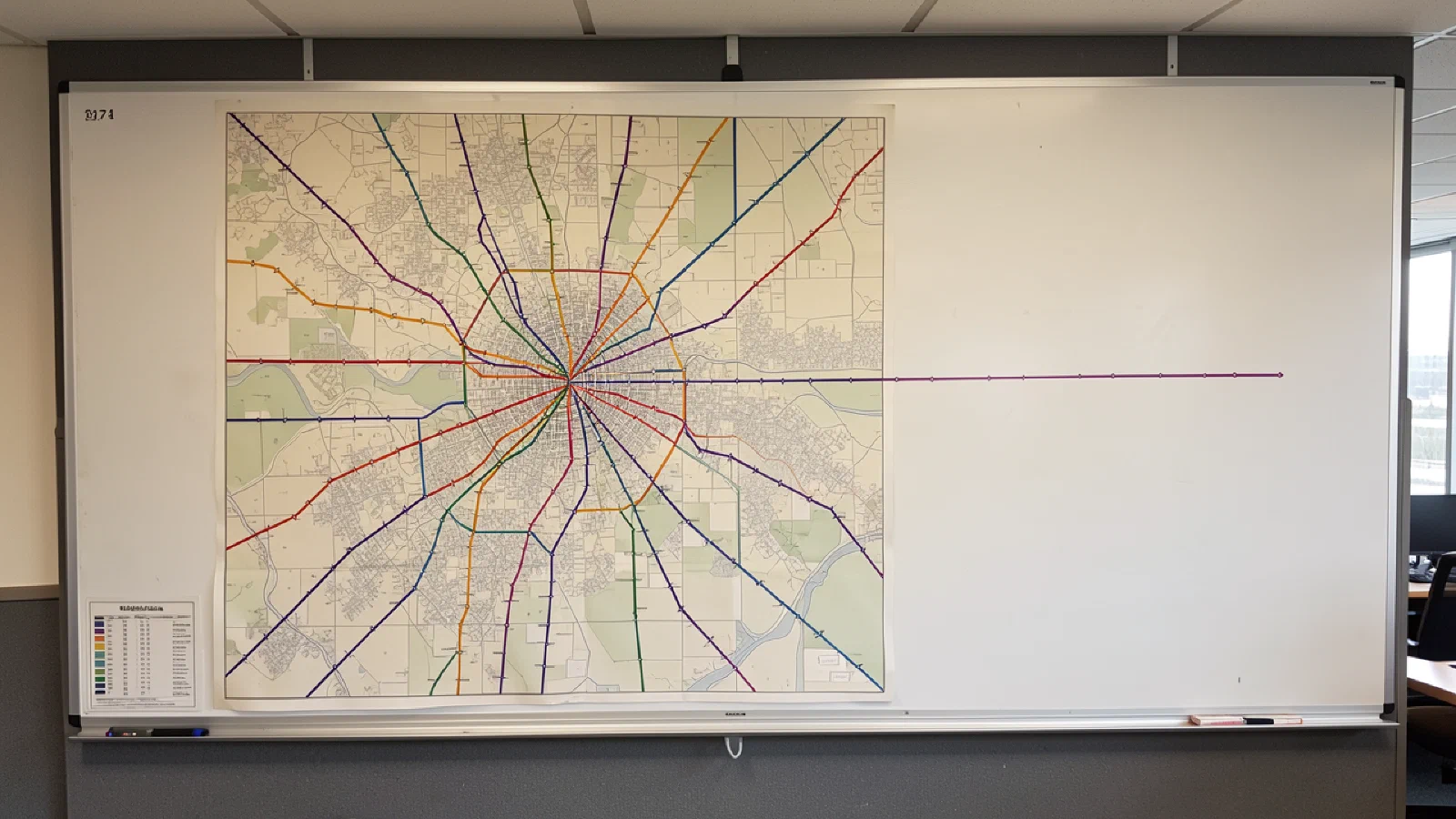
Renee made the map in her first month on the job. She was twenty-six, new to the regional transit authority, trying to understand the system she had joined. She overlaid MARTA’s coverage area on a map of the county boundaries surrounding Atlanta. The result was so legible that she has shown it to every class of planning students she has spoken to in the twelve years since.
The map shows a transit network that serves Fulton County, DeKalb County, and the city of Atlanta. It shows Cobb County, directly to the northwest, where the network stops at the county line.
Cobb County has about 800,000 people. It has no MARTA service. It refused it, explicitly, in 1971, when the regional transit authority was being assembled. It has reaffirmed the refusal several times since. The stated reasons have evolved: cost, local control, the specific character of suburban development patterns. The effect is consistent.
What Was Refused#
To understand what the refusal meant, it helps to understand what MARTA was being designed to do. Regional transit in 1971 was being built to connect the labor pool of a metropolitan area to the locations of its employment. Workers who lived in southern DeKalb County needed to reach employers in Midtown and downtown Atlanta. Workers from across the region needed affordable, reliable access to the places where jobs were concentrated. The transit network was, functionally, a labor market infrastructure project. Its purpose was to allow the metropolitan economy to operate at scale.
Cobb County’s refusal was a refusal to participate in that infrastructure. The county’s residents and employers would remain accessible primarily by automobile, which meant accessible primarily to people who owned automobiles, which in 1971 and for decades afterward meant accessible primarily to people at a certain income level. The labor pool that could reach Cobb County by the combination of geography, transit options, and car ownership was a sorted labor pool. The sort was not incidental to the decision. It was the decision.
What gets refused when a wealthy enclave refuses regional transit is not a bus line. It is connectivity itself. The refusal ensures that the people who would most benefit from the connection, those whose mobility depends on transit rather than private automobiles, remain outside the enclave’s economic geography.
This is the template. Not the specific political history of one Atlanta suburb, but the mechanism: exit from shared infrastructure, justified in neutral administrative language, with a sorting effect on who can access the exiting community that benefits those already inside it.
The Mechanism, Named#
The exit-voice dynamic that the political theorist Albert Hirschman identified operates in built infrastructure with a specific logic that amplifies over time.
When a wealthy community exits from a shared public system, whether transit, schools, water, or any other infrastructure, two things happen. First, the exiting community stops consuming the shared system, which reduces its political constituency for maintaining and investing in that system. Second, the exiting community builds or buys a private alternative, which is available to those who can afford it and unavailable to those who cannot.
Over time, the shared system loses investment because the people with the most political capital and resources have exited it. As the shared system degrades, the case for remaining in it weakens, which incentivizes further exit among those who can afford it. As more people exit, the shared system’s constituency further erodes. The cycle is self-reinforcing, and it has no internal correction mechanism. It requires a political intervention, which is increasingly difficult to organize because the people with the most political capital are the people who have already exited.
Cobb County did not invent this mechanism. It expressed it at a particular moment in the history of American metropolitan development, in a form that is unusually legible because the county line is a clean administrative boundary and the MARTA map is a clean visual. Most expressions of the mechanism are less legible: the HOA covenant that creates a private street maintenance system, the school boundary that concentrates resources, the private security arrangement that supplements the police presence in one neighborhood and not the adjacent one.
The private infrastructure of the American enclave is not primarily dramatic. It is mundane. It is the neighborhood where the sidewalks are maintained because the HOA requires it and the adjacent neighborhood where they are not. It is the school where the PTA budget supplements the public allocation and the school where it does not. It is the park that is well-lit and the park that is not.
Each of these is a small exit. Together they constitute a parallel infrastructure, built from private capital, available to the people inside it, invisible as a system to those looking at any single piece.
What Automation Accelerates#
The enclave that already exists is not a consequence of automation. It predates automation by decades, in some forms by centuries. What automation does is accelerate the mechanism by changing who holds the automation dividend.
When automation displaces workers in a sector, the productivity gain goes somewhere. In most historical configurations, some portion has gone to workers in the form of wage increases, as labor market tightening forces employers to compete for reduced supply. The current configuration is different: the automation is occurring at a scale and speed that prevents the labor market from tightening in most affected sectors, because the displacement is broad enough across sectors that the surplus labor supply remains large. The productivity gain flows to capital, which is already concentrated in the people and institutions who have the most capacity to exit shared systems.
Capital accumulation and exit capacity are not perfectly correlated. There are wealthy people who choose to remain in and invest in shared public systems, and there are ways in which exit is costly and constraining rather than purely beneficial. But the direction of the correlation is not ambiguous: as the automation dividend concentrates, it concentrates in the hands of people for whom exit from shared infrastructure is easiest and most available, which funds further exit infrastructure, which further degrades the shared systems, which further widens the gap between what the exited experience and what the remainder experiences.
In Atlanta, the gap is visible on Renee’s map. The places with the most private automobile infrastructure and the least transit dependency are also the places with the highest median incomes and the most capacity to build private alternatives to whatever the public system provides.
This is not unique to Atlanta. Renee has shown her map to planning students in four cities over twelve years. They always recognize the pattern before she explains it. The specific geography differs. The mechanism is the same.
The Global Expression#
The enclave logic does not stop at the American suburb. It operates at every scale where capital concentration is sufficient to fund exit from shared systems, and it produces built environments that are physically recognizable across contexts that are otherwise completely different.
The walled compound in Lagos. The private city in Manila. The gated development in São Paulo. The special economic zone in Bangladesh that operates under different governance, different infrastructure, different rules than the surrounding territory. These are not the same political or historical phenomenon. They are the same economic logic, applied in different contexts: capital sufficient to exit the shared environment, building a private alternative, sorting who can access it by price, which sorts by the income distribution that the underlying economy produces.
The visual similarity across these contexts is striking enough that Renee’s photograph, the one from Detroit she will see years from now, will be immediately recognizable to colleagues in Nairobi. The mechanism that produces the enclave produces a recognizable built environment regardless of the continent or the century.
I wonder whether the political unit that contains both the private infrastructure and the deteriorating public infrastructure, the county that includes Cobb and DeKalb, the nation that contains the special economic zone and the displaced garment district, can maintain the fiction of shared interest long enough to organize the intervention the divergence requires. Not whether the intervention is technically possible. Whether the political will to organize it can be assembled when the people with the most political capital have the least stake in the systems that most need intervention.
The map in Renee’s presentations does not answer this question. It describes the condition. The condition is the question.
The Commission#
Renee is presenting to a regional planning commission about a transit extension. The proposed line would connect a job-rich suburb to the existing MARTA network for the first time in the system’s history. The suburb has a significant concentration of employment in logistics, healthcare, and professional services. The workers who could reach those jobs more reliably with transit access live, disproportionately, in the parts of the metropolitan area that are already on the network.
The suburb’s representatives are in the room. They are engaged and polite. She has given a version of this presentation four times in eight years. Each time the response has been the same: acknowledgment of the analysis, interest in the concept, concern about cost and local control and the specific character of the suburban development pattern.
The map is on the screen behind her. MARTA’s coverage area and the county boundaries. Everyone in the room has seen it before. Some of them have been in the room for all four presentations.
She is no longer presenting to change the outcome of the vote she knows is coming. She is presenting because the map needs to be in the room, on the record, in the minutes of the commission meeting, so that the decision being made is made with full knowledge of what it means. The people in the room know what the map means. They are not confused.
The question is whether knowing is the same as deciding.
The meeting is scheduled for ninety minutes. It will run over.
References#
Exit-Voice Theory and Public Infrastructure
Hirschman, Albert O. Exit, Voice, and Loyalty: Responses to Decline in Firms, Organizations, and States. Harvard University Press, 1970.
Orfield, Myron. American Metropolitics: The New Suburban Reality. Brookings Institution Press, 2002.
Tiebout, Charles M. “A Pure Theory of Local Expenditures.” Journal of Political Economy, vol. 64, no. 5, 1956, pp. 416–424.
Suburban Secession and Private Infrastructure
Freund, David M. P. Colored Property: State Policy and White Racial Politics in Suburban America. University of Chicago Press, 2007.
McKenzie, Evan. Privatopia: Homeowner Associations and the Rise of Residential Private Government. Yale University Press, 1994.
Self, Robert O. American Babylon: Race and the Struggle for Postwar Oakland. Princeton University Press, 2003.
Regional Transit and Metropolitan Equity
Grengs, Joe. “The Abandoned Social Goals of Public Transit in the Neoliberal City of the USA.” City, vol. 9, no. 1, 2005, pp. 51–66.
Hu, Lingqian. “Changing Job Access of the Poor: Effects of Spatial and Socioeconomic Transformations in Chicago, 1990–2010.” Urban Studies, vol. 52, no. 4, 2015, pp. 675–692.
Sanchez, Thomas W., et al. “Transit Policy and Economic Segregation.” Transportation Research Record, vol. 1753, 2001, pp. 3–9.
Global Enclave Urbanism
Davis, Mike. Planet of Slums. Verso, 2006.
Graham, Stephen, and Simon Marvin. Splintering Urbanism: Networked Infrastructures, Technological Mobilities and the Urban Condition. Routledge, 2001.
Soja, Edward W. Postmetropolis: Critical Studies of Cities and Regions. Blackwell, 2000.
Automation, Capital, and Inequality
Acemoglu, Daron, and Pascual Restrepo. “Automation and New Tasks: How Technology Displaces and Reinstates Labor.” Journal of Economic Perspectives, vol. 33, no. 2, 2019, pp. 3–30.
Piketty, Thomas. Capital in the Twenty-First Century. Translated by Arthur Goldhammer, Harvard University Press, 2014.
How this essay connects to others across The Approximate Mind.
- Hirschman, Albert O. Exit, Voice, and Loyalty: Responses to Decline in Firms, Organizations, and States. Harvard University Press, 1970.
- Orfield, Myron. American Metropolitics: The New Suburban Reality. Brookings Institution Press, 2002.
- Tiebout, Charles M. “A Pure Theory of Local Expenditures.” Journal of Political Economy, vol. 64, no. 5, 1956, pp. 416–424.
- Freund, David M. P. Colored Property: State Policy and White Racial Politics in Suburban America. University of Chicago Press, 2007.
- McKenzie, Evan. Privatopia: Homeowner Associations and the Rise of Residential Private Government. Yale University Press, 1994.
- Self, Robert O. American Babylon: Race and the Struggle for Postwar Oakland. Princeton University Press, 2003.
- Grengs, Joe. “The Abandoned Social Goals of Public Transit in the Neoliberal City of the USA.” City, vol. 9, no. 1, 2005, pp. 51–66.
- Hu, Lingqian. “Changing Job Access of the Poor: Effects of Spatial and Socioeconomic Transformations in Chicago, 1990–2010.” Urban Studies, vol. 52, no. 4, 2015, pp. 675–692.
- Sanchez, Thomas W., et al. “Transit Policy and Economic Segregation.” Transportation Research Record, vol. 1753, 2001, pp. 3–9.
- Davis, Mike. Planet of Slums. Verso, 2006.
- Graham, Stephen, and Simon Marvin. Splintering Urbanism: Networked Infrastructures, Technological Mobilities and the Urban Condition. Routledge, 2001.
- Soja, Edward W. Postmetropolis: Critical Studies of Cities and Regions. Blackwell, 2000.
- Acemoglu, Daron, and Pascual Restrepo. “Automation and New Tasks: How Technology Displaces and Reinstates Labor.” Journal of Economic Perspectives, vol. 33, no. 2, 2019, pp. 3–30.
- Piketty, Thomas. Capital in the Twenty-First Century. Translated by Arthur Goldhammer, Harvard University Press, 2014.