The Uncounted
What Happens When Work Was Never Called Work
TAM-RIM.1-06 · The Reimagined, Cluster 1: The Human Work · The Approximate Mind
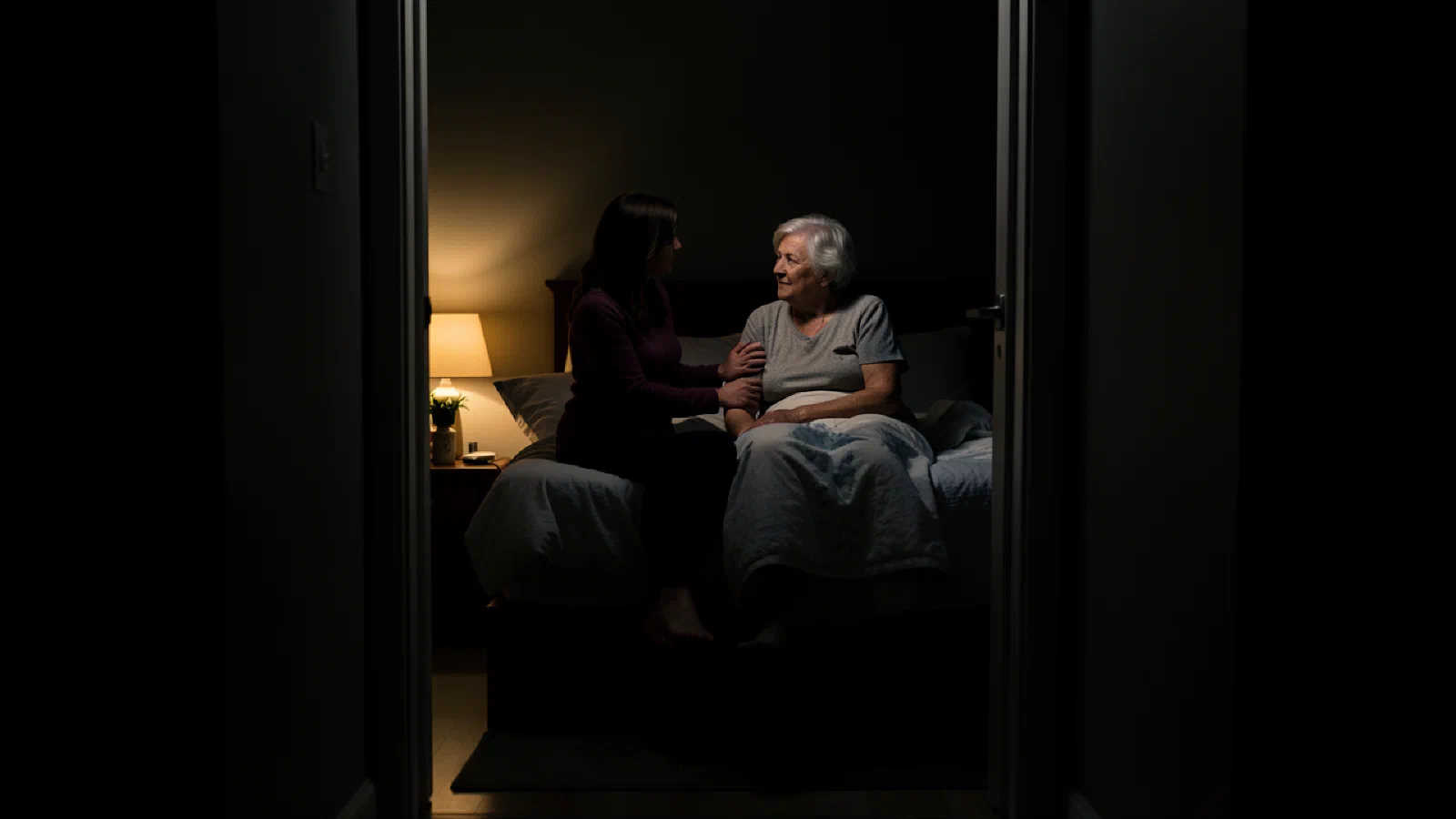
Sandra’s mother wakes up at 3 AM and does not know where she is. This happens two or three nights a week. The stroke damaged the part of her brain that anchors her in the present, so when she surfaces from sleep, she surfaces into a kind of temporal fog, and Sandra can tell by the quality of the sound her mother makes, not a word, not a cry, a specific exhalation of confusion, whether this is a mild episode that will resolve in thirty seconds or a bad one that will require Sandra to sit on the edge of the bed and hold her mother’s hand and say “You’re home, Mom. You’re in your room. I’m right here” until the fog lifts and her mother’s eyes focus and her mother says “Sandra?” and Sandra says “Yeah, Mom” and her mother says “Okay” and goes back to sleep.
Sandra has gotten good at the sound. She can distinguish the two kinds from the next room. She sleeps with her door open. She has not slept through a full night in two and a half years.
She is forty-six. She quit her job at an insurance company to do this. She did not make a pros-and-cons list. She did not consult a financial advisor. Her mother was in the hospital and her brother was in Portland and someone had to be there. Someone was Sandra.
She does not describe this as a sacrifice because the word sacrifice implies she considered not doing it, and she did not. Her mother needed her. She went. The going was not a decision in the way that decisions are usually understood, as a weighing of options. It was a recognition, the same kind of recognition this series has described in other contexts, of what you are for.
The Day#
Sandra’s days have a structure that no one designed and everyone depends on.
She wakes at six, or whenever her mother last woke her, whichever is later. She makes coffee. She takes her mother’s blood pressure and logs it in a notebook, not because any doctor asked her to keep a notebook but because she noticed, four months in, that her mother’s blood pressure spiked on days when her mother had slept badly, and the correlation was useful information that the system did not collect because the system saw her mother every three months and Sandra saw her mother every day.
She makes breakfast. Her mother can feed herself but her right hand is unreliable, so Sandra cuts everything into pieces small enough that the tremor does not matter. This takes three minutes. It is one of a hundred adaptations Sandra has invented, none of which appear in any care plan, each of which represents a specific piece of knowledge about a specific person that no algorithm possesses.
She manages the medications. Seven pills at 8 AM. Three at noon. Four at 6 PM. Two at bedtime. The 8 AM set includes a blood thinner that interacts with leafy greens, so Sandra has adjusted her mother’s diet, which means Sandra has adjusted her own diet, which means Sandra has not eaten a salad in two years, which is a trivially small thing and also the kind of thing that accumulates into a life being quietly reorganized around someone else’s body.
She drives her mother to physical therapy on Mondays and Thursdays. She argues with the insurance company on an ongoing basis about coverage for a speech therapist, which is darkly ironic because she worked at an insurance company for eleven years and knows exactly how the denial process works. She knows which codes to use. She knows when to appeal. She knows that the first denial is automatic and the second denial is human and the third denial requires a letter from the physician and that the physician’s office will not write the letter unless Sandra calls them, which she does, every time, because the system is designed to exhaust the person navigating it and Sandra has learned that the exhaustion is the point.
She does this for fourteen hours a day. She is not paid. She does not appear in any labor statistic.
The Number#
Fifty-three million. That is the number of Americans providing unpaid care to a family member. The economic value of this labor, calculated at market rates for the services provided, exceeds $600 billion annually. The number does not appear in GDP. The people do not appear in workforce surveys. The work does not appear in any accounting of the economy except as an absence: the people who left the paid workforce and whose departure is coded as voluntary, as though the word voluntary applies to a woman whose mother cannot remember where she is at 3 AM.
Sandra knows the number. A social worker at the hospital gave her a pamphlet that included it, along with information about support groups and respite services and a phone number she could call. She called the phone number. She was placed on hold for twenty-two minutes and then told that the respite program in her county has an eleven-month waitlist.
She did not call back.
The economy counts what it pays for. It does not pay for care. Therefore care does not count. This is not an oversight. It is a design.
The design is old. It predates AI. It predates computers. It predates the industrial economy. The assumption that care is private, that families absorb the work of keeping each other alive, that the labor of love is free because it is love: this assumption is the foundation on which every economic system in the modern world is built, and the foundation is made of women like Sandra, and nobody looks at the foundation because the foundation is underground.
What AI Does Here#
AI enters Sandra’s life through two doors, and she has thought carefully about both.
The first door is help. A monitoring system that tracks her mother’s vitals and alerts Sandra if something changes. A medication management tool that reminds and logs and flags interactions. A communication platform that lets the physician see what Sandra sees, the daily blood pressure, the sleep patterns, the slow changes that are invisible in a quarterly appointment and obvious in a daily log. Sandra would use these tools. She would use anything that makes the 3 AM less lonely, that gives her data to bring to the doctor instead of anecdotes the doctor does not have time to hear.
The second door is the one that frightens her. AI-powered care coordination that demonstrates, in institutional logic, that caregiving can be technologically supported. That the monitoring handles the vital signs. That the medication app handles the schedule. That the platform handles the communication. Each demonstration is true and each demonstration implies that the human component, Sandra, is less necessary than she was before the technology arrived.
Sandra sees the trajectory. If AI makes her work easier to quantify, easier to supplement, easier to partially automate, then the argument for paying someone to do it gets weaker, not stronger. The institution looks at the technology and sees efficiency. Sandra looks at the technology and sees the beginning of an argument that she is not needed, when what she does at 3 AM, the hand on her mother’s hand, the voice that says “You’re home, Mom,” the presence that cannot be monitored or measured or replaced, is the thing that keeps her mother’s life from becoming something merely managed.
What Sandra Needs#
Sandra does not need a reimagined profession. She needs to be seen.
She needs income that arrives regularly enough that she is not calculating, every month, whether she can afford both the electric bill and her mother’s prescriptions. She is spending her savings. She has $6,400 left of what used to be $23,000. The arithmetic is straightforward and she does it in her head while making breakfast and the number gets smaller every month.
She needs the three-year gap on her resume to be legible when this is over, and she knows it will be over, because her mother is sixty-nine and had a stroke and Sandra can do the other arithmetic too. When she returns to the job market, the hiring algorithm will see a gap and score it the way it scores all gaps, as instability. The algorithm will not know that Sandra spent those years doing the hardest, most cognitively demanding, most emotionally complex work of her life. The algorithm will see absence.
She needs rest. Not vacation. One day. One day a week when someone competent stays with her mother and Sandra can leave the house without her phone feeling like a tether, without the low-grade vigilance that never fully turns off, without listening for the sound.
She needs to be counted. Included in the numbers. Present in the data that policy is made from. Not celebrated, not called a hero, not made into an inspiration. Counted, the way Denise is counted when she clocks in, the way Kevin is counted when he files for unemployment, the way Marcus is counted when the system rejects him. Sandra is not counted at all. She exists in the economy’s negative space, doing work the economy depends on and refuses to see.
I wonder sometimes whether counting her would change anything, or whether it would simply make the invisibility official. Put a number on it, call it $78,000 a year in imputed value, publish the statistic, and then continue not paying her, the way the country publishes the $600 billion number and continues not paying any of them. The counting might be the final insult: we see you, we measured you, and we decided your work is still free.
3 AM#
Her mother wakes up. The sound is the second kind, the bad one. Sandra is already moving before she is fully awake, her feet on the floor, the hallway in the dark, her mother’s doorway.
“You’re home, Mom. You’re in your room.”
Her mother’s hand finds hers. The grip is strong on the left side, weak on the right. The fog lifts. Her mother’s eyes focus.
“Sandra?”
“Yeah, Mom.”
“Okay.”
Her mother goes back to sleep. Sandra sits on the edge of the bed for another minute. She does not go back to her room immediately. She sits with her mother’s breathing, the steadying of it, the return to rhythm. She has heard this rhythm a thousand times. She could score it, if anyone asked, from the inside, the way a musician knows a piece not from the notes but from the feel of playing it.
No one asks.
She goes back to bed. She does not close her door.
This is the sixth essay in The Reimagined, Cluster 1: The Human Work. It examines the 53 million Americans whose unpaid care labor sustains the systems that every reimagined profession will be built on top of. If the Reimagined does not see them first, it builds on a foundation it does not understand.
References#
Caregiving and Invisible Labor
Folbre, Nancy. The Invisible Heart: Economics and Family Values. The New Press, 2001.
AARP and National Alliance for Caregiving. “Caregiving in the United States 2020.” AARP, 2020.
Hochschild, Arlie Russell. The Second Shift: Working Families and the Revolution at Home. Viking, 1989.
Care, Gender, and Political Economy
Federici, Silvia. Revolution at Point Zero: Housework, Reproduction, and Feminist Struggle. PM Press, 2012.
Tronto, Joan C. Caring Democracy: Markets, Equality, and Justice. New York University Press, 2013.
Kittay, Eva Feder. Love’s Labor: Essays on Women, Equality, and Dependency. Routledge, 1999.
How this essay connects to others across The Approximate Mind.
- Folbre, Nancy. The Invisible Heart: Economics and Family Values. The New Press, 2001.
- AARP and National Alliance for Caregiving. “Caregiving in the United States 2020.” AARP, 2020.
- Hochschild, Arlie Russell. The Second Shift: Working Families and the Revolution at Home. Viking, 1989.
- Federici, Silvia. Revolution at Point Zero: Housework, Reproduction, and Feminist Struggle. PM Press, 2012.
- Tronto, Joan C. Caring Democracy: Markets, Equality, and Justice. New York University Press, 2013.
- Kittay, Eva Feder. Love’s Labor: Essays on Women, Equality, and Dependency. Routledge, 1999.