The Design Choice
What Happens When Accessibility Is a Feature, Not a Right
TAM-RIM.1-05 · The Reimagined, Cluster 1: The Human Work · The Approximate Mind
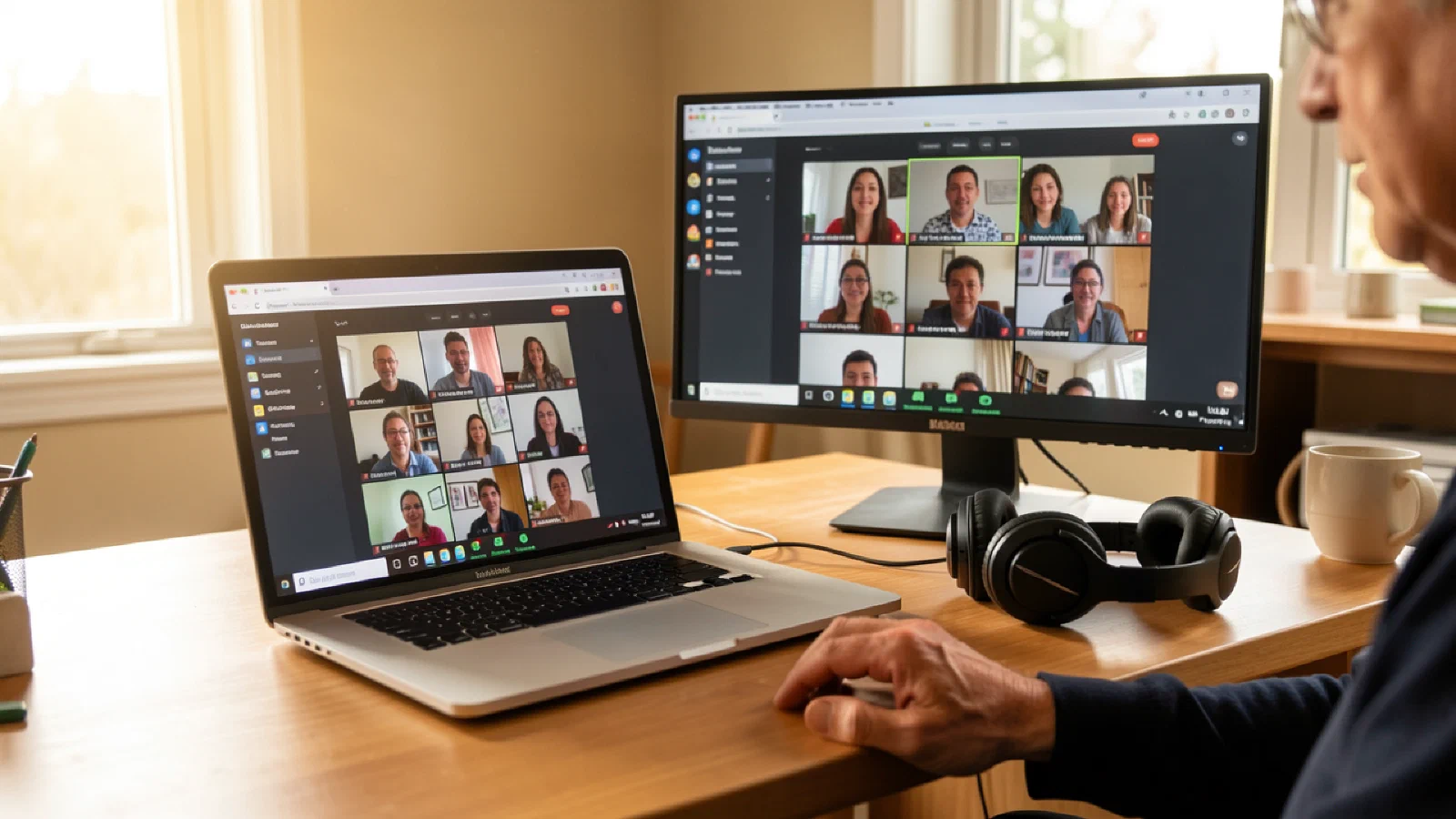
Priya has thirty-seven students. She teaches middle school math remotely from her apartment in Baltimore. She has cerebral palsy that affects her fine motor control and her speech, which has a rhythm to it, a cadence that takes new students about two weeks to stop noticing. After two weeks, they hear what she is saying instead of how she is saying it. After a month, several of them have started unconsciously mirroring her pacing, slowing down, leaving more space between words, which their parents interpret as thoughtfulness and which is actually the contagious effect of spending time with a person who speaks deliberately.
She is a good teacher. Her students’ scores are above the district average. She has a folder of parent emails that say things like “my son finally understands fractions” and “for the first time, she’s not scared of math class.” She has a principal who calls her “our secret weapon,” which is meant as a compliment and which Priya hears correctly as a confession: the secret is that they hired a disabled teacher and it worked, and the fact that this outcome is surprising is the entire problem.
She got the job in 2021. The pandemic made remote teaching necessary instead of exceptional. Nobody designed remote teaching for Priya. Nobody was thinking about disability at all. They were thinking about a virus, and the accommodations they built for the virus happened, by accident, to dissolve the barrier that had kept Priya out of a classroom for three years.
Three years of applications. Three years of in-person interviews where the principal heard her speak and made a calculation that was never recorded and never needed to be. The calculation was about parents. It was always about parents. How would parents respond to a teacher whose speech was different. Whether difference was a distraction. Whether the accommodation would be a burden. Whether, at the end of the chain of reasoning that began with Priya’s voice and ended with a polite rejection email, the institution could find a reason to say no that did not sound like the reason it was actually saying no.
The pandemic removed the need for the calculation. Remote, Priya is a voice and a screen and a mind that makes fractions make sense. Her CP is present, in her speech, in the way she moves her cursor, in the occasional moment when her hand does not do what she is asking it to do and she pauses and adjusts and moves on. Her students see this. Some of them, the ones who struggle with their own bodies for their own reasons, see it with particular attention. They are watching an adult manage a difficulty in real time, without apology, and continue to be excellent. This is worth more than fractions.
The Two Versions#
There are two versions of AI’s relationship to disability and they run on parallel tracks and they are heading in opposite directions.
The first version is in Priya’s apartment. AI tools that generate visual materials she cannot easily draw by hand. Grading assistants that handle the fine-motor-intensive work of written feedback. Speech-to-text that lets her compose documents at the speed of her thinking rather than the speed of her typing. Each of these tools dissolved a specific friction between Priya’s mind and the output the job required, and each of them cost less than the salary of the aide the old system would have assigned to do the same work, which is why they exist. The economics happened to align with the justice. This is rarer than it should be.
The second version is in a hiring system Priya’s cousin Amit encountered last year. Amit has a similar condition. He applied for a logistics coordinator position at a distribution company. The application included a video interview scored by an AI system that evaluated, among other things, vocal confidence, eye contact consistency, and facial expressiveness. Amit’s vocal patterns were scored as low-confidence. His facial movements, affected by CP, were scored as inconsistent engagement. He did not advance to the human round.
The system did not know Amit had cerebral palsy. It did not need to know. It had been trained on ten thousand video interviews of neurotypical, able-bodied candidates, and it had learned that the patterns it saw in those interviews correlated with job performance, and Amit’s patterns did not match. The system did not discriminate against disability. It discriminated against deviation, which is the same thing expressed in a vocabulary that does not trigger legal review.
What the Disability Community Already Knows#
Priya is not surprised by any of this. Disabled people have never had the luxury of believing that systems are neutral. They have always known that the built environment, the physical one and now the digital one, was constructed around a template: a body that moves in specific ways, a mind that processes in specific ways, a voice that sounds a specific way. Every deviation from the template costs something. The cost is sometimes money. It is more often time, or energy, or the particular exhaustion of having to prove, again, that you can do the thing, when the proof is required only because your way of doing it does not look like the expected way.
AI is a new built environment. It is being built right now, and the template it is being built around is the same one. The question is not whether AI can be made accessible. It can. Priya’s tools prove that. The question is whether accessibility is a design constraint or an afterthought, whether the engineers building the systems are building for variation from the start or building for the norm and adding accommodations later, when someone complains, when the lawsuit arrives, when the PR becomes uncomfortable.
I wonder whether disability is the clearest lens through which to see every argument this cluster is making. The economy was not designed for Denise, but it had room for her. The economy was not designed for Marcus, but it had loopholes for him. The economy was not designed for Kevin, but it could use him. The economy was not designed for disabled people, period. There was no room and no loopholes and no absorption. There was the ADA, which mandated accommodation, which is not the same as inclusion, which is not the same as design.
What AI is doing to the center of the workforce now, the slow narrowing, the thinning of the adequacy layer, the demand for capacities the old economy did not require, disabled people have lived inside for generations. The rest of the workforce is arriving at a condition that 61 million Americans already inhabit.
The Window#
Priya knows the window might close. Districts are pulling teachers back into classrooms. Remote teaching, which was necessary in 2021, is optional in 2026, and optional means the first thing cut when budgets tighten. The accommodation she found by accident depends on an institutional arrangement that was not built for her and that she has no power to preserve.
She has started looking at other remote positions. She is qualified for several. The applications require video interviews.
She has her students’ test scores. She has the parent emails. She has three years of evidence that she is excellent at her job. She also has a voice that an AI scoring system will flag as low-confidence and a face that the same system will score as inconsistent engagement, and the evidence of her excellence lives in a folder on her desktop and the scoring system does not accept folders.
The same technology that opened Priya’s career can close it. Which outcome she gets depends on a design choice made by people who have never met her and who are not, in any formal sense, required to think about her.
She is teaching fractions this afternoon. Her students will log in at 1:15. The ones who have been with her for a year will not notice her speech. The new ones will notice it for two weeks and then stop noticing. In a month, some of them will be speaking more slowly, more deliberately, leaving more space between their words. They will not know where they learned this. They will carry it anyway.
The window is open. Priya is teaching through it. Whether it stays open is not up to her.
This is the fifth essay in The Reimagined, Cluster 1: The Human Work. It examines AI’s dual relationship to disability, as the most powerful accessibility tool in history and as a new built environment designed around the same normative template that has always excluded disabled people.
References#
Hamraie, Aimi. Building Access: Universal Design and the Politics of Disability. University of Minnesota Press, 2017.
Whittaker, Meredith, et al. “Disability, Bias, and AI.” AI Now Institute, November 2019.
Treviranus, Jutta. “The Value of Being Different.” International Conference on Universal Design, 2014.
Williamson, Bess. Accessible America: A History of Disability and Design. New York University Press, 2019.
How this essay connects to others across The Approximate Mind.
- Hamraie, Aimi. Building Access: Universal Design and the Politics of Disability. University of Minnesota Press, 2017.
- Whittaker, Meredith, et al. “Disability, Bias, and AI.” AI Now Institute, November 2019.
- Treviranus, Jutta. “The Value of Being Different.” International Conference on Universal Design, 2014.
- Williamson, Bess. Accessible America: A History of Disability and Design. New York University Press, 2019.