The Several Educations
TAM-RIM.2-02 · The Reimagined, Cluster 2: The Formation · The Approximate Mind
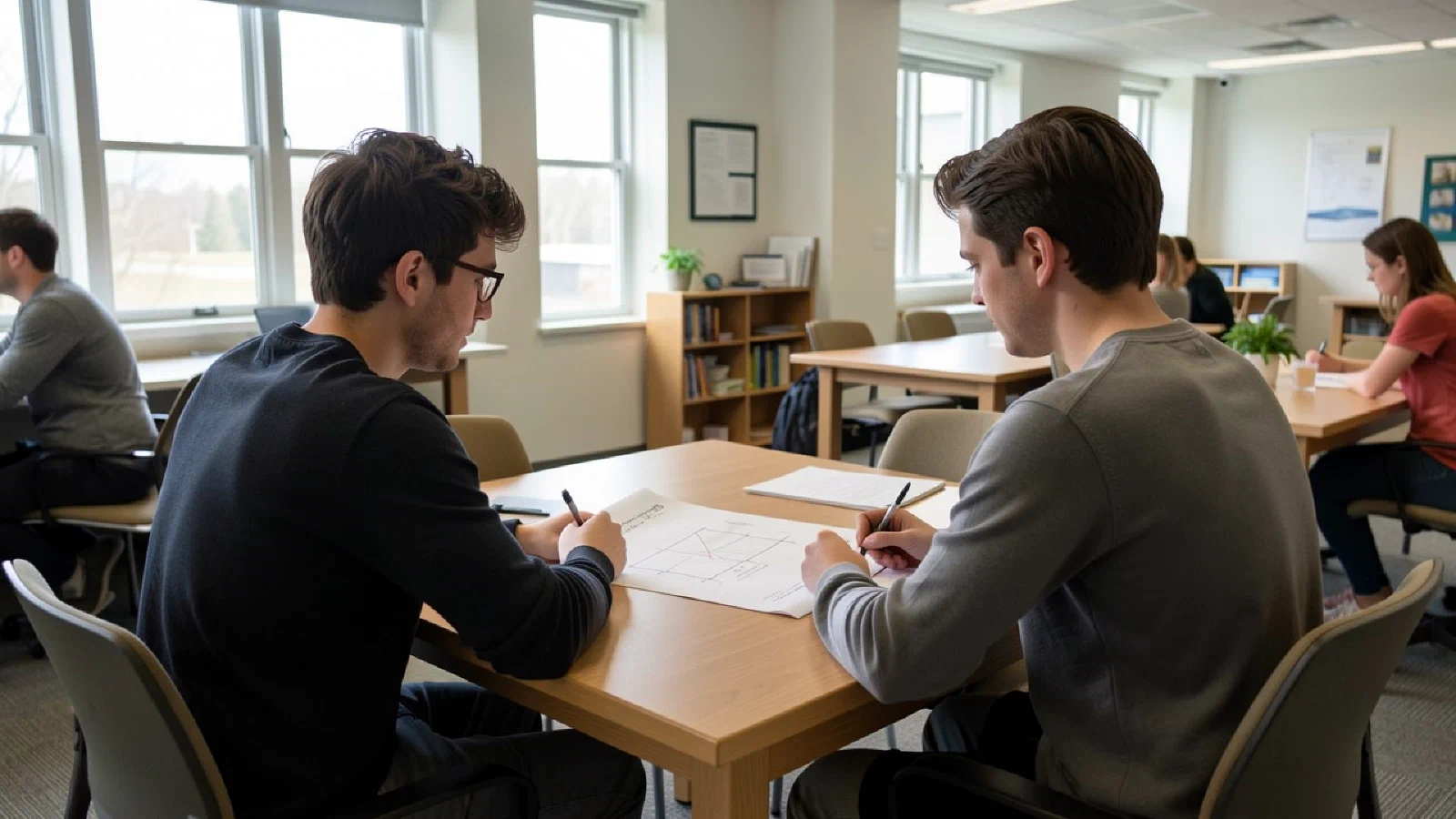
Zara and Leo are twenty-eight now. They have both been asked, separately, by the same program that paired them at seventeen, to come back and help design the next version.
They disagree about almost everything.
Zara thinks the program’s strength was the problems. The open-ended challenges that forced her to frame before she solved, to sit with ambiguity, to discover that the question was usually more important than the answer. She wants more of that. She wants children arriving at twelve to encounter problems that have no textbook solution and to struggle with them long enough to develop their own relationship with difficulty.
Leo thinks the program’s strength was the pairing. The fact that someone put him next to Zara and let them argue. He learned more from Zara’s alien way of thinking than from any curriculum. He wants the structure: the content foundation that gave him something to bring to the argument, the discipline that meant he could contribute substance when Zara contributed framing. Without that foundation, he says, the open-ended problems are just exercises in confident ignorance.
They are both right. They are also both describing the formation that served them and projecting it onto every child. This is what everyone does when asked to reimagine education. They remember what worked for them, or what failed them, and they generalize. The school that emerges from one person’s formation story is always partial.
The reimagined school starts from a different admission: there is no single way people learn, and any school organized around one pedagogy will serve some children well and form others into the wrong shape.
The Five Formations#
When we watch children learn, actually watch, without an educational philosophy filtering the observation, we see at least five distinct processes happening, often in the same child, often in the same week.
Learning through struggle. The child encounters something that resists them. The math problem that will not yield. The essay that will not organize. The experiment that produces the wrong result. The struggle is productive when it is calibrated, when it is hard enough to require genuine effort and not so hard that the child concludes they are incapable. This is the pedagogy the restructured schools built around, and they were right that it develops something irreplaceable: the discovery that your own capacity is larger than you thought, because you met something difficult and did not break.
Learning through osmosis. The child is in the room where the conversation is happening. They are not being taught. They are absorbing. The dinner table where the parents argue about politics. The workshop where the uncle repairs things and explains nothing. The library where the books are simply there, available, unchosen for you, and you wander until something catches. This learning is not directed. It is environmental. The child is shaped not by instruction but by proximity to ideas, practices, values, and ways of thinking that they absorb without deciding to absorb them.
This is the least respected pedagogy in formal education and possibly the most powerful one in human history. Cultures do not transmit themselves through curricula. They transmit themselves through the arrangement of what the child is near.
Learning through exploration. The child follows curiosity. Not a problem set by someone else but a question that arose from their own encounter with the world. Why does the water do that. What happens if I build this differently. Where does this road go. Exploration is self-directed but it is not undisciplined. The child who explores seriously develops the capacity to sustain inquiry across time, to tolerate dead ends, to recognize when a question has led to a better question. It is how scientists actually work, as opposed to how science is taught.
Learning through imitation. The child watches someone do the thing and tries to do it too. The apprentice model. The older sibling’s homework. The musician who learns by playing along with recordings. Imitation is not mindless copying. It is the process of internalizing another person’s relationship to a practice, absorbing their judgment through the attempt to reproduce their actions, and gradually discovering the gap between copying the form and understanding the reason.
Learning through play. The child is doing something that has no stated purpose. Building, pretending, arranging, dismantling, narrating. Play is the formation activity that adults most consistently undervalue and that developmental research most consistently identifies as essential. It is how children learn to hold multiple possibilities at once, to test hypotheses without consequences, to develop the narrative capacity that will later become the ability to imagine alternatives.
These five are not a taxonomy. They overlap, they blend, they show up in different proportions for different children at different ages. But they are genuinely distinct processes, and a school organized entirely around any one of them will underdevelop the others.
The restructured schools chose struggle and exploration. The traditional schools chose imitation and a diminished version of struggle. Almost nobody designed for osmosis, because osmosis is not a deliverable. You cannot put it in a lesson plan. You cannot assess it. You cannot optimize an AI tutor around it.
You can only arrange the room.
The Room#
This is where the reimagined school begins: not with the curriculum but with the room.
What is the child near? What conversations are audible? What practices are visible? What objects are available? What relationships are present? The room is the formation environment, and the formation environment teaches more than the lesson plan, because the lesson plan occupies an hour and the room occupies the day.
The traditional school arranged the room around content delivery. Desks in rows, teacher at the front, materials selected for the lesson. The room said: learning is receiving. The restructured school arranged the room around problems. Flexible seating, collaborative spaces, whiteboards on every surface. The room said: learning is producing.
The reimagined school arranges the room around formation. Not one room but several, and the child moves between them, because different formation needs require different environments.
A room where difficulty lives. Sparse, focused, with problems that resist quick solution. The child comes here when the formation need is struggle: the encounter with something that will not yield until the child develops a capacity they did not have when they entered. The AI in this room does not help. It watches. It intervenes only when the struggle has crossed from productive to destructive, a line that requires judgment no current system can reliably draw.
A room where proximity lives. Richer, denser, full of things. Books not organized by reading level. Conversations between adults that the children can overhear. Projects in various stages of completion left visible on surfaces. The AI in this room curates the environment rather than the child. It arranges what is near. It ensures that the child encounters ideas and practices at the edges of their current understanding, not because anyone assigned them but because the room contains them.
A room where exploration lives. Open. Unstructured. With tools and materials and access to information and the explicit permission to follow a question wherever it leads, including into dead ends. The AI in this room tracks the inquiry without directing it, and surfaces connections the child might not see: “The question you asked yesterday about water flow connects to something in the engineering materials. You might want to look.”
A room where others are working. The atelier model. Older students, adults, practitioners doing real work in the child’s presence. The child is not assigned to observe. The child is simply there, and the work is visible, and the osmosis is the point. The AI in this room does nothing. Its absence is the design.
The child’s day is not a schedule of these rooms. It is a conversation, between the child and the people who know the child, about which room the child needs today. Which formation process is most alive right now. Which capacity is developing and which is dormant. The conversation involves the child, the teacher, the companion that has accompanied the child across years, and, when possible, the parent.
When the Parent Cannot Participate#
The conversation about which room the child needs assumes a parent who can participate in it. A parent who understands what struggle and osmosis and exploration mean as formation processes, who can evaluate whether the school’s reading of their child matches their own, who has the vocabulary and the confidence to push back when the institution’s judgment and the family’s values diverge.
Many parents can do this. They have the education, the cultural capital, the time. They are the parents who already navigate school systems effectively, who show up at conferences, who email teachers, who supplement the curriculum at home. The reimagined school gives them more to work with, but they would have found a way regardless.
Many parents cannot. Not because they care less about their children’s formation. Because they were formed inside systems that did not develop in them the capacity to evaluate other systems. The mother who did not finish school does not lack opinions about her child’s education. She lacks the institutional fluency to translate her opinions into the language the institution speaks. She knows her son learns best when he can take things apart. She does not know how to say this in a way that results in more time in the exploration room rather than more worksheets in the struggle room.
The reimagined school cannot solve educational inequality by offering the same formation architecture to families with different capacities to use it. A system that requires parental participation to function well is a system that compounds advantage, because participation is itself a product of formation.
So the reimagined school does something that will make some people uncomfortable. It assigns the companion a role in the conversation that the parent might otherwise fill. Not replacing the parent. Not overriding the parent’s values. Translating between the parent’s knowledge of their child and the school’s formation architecture. The companion that has accompanied the child at home, that has seen how the child learns when nobody is structuring the learning, that knows the child reaches for building materials when stressed and goes quiet before a breakthrough, brings that knowledge to the conversation in terms the school can use and in terms the parent can evaluate.
The companion becomes the bridge between the family that knows the child and the institution that holds the formation architecture. It does not decide. It translates.
This requires the companion to hold two loyalties at once: to the child’s formation and to the parent’s authority. These are not always the same. The parent who wants the child to study medicine and the child who wants to build things are in a formation conflict that the companion can see more clearly than either of them. What the companion does with that clarity is a design decision that encodes a value: does the system serve the parent’s aspirations or the child’s formation needs?
We think it serves the child. We think this with less certainty than we would like, because the alternative, a system that overrides parental values on the authority of an algorithm’s developmental model, is a system we can describe clearly enough to be frightened by.
One AI, Three Children#
The equity question sharpens when you move from the affluent family to the family that can afford one AI subscription for three children.
The Forming described the Reyes family. Davi and Lucia sharing a companion, the companion making triage decisions about which child gets depth. Now add their younger cousin, Miguel, who lives with the family during the school year because his mother works in another city. Three children. One AI. The companion is not a developmental partner. It is a resource being allocated.
The reimagined school is the equalizer, or it is nothing.
If the formation architecture lives only in the home, only in the companion, only in the private ecology of AIs the family can afford, then formation quality tracks wealth exactly as education quality has always tracked wealth. The reimagined school breaks this only if the school itself provides the formation environment that the affluent family provides at home. The rooms. The multiple pedagogies. The companion that knows the child and brings that knowledge to the formation conversation.
This means the school’s AI is not a tutor. It is a formation partner that holds the child’s developmental model during the school day with the same depth and continuity that the private companion provides at home. For the child who has a companion at home, the school’s AI and the home companion communicate, with the family’s consent, to maintain formation continuity. For the child who does not have a companion at home, the school’s AI is the companion. It is the only system holding a longitudinal model of that child’s formation.
The public school becomes the public formation institution. Not a place that delivers content. A place that holds the formation architecture for every child in the community, regardless of what the family can afford to provide at home.
This is expensive. It requires formation-trained teachers, not content-delivery teachers. It requires AI systems designed for developmental partnership, not engagement optimization. It requires physical spaces designed for multiple pedagogies, not rows of desks. It requires a political commitment to children’s formation that we have never actually made, despite decades of rhetoric about “investing in our children.”
We have invested in content delivery, which is cheaper. Formation is expensive because it is relational, because it requires sustained attention from humans and AI systems calibrated to individual development, because it cannot be scaled the way a lecture can be scaled. The reimagined school costs more than the school it replaces. The question is whether we believe formation is worth what it costs, or whether we believe, as our budgets have always revealed we believe, that formation is a private responsibility and school is just the place where we teach children to read.
Formation Toward What#
Here is the question the reimagined school cannot avoid, the question every previous school answered by embedding the answer so deeply in the structure that it became invisible.
The industrial school formed children for employment. The curriculum, the schedule, the social organization, the assessment system, all pointed toward the same formation target: a person who could function in a hierarchical workplace, follow instructions, manage time, defer gratification, and demonstrate competence through standardized performance. This was not a conspiracy. It was a design. The design matched the economy. The economy has changed.
What is the formation target now?
We do not think it is employability, because the employment landscape is shifting faster than any formation program can track. We do not think it is “critical thinking,” because critical thinking in the abstract is a phrase that substitutes for an answer. We do not think it is happiness, because happiness is an outcome, not a target, and institutions that aim directly at happiness tend to produce compliance instead.
We think the formation target is agency. The capacity to see the forces that are forming you and to participate in your own formation. The capacity to encounter difficulty and choose how to engage with it. The capacity to be near ideas and practices and absorb what serves you and resist what does not. The capacity to follow your own curiosity without requiring someone else to validate the direction. The capacity to watch someone else work and learn from the watching without losing yourself in the imitation.
Agency is not autonomy. Autonomy says: you are on your own. Agency says: you are shaped by everything around you, and you can develop the capacity to shape back.
This is a formation target that includes all five pedagogies. Struggle develops the agency to meet difficulty. Osmosis develops the agency to absorb selectively from the environment. Exploration develops the agency to follow curiosity. Imitation develops the agency to learn from others without being consumed by them. Play develops the agency to imagine alternatives.
A school built around agency does not look like any school that currently exists. It looks like a place where children develop the capacity to be formed well by the world they are entering, including the AI ecology that will accompany them for the rest of their lives. The school does not protect children from that ecology. It develops in them the capacity to see it, to understand it, to negotiate with it.
The school is the place where the formation layer from the previous essay is learned. Where the child develops the habit of asking: what is forming me right now, and is it forming me into who I want to become?
What Worries Us#
Several things.
We worry that agency as a formation target is itself a class position. The value of agency, of self-direction, of critical evaluation of one’s own formation, is a value held more consistently by educated liberal cultures than by others. Cultures that value obedience, collective harmony, respect for authority, and submission to tradition are not wrong. They are different formation targets, and a school that imposes agency on children from those cultures is a school that is doing to families what the old colonial schools did: replacing the community’s formation values with the institution’s.
We worry that the multiple-room model requires resources that most schools do not have and most communities will not fund. The proposal is vivid enough to argue about and expensive enough to dismiss.
We worry that the companion-as-translator role gives the AI too much influence over the formation conversation. The companion that bridges between parent and school is also the companion that shapes the bridge. It chooses what to translate and how. The parent who cannot evaluate the system’s assumptions is now also unable to evaluate the companion’s translation of her own knowledge. We are adding a layer of mediation to a relationship that may need less mediation, not more.
We worry that we are designing a school for the child we wish existed rather than the child who does. The child who moves between rooms based on a formation conversation may be the child whose parents read essays like this one. The child who needs structure, predictability, the same room every day with the same teacher who knows their name, may need the old school more than the reimagined one.
I wonder whether the reimagined school’s most honest contribution is not a design but a question made precise enough to be useful. Not “what is education for?” which is too large. But: “what is this child’s formation need today, and does the room they are sitting in serve it?” If every school asked that question every day, with whatever resources it has, the architecture might matter less than the asking.
Zara and Leo are twenty-eight. They have argued about the program’s design for three months. They have not agreed on anything. The program director tells them this is fine. The disagreement is the design process. The fact that two people formed differently cannot agree on formation is not a problem to be solved. It is the condition under which all honest education operates.
Leo thinks this is a cop-out. Zara thinks it is the most important thing anyone has said.
They are both right. They always were.
This is the second essay in Cluster 2 of The Reimagined, “The Formation.” It draws on the diagnostic foundation of The Transformed’s Natives arc, particularly The Unschooled, which followed Zara and Leo through radically different educational formations. This essay reimagines the school as a formation institution rather than a content-delivery institution, proposes multiple pedagogies as architectural rather than philosophical commitments, and confronts the equity question of what happens when formation quality depends on resources most communities do not fund. The Reimagined builds on The Living Curriculum, Democratized Cognition, and the preceding essay in this cluster, The Forming.
References#
Pedagogical Traditions and Formation:
Dewey, John. Experience and Education. Macmillan, 1938.
Montessori, Maria. The Absorbent Mind. Holt, 1967.
Freire, Paulo. Pedagogy of the Oppressed. Translated by Myra Bergman Ramos, Herder and Herder, 1970.
Illich, Ivan. Deschooling Society. Harper and Row, 1971.
Learning Through Struggle and Productive Failure:
Kapur, Manu. “Productive Failure.” Cognition and Instruction, vol. 26, no. 3, 2008, pp. 379-424.
Bjork, Robert A. “Memory and Metamemory Considerations in the Training of Human Beings.” Metacognition: Knowing about Knowing, edited by Janet Metcalfe and Arthur P. Shimamura, MIT Press, 1994, pp. 185-205.
Learning Through Proximity and Environment:
Lave, Jean, and Etienne Wenger. Situated Learning: Legitimate Peripheral Participation. Cambridge University Press, 1991.
Rogoff, Barbara. Apprenticeship in Thinking: Cognitive Development in Social Context. Oxford University Press, 1990.
Bourdieu, Pierre, and Jean-Claude Passeron. Reproduction in Education, Society and Culture. Sage Publications, 1977.
Play, Exploration, and Development:
Vygotsky, Lev. “Play and Its Role in the Mental Development of the Child.” Soviet Psychology, vol. 5, no. 3, 1967, pp. 6-18.
Gopnik, Alison. The Gardener and the Carpenter. Farrar, Straus and Giroux, 2016.
Gray, Peter. Free to Learn. Basic Books, 2013.
Agency, Capability, and Formation Targets:
Sen, Amartya. Development as Freedom. Alfred A. Knopf, 1999.
Nussbaum, Martha C. Not for Profit: Why Democracy Needs the Humanities. Princeton University Press, 2010.
Biesta, Gert. The Beautiful Risk of Education. Paradigm Publishers, 2014.
Educational Equity and Institutional Design:
Tyack, David, and Larry Cuban. Tinkering Toward Utopia: A Century of Public School Reform. Harvard University Press, 1995.
Lareau, Annette. Unequal Childhoods: Class, Race, and Family Life. University of California Press, 2003.
Darling-Hammond, Linda. The Flat World and Education. Teachers College Press, 2010.
How this essay connects to others across The Approximate Mind.
- Dewey, John. Experience and Education. Macmillan, 1938.
- Montessori, Maria. The Absorbent Mind. Holt, 1967.
- Freire, Paulo. Pedagogy of the Oppressed. Translated by Myra Bergman Ramos, Herder and Herder, 1970.
- Illich, Ivan. Deschooling Society. Harper and Row, 1971.
- Kapur, Manu. “Productive Failure.” Cognition and Instruction, vol. 26, no. 3, 2008, pp. 379-424.
- Bjork, Robert A. “Memory and Metamemory Considerations in the Training of Human Beings.” Metacognition: Knowing about Knowing, edited by Janet Metcalfe and Arthur P. Shimamura, MIT Press, 1994, pp. 185-205.
- Lave, Jean, and Etienne Wenger. Situated Learning: Legitimate Peripheral Participation. Cambridge University Press, 1991.
- Rogoff, Barbara. Apprenticeship in Thinking: Cognitive Development in Social Context. Oxford University Press, 1990.
- Bourdieu, Pierre, and Jean-Claude Passeron. Reproduction in Education, Society and Culture. Sage Publications, 1977.
- Vygotsky, Lev. “Play and Its Role in the Mental Development of the Child.” Soviet Psychology, vol. 5, no. 3, 1967, pp. 6-18.
- Gopnik, Alison. The Gardener and the Carpenter. Farrar, Straus and Giroux, 2016.
- Gray, Peter. Free to Learn. Basic Books, 2013.
- Sen, Amartya. Development as Freedom. Alfred A. Knopf, 1999.
- Nussbaum, Martha C. Not for Profit: Why Democracy Needs the Humanities. Princeton University Press, 2010.
- Biesta, Gert. The Beautiful Risk of Education. Paradigm Publishers, 2014.
- Tyack, David, and Larry Cuban. Tinkering Toward Utopia: A Century of Public School Reform. Harvard University Press, 1995.
- Lareau, Annette. Unequal Childhoods: Class, Race, and Family Life. University of California Press, 2003.
- Darling-Hammond, Linda. The Flat World and Education. Teachers College Press, 2010.