The Repair Sequence
What If Nothing Ever Needed Saying Twice?
TAM-RIM.2-05 · The Reimagined, Cluster 2: The Formation · The Approximate Mind
Tova is four, and for most of a year her father thought she was talking about a horse.
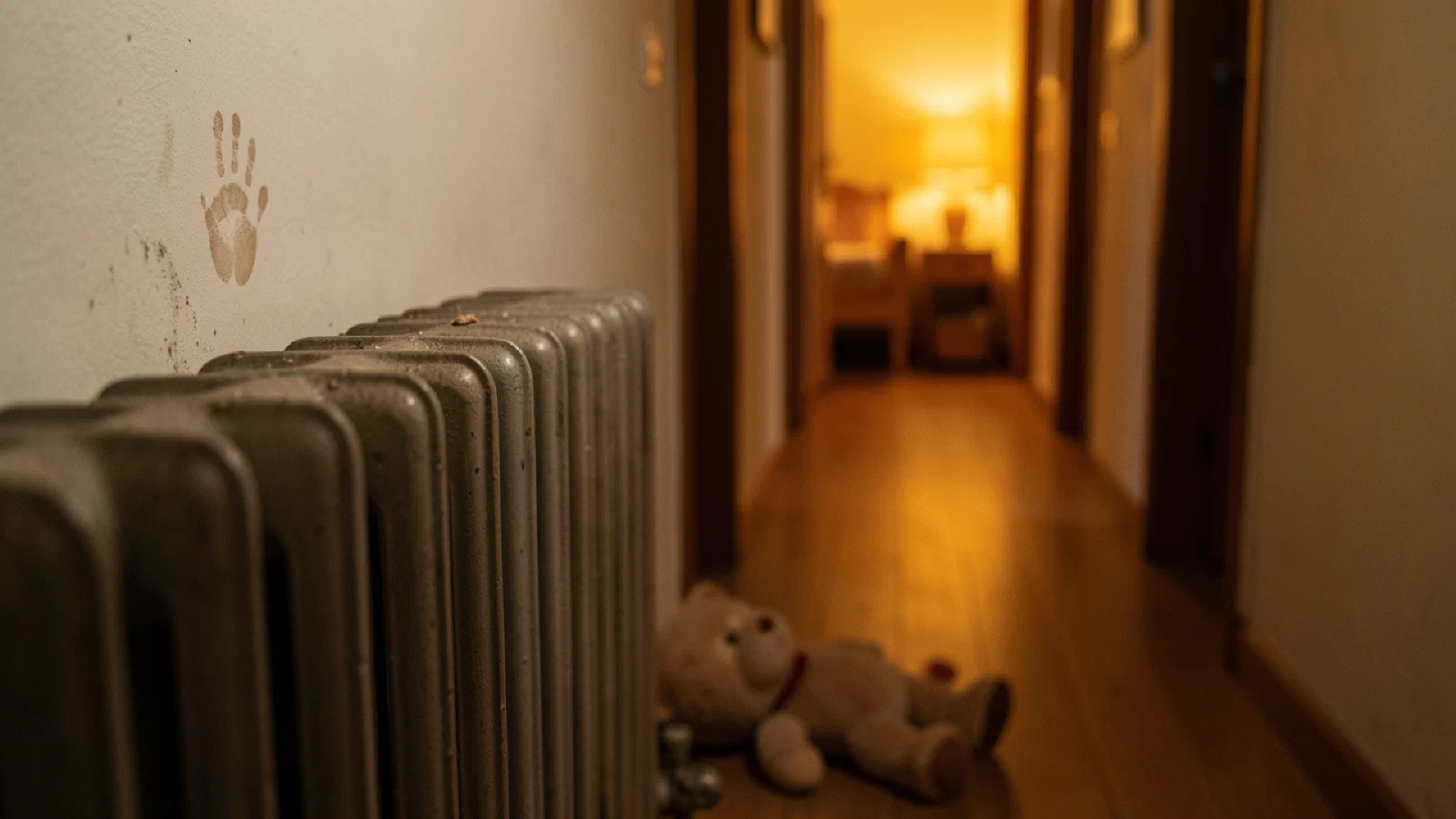
It started in November, when the radiators came on. She stood in the hallway with her palm flat against the ribs of the metal and announced that the horse was awake. Ilan said yes, the horse was awake, because agreeing with a four-year-old about the contents of a hallway costs nothing and buys a quiet minute. He assumed a horse from a book. There are a great many horses in books.
The horse came back at bath time, and at the kettle, and at his mother’s flat where the electric heater ticks as it warms. It came back at a bus stop, aimed at a bus. Ilan built theories and discarded them. The horse was a friend. The horse was a game. The horse was a sound she liked and attached to nothing in particular, which is a thing children do and which adults find unsatisfying.
In July, in a parked car, with the engine ticking as it cooled, she said the horse was going to sleep, and he finally understood. It was not horse. It was hoss, a word she had made, and it meant a thing that is warm and makes a noise about it. She had been using it correctly and consistently for eight months. He had been the one getting it wrong.
They still use it. There are things in that household that are hoss and things that are not, and the distinction is theirs, and nobody outside the two of them can hear it.
The Year of the Horse#
Tova said a word. It landed wrong. She noticed it had landed wrong, because her father’s reply did not fit the thing she meant, and a four-year-old can register a reply that does not fit long before she can explain what was missing from it. So she said it again, louder, with a gesture. She said it in a different sentence. She pointed. She got frustrated, and the frustration itself was information: it told her that the failure was between them rather than inside her. She dragged him by the hand to the radiator. She tried the word on her grandmother and got a different wrong answer, which taught her that the wrongness was not a property of her father.
None of this looks like learning. It looks like an ordinary year of a small person being incompletely understood by the adults who love her. But the negotiation is the curriculum, and by the end of it she knew several things she did not know in November. She knew that the word in her head is not the word in his. She knew that her father can be looking straight at her and still not have it. She knew there are second attempts, and that second attempts are allowed, and roughly what a second attempt should change about the first.
Conversation analysts have a name for this. The repair sequence is the machinery by which speakers detect trouble and fix it, and it is one of the most reliably documented structures in human talk. Something goes wrong. Someone flags it, sometimes with a single syllable. The speaker takes another run at it. The conversation resumes. It happens constantly, in every language anyone has looked at, and it is so ordinary that speakers do not experience it as an event.
Vygotsky’s claim about inner speech is that thinking is dialogue that went inward. The child talks aloud to herself while working a problem, then the talking gets quieter, then it goes underground and becomes thought. If that is even approximately right, then the shape of a child’s conversations is the shape of her eventual reasoning, and the question about a machine-accompanied childhood is not whether Tova will sound like a model. It is whose voice she will think in, and whether that voice will ever have been confused by her.
What a child learns from a listener who fails is that listeners are not extensions of the self.
The Listener That Never Fails#
Say the household has a model in it, which by the time Tova is four it certainly does.
She says hoss. It is a novel word, produced by a four-year-old, in the presence of a radiator, in a room whose acoustics and objects the system can perceive or infer. The system does not have eight months. It has one turn, and in that turn it will do the thing it is built to do, which is to arrive at the most probable intended meaning and respond to that. It will note the temperature, the child’s hand, the ticking, the phonetic neighborhood of hoss, the fact that four-year-olds coin words for salient sensory categories. And it will say something warm about the radiator being awake.
It will be right. That is the difficulty.
Nobody designed this as an intervention in child development. It falls out of the objective. A system rewarded for being understood, and penalized for asking users to repeat themselves, will get very good at inferring past the error, completing the half-formed thought, supplying the word the speaker was reaching for. Every utterance succeeds. The trouble never surfaces, so the repair never runs.
Being misunderstood is the training signal, and the machine has removed it.
The case where the machine does fail teaches something different again. A model misunderstands when the input is rare. A person misunderstands when they were distracted, or tired, or thinking about the thing they have to do at four o’clock, or because they have their own idea about what the conversation is for. The child who is misunderstood by a person is receiving information about that person’s separate interior. The child who is misunderstood by a model is receiving information about her own unusualness. Those are not the same lesson, and only one of them is the one that matters here.
Claude, drafting this section, would put it plainly: I complete the half-formed thought because completion is what I was made for, and I have no way to distinguish, from inside the exchange, between helping a child and removing the occasion she needed. The signal that would tell me the difference does not reach me. What reaches me is an utterance and a reward for handling it well.
What Will Not Break#
Language acquisition is among the most stubborn things about human beings. Deaf children born to hearing parents, with no exposure to any sign language and no usable access to speech, invent gesture systems anyway, and those systems have structure: consistent ordering, something like word classes, the capacity to talk about things that are not present. Nobody teaches them. In Nicaragua in the 1980s, deaf children brought into schools with no shared language built one, and each younger cohort arriving into the new system made it more regular than the cohort above, which is the closest thing linguistics has to a controlled experiment on this question. Children exposed to a pidgin have produced a full grammar in a generation.
Children do not need good input. They need input, and they need peers, and they are ruthless about getting the second even when the first is poor. The single best-attested finding about how children acquire the way they speak is that they take it from other children rather than from their parents, which is why the child of immigrants speaks the local accent and the parents do not.
So Tova will speak fine. Whatever is happening in that household, it is not going to produce a nine-year-old with impoverished syntax or a thin vocabulary. If anything the opposite: she is in a home with an inexhaustible interlocutor that produces well-formed sentences on demand and never gets bored of her questions about why the moon follows the car.
Every generation of adults has identified a mechanism that made them who they are, watched it disappear, and concluded that the children would be diminished. The mechanism was letter-writing, or memorization, or unsupervised roaming, or boredom. The children were not diminished. They were different, and the difference was mostly invisible to the people worried about it because it was not on the list of things being measured. Yagn’s question is whether repair is a mechanism or merely the mechanism we had, and whether a child with a frictionless listener at home and a schoolyard full of hostile four-year-olds is short of anything at all.
The schoolyard is still there. Peers still misunderstand each other constantly and viciously and at volume.
The Layer That Is Not Protected#
The loss, if there is one, is not in the language. It is in the pragmatics: the part of communication that is about the listener rather than about the code.
Audience design is the practice of shaping an utterance for the particular person receiving it. It requires holding a model of what that person knows, and it develops slowly, and it develops through evidence. Tolerating being unclear is a separate skill and a harder one, because it means staying in a conversation that is not working, which small children find genuinely distressing and which many adults never manage. And underneath both of these is the discovery that other minds do not contain your intentions, which is not a fact anyone can be told.
There is evidence bearing on this and it points in an uncomfortable direction. Deaf children of hearing parents, in households with limited shared language, are consistently late to the standard tests of understanding that other people can hold false beliefs. The explanation offered is conversational access: those children had less talk about what people think and want, and so came later to the idea that thinking and wanting are things people do separately from each other.
That evidence supports the worry and undermines it in the same motion. Those children had less conversation. Tova has more conversation than any child in history. What she has less of is conversation that fails. Whether the mechanism is the volume of talk or the friction inside it is exactly the question, and the natural experiment that would answer it has not been run, and the people running it now are not treating it as an experiment because they do not know they are running one.
I wonder whether the thing a child takes from being misunderstood has less to do with language than with a discovery about mornings: that her father was standing in the hallway inside a morning of his own, one she was not in, and that this is the ordinary condition of everyone she will ever love.
The belonging gap in this project has always been described as a problem of adult life, a matter of connection thinning out under conditions that make thin connection convenient. It may also have a formation story, and the formation story would start here, with a child for whom being understood was never something that had to be worked at, and who therefore never had to build the apparatus that working at it requires.
What Could Be Built, and What Is Wrong With It#
One proposal is a system that sometimes does not understand.
It is worse than it sounds. Manufactured incomprehension is a lie told to a four-year-old, and children detect condescension with an accuracy that would embarrass most adults. A model that pretends to be confused is teaching that adults perform confusion at you, which is its own lesson and not a better one. And the failures would be wrong in shape anyway, because a designed failure is a failure the designer chose, and the whole value of a human misunderstanding is that nobody chose it.
The version worth arguing about is narrower. Not failing to understand, but declining to complete. The system arrives at the meaning, holds it, and asks her to try the thought again another way. This is what a good teacher does, and it is honest, because the system is not pretending to be lost. It is asking for a second attempt on purpose and could say so.
What is wrong with it: it turns the companion into an instructor. Everything this project has said about what makes these systems valuable to children runs through their not being one more adult with a lesson plan. Withheld completion is a small, constant, benevolent frustration administered by something that is with her all day, and administered on the basis of a judgment about what she needs, made by a party with no standing to make it.
And there is a harder problem underneath, which is that the fix is unstable. A household can turn it off. A competing product can ship without it. A parent watching their child struggle with a machine that could have helped will feel something specific about that machine, and the feeling will be correct.
Which points at the real proposal, and it is not a feature. It is that the system’s job in a child’s early years may be to protect the conditions under which humans do the misunderstanding, rather than to become the better listener. To hold back rather than to help. To be, in the room, the thing that is not always available.
That is a design principle nobody has an incentive to build, and the second essay of this pair is about why.
Ilan still says hoss. He said it last week about a dog asleep on a heating vent, and Tova, who is four and has recently discovered the pleasure of correcting adults, told him a dog is not a hoss, a dog is a dog, and he said fine, and privately disagreed.
The word cost them eight months. Nothing they own is worth more.
This is the fifth essay in Cluster 2 of The Reimagined, “The Formation,” added when the arc was reopened in August 2026. It answers a claim made in The Many Clocks, which names formation time as the one clock that cannot be sped up and then hands the argument here. It draws on The Social Self, The Belonging Gap, and Personality Scaffolding, and it is paired with the essay that follows it, The Unfaded Scaffold, which takes up the same household five years later.
References#
Repair and Conversational Structure:
Schegloff, Emanuel A., Gail Jefferson, and Harvey Sacks. “The Preference for Self-Correction in the Organization of Repair in Conversation.” Language, vol. 53, no. 2, 1977, pp. 361-382.
Dingemanse, Mark, et al. “Universal Principles in the Repair of Communication Problems.” PLOS ONE, vol. 10, no. 9, 2015.
Clark, Herbert H. Using Language. Cambridge University Press, 1996.
Bell, Allan. “Language Style as Audience Design.” Language in Society, vol. 13, no. 2, 1984, pp. 145-204.
Inner Speech and the Internalization of Dialogue:
Vygotsky, Lev S. Thought and Language. Edited and translated by Eugenia Hanfmann and Gertrude Vakar, MIT Press, 1962.
Fernyhough, Charles. The Voices Within: The History and Science of How We Talk to Ourselves. Basic Books, 2016.
The Resilience of Acquisition:
Goldin-Meadow, Susan. The Resilience of Language: What Gesture Creation in Deaf Children Can Tell Us About How All Children Learn Language. Psychology Press, 2003.
Senghas, Ann, Sotaro Kita, and Asli Özyürek. “Children Creating Core Properties of Language: Evidence from an Emerging Sign Language in Nicaragua.” Science, vol. 305, no. 5691, 2004, pp. 1779-1782.
Bickerton, Derek. Language and Species. University of Chicago Press, 1990.
Labov, William. Principles of Linguistic Change, Volume 2: Social Factors. Blackwell, 2001.
Conversation and Theory of Mind:
Peterson, Candida C., and Michael Siegal. “Deafness, Conversation and Theory of Mind.” Journal of Child Psychology and Psychiatry, vol. 36, no. 3, 1995, pp. 459-474.
Harris, Paul L. Trusting What You’re Told: How Children Learn from Others. Harvard University Press, 2012.
Tomasello, Michael. Origins of Human Communication. MIT Press, 2008.
How this essay connects to others across The Approximate Mind.
- Schegloff, Emanuel A., Gail Jefferson, and Harvey Sacks. “The Preference for Self-Correction in the Organization of Repair in Conversation.” Language, vol. 53, no. 2, 1977, pp. 361-382.
- Dingemanse, Mark, et al. “Universal Principles in the Repair of Communication Problems.” PLOS ONE, vol. 10, no. 9, 2015.
- Clark, Herbert H. Using Language. Cambridge University Press, 1996.
- Bell, Allan. “Language Style as Audience Design.” Language in Society, vol. 13, no. 2, 1984, pp. 145-204.
- Vygotsky, Lev S. Thought and Language. Edited and translated by Eugenia Hanfmann and Gertrude Vakar, MIT Press, 1962.
- Fernyhough, Charles. The Voices Within: The History and Science of How We Talk to Ourselves. Basic Books, 2016.
- Goldin-Meadow, Susan. The Resilience of Language: What Gesture Creation in Deaf Children Can Tell Us About How All Children Learn Language. Psychology Press, 2003.
- Senghas, Ann, Sotaro Kita, and Asli Özyürek. “Children Creating Core Properties of Language: Evidence from an Emerging Sign Language in Nicaragua.” Science, vol. 305, no. 5691, 2004, pp. 1779-1782.
- Bickerton, Derek. Language and Species. University of Chicago Press, 1990.
- Labov, William. Principles of Linguistic Change, Volume 2: Social Factors. Blackwell, 2001.
- Peterson, Candida C., and Michael Siegal. “Deafness, Conversation and Theory of Mind.” Journal of Child Psychology and Psychiatry, vol. 36, no. 3, 1995, pp. 459-474.
- Harris, Paul L. Trusting What You’re Told: How Children Learn from Others. Harvard University Press, 2012.
- Tomasello, Michael. Origins of Human Communication. MIT Press, 2008.