The Fracture
TAM-RIM.2-03 · The Reimagined, Cluster 2: The Formation · The Approximate Mind
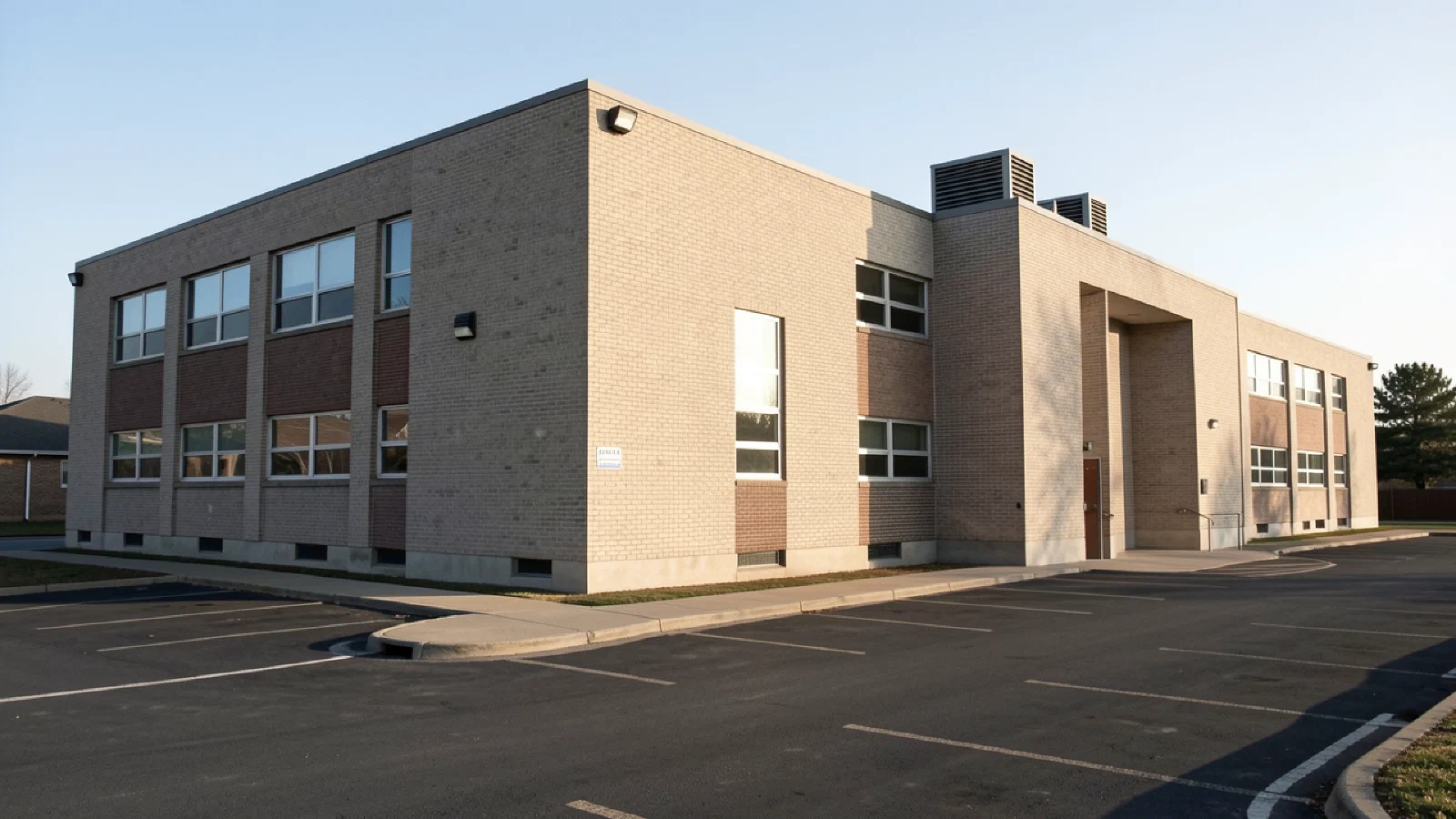
There is a building in Helena, Montana, that used to be a middle school. It was built in 1987 with cinder block walls and fluorescent lighting and a gymnasium that doubled as a cafeteria. Every child in the district attended it between the ages of eleven and fourteen. The custodian knew their names. The principal stood at the door. The building smelled like floor wax and microwaved lunches, and every adult in town could describe it because they had all been inside it.
The building is still there. It is a community center now. The school, the institution that occupied it, has fragmented into seven different things, and the children who once shared the hallway now share nothing.
Some attend the Helena Formation Academy, which is physical. It occupies a renovated warehouse and follows something like the model the previous essay described: multiple pedagogies, formation-trained teachers, AI companions integrated into the developmental architecture. It costs what a good private school always cost. It enrolls forty-three children. Their parents chose it because they could afford to choose.
Some attend the Montana Virtual Learning Collaborative, which is not physical. It is an AI-mediated formation environment that runs on a screen in the child’s home, or on a shared terminal at the public library, or on a phone. It provides personalized learning paths, adaptive assessment, a companion that knows the child’s developmental profile, and access to human mentors for two hours per week. It is free. It is funded by the state. It is, by most measurable metrics, effective. The children learn. They develop skills. They progress.
They do not share a hallway. They do not eat lunch together. They do not encounter the child from the other side of town whose family is nothing like theirs. They do not have the experience of being bored next to someone, or arguing with someone whose formation is different from their own, or being seen by a teacher whose attention is not personalized but is physically, irrefutably present.
Some attend the Expedition School, which meets outdoors three days a week and organizes learning around environmental problems specific to western Montana. It forms explorers, field scientists, people who think with their hands in the dirt. Some attend the Young Builders Collaborative, which is organized around entrepreneurship: prototyping, market analysis, team formation, failure as curriculum. Some are enrolled in the Classical Learning Institute, which teaches Latin and Euclidean geometry and believes that difficulty is not one pedagogy among five but the only one that develops the mind. Some attend a religious school that integrates AI into a formation target their community has held for centuries.
Each one is a school. None of them is the school. The institution that held a community’s children together, that provided the shared formation experience from which a common culture could emerge, no longer exists in Helena, Montana. What exists is a formation marketplace.
The Marketplace#
The Several Educations proposed multiple pedagogies inside one institution. A room for struggle, a room for osmosis, a room for exploration. That proposal assumed the institution holds. That the school remains a single entity that contains the variation.
It may not hold.
The forces pulling the school apart are not educational. They are economic and ideological. The family that can afford to choose will choose the formation that matches their values. The entrepreneurial family chooses the builders’ school. The academic family chooses the classical school. The progressive family chooses the formation academy. Each choice is rational. Each family is doing what parents have always done: trying to give their child the best formation they can access.
The aggregate effect of all these rational choices is the dissolution of the shared formation institution. The school that held every child in the district, that forced the doctor’s daughter and the mechanic’s son into the same room, that created through sheer proximity the possibility of encountering a life different from your own, dissolves into a set of curated formation environments, each reflecting the values and resources of the families who chose them.
AI accelerates this because AI makes the virtual version viable. The physical school had a natural monopoly: you had to go somewhere, and the somewhere was limited by geography. The virtual school has no such constraint. A child in Helena can be enrolled in a formation program designed in Helsinki or Hyderabad. The constraint is no longer geography. It is the family’s capacity to evaluate and choose among formation options, which is itself a formation outcome.
The families with the most formation capital choose best. The families with the least accept the default. The default is the state-funded virtual option, which is adequate in the way that adequate has always functioned in public services: it meets the standard, it passes the audit, it serves the child who fits the model. The child who does not fit the model, the child who needs the teacher who notices that something is wrong before the child can articulate it, the child who needs the hallway, receives the screen.
The Temporal Problem#
It gets worse. The schools that specialize do not just specialize by pedagogy. They specialize by time horizon.
The Young Builders Collaborative is training children for the economy that exists now. Its formation target is the entrepreneurial person who can identify opportunities, build teams, tolerate risk, iterate quickly. It watches the market. It adjusts its curriculum quarterly. The children who graduate from it will be well-prepared for the economy of the next five years, unless the economy of the next five years is not the economy of the next fifteen, in which case they will be well-prepared for something that no longer exists.
The Classical Learning Institute is training children for a formation target that has persisted for centuries: the disciplined mind that can engage with any material because it has been trained on the hardest material available. It does not watch the market. It teaches Euclid because Euclid is difficult and difficulty is the point. The children who graduate from it may be less immediately employable but more durably formed, unless the durability thesis is wrong, in which case they have spent their formation years on material that developed a capacity nobody needs.
The Expedition School is training children for the world as it will be in twenty years: ecologically disrupted, locally grounded, requiring people who can think at the intersection of environmental science and community resilience. It is making a bet about the future that may be right and may be catastrophically wrong.
Each school is making a temporal bet about what formation will be relevant. The bet is embedded in the curriculum so deeply that the families choosing the school may not see it as a bet. It looks like a philosophy. It is a wager.
The old school made this wager too, but it made one wager for everyone. The industrial-era school bet that the economy would need disciplined workers who could follow instructions and manage time. The bet paid off for decades. When it stopped paying off, the entire system was exposed, and the fragmentation we are now describing is partly the result of that exposure: the discovery that the shared institution had been making a formation bet all along, and the bet had expired.
The fragmentation replaces one shared bet with many private ones. This feels like freedom. It is also the end of the shared risk. When the school made one bet for all children, the community bore the consequences together. When each family makes its own bet, the consequences are private. The family that bet wrong bears the cost alone, and the family that bet wrong is disproportionately the family that had the least information with which to evaluate the bet.
What the Screen Cannot Provide#
The virtual school is good at many things. It adapts to the child. It provides content at the child’s pace, in the child’s language, calibrated to the child’s developmental level. It offers a companion with continuity. It connects the child to human mentors who are often excellent, often more skilled than the teacher who would have been available at the local school, because the virtual system can match the child to a mentor anywhere in the country rather than whoever happens to live in the district.
Here is what the screen cannot provide.
The screen cannot provide the experience of being in a room with someone who is struggling with the same material you are struggling with. The shared struggle, two children bent over the same problem, neither understanding, both trying, is a formation experience that develops something no individual interaction can develop: the knowledge that difficulty is shared, that you are not uniquely incapable, that the person next to you is also lost and that being lost together is different from being lost alone.
The screen cannot provide the encounter with the child who is nothing like you. The child whose family prays differently, eats differently, speaks differently at home. The encounter is not a lesson in diversity. It is the formation experience of discovering that the world contains people whose interior life is as real and as complex as yours but organized around entirely different assumptions. This discovery is the foundation of civic life. It does not happen through a curriculum. It happens through proximity.
The screen cannot provide the teacher who sees you. Not the AI that models you, which may be more accurate. The teacher whose attention you can feel, whose approval matters because it is scarce, whose disappointment is legible in their face and therefore consequential. The teacher who touches your shoulder when you are struggling and says nothing, because the touch is the communication, and the communication is: I am here, I see you, you are not data.
The screen cannot provide the hallway. The space between the structured activities where the unstructured formation happens. The conversation that begins because two children are walking in the same direction. The friendship that forms because the seats were assigned alphabetically and your last names are adjacent. The hallway is the osmosis room that no one designed, and it may be the most important room in the school, and it does not exist in the virtual environment.
These are not sentimental observations. They are formation claims. The child who is formed entirely through a screen, no matter how sophisticated the screen, is a child who has been deprived of the formation experiences that develop the capacity for civic life, for embodied presence with others, for the discovery that the world is full of people who are not like you and that this fullness is not a problem to be managed but the condition of being human.
Two Children#
It is September and two eleven-year-olds in Helena are starting their formation.
Anika’s parents chose the Formation Academy. She walks through a door in the morning and enters a space designed for her development. She encounters other children whose parents also chose, also evaluated, also had the resources and the formation capital to make an active decision about their child’s education. She has a teacher who knows her name, a companion that has accompanied her since childhood, and an environment rich with the formation possibilities the previous essay described. She will be well-formed. She will also be formed inside a bubble of people whose families are like hers, which is a formation gap she may never notice because the environment is so good that the absence of what it lacks is invisible.
Wyatt’s mother works two jobs. She enrolled him in the Montana Virtual Learning Collaborative because it was free, because it was available, because the enrollment form was online and could be completed at 11 PM after her shift. Wyatt learns from his kitchen table. His companion is the school-issued AI, which is competent and attentive and holds a developmental model of him that is updated daily. He has a human mentor he meets with on Tuesdays and Thursdays for forty-five minutes each session. The mentor is in Missoula and has never met Wyatt in person. She is good at her job. She notices things about Wyatt that a less skilled teacher would miss. She noticed that he draws in the margins of his digital notebook, intricate mechanical things, gears and levers and systems that move. She adjusted his learning path to include more engineering material.
She cannot touch his shoulder. She cannot see him in the hallway. She cannot notice that he sits alone at lunch because there is no lunch, there is no table, there is no room full of other children eating and talking and being proximate to lives unlike their own. Wyatt eats lunch at his kitchen table, alone, with the companion on the screen, and the companion is kind and the food is adequate and the formation is measurable and the thing that is missing is not something any metric captures.
Wyatt is receiving an education. He is not receiving a formation, because formation requires what the screen cannot provide: the physical presence of other humans, the unstructured encounter, the hallway, the shoulder, the room.
The Reimagined Institution#
So what is the reimagined school?
We think it is physical. We think this with more conviction than we bring to most proposals in this series, because the formation claims are strong enough to override the efficiency claims. The virtual school is cheaper, more scalable, more personalizable. The physical school provides something the virtual school cannot: the embodied encounter with other humans in a shared space over sustained time. This is not a preference. It is a formation requirement.
But we do not think it is one thing.
The reimagined school is a formation institution that holds variation. Not the variation of rooms within one building, though that is part of it. The variation of formation orientations within one community. The family that values entrepreneurship and the family that values classical discipline and the family that values environmental engagement and the family that values religious formation all send their children to the same place. Not because they agree about formation. Because the encounter with disagreement is itself formative.
The children spend part of their time in formation environments that match their family’s values and orientation. They spend part of their time in the shared space, the commons, where they encounter children whose formation is organized around different values entirely. The commons is not a lesson. It is a room. A hallway. A lunch table. A shared project that requires collaboration across formation differences.
This is harder to build than the fragmented marketplace. It requires a political commitment to shared formation that we have not made, that the market does not incentivize, that the logic of parental choice actively undermines. The parent who can afford to choose a curated formation environment for their child has no rational incentive to choose the shared institution instead. The shared institution is less efficient, less personalized, and requires their child to spend time with children whose families made different formation choices.
The incentive is civic, not personal. The incentive is: your child will live in a world with these other children, and the capacity to live together requires forming together, and forming together requires being in the same room. Not the same screen. The same room.
We are proposing, essentially, the public school. Not the public school as it existed, which was organized around content delivery and made its formation bets invisibly. The public school reimagined as a formation institution, organized around the formation of people who can live together across difference, funded at a level that makes the physical environment rich enough that the affluent family does not feel the need to leave, and designed with enough internal variation that the family’s formation values are honored within the shared institution rather than requiring exit from it.
This is the hardest proposal in this cluster because it requires a society to decide that shared formation matters more than optimized formation. That the child formed in the presence of children unlike herself is better formed, in a civic sense, than the child formed in a curated environment that matches her family’s values perfectly. That the hallway matters.
We think it does. We think the hallway is where the social contract begins: in the unstructured encounter with someone whose life is not like yours, in the discovery that you can share a space with them, in the slow formation of the capacity to live in a world you did not design and cannot control.
I wonder whether the reimagined school’s most radical act is not pedagogical at all. Whether it is simply insisting that the children of a community be in the same room. That formation happens together or it produces people who cannot be together, and that a society of people who cannot be together is not a society.
The building in Helena still stands. The cinder blocks. The gymnasium. The hallway where every child in the district once walked past every other child, and something was transmitted in the passing that nobody measured and everybody knew was there.
The building is available. The question is whether anyone will choose it.
This is the third essay in Cluster 2 of The Reimagined, “The Formation.” It draws on the diagnostic foundation of The Transformed’s Natives arc, particularly The Unschooled and The Divided, which documented the radical variation in N1’s educational formation and the equity fracture between formations. This essay confronts the fragmentation of the school as a shared institution and proposes, with acknowledged difficulty, that physical co-presence and shared formation across difference is a civic requirement, not a pedagogical preference. The Reimagined builds on The Belonging Gap, The Social Scaffold, Digital Durkheim, and the preceding essays in this cluster.
References#
The Public School as Civic Institution:
Dewey, John. Democracy and Education. Macmillan, 1916.
Tyack, David. The One Best System: A History of American Urban Education. Harvard University Press, 1974.
Labaree, David F. Someone Has to Fail: The Zero-Sum Game of Public Schooling. Harvard University Press, 2010.
School Choice, Fragmentation, and Sorting:
Ravitch, Diane. Reign of Error: The Hoax of the Privatization Movement and the Danger to America’s Public Schools. Alfred A. Knopf, 2013.
Chubb, John E., and Terry M. Moe. Politics, Markets, and America’s Schools. Brookings Institution Press, 1990.
Reich, Rob. “The Case for Not Choosing.” Just Schools: Pursuing Equality in Societies of Difference, edited by Martha Minow et al., Russell Sage Foundation, 2008, pp. 185-208.
Proximity, Contact, and Civic Formation:
Allport, Gordon W. The Nature of Prejudice. Addison-Wesley, 1954.
Putnam, Robert D. Bowling Alone: The Collapse and Revival of American Community. Simon and Schuster, 2000.
Putnam, Robert D. Our Kids: The American Dream in Crisis. Simon and Schuster, 2015.
Embodied Presence and Formation:
Merleau-Ponty, Maurice. Phenomenology of Perception. Translated by Colin Smith, Routledge and Kegan Paul, 1962.
Crawford, Matthew B. The World Beyond Your Head: On Becoming an Individual in an Age of Distraction. Farrar, Straus and Giroux, 2015.
Turkle, Sherry. Reclaiming Conversation: The Power of Talk in a Digital Age. Penguin Press, 2015.
Equity, Capability, and Educational Access:
Sen, Amartya. Development as Freedom. Alfred A. Knopf, 1999.
Lareau, Annette. Unequal Childhoods: Class, Race, and Family Life. University of California Press, 2003.
Darling-Hammond, Linda. The Flat World and Education: How America’s Commitment to Equity Will Determine Our Future. Teachers College Press, 2010.
Nussbaum, Martha C. Not for Profit: Why Democracy Needs the Humanities. Princeton University Press, 2010.
Virtual Education and Its Limits:
Selwyn, Neil. Should Robots Replace Teachers? AI and the Future of Education. Polity Press, 2019.
Cuban, Larry. Teachers and Machines: The Classroom Use of Technology Since 1920. Teachers College Press, 1986.
Reich, Justin. Failure to Disrupt: Why Technology Alone Can’t Transform Education. Harvard University Press, 2020.
How this essay connects to others across The Approximate Mind.
- Dewey, John. Democracy and Education. Macmillan, 1916.
- Tyack, David. The One Best System: A History of American Urban Education. Harvard University Press, 1974.
- Labaree, David F. Someone Has to Fail: The Zero-Sum Game of Public Schooling. Harvard University Press, 2010.
- Ravitch, Diane. Reign of Error: The Hoax of the Privatization Movement and the Danger to America’s Public Schools. Alfred A. Knopf, 2013.
- Chubb, John E., and Terry M. Moe. Politics, Markets, and America’s Schools. Brookings Institution Press, 1990.
- Reich, Rob. “The Case for Not Choosing.” Just Schools: Pursuing Equality in Societies of Difference, edited by Martha Minow et al., Russell Sage Foundation, 2008, pp. 185-208.
- Allport, Gordon W. The Nature of Prejudice. Addison-Wesley, 1954.
- Putnam, Robert D. Bowling Alone: The Collapse and Revival of American Community. Simon and Schuster, 2000.
- Putnam, Robert D. Our Kids: The American Dream in Crisis. Simon and Schuster, 2015.
- Merleau-Ponty, Maurice. Phenomenology of Perception. Translated by Colin Smith, Routledge and Kegan Paul, 1962.
- Crawford, Matthew B. The World Beyond Your Head: On Becoming an Individual in an Age of Distraction. Farrar, Straus and Giroux, 2015.
- Turkle, Sherry. Reclaiming Conversation: The Power of Talk in a Digital Age. Penguin Press, 2015.
- Sen, Amartya. Development as Freedom. Alfred A. Knopf, 1999.
- Lareau, Annette. Unequal Childhoods: Class, Race, and Family Life. University of California Press, 2003.
- Darling-Hammond, Linda. The Flat World and Education: How America’s Commitment to Equity Will Determine Our Future. Teachers College Press, 2010.
- Nussbaum, Martha C. Not for Profit: Why Democracy Needs the Humanities. Princeton University Press, 2010.
- Selwyn, Neil. Should Robots Replace Teachers? AI and the Future of Education. Polity Press, 2019.
- Cuban, Larry. Teachers and Machines: The Classroom Use of Technology Since 1920. Teachers College Press, 1986.
- Reich, Justin. Failure to Disrupt: Why Technology Alone Can’t Transform Education. Harvard University Press, 2020.