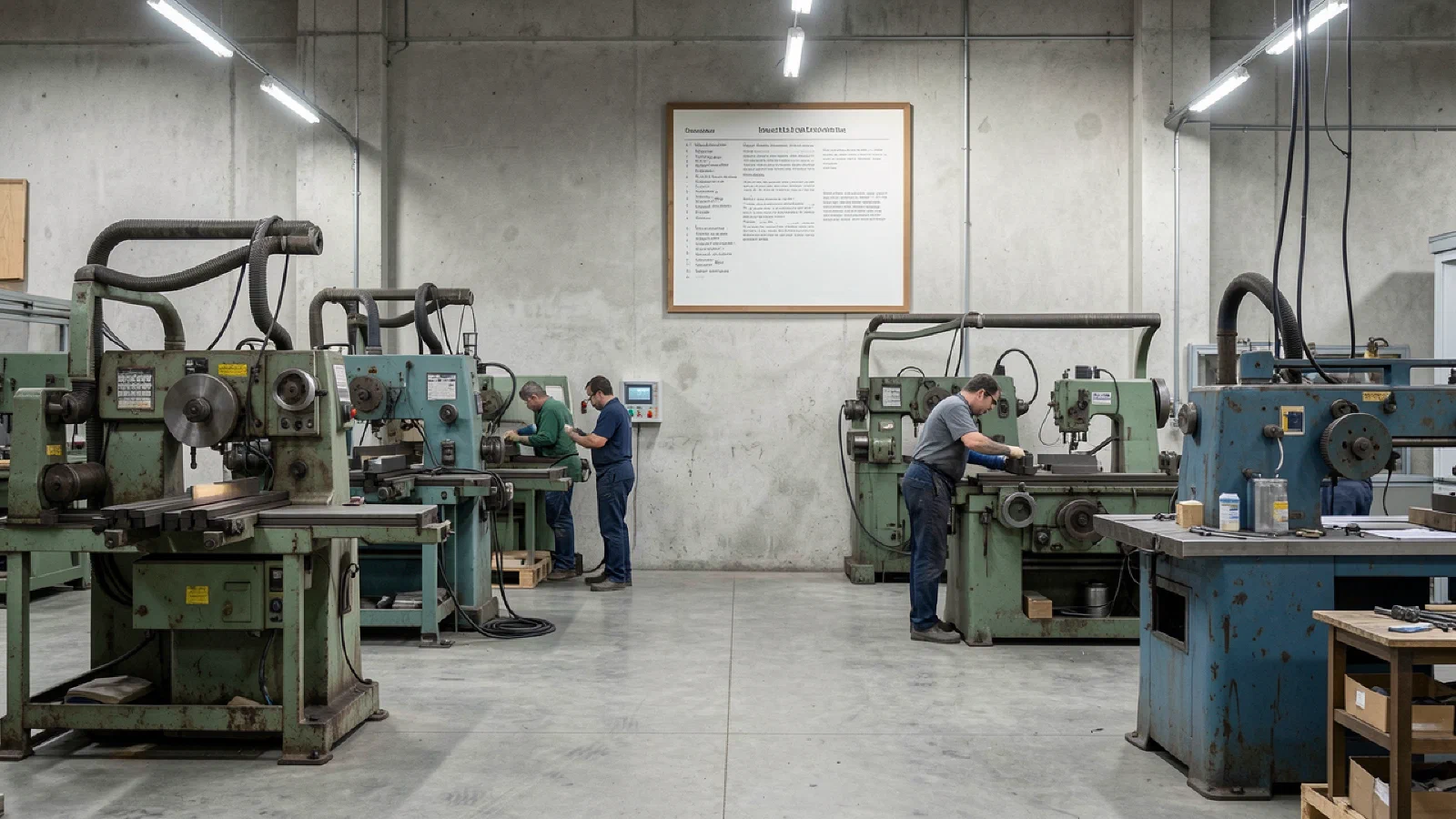
The Owned Factory
What Happens When the Union Becomes the Firm
TAM-RIM.6-04 · The Reimagined, Cluster 6: The Coordination · The Approximate Mind
The plant closed in 2019.
It made catalytic converters for a supplier that supplied a company that supplied General Motors. At peak employment it had 340 workers. The parking lot could hold 400 cars. The building is 165,000 square feet of concrete and steel on a frontage road outside Lordstown, Ohio, a town that has had its economy removed and replaced and removed again so many times that the residents describe their relationship to industrial employment the way a person in a floodplain describes their relationship to the river. It comes. It goes. You rebuild.
The plant sits empty. Not derelict. Empty. The roof is sound. The electrical service is intact. The floor is clean because the last owner paid for the remediation before walking away, which is more consideration than most departing employers extend. The tooling was sold at auction. The parking lot has weeds in the expansion joints. The chain-link fence is padlocked with a combination that someone at the county clerk’s office probably knows.
Charlene drove past it this morning on her way to her shift at a distribution center twenty minutes east, where she loads packages for a logistics company whose name she cannot remember without checking her badge. She worked at the plant for eleven years. She was a quality inspector on the converter line. She could identify a defective weld by sound, a skill she developed over time and cannot fully explain and that nobody has asked her to use since 2019.
She is fifty-one. She makes fourteen dollars an hour less than she made at the plant. She has a photograph on her refrigerator of her crew from the last Christmas party, 2018, twelve people in safety glasses and company shirts, and she cannot look at it without a specific feeling she has learned not to name out loud because it sounds like self-pity and she does not think of herself as a person who indulges in that.
The plant is still there. The workers are still here. The skills are still in their hands. What is missing is the organizational structure that connected the workers to the work, and the capital that funded the structure, and the management that operated it.
Two of those three things have changed.
The Proposition#
Imagine that the AFL-CIO, or one of its member unions, or a regional labor council with access to pension fund capital, decides to do something that no union has done before.
It acquires the plant. The purchase price is modest. Empty industrial real estate in the Rust Belt is not expensive. The building is there, the infrastructure is there, the community is there, the workforce, dispersed to distribution centers and gas stations and disability, is recoverable.
It installs an AI coordination layer. Not to replace the workers. To replace the management. The AI handles production scheduling, supply chain coordination, quality system management, financial planning, regulatory compliance, customer acquisition. Every function that the plant’s management performed, from the floor supervisor to the plant manager to the regional VP who visited twice a year and said things about efficiency, is performed by the system.
The workers own the enterprise. Through the union, through a cooperative structure, through whatever legal form best protects their collective interest. They show up. They do the work. The AI coordinates the work. The value that the work produces flows to the workers, minus operating costs, minus capital repayment, minus reinvestment. There is no management layer taking a share. There is no distant corporate parent extracting surplus to service debt from the leveraged buyout that nobody on the floor understood.
Charlene is back on the converter line. Or whatever the line produces now, because the product decision is itself a coordination function that the AI handles by analyzing market demand, manufacturing capability, and supply chain availability. The AI identifies the product. The workers make it. The union governs the enterprise.
This is not a thought experiment. Every component exists. The capital is available. Pension funds alone, managed on behalf of union workers, represent trillions of dollars. The plants are available. Hundreds sit empty across the industrial Midwest, structurally sound, remediated, waiting. The workforce is available, underemployed and proximate. The AI coordination capability is available, commercial-grade, deployable within months rather than years.
What has never existed is the will to assemble these components in this configuration.
What the Union Was#
To understand why this configuration has not been tried, it helps to understand what unions were built to do and what they were not.
Unions were built as a counterweight. The organizing principle was adversarial: workers against management, labor against capital. The union existed to negotiate the terms under which workers sold their labor to the firm. Better wages. Better conditions. Better benefits. The union’s power derived from collective bargaining, the threat that all workers would withdraw their labor at once, which was credible only because the firm needed the workers and could not quickly replace them.
The adversarial frame assumed a fixed structure: the firm exists, management runs it, workers work in it, and the negotiation is about the distribution of value within that structure. The union never challenged the structure itself. It challenged the split.
This is why the proposition is genuinely new. It does not ask the union to negotiate better terms within the existing structure. It asks the union to become the structure. To own the firm, operate it through AI coordination, and govern it through collective decision-making. The adversary disappears, not because the union won but because the function the adversary performed has been automated.
The union, which was designed as an opposition party, is being asked to become the government.
What Has to Be True#
For this to work, several things must hold. Each is plausible. None is certain.
The AI coordination layer must be good enough to manage a manufacturing operation without human management oversight. This is the closest to being true. Production scheduling, quality systems, supply chain management, financial tracking, regulatory compliance: each of these is an information processing function that AI handles at or above the level of a competent plant manager. Not a brilliant plant manager. Not the leader who walks the floor and knows every worker’s name and makes the call that saves the contract. A competent one. The median. The one the workers actually had, as opposed to the one management theory describes.
The workers must be willing to govern collectively. This is harder. Cooperatives exist and have existed for more than a century. Mondragon, in the Basque Country, employs over 80,000 people across more than a hundred cooperatives. It works. It has worked since 1956. But it works within a specific cultural context, with specific institutional supports, and with a governance structure that took decades to develop and refine. Transplanting collective governance into a Rust Belt factory with no cooperative tradition, where the workers’ experience of organizational life is strictly hierarchical, is not a matter of installing the right software.
The product must find a market. The AI can identify demand and optimize production, but the enterprise must compete with firms that have established brands, existing customer relationships, and scale advantages. A worker-owned factory in Lordstown making auto parts is competing with global suppliers whose cost structures reflect labor markets the cooperative cannot match. The AI coordination layer removes management overhead, which helps, but management overhead is not the primary cost advantage of offshore manufacturing. Labor cost is.
The financing must work. Pension fund capital is available in principle, but pension fund managers have a fiduciary duty to their beneficiaries, which means they must evaluate this investment against alternatives that have clearer return profiles and lower risk. A worker-owned, AI-coordinated manufacturing cooperative with no track record is not an obvious pension fund investment. It is, by the standards of institutional capital, a speculative bet on a novel organizational form.
Each of these conditions is achievable. Together, they describe a proposition that is possible but not easy, fundable but not obviously, and governable but not without a governance architecture that does not yet exist.
The Governance Gap#
This is the hardest part. Not the technology. Not the capital. Not the market. The governance.
In a traditional firm, decisions are made by a management hierarchy. The hierarchy is imperfect, political, sometimes corrupt, but it resolves disputes. When two priorities conflict, a manager decides. When resources are scarce, a manager allocates. When the strategy needs to change, a manager changes it. The hierarchy concentrates decision-making authority in a way that enables action, even if the action is sometimes wrong.
In the worker-owned cooperative, decision-making authority is distributed. This is the point. Worker ownership means worker governance, which means the workers must collectively make the decisions that management used to make individually.
The AI coordination layer handles operational decisions: scheduling, routing, quality control, supply chain. These are algorithmic. But strategic decisions, what to produce, how to price it, how to distribute surplus, how much to reinvest, whether to expand or contract, these are not algorithmic. They involve trade-offs between competing interests, and the workers have competing interests.
Charlene wants higher wages now. She has been making fourteen dollars an hour less for five years and she has debts. Marcus, who is twenty-seven and was hired into the cooperative six months ago, wants investment in new equipment that will position the enterprise for higher-margin products in three years. Diane wants the cooperative to hire her cousin, who needs work. Ray wants to know why the AI recommended a supplier change when the current supplier is run by a friend from his church.
In a traditional firm, a manager works these conflicts through a combination of authority, judgment, and organizational politics. The manager’s decision may not be optimal, but it is decisive. The firm moves.
In the cooperative, the same conflicts must be navigated through collective process. Votes. Meetings. Deliberation. The process is more democratic. It is also slower, more exhausting, and more vulnerable to the factions and resentments that any group of humans generates when they must make consequential decisions together over extended periods.
Mondragon solved this by building a layered governance structure with elected management, worker councils, and clear decision-making protocols refined over decades. The Lordstown cooperative does not have decades. It has a group of former factory workers who are accustomed to being told what to do, who are learning to tell themselves, and who must make this transition while also producing product, serving customers, and repaying the capital that funded the enterprise.
The AI replaced the management function. It did not replace the governance function. And governance turns out to be the harder problem.
What It Demonstrates#
Suppose it works. Not perfectly. Messily, the way real things work. The Lordstown cooperative produces product, serves customers, employs workers, governs itself through a process that is imperfect and evolving. It makes it through the first year. The second. It is not Mondragon. It is a factory in Ohio where fifty-three people own their work and an AI system coordinates their production and nobody between them and the value they create is taking a cut.
What has been demonstrated?
Not that cooperatives are the future of manufacturing. The conditions are too specific and the governance too fragile for that claim.
What has been demonstrated is that management was optional.
Not management as leadership, as human attention, as the Rhonda function from the previous essay. Management as a class. As a structural layer that justified its share of the enterprise’s value through the coordination function it performed. The AI proved that the coordination function can be performed without the class. The cooperative proved that the enterprise can be governed without the hierarchy.
The demonstration cannot be taken back. This is the thing about proofs of concept. Even if the Lordstown cooperative fails in year three, the demonstration persists. Someone will point to it and say: for two years, fifty-three workers in Ohio ran a factory without a manager, coordinated by AI, governed by themselves. It worked. Not forever. But long enough to prove that the thing everyone said was impossible was merely difficult.
Mondragon proved something similar in 1956. Seven decades later, the proof still stands, and every conversation about worker ownership references it. The Lordstown cooperative would not need to last seven decades. It would need to last long enough to enter the record.
What Charlene Knows#
Charlene does not think about organizational theory. She does not use the word “cooperative” in conversation unless someone asks, and then she says “the plant” and lets them figure out the rest.
She knows the lines are running. She knows the quality is good because she is the one inspecting it, and her ear for defective welds has not atrophied in the years since the plant closed. She knows the paycheck is better than the distribution center, though not yet what she was making before 2019. She knows the meetings are long and sometimes difficult and that Ray’s complaint about the supplier was actually about something else that nobody has the vocabulary to name.
She knows the AI system sends her assignments that make sense, which is more than she could say for the last three human supervisors she worked under at the old plant. She knows the photograph on her refrigerator has been joined by a newer one, taken at the cooperative’s first-year gathering, fewer people, no company shirts because there is no company, just the plant.
She knows something she does not say directly: that the empty building on the frontage road is not empty anymore, and that the combination on the padlock is hers.
Whether the cooperative survives is not something she can know. The governance is hard. The market is unforgiving. The capital needs repaying. The people she works with are the same complicated, difficult, generous, frustrating humans they were when someone else was in charge, and now they are in charge, and being in charge turns out to require muscles that the old structure never asked them to develop.
She is developing them. Slowly. Imperfectly. Without certainty that the effort will pay off.
The plant is running. That is enough for now.
This is the fourth essay in The Coordination, a cluster within The Reimagined examining what happens to the structure of the firm when AI can perform the coordination function. The previous essays traced the one-person firm (The Solo Machine), the zero-person firm (The Empty Chair), and the inverted firm (The Inverted Firm). This essay asks what happens when a union deploys AI to replace management rather than when capital deploys AI to replace labor. The essay that follows, The Direct Chain, extends the ownership proposition across the supply chain. This essay connects to the administrative burden essays (The Paperwork of Being Alive through The Three Delegations), where the friction of bureaucratic systems exhausts human capacity and the removal of that friction has structural consequences; to the gravity in The Gravity, where distillation reveals vocational orientation; to the enclosure of coordination in The Enclosure of Coordination, here inverted because the workers enclose the coordination rather than capital; and to the friction-was-load-bearing insight that runs through the project, applied here to the management layer itself.
References#
Worker Cooperatives and Democratic Governance
Cheney, George. Values at Work: Employee Participation Meets Market Pressure at Mondragon. Cornell University Press, 1999.
Dow, Gregory K. Governing the Firm: Workers’ Control in Theory and Practice. Cambridge University Press, 2003.
Pencavel, John. “Worker Cooperatives and Democratic Governance.” Handbook of Economic Organization, edited by Anna Grandori, Edward Elgar, 2013.
Whyte, William Foote, and Kathleen King Whyte. Making Mondragon: The Growth and Dynamics of the Worker Cooperative Complex. Cornell University Press, 1988.
Deindustrialization and Community
Hochschild, Arlie Russell. Strangers in Their Own Land: Anger and Mourning on the American Right. New Press, 2016.
Russo, John, and Sherry Lee Linkon. Steeltown U.S.A.: Work and Memory in Youngstown. University Press of Kansas, 2002.
Vance, J. D. Hillbilly Elegy: A Memoir of a Family and Culture in Crisis. Harper, 2016.
Union Capital and Pension Fund Investment
Hebb, Tessa. No Small Change: Pension Funds and Corporate Engagement. Cornell University Press, 2008.
Rifkin, Jeremy. The End of Work: The Decline of the Global Labor Force and the Dawn of the Post-Market Era. G. P. Putnam’s Sons, 1995.
AI and Organizational Coordination
Brynjolfsson, Erik, and Andrew McAfee. The Second Machine Age: Work, Progress, and Prosperity in a Time of Brilliant Technologies. W. W. Norton, 2014.
Malone, Thomas W. Superminds: The Surprising Power of People and Computers Thinking Together. Little, Brown, 2018.
How this essay connects to others across The Approximate Mind.
- Cheney, George. Values at Work: Employee Participation Meets Market Pressure at Mondragon. Cornell University Press, 1999.
- Dow, Gregory K. Governing the Firm: Workers’ Control in Theory and Practice. Cambridge University Press, 2003.
- Pencavel, John. “Worker Cooperatives and Democratic Governance.” Handbook of Economic Organization, edited by Anna Grandori, Edward Elgar, 2013.
- Whyte, William Foote, and Kathleen King Whyte. Making Mondragon: The Growth and Dynamics of the Worker Cooperative Complex. Cornell University Press, 1988.
- Hochschild, Arlie Russell. Strangers in Their Own Land: Anger and Mourning on the American Right. New Press, 2016.
- Russo, John, and Sherry Lee Linkon. Steeltown U.S.A.: Work and Memory in Youngstown. University Press of Kansas, 2002.
- Vance, J. D. Hillbilly Elegy: A Memoir of a Family and Culture in Crisis. Harper, 2016.
- Hebb, Tessa. No Small Change: Pension Funds and Corporate Engagement. Cornell University Press, 2008.
- Rifkin, Jeremy. The End of Work: The Decline of the Global Labor Force and the Dawn of the Post-Market Era. G. P. Putnam’s Sons, 1995.
- Brynjolfsson, Erik, and Andrew McAfee. The Second Machine Age: Work, Progress, and Prosperity in a Time of Brilliant Technologies. W. W. Norton, 2014.
- Malone, Thomas W. Superminds: The Surprising Power of People and Computers Thinking Together. Little, Brown, 2018.