The New Collective
The Thing Between Communism and Capitalism That Does Not Have a Name
TAM-RIM.6-07 · The Reimagined, Cluster 6: The Coordination · The Approximate Mind
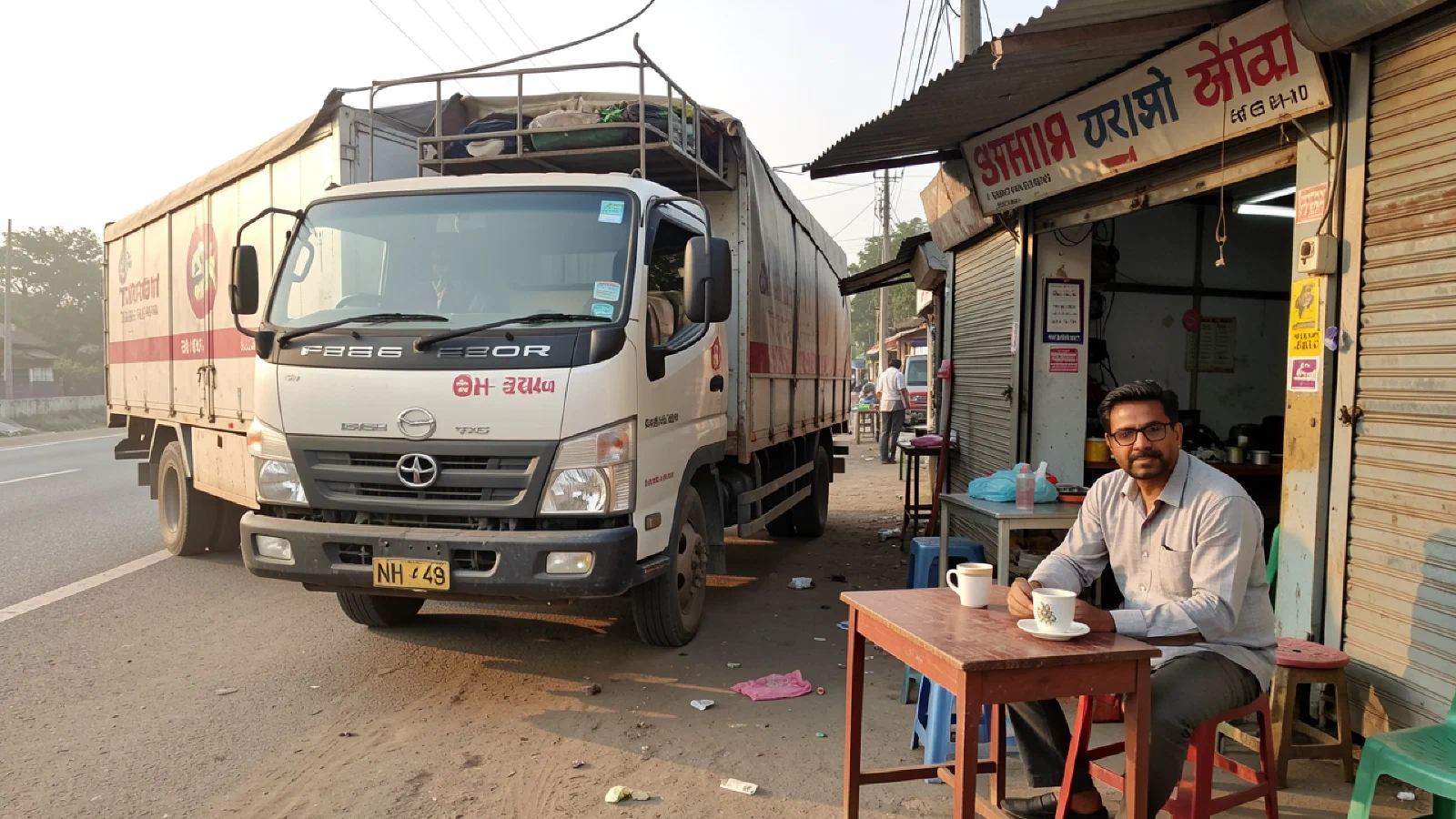
The truck driver’s name is Anand. He drives a Tata 407 between Tirupur and Chennai, a route he has been running for six years, carrying finished garments from the manufacturing cluster to the port and returning with raw materials, machine parts, and whatever else the logistics network needs moved in the other direction. He owns his truck. He maintains it himself, mostly, with help from a mechanic named Suresh who operates out of a shop on the NH48 that smells permanently of diesel and cardamom because Suresh’s wife runs a tea stall from the adjacent room.
Anand joined the cooperative four months ago. Not Venkatraman’s manufacturing cooperative from the previous essay, but the broader network that the manufacturing cooperative’s existence made possible. The AI coordination layer that Venkatraman built to connect fifty manufacturers to consumers had a logistics gap: the goods had to move, and the movement was being handled by a patchwork of transport brokers and freight agents who charged margins that the cooperative’s direct-to-consumer model was supposed to eliminate.
Venkatraman’s solution, or rather the solution that the AI system identified when given the transportation cost data, was to extend the cooperative to include the drivers. Anand now receives his assignments through the same AI layer that coordinates the manufacturing. His routes are optimized across the network’s shipping needs. His truck is loaded efficiently because the system knows what needs to go where and when. His income is higher than what the transport brokers paid, because the broker’s margin is now his.
He has not changed what he does. He drives. He has changed who he does it for. Or more precisely, he has changed the structure within which his driving creates value. He is no longer selling his labor to an intermediary. He is contributing his capability to a collective that he partially owns.
He does not use the word “collective.” He says “the network.” His wife, who manages their household finances with a precision that would impress any CFO, says the money is better and the work is steadier and she does not fully understand how the system works but she understands the deposit that arrives in their account every two weeks, which is more regular and more transparent than anything the brokers provided.
The Chain Completes#
The cotton farmer who grows the raw material. The mill that processes the fiber. The manufacturer who knits the fabric and sews the garment. The driver who moves the goods. The consumer who wears the shirt.
When Anand joined the cooperative, the chain between maker and buyer shortened by another link. The transport broker, who existed because the manufacturer did not know which drivers were available and the drivers did not know which manufacturers needed shipping, was performing an information matching function. The AI performs the matching function. The broker’s margin disappears.
Extend this further. The cotton farmer who sells to a middleman at the mandi could sell through the cooperative’s procurement layer directly. The mill that processes fiber could join the network. At each stage, the intermediary is performing an information function that the AI can perform, and the intermediary’s margin is value that could remain with the person doing the physical work.
The fully connected chain looks like this: farmer to mill to manufacturer to driver to consumer. AI coordinating across all of them. No intermediary at any stage. Each participant owns a share of the coordination layer proportional to their contribution. The value flows to the people who grow, process, make, move, and use the thing.
It is cleaner on paper than it will ever be in practice, and the distance between the paper and the practice is where the argument sharpens.
What This Is Not#
It is not communism.
Communism required the state to perform the coordination function. Central planning was the mechanism by which the state allocated resources, directed production, set prices, and distributed goods. The mechanism failed, catastrophically and repeatedly, because central planning was an information processing problem of a kind that no bureaucracy could solve. The information about what people needed, what factories could produce, what materials were available, what transportation could handle, was too distributed, too granular, too fast-changing for any central authority to collect, process, and act on in time.
The market solved this problem through price signals. Prices aggregated distributed information automatically, without requiring anyone to collect it. The butcher and the brewer and the baker coordinated through the price mechanism without any of them needing to understand the system as a whole. The market was, as Hayek argued, an information processing system that worked precisely because it was decentralized.
But the market’s solution came with a structure. The people who owned the means of production, who controlled the capital, who financed the factories and the supply chains, extracted value from the coordination they enabled. The market distributed information efficiently and distributed value unequally, and the inequality was structural rather than incidental.
AI changes the terms.
The AI coordination layer can process distributed information with the efficiency of prices and the granularity of central planning. It knows what consumers want because it processes demand signals in real time. It knows what manufacturers can produce because it tracks capacity and capability continuously. It knows what drivers can move because it optimizes routes across the network. It does what the market does, information aggregation, without the market’s structural requirement that someone own the aggregation mechanism and extract rent from it.
This is not communism because there is no state. There is no central authority directing production. The coordination is performed by a system, not a bureaucracy. The participants own the system collectively. The decisions about what to produce, how to price it, how to distribute the surplus, are made by the participants, not by a politburo.
It is not capitalism because capital does not employ labor. Labor employs capital. The AI is the capital, the coordination infrastructure that makes the enterprise possible. The workers, the farmers, the drivers, they own it. The returns flow to the people doing the work, not to the people who financed the tool.
For the first time in history, decentralized ownership and centralized coordination can coexist. The AI makes both possible at once.
Whether this is a third thing, or an unstable hybrid that collapses into one of the two things it claims to transcend, is genuinely unknown.
The Governance Problem, Again#
Fifty manufacturers agreeing on pricing. That was hard enough.
Now add the drivers. Add the cotton farmers. Add the mills. Each group has different interests, different time horizons, different relationships to risk. The manufacturer wants stable input prices. The farmer wants the highest price for cotton. The driver wants efficient routes that minimize empty running. The consumer wants the lowest price. These interests conflict, and the conflicts are not resolvable by optimization because optimization requires a single objective function and these participants have different objective functions.
In a market, prices resolve the conflict. The farmer charges what the market will bear. The manufacturer pays what the farmer charges and passes the cost forward. The price mechanism is impersonal and amoral and effective.
In a firm, management resolves the conflict. The supply chain director negotiates with suppliers, manages the logistics team, and makes trade-offs that serve the firm’s overall strategy. The resolution is hierarchical and personal and imperfect.
In the collective, who resolves the conflict?
The AI can present options. It can model the consequences of different pricing structures, allocation rules, surplus distribution formulas. It can show, with precision, what happens to each participant under each scenario. It can optimize for any objective function the collective specifies.
But specifying the objective function is the political act. It is the decision about what the collective values most: maximum income for manufacturers, maximum stability for farmers, maximum efficiency for drivers, minimum price for consumers. These cannot all be maximized at once. The choice between them is a choice about values, and values are not computable.
Mondragon solved this with elected management, worker councils, and a set of principles refined over seven decades. The principles include wage solidarity (the ratio between the highest and lowest paid member is capped), reinvestment requirements, democratic governance, and commitment to education. These principles were not derived from optimization. They were argued about, fought over, and eventually agreed upon by people who had to live with the consequences.
The Tirupur collective has no seven decades. It has Venkatraman, who is twenty-three and built the system, and Venkatraman’s mother, who understands the relationships, and Anand, who drives the truck and wants to know why his route was changed last Tuesday and whether anyone considered that the new route passes through a town where the road floods in monsoon season.
Anand’s question is the governance question in miniature. The AI optimized his route for fuel efficiency and delivery timing. It did not consider monsoon flooding because monsoon season is two months away and the optimization horizon is two weeks. A human dispatcher with local knowledge would have considered it. The AI did not, because local knowledge about seasonal road conditions in a specific town was not in the training data.
Venkatraman can add the monsoon data. He can add any data, given time. But the gap between what the AI optimizes and what the participants need is filled, in any organization, by governance: the process through which people who are affected by decisions participate in making them.
The collective has meetings. The meetings are long. They are held in a room above a warehouse in Tirupur, plastic chairs, too many people, insufficient ventilation. The manufacturers argue about order allocation. The drivers argue about route assignments. The farmers, who joined most recently, sit quietly and watch, because they are accustomed to having no voice in the systems that determine their income and they do not yet believe that this system is different.
Venkatraman facilitates. His mother translates, not between languages but between contexts: the manufacturer’s complaint about quality standards is actually about the allocation algorithm favoring units with newer equipment, and the solution is not a technical adjustment but a conversation about fairness that the manufacturer does not know how to initiate.
This is governance. It is slow, difficult, human, and irreplaceable. The AI optimizes. The humans govern. The two functions are not substitutes.
The Recursion#
There is a recursion in this model that should be named.
Venkatraman built the AI layer. Venkatraman made a thousand decisions about what to optimize, which data to include, how to weight competing objectives, what constraints to impose. Each decision was a value judgment encoded as a technical parameter. The collective did not vote on these decisions. Most of the collective does not understand them. Venkatraman made them because he was the one who could, and because the system needed to be built before it could be governed.
This means the collective’s founding constitution was written by one person. Not a constitution in the legal sense. A constitution in the deeper sense: the set of assumptions about what the system values, what it prioritizes, what it ignores. Venkatraman’s assumptions. Venkatraman’s values. Venkatraman’s blind spots.
Now imagine the model propagates. It works in Tirupur, imperfectly, and someone in Surat reads about it and builds a version for the textile industry there. Someone in Moradabad builds one for brassware. Someone in Ludhiana builds one for hosiery. Each builder makes their own thousand decisions, encoded in their own AI layer, reflecting their own values and blind spots.
Or, more likely: someone builds a template. A generalizable AI coordination layer for producer cooperatives. Configurable, deployable, scalable. The template encodes the first builder’s assumptions about governance, allocation, pricing, surplus distribution. These assumptions propagate to every cooperative that adopts the template. A thousand collectives running on one person’s values, never interrogated, operating in their most authoritative and invisible form.
One person’s instincts, frozen into a template, reproduced across a thousand collectives that never examined the assumptions underneath.
This is the injected center from The Injected Center applied to economic structure. The manufactured consensus about how collectives should operate, embedded in the AI layer, reproduced without deliberation. The coordination is decentralized. The values encoded in the coordination are not.
The antidote is governance. The slow, exhausting, human process of the people in the plastic chairs arguing about what the system should value. The antidote is Anand asking about the monsoon road. The antidote is Venkatraman’s mother translating the manufacturer’s technical complaint into a fairness conversation.
The antidote is the thing that cannot be automated.
What Is Unnamed#
This essay has described a structure that is not communism and not capitalism and that does not have a name. The absence of a name is not a rhetorical gap. It is a conceptual one. We do not have the vocabulary for an economic arrangement in which coordination is centralized and ownership is distributed, in which the means of production are owned by the people who produce, in which the market still operates but the intermediary class has been removed, in which the state is not the coordinator and the corporation is not the owner and the platform is not the landlord.
The existing vocabulary forces a choice. If the workers own the means of production, it is socialism. If the market determines prices, it is capitalism. If the coordination is centralized, it is planning. If the ownership is distributed, it is cooperation. Each label captures one dimension of the structure and misses the others.
I wonder whether the vocabulary matters. Whether the thing needs a name in order to be built, or whether naming it prematurely forces it into a category that constrains what it can become. Mondragon did not name its model before it built it. The name came later, applied by academics who needed a category for what the Basque cooperators had done. The cooperators themselves were too busy running the factories to worry about what to call the arrangement.
Venkatraman does not have a name for it either. He calls it “the network,” which is accurate and insufficient, like calling the internet “the wires.”
His mother calls it work. This is also accurate, and possibly sufficient.
The room above the warehouse. The plastic chairs. The argument about allocation. The driver who wants to know about the monsoon road. The farmer who is learning to speak in a room where speaking has consequences. The AI that coordinates everything and governs nothing.
Whatever this is, it is being built before it is being named. The naming can wait. The building cannot.
This is the seventh essay in The Coordination, a cluster within The Reimagined examining what happens to the structure of the firm when AI can perform the coordination function. The previous essays traced the one-person firm (The Solo Machine), the zero-person firm (The Empty Chair), the inverted firm (The Inverted Firm), the worker-owned factory (The Owned Factory), the direct supply chain (The Direct Chain), and the assembled workforce (The Assembled Workforce). This essay asks what happens when everyone in the production chain joins a single collective coordinated by AI, and what to call the thing that results. The essay that follows, The Government Question, asks what happens when governments enable the first movers. This essay connects to the injected center in The Injected Center, where manufactured consensus operates in its most authoritative form; to the choreographed market in The Choreographed Market, where algorithmic coordination reshapes what markets are; to the toll booth economy across The Curation Economy and The Choreographed Market; to the governance questions underlying the reimagined social contract in the Reimagined architecture; and to the Mondragon precedent that demonstrates cooperative economics can operate at scale without resolving the question of what to call it.
References#
Cooperative Economics and Alternative Ownership
Alperovitz, Gar. What Then Must We Do? Straight Talk about the Next American Revolution. Chelsea Green, 2013.
Mondragón Corporation. “Corporate Profile.” Mondragón, 2023.
Ostrom, Elinor. Governing the Commons: The Evolution of Institutions for Collective Action. Cambridge University Press, 1990.
Wright, Erik Olin. Envisioning Real Utopias. Verso, 2010.
Markets, Planning, and Information
Hayek, Friedrich A. “The Use of Knowledge in Society.” American Economic Review, vol. 35, no. 4, 1945, pp. 519-530.
Lange, Oskar. “On the Economic Theory of Socialism.” Review of Economic Studies, vol. 4, no. 1, 1936, pp. 53-71.
Morozov, Evgeny. “Digital Socialism? The Calculation Debate in the Age of Big Data.” New Left Review, no. 116/117, 2019.
Platform Cooperativism
Scholz, Trebor. Platform Cooperativism: Challenging the Corporate Sharing Economy. Rosa Luxemburg Stiftung, 2016.
Scholz, Trebor, and Nathan Schneider, editors. Ours to Hack and to Own: The Rise of Platform Cooperativism, a New Vision for the Future of Work and a Fairer Internet. OR Books, 2017.
Indian Economic Development and Public Infrastructure
Drèze, Jean, and Amartya Sen. An Uncertain Glory: India and Its Contradictions. Princeton University Press, 2013.
Kurien, Verghese. I Too Had a Dream. Roli Books, 2005.
Nilekani, Nandan, and Viral Shah. Rebooting India: Realizing a Billion Aspirations. Penguin Allen Lane, 2015.
Governance and Collective Decision-Making
Fung, Archon. “Recipes for Public Spheres: Eight Institutional Design Choices and Their Consequences.” Journal of Political Philosophy, vol. 11, no. 3, 2003, pp. 338-367.
Mansbridge, Jane J. Beyond Adversary Democracy. University of Chicago Press, 1983.
How this essay connects to others across The Approximate Mind.
- Alperovitz, Gar. What Then Must We Do? Straight Talk about the Next American Revolution. Chelsea Green, 2013.
- Mondragón Corporation. “Corporate Profile.” Mondragón, 2023.
- Ostrom, Elinor. Governing the Commons: The Evolution of Institutions for Collective Action. Cambridge University Press, 1990.
- Wright, Erik Olin. Envisioning Real Utopias. Verso, 2010.
- Hayek, Friedrich A. “The Use of Knowledge in Society.” American Economic Review, vol. 35, no. 4, 1945, pp. 519-530.
- Lange, Oskar. “On the Economic Theory of Socialism.” Review of Economic Studies, vol. 4, no. 1, 1936, pp. 53-71.
- Morozov, Evgeny. “Digital Socialism? The Calculation Debate in the Age of Big Data.” New Left Review, no. 116/117, 2019.
- Scholz, Trebor. Platform Cooperativism: Challenging the Corporate Sharing Economy. Rosa Luxemburg Stiftung, 2016.
- Scholz, Trebor, and Nathan Schneider, editors. Ours to Hack and to Own: The Rise of Platform Cooperativism, a New Vision for the Future of Work and a Fairer Internet. OR Books, 2017.
- Drèze, Jean, and Amartya Sen. An Uncertain Glory: India and Its Contradictions. Princeton University Press, 2013.
- Kurien, Verghese. I Too Had a Dream. Roli Books, 2005.
- Nilekani, Nandan, and Viral Shah. Rebooting India: Realizing a Billion Aspirations. Penguin Allen Lane, 2015.
- Fung, Archon. “Recipes for Public Spheres: Eight Institutional Design Choices and Their Consequences.” Journal of Political Philosophy, vol. 11, no. 3, 2003, pp. 338-367.
- Mansbridge, Jane J. Beyond Adversary Democracy. University of Chicago Press, 1983.