The Inverted Firm
When the Org Chart Flips
TAM-RIM.6-03 · The Reimagined, Cluster 6: The Coordination · The Approximate Mind
Dale has had eleven managers in nine years.
He works as a lineman for a regional power company in the upper Midwest, the kind of territory where winter means ice on the lines and sixteen-hour shifts and driving a bucket truck through conditions that would keep most people indoors. He has been doing this since he was twenty-three. He is thirty-two now and he can read a distribution line the way a doctor reads a patient: the sound of the transformer, the sag pattern of the conductor in different temperatures, the particular way a cross-arm shifts when the bolts are loosening. He learned this from a man named Gary who retired four years ago and who learned it from a man whose name Dale never knew.
The eleven managers were all, in Dale’s description, fine. Some better than others. A couple he liked. One he actively avoided. Most occupied a space in his working life that was functionally equivalent to weather: present, occasionally significant, mostly something to work around.
What none of them did, in nine years, was tell him anything he didn’t already know about the lines. They told him where to go. They told him what the priorities were. They told him when the overtime budget was tight and when to file the safety reports and how to code the work orders in the new system that replaced the old system that had replaced the system before that. They managed him, in the organizational sense. They did not manage the work, in the sense that mattered to the work itself.
His twelfth manager is not a person.
The company rolled out an AI coordination system eight months ago. It assigns routes based on real-time grid data, weather modeling, historical failure patterns, and crew availability. It prioritizes outages by impact severity and estimated restoration time. It tracks parts inventory across the district and pre-positions material at staging points based on predicted demand. It generates the safety documentation automatically. It handles the work order coding that used to eat an hour of every shift.
Dale’s relationship to the system is simpler than his relationship to any of his eleven human managers. He checks his assignments in the morning. The assignments are, in his experience, better than what the human dispatchers used to produce: more logical routing, better parts staging, fewer trips back to the yard for material somebody forgot. The system does not ask him how he is doing. It does not hold performance reviews. It does not make small talk in the break room. It does not remember his daughter’s name, which two of the eleven managers did.
He does not miss the small talk. He is surprised by this, but he does not.
“It doesn’t get in the way,” he says.
He pauses.
“That’s not exactly right either. It doesn’t get in the way, and also nothing gets in the way. There’s nobody between me and the work anymore.”
The Layer That Was There#
Every organization has a layer between the people who do the work and the purpose of the organization. In traditional firms, this layer is called management. Its function is coordination: translating strategic intent into operational direction, allocating resources, resolving conflicts, monitoring performance, communicating between levels. The layer exists because the organization is too large and too complex for the people doing the work to coordinate themselves.
The layer is expensive. Management salaries, benefits, office space, the time spent in meetings about meetings, the organizational politics that emerge whenever a hierarchy exists, the Peter Principle promoting people to their level of incompetence, the empire-building that turns coordination into turf. The cost is visible in the budget and invisible in the daily experience of the people managed: the directives that make no operational sense, the priorities that shift because someone above shifted theirs, the reports generated for the consumption of a layer that does not touch the work.
But the layer is not only cost. It also does things.
It resolves disputes. When two crews need the same equipment, someone decides who gets it. When a priority conflicts with a safety concern, someone weighs the trade-off. When a worker is struggling, someone is supposed to notice and intervene. The management layer carries, at least in theory, a burden of attention toward the people it manages. Not just whether the work gets done but whether the people doing it are functioning, developing, safe.
The AI coordination system does the first part well. Resource allocation, priority setting, scheduling, logistics: these are optimization problems, and optimization is what AI does. The system resolves the equipment conflict by calculating which crew’s assignment has higher grid impact. It weighs the priority-safety trade-off by referencing the safety protocols and the outage severity data. It does these things faster and more consistently than any human manager Dale has worked for.
The second part, the attention toward the people, is where the inversion gets complicated.
What Managers Actually Did#
Ask the management theorists and they will tell you that a manager’s role is leadership, development, motivation, culture. Ask the people being managed and the answers are different.
Most of what Dale’s eleven managers did, in practice, was administrative. Schedule coordination. Budget tracking. Report generation. System navigation. Policy interpretation. The hundred small bureaucratic tasks that exist not because the work requires them but because the organization requires them. The manager was the person who absorbed the organization’s administrative overhead so that the lineman could climb the pole.
AI absorbs this overhead more completely than any human manager could. The administrative function of management is an information processing function, and information processing is precisely what AI does better, faster, cheaper.
What remains after the administration is absorbed is the part that management theory calls leadership: the human dimension of managing humans. Noticing that Dale is tired. Recognizing that a newer crew member is struggling with confidence. Mediating the tension between two workers who don’t communicate well. Making the judgment call that the rulebook doesn’t cover because the situation is specific and human and requires someone present to read it.
Here is the honest accounting. Some managers did this. The two Dale liked. Most did not, because the administrative burden consumed their time and attention, because the organizational politics consumed their energy, because they were promoted for technical competence and given no tools for human leadership, because the layer itself was structured around administration and treated the human dimension as a soft skill rather than a core function.
The management layer promised attention to the people and delivered administration of the system. AI is better at the administration. Whether anyone was ever good at the attention is a harder question.
The Inversion#
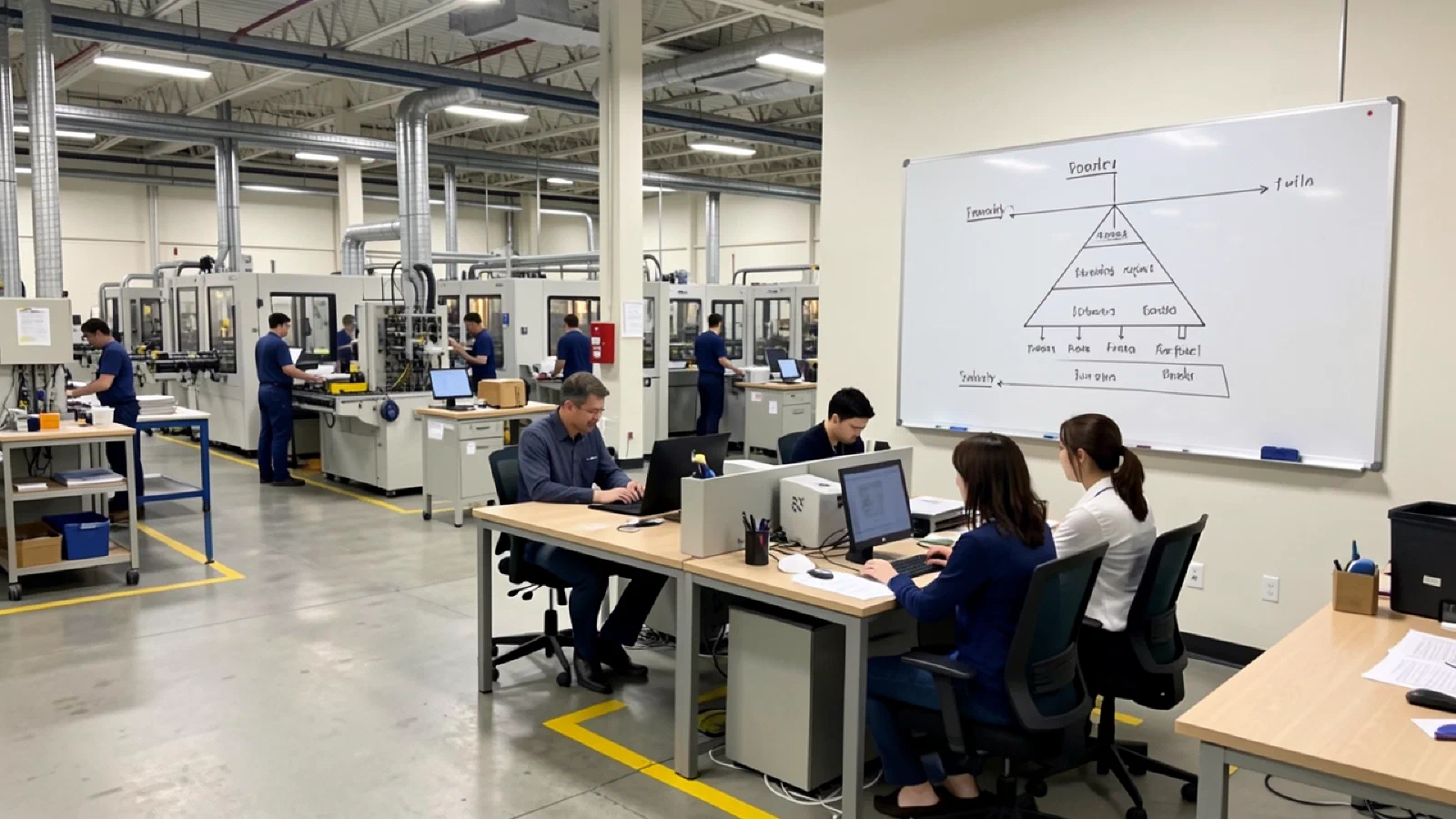
What Dale’s company has done, without using the word, is invert the organizational hierarchy. The AI sits where management sat: between the frontline and the strategic direction of the company. It receives strategic priorities from the executives, such as they are, and translates them into operational assignments. It monitors performance, allocates resources, generates reports. It does the coordination.
The humans are at the bottom, doing the physical work that AI cannot do. Climbing the poles. Reading the lines. Replacing the hardware in conditions that robots are decades from handling. The work that requires a body in a place, hands on a conductor, eyes on a cross-arm, judgment that comes from years of paying attention to physical systems under stress.
The org chart, if anyone drew it honestly, would show AI in the middle and humans at the edges. Executives at the top setting direction. AI translating direction into operations. Humans executing operations in the physical world.
This is not how the company describes it. The company describes the AI system as a “decision support tool” that “assists” the dispatch function. This language is designed to preserve the appearance of human management while the substance of management migrates to the system. The dispatcher who used to assign routes now reviews the AI’s assignments and clicks “approve.” He overrides the system perhaps twice a month, and one of those overrides is usually wrong.
The inversion is real. The language has not caught up.
What the Frontline Gains#
Dale is more productive. His routes are better. His parts are staged correctly. His paperwork is handled. He spends more of his time doing the work he was trained for and less time working around the organization that surrounds the work.
This is not a small thing.
The frustration that permeates physical work in large organizations is not about the work. It is about the obstacles between the worker and the work. The truck that doesn’t have the right parts because someone in the warehouse misread the work order. The route that sends you forty miles out of the way because the dispatcher didn’t check the road closures. The safety meeting that covers material everyone already knows because the compliance calendar says it is due. The report that takes thirty minutes to file and that no one reads.
Each obstacle is, individually, minor. Collectively, they communicate something corrosive: that the organization does not respect the worker’s time, competence, or judgment. That the worker exists to serve the system rather than the system existing to serve the work.
The AI coordination system reverses this. Not perfectly. Not by design, exactly. But by consequence. When the system optimizes for operational efficiency, the optimization incidentally removes the obstacles that the human management layer generated as a byproduct of its own functioning. The bad routes were not malicious. They were the product of a dispatcher managing too many variables with too little information. The wrong parts were not intentional. They were the product of a communication chain with too many links. The pointless meetings were not designed to waste time. They were the product of a compliance architecture that defaulted to calendar-based delivery regardless of need.
The AI doesn’t have these failure modes because it doesn’t have the structural incentives that produce them. It doesn’t protect its territory. It doesn’t fill time to justify headcount. It doesn’t default to familiar routines because change is uncomfortable. It optimizes, and the optimization, for the frontline worker, feels like respect.
Dale would not use that word. He would say it works better. But the experience of a system that works, of being in an organization where the obstacles have been removed, where the path between you and the work you know how to do is clear, that experience is closer to respect than anything his eleven human managers provided.
What the Middle Loses#
There is a man named Glenn who used to be Dale’s district supervisor. He managed four crews across a territory that covered three counties. He was good at the job in the sense that he cared about his people, knew the grid, and could make a difficult call under pressure. He was also good at the job in the sense that he could work the organization: manage up to the regional director, translate executive priorities into something his crews could work with, shield his people from the worst of the corporate directives.
Glenn’s position was eliminated seven weeks after the AI system was fully deployed. Not because he was bad at his job. Because his job was coordination, and the AI coordinated better.
He was offered a position as a “field operations analyst,” which involved reviewing the AI system’s performance and generating reports for the regional office. He took it because the alternative was severance. He sits at a desk now. He does not climb poles. He does not manage people. He analyzes data that the AI generates and writes summaries that the regional director reads in a format the AI could have produced directly.
He goes home at five. He has dinner with his wife. He has more time than he has had in fifteen years of management. He does not know what to do with it.
The inversion’s cruelty is specific: it liberates the people at the bottom and eliminates the people in the middle.
The linemen are better off. Their work is unchanged, their obstacles reduced, their time respected. The executives are unaffected. They still set strategy, still communicate with the board, still make decisions that the AI translates into operations. The Glenns, the middle managers, the district supervisors, the shift coordinators, the people whose entire professional identity was built on being the layer between, are the ones who disappear.
This is the opposite of the story everyone tells about AI and work. The dominant narrative is that AI threatens the frontline: the factory worker, the truck driver, the cashier. The management layer, the story goes, is safe because management requires human judgment, human relationships, human leadership.
The inversion says otherwise. The frontline is safe because the frontline does physical work in the physical world, and the physical world resists automation in ways that information processing does not. The management layer is vulnerable because management is coordination, and coordination is information processing, and information processing is what AI does.
The class politics of this are explosive and unspoken. The professional-managerial class, the people who went to college, who wore the badge, who managed the workers, who justified their compensation through the complexity of the coordination they performed, that class is the one AI threatens most directly. The lineman who did not go to college, who works with his hands, who was told for thirty years that his job was the vulnerable one, turns out to be the safest person in the building.
Nobody in a policy conversation is saying this. Partly because the people in policy conversations are themselves members of the professional-managerial class. Partly because the narrative of frontline displacement is so deeply embedded that it shapes perception even as the evidence accumulates in the other direction.
The Empathy Split#
Dale’s AI system does not know his daughter’s name. Two of his human managers did. One of them, a woman named Rhonda who managed his crew for eighteen months before she was promoted to the regional office, noticed when he came in one Monday looking wrecked and told him to go home, that she would cover for him with dispatch. His daughter had been in the emergency room the night before with an asthma attack. Rhonda did not know this. She just saw that Dale was not right, and she acted.
The AI system cannot do this. It does not see Dale. It sees a resource with a skill profile and an availability status.
But Rhonda was one of eleven. The other ten did not notice, or did not act, or were too consumed by the administrative overhead of the role to have the attentional bandwidth for the human dimension. The management layer promised the Rhondas and mostly delivered the others.
The empathy question splits. There is empathy as feeling what another person feels, as being present with their experience, as Rhonda was present with Dale’s exhaustion that Monday morning. AI cannot do this. There is no one there to feel anything.
Then there is empathy as behaving in ways that account for what another person feels. Scheduling flexibility. Predictable hours. Clear communication. Reasonable workload distribution. Consistent treatment regardless of who the manager likes. No retaliation. No favoritism. No decisions made in a meeting you weren’t invited to that determine whether your shift gets cut.
The AI system provides the second kind of empathy more reliably than nine of Dale’s eleven managers did. Not because it cares. Because it optimizes without ego, and ego was the thing that made most management relationships worse than they needed to be.
Dale would trade the system for Rhonda. He would not trade the system for the other ten.
I wonder how many Rhondas there were, across all the organizations, and whether the management layer’s actual rate of human attention was ever high enough to justify the layer’s cost. The honest answer might be that the layer was built for coordination and claimed credit for attention it rarely provided.
The Quiet Reversal#
There is a broader reversal happening underneath Dale’s story.
For two centuries, the direction of economic progress has been described as a movement from physical labor toward cognitive labor. The knowledge economy. The information economy. The service economy. Each stage elevated the people who worked with information and reduced the standing of the people who worked with their hands. The hierarchy was clear: thinking was more valuable than doing.
AI reverses this. Not in theory. In practice. The knowledge work is what AI absorbs first, because knowledge work is information processing. The physical work is what AI absorbs last, because the physical world is messy, unpredictable, and hostile to optimization.
The lineman climbing the pole in an ice storm is doing something that the most advanced AI system cannot replicate. The middle manager reviewing a spreadsheet is doing something that the most basic AI system can replicate today.
The hierarchy inverts. Doing becomes more valuable than thinking, or at least more scarce, which in market terms is the same thing.
This is not a comfortable conclusion for the people who built their lives and identities on the assumption that cognitive work was the apex of economic value. It is not comfortable for the educational institutions that organized themselves around producing knowledge workers. It is not comfortable for the policy thinkers who designed workforce development around “upskilling” toward cognitive tasks.
It might be the most important labor market development since industrialization, and it is happening faster than the language has adjusted.
Dale does not think about any of this. He drives his truck to the next assignment. The route is good. The parts are staged. The lines need attention.
He has his work. The work has not changed. Everything around it has.
This is the third essay in The Coordination, a cluster within The Reimagined examining what happens to the structure of the firm when AI can perform the coordination function. The first essay, The Solo Machine, traced the one-person firm and its psychology. The second, The Empty Chair, asked what happens when the last person leaves by design. This essay asks what happens when the hierarchy inverts: AI coordinating, humans executing. The essay that follows, The Owned Factory, asks what happens when a union deploys AI against management rather than against labor. This essay connects to the distillation thesis in The Gravity, where AI reveals vocational gravity by absorbing the skill scaffolding; to the dissolved middle in The Dissolved Middle, where the middle of the economic distribution compresses; to the professional-managerial class challenge in The Post-Professional Society; to the administrative burden essays (The Paperwork of Being Alive through The Three Delegations), where bureaucratic systems exhaust human capacity; and to the fade thesis in The Dissolved Boundary, where human professional presence attenuates directionally rather than collapsing.
References#
Management and the Firm
Coase, Ronald H. “The Nature of the Firm.” Economica, vol. 4, no. 16, 1937, pp. 386-405.
Drucker, Peter F. The Practice of Management. Harper and Brothers, 1954.
Mintzberg, Henry. Managing. Berrett-Koehler, 2009.
The Professional-Managerial Class
Ehrenreich, Barbara, and John Ehrenreich. “The Professional-Managerial Class.” Between Labor and Capital, edited by Pat Walker, South End Press, 1979.
Liu, Catherine. Virtue Hoarders: The Case against the Professional Managerial Class. University of Minnesota Press, 2021.
Physical Labor and Craft Knowledge
Crawford, Matthew B. Shop Class as Soulcraft: An Inquiry into the Value of Work. Penguin Press, 2009.
Sennett, Richard. The Craftsman. Yale University Press, 2008.
AI, Automation, and Labor Markets
Acemoglu, Daron, and Pascual Restrepo. “Robots and Jobs: Evidence from US Labor Markets.” Journal of Political Economy, vol. 128, no. 6, 2020, pp. 2188-2244.
Autor, David H. “Work of the Past, Work of the Future.” AEA Papers and Proceedings, vol. 109, 2019, pp. 1-32.
Susskind, Daniel. A World Without Work: Technology, Automation, and How We Should Respond. Metropolitan Books, 2020.
Organizational Psychology and Worker Experience
Graeber, David. Bullshit Jobs: A Theory. Simon and Schuster, 2018.
Herzberg, Frederick. “One More Time: How Do You Motivate Employees?” Harvard Business Review, vol. 46, no. 1, 1968, pp. 53-62.
How this essay connects to others across The Approximate Mind.
- Coase, Ronald H. “The Nature of the Firm.” Economica, vol. 4, no. 16, 1937, pp. 386-405.
- Drucker, Peter F. The Practice of Management. Harper and Brothers, 1954.
- Mintzberg, Henry. Managing. Berrett-Koehler, 2009.
- Ehrenreich, Barbara, and John Ehrenreich. “The Professional-Managerial Class.” Between Labor and Capital, edited by Pat Walker, South End Press, 1979.
- Liu, Catherine. Virtue Hoarders: The Case against the Professional Managerial Class. University of Minnesota Press, 2021.
- Crawford, Matthew B. Shop Class as Soulcraft: An Inquiry into the Value of Work. Penguin Press, 2009.
- Sennett, Richard. The Craftsman. Yale University Press, 2008.
- Acemoglu, Daron, and Pascual Restrepo. “Robots and Jobs: Evidence from US Labor Markets.” Journal of Political Economy, vol. 128, no. 6, 2020, pp. 2188-2244.
- Autor, David H. “Work of the Past, Work of the Future.” AEA Papers and Proceedings, vol. 109, 2019, pp. 1-32.
- Susskind, Daniel. A World Without Work: Technology, Automation, and How We Should Respond. Metropolitan Books, 2020.
- Graeber, David. Bullshit Jobs: A Theory. Simon and Schuster, 2018.
- Herzberg, Frederick. “One More Time: How Do You Motivate Employees?” Harvard Business Review, vol. 46, no. 1, 1968, pp. 53-62.