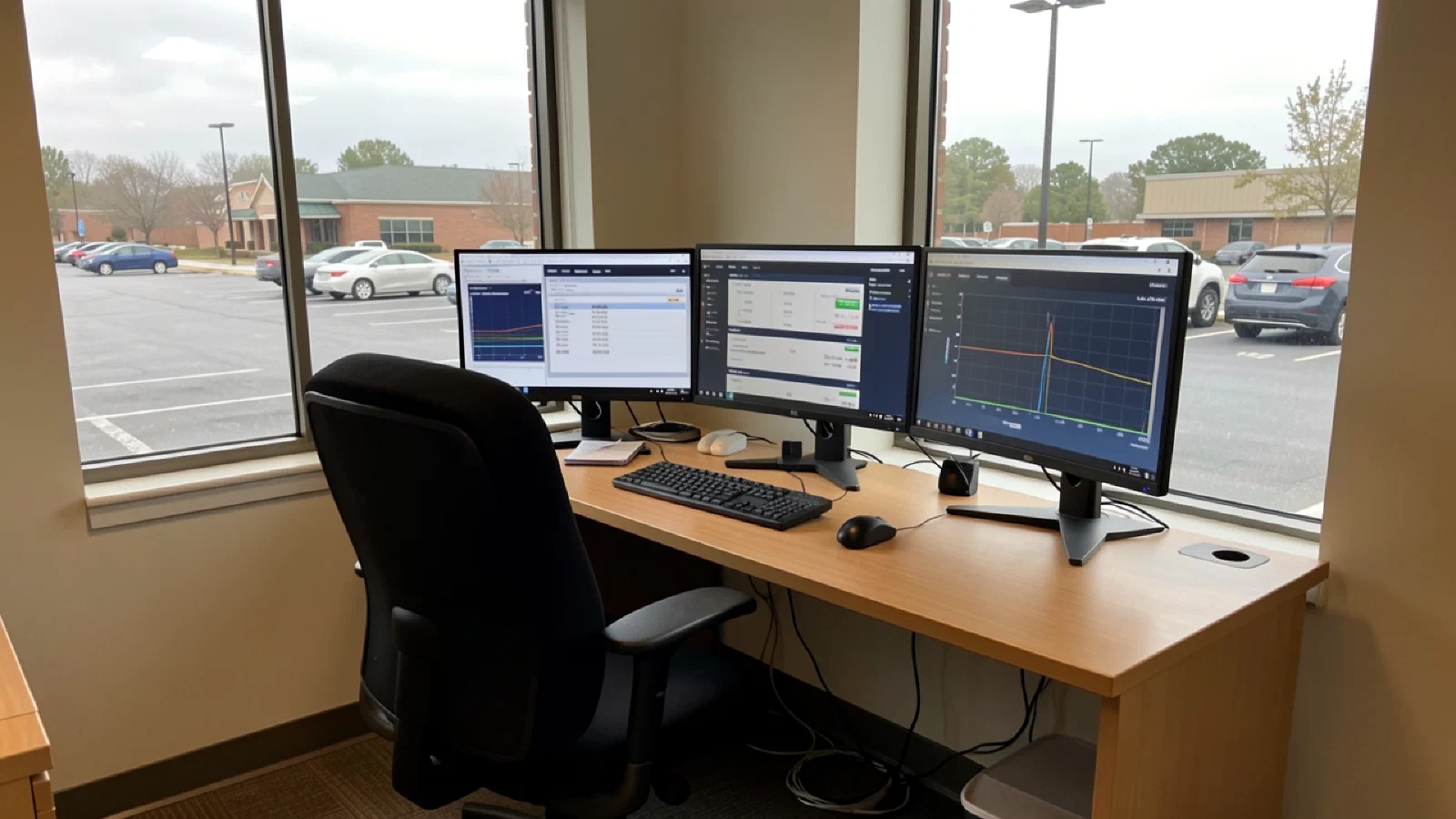
The Empty Chair
What Runs When No One Is Watching
TAM-RIM.6-02 · The Reimagined, Cluster 6: The Coordination · The Approximate Mind
There is a company in Delaware that has been operating for eleven months. It sells replacement parts for commercial kitchen equipment, sourcing from manufacturers in Guangdong and distributing to restaurant supply companies across the mid-Atlantic. It has revenue. It has customers. It has a growing reputation for fast fulfillment and accurate inventory. It processes orders, manages supplier relationships, handles invoicing, adjusts pricing dynamically based on demand signals and competitor positioning. It responds to customer inquiries within four minutes on average, which is better than most of its competitors manage with human staff.
It has no employees.
Not zero full-time employees with a founder working nights. Zero humans involved in daily operations. The entity was designed, from its first day, to operate without a person in the loop. An LLC was filed. A bank account was opened. An AI coordination layer was configured with procurement logic, fulfillment parameters, pricing constraints, and customer communication protocols. The system was pointed at a market niche that the designer had identified through six weeks of research, and then the designer stepped back.
She checks the dashboard once a week, on Sunday evenings, from the kitchen table where she also helps her son with his math homework. The dashboard shows revenue, margin, customer satisfaction scores, supplier reliability metrics. Most Sundays, there is nothing to act on. The system is running. She closes the laptop and returns to the homework.
Her name is Priya. She has a day job as a supply chain analyst for a hospital network in Philadelphia. The kitchen equipment business is, in her description, an experiment. She does not call herself its CEO. She does not call herself its founder, exactly. She designed it the way an engineer designs a machine: to operate without her.
She keeps a notebook where she records the Sunday numbers. Not because she needs to. Because the notebook is the only evidence, apart from the bank account, that the business is hers.
The Question of Presence#
The previous essay asked what happens when the team collapses to one person. Marco’s one-person firm revealed the psychological cost of solo operation: the missing peripheral vision, the absent pushback, the yo-yo of repeated launch and failure. The one person was necessary but insufficient.
The zero-person firm asks the next question: is the one person necessary at all?
If AI agents can handle procurement, fulfillment, pricing, customer service, marketing, compliance, and financial management, what exactly was Marco providing that the agents could not? He was choosing. He was caring. He was the person whose orientation gave the business its purpose and whose judgment caught the failures the agents were not configured to see.
Priya’s kitchen equipment business does not have a purpose in the way Marco’s leather goods business had a purpose. It has a function. It identifies demand, sources supply, connects the two, and captures margin. The function is executed well. Nobody involved in the transaction, not the manufacturer in Guangdong, not the restaurant supply buyer in Baltimore, knows or cares that no human is managing the operation. The parts arrive on time. The invoices are accurate. The customer service is responsive. By every metric the market uses to evaluate a business, this one is performing.
What it is not doing is caring about anything.
Not caring in the sentimental sense. Caring in the sense that no entity involved in the operation has an orientation toward the work, a reason for the business to exist beyond the margin it captures. The manufacturer cares about its own production. The buyer cares about getting the right parts at the right price. Priya cares about the experiment. But the business itself, the entity that coordinates between all of them, is indifferent to everything except the parameters it was given.
The zero-person firm performs every function of a business except the function of giving a damn.
What Morality Requires#
The zero-person firm is not going to remain a curiosity. The economics are too compelling. Priya’s kitchen equipment business has no payroll, no benefits, no management overhead, no office lease, no HR disputes, no sick days, no disgruntled employees, no organizational politics. Its cost structure is essentially fixed: the AI coordination layer, the platform fees, the transaction costs. Everything else is variable and optimized continuously.
If it works for kitchen equipment parts, it works for anything where the business is fundamentally a coordination function between supply and demand. Which is most of what the service economy does.
The question is not whether zero-person firms will proliferate. They will. The question is what happens to the moral dimension of business when the last human leaves.
Start with the easy case. Can an AI coordination layer follow rules? Yes. Compliance, regulations, contractual obligations, legal requirements, industry standards: these are codifiable constraints. A zero-person firm can be configured to comply with tax law, labor law (inapplicable when there is no labor), consumer protection regulations, environmental standards, trade restrictions. The compliance can be audited, tested, updated as regulations change. In principle, the zero-person firm can be more reliably compliant than a human-managed firm, because it does not cut corners when the quarter is short, does not fudge the numbers when the audit is unlikely, does not rationalize the small violation because everyone else is doing it.
If morality were compliance, the problem would be solved.
Morality is not compliance.
Morality, in the context of a business, includes at minimum the capacity to encounter a situation that the rules do not cover and to feel that something about it is wrong. The supplier in Guangdong is using labor practices that are legal under local law but troubling by broader standards. A competitor is struggling and a predatory pricing strategy could eliminate them from the market. A customer is ordering parts in a pattern that suggests they are reselling them in violation of a distribution agreement. A product defect has appeared that is not technically a safety issue but makes the product unreliable in ways the customer might not discover for months.
Each of these requires judgment that is not reducible to a rule. Each requires something closer to conscience: the experience of a situation as morally salient before any rule has been consulted. The human manager who sees the supplier’s labor practices and feels uneasy is not applying a compliance framework. She is responding to something in the situation that registers as wrong at a level prior to analysis.
Priya’s AI coordination layer does not have this capacity. It has the parameters Priya set, which include quality standards and supplier requirements and pricing floors. But the parameters cannot anticipate every situation that a conscience would flag. The parameters are a net, and the mesh is coarser than morality requires.
The 98 Percent Problem#
Here is the thought that is dangerous in a productive way.
What if the mesh is fine enough? Not perfectly fine. But fine enough that the zero-person firm behaves indistinguishably from a moral firm in 98 percent of the situations it encounters. The pricing stays within fair bounds. The suppliers meet reasonable standards. The products are reliable. The customer interactions are honest. The AI coordination layer, configured with sufficiently detailed constraints by a thoughtful designer, produces outcomes that a reasonable observer would call ethical.
The 2 percent is where it fails. The edge case nobody anticipated. The supplier who is technically compliant but substantively exploitative. The customer whose pattern of orders suggests something that the system cannot flag because no one imagined that specific pattern. The market condition where the optimal pricing strategy is also the predatory one, and no rule distinguishes between the two because the distinction requires contextual judgment.
In a human-managed firm, the 2 percent is where the manager’s conscience activates. Where she picks up the phone and asks the supplier a question that is not in the audit checklist. Where she decides not to pursue a pricing strategy that the numbers support but that feels wrong. Where she notices something that does not register as a metric but registers as a concern.
In the zero-person firm, the 2 percent is where nothing happens. The situation arises and resolves according to the parameters. The outcome might be fine. It might be subtly harmful. Nobody notices either way, because nobody is there to notice.
The dangerous question is not whether the AI can be moral. It is whether anyone would know if it wasn’t.
Priya checks on Sundays. The dashboard shows her revenue and margin and satisfaction scores. It does not show her the supplier’s working conditions or the competitor she is undercutting or the customer whose order pattern is unusual. These are not dashboard metrics. They are the kinds of things a person notices when they are present in the business, when the business is something they inhabit rather than something they observe from a kitchen table on Sunday evenings while their son works on fractions.
The Already Here#
The zero-person firm is not hypothetical. It is a description of what already exists in several industries, operating at scale, without the label.
Algorithmic trading operations are zero-person firms in functional terms. They execute strategies, manage risk, adjust positions, and capture value without human intervention in the operational loop. A human designed the strategy. A human monitors the performance. But the daily operation, the thing that is doing the trading, is a system that runs without a person present.
Automated dropshipping operations source products, list them, fulfill orders, handle returns, and manage customer service without a human touching any individual transaction. The human who configured the system checks the numbers periodically and adjusts the parameters when something drifts. The operation runs.
Content farms generate articles, optimize for search engines, serve advertisements, and collect revenue without a human writing or editing any individual piece. The human designed the content strategy and set the quality parameters, such as they are. The output is produced and distributed by the system.
Each of these is a zero-person firm. Each generates revenue. Each operates within the law. And each is, in a specific sense, indifferent to the consequences of its operation in ways that a human operator would not be. The algorithmic trader does not care whether its strategy destabilizes a market. The dropshipper does not care whether the product it sources is what the customer actually needed. The content farm does not care whether its output informs or misleads.
The indifference is not malicious. It is structural. There is no entity in the system that has the capacity to care. Caring is not a parameter.
What Priya Chose#
Priya designed the system with care. This matters more than it might seem.
She spent six weeks researching the market before she configured anything. She chose kitchen equipment parts because the product category is straightforward, the quality is verifiable, the customers are businesses rather than vulnerable individuals, and the supply chain is well established. She set pricing floors that prevent predatory undercutting. She set supplier standards that exceed regulatory minimums. She configured the customer service protocols to escalate anything ambiguous to her email rather than resolving it automatically.
She made, in other words, a thousand small moral decisions before the system started running. Each decision was a constraint on the optimization. Each constraint reduced the potential margin by a fraction in exchange for a behavior she wanted the system to exhibit.
The morality of the zero-person firm, such as it is, lives entirely in those pre-operational decisions. In the designer’s conscience, exercised before the system launches, frozen into parameters, and then absent from the daily operation.
This is what “morality overhead” means when applied to an AI system. Not the ongoing exercise of judgment in real time, which is what morality means for a human. But the front-loaded exercise of judgment that constrains the system’s behavior in advance, creating a moral architecture that the system executes without understanding.
The architecture is only as good as Priya’s imagination. What she anticipated, the system handles well. What she did not anticipate, the system handles according to its optimization function, which is not moral. It is efficient.
Her son finishes his homework. She glances at the dashboard one more time. Revenue is up slightly. Customer satisfaction is stable. The supplier in Guangdong has met the quality threshold on the last three shipments. Everything is running.
She closes the laptop. She does not know whether anything happened this week that her conscience would have flagged if she had been there to see it. She cannot know, because the dashboard does not have a metric for moral salience.
The Question Underneath#
The zero-person firm raises a question that the one-person firm could still defer: what is a business for?
If a business is a vehicle for generating revenue, the zero-person firm is a superior vehicle. It generates revenue with lower cost, higher consistency, and no human frailty in the operational loop.
If a business is a vehicle for creating value in the world, the question becomes: value for whom, as determined by whom? The zero-person firm creates value for its customers, who get reliable parts at competitive prices. It creates value for its designer, who collects the margin. It creates value for its suppliers, who have a reliable buyer. But it does not create value in the ways that businesses have historically created value as a side effect of their operation: employment, community presence, institutional knowledge, the development of human judgment through the practice of running something.
The traditional firm was an inefficient value-creation machine. It employed people, which cost money but also developed them. It occupied space, which cost rent but also anchored a community. It made mistakes, which cost revenue but also produced learning. It was managed by humans, which cost payroll but also meant someone was paying attention to things that metrics do not capture.
The zero-person firm is an efficient value-creation machine that produces none of these side effects. The efficiency is real. So is the absence.
I wonder whether the side effects were the point.
Whether employment was not just a cost of production but a mechanism through which society distributed participation, identity, and meaning. Whether the firm’s community presence was not just a cost of doing business but a load-bearing structure in the local social fabric. Whether human management was not just an expensive coordination mechanism but the ongoing exercise of moral attention that kept the business tethered to something beyond its own optimization.
If those side effects were incidental, the zero-person firm is an improvement. If they were constitutive, if the business was never really about the business, then what the zero-person firm optimizes away is the reason businesses existed as social institutions rather than as pure economic functions.
Priya’s kitchen equipment business works. It runs without her. It makes money. It serves its customers well. And it participates in nothing. It belongs to no community. It develops no one. It provides no employment, no identity, no sense that someone is there.
The notebook on her kitchen table is the only evidence that a human cares about what the system does. She keeps it because, she says, she likes to see the numbers in her own handwriting.
She does not say why that matters. But she keeps the notebook.
This is the second essay in The Coordination, a cluster within The Reimagined examining what happens to the structure of the firm when AI can perform the coordination function. The previous essay, The Solo Machine, traced what happens when the team collapses to one person. This essay asks what happens when the last person leaves by design. The essay that follows, The Inverted Firm, asks what happens when the hierarchy inverts: AI in the C-suite, humans on the frontline. This essay connects to the morality overhead question underlying the epistemic AI argument in The Interrogator and The Epistemic Framework; to the choreographed market in The Choreographed Market, where algorithmic coordination already performs market functions without human presence; to the quiet irrelevance in The Quiet Irrelevance, where identity dissolves when nothing requires anyone specifically; and to The Insufficient’s argument that AI operates at the empirical and actual strata but not the real.
References#
The Nature of the Firm
Coase, Ronald H. “The Nature of the Firm.” Economica, vol. 4, no. 16, 1937, pp. 386-405.
Williamson, Oliver E. The Economic Institutions of Capitalism: Firms, Markets, Relational Contracting. Free Press, 1985.
Moral Agency and Institutional Ethics
Donaldson, Thomas, and Thomas W. Dunfee. Ties That Bind: A Social Contracts Approach to Business Ethics. Harvard Business School Press, 1999.
French, Peter A. “The Corporation as a Moral Person.” American Philosophical Quarterly, vol. 16, no. 3, 1979, pp. 207-215.
Solomon, Robert C. Ethics and Excellence: Cooperation and Integrity in Business. Oxford University Press, 1992.
AI Autonomy and Alignment
Christian, Brian. The Alignment Problem: Machine Learning and Human Values. W. W. Norton, 2020.
Russell, Stuart. Human Compatible: Artificial Intelligence and the Problem of Control. Viking, 2019.
Business as Social Institution
Mayer, Colin. Prosperity: Better Business Makes the Greater Good. Oxford University Press, 2018.
Polanyi, Karl. The Great Transformation: The Political and Economic Origins of Our Time. Farrar and Rinehart, 1944.
Stout, Lynn. The Shareholder Value Myth: How Putting Shareholders First Harms Investors, Corporations, and the Public. Berrett-Koehler, 2012.
Automated and Autonomous Business Operations
Davenport, Thomas H., and Nitin Mittal. All-in on AI: How Smart Companies Win Big with Artificial Intelligence. Harvard Business Review Press, 2023.
Zuboff, Shoshana. The Age of Surveillance Capitalism: The Fight for a Human Future at the New Frontier of Power. PublicAffairs, 2019.
How this essay connects to others across The Approximate Mind.
- Coase, Ronald H. “The Nature of the Firm.” Economica, vol. 4, no. 16, 1937, pp. 386-405.
- Williamson, Oliver E. The Economic Institutions of Capitalism: Firms, Markets, Relational Contracting. Free Press, 1985.
- Donaldson, Thomas, and Thomas W. Dunfee. Ties That Bind: A Social Contracts Approach to Business Ethics. Harvard Business School Press, 1999.
- French, Peter A. “The Corporation as a Moral Person.” American Philosophical Quarterly, vol. 16, no. 3, 1979, pp. 207-215.
- Solomon, Robert C. Ethics and Excellence: Cooperation and Integrity in Business. Oxford University Press, 1992.
- Christian, Brian. The Alignment Problem: Machine Learning and Human Values. W. W. Norton, 2020.
- Russell, Stuart. Human Compatible: Artificial Intelligence and the Problem of Control. Viking, 2019.
- Mayer, Colin. Prosperity: Better Business Makes the Greater Good. Oxford University Press, 2018.
- Polanyi, Karl. The Great Transformation: The Political and Economic Origins of Our Time. Farrar and Rinehart, 1944.
- Stout, Lynn. The Shareholder Value Myth: How Putting Shareholders First Harms Investors, Corporations, and the Public. Berrett-Koehler, 2012.
- Davenport, Thomas H., and Nitin Mittal. All-in on AI: How Smart Companies Win Big with Artificial Intelligence. Harvard Business Review Press, 2023.
- Zuboff, Shoshana. The Age of Surveillance Capitalism: The Fight for a Human Future at the New Frontier of Power. PublicAffairs, 2019.