The Floor
What Happens After the Last Errand?
TAM-RIM.3-02 · The Reimagined, Cluster 3: The Commons · The Approximate Mind
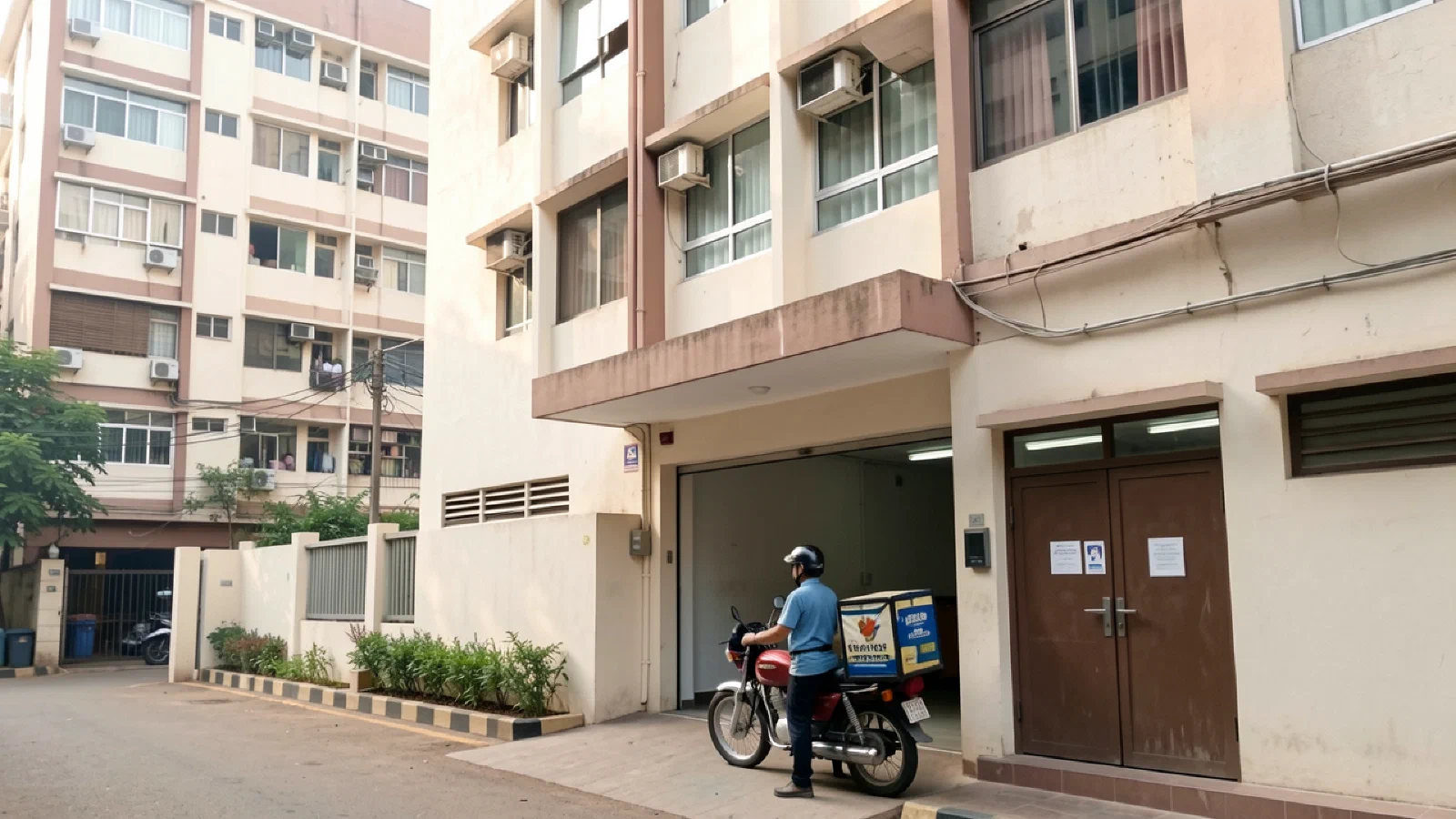
Ravi is twenty-three and he delivers things. He has delivered things since he was eighteen, when he came to Bengaluru from a village in Karnataka with a smartphone and a cousin who knew someone who knew someone at one of the platforms. He started on a bicycle. He bought a motorcycle after four months. He delivers food from cloud kitchens, groceries from dark stores, medicine from pharmacy apps, documents from businesses that still use paper. He picks up from windowless warehouses and drops off at apartment doors. He has never been inside most of the businesses he serves. They do not have insides. They are inventory systems with loading docks.
Ravi earns enough. Not enough to be comfortable but enough to send money home, to share a room with two other riders, to eat, to maintain the motorcycle. He works twelve-hour days. He does not have benefits in any formal sense. He has the platform, which tracks him, rates him, assigns him, and can remove him without explanation. He is, in the language of the gig economy, an independent contractor. In the language of his life, he is a boy from a village who found a way to exist in the city.
The drone pilot program started in Ravi’s delivery zone three months ago. He has seen them: white quadcopters with insulated compartments, launching from the rooftops of the dark stores, landing on the apartment balconies that have been retrofitted with small platforms. They are not replacing him yet. They handle the light packages, the ones under two kilograms, on routes that stay within a three-kilometer radius. Ravi still handles the heavy orders, the awkward shapes, the addresses the drones cannot reach.
He knows what is coming. Everyone knows. The riders talk about it the way workers have always talked about the machine that will replace them: with bravado, with denial, with the specific anxiety of a person who can see the future clearly and cannot do anything about it.
Within two years, the drones will handle most of what Ravi delivers. Within five, the autonomous ground vehicles will handle the rest. The last human in the commercial chain, the boy on the motorcycle who shows up at your door and hands you the bag and says nothing and rides away, will be unnecessary.
There are seven to eight million Ravis in India. The delivery economy, which barely existed fifteen years ago, absorbed a generation of young men from villages and small towns and gave them a foothold in the city. Not a career. Not a profession. A foothold: income, purpose, the daily structure of assignments and routes and drop-offs that organized the day and provided, if not meaning, at least direction. Wake up, check the app, ride to the first pickup, deliver, repeat. It is not what Ravi imagined for himself when he left the village. It is what exists.
When the drone replaces the motorcycle, what exists will not exist.
The Precedent#
India built something that most countries have not built. It is called UPI, and it is the closest thing to universal basic infrastructure that any nation has achieved.
UPI is a digital payment system. It is public, built by the government through the National Payments Corporation. It is free. No transaction fees. No subscription. No minimum balance. It is universal: the chai stall uses it, the vegetable cart uses it, the autorickshaw driver uses it, the temple donation box uses it. It is interoperable: any bank, any app, any platform, all connected through one public rail. Two billion transactions a month. In a country where half the population was unbanked a decade ago.
UPI did not wait for the market to build a payment system. The market would have built a dozen competing systems, each extracting fees, each requiring its own account, each serving the customers profitable enough to serve. The market would have built payment infrastructure the way America built payment infrastructure: fragmented, expensive, extractive, and universal only for people who already had access to the financial system.
India built it as a road. Not a product. Infrastructure. The kind of thing a country does when it decides that a capability is too fundamental to leave to the market’s incentives.
AI needs to be UPI.
Not AI as a product. Not AI as a subscription. Not AI as a service offered by four companies to the customers who can afford it. AI as public infrastructure. The health AI that manages Ravi’s medications, free, the way the road he rides on is free. The financial AI that manages his savings, free, the way UPI is free. The education AI that could develop his capabilities, free, the way the public school was free. The benefits AI that coordinates whatever safety net exists, free, interoperable, universal.
This is not a utopian proposal. UPI exists. It works. It was built by a developing country in less than a decade. The question is not whether public AI infrastructure is possible. The question is whether any government will build it, or whether AI remains a product sold by the companies that built it, at the prices the market will bear, to the people who can afford to pay.
Universal Basic Existence#
When the delivery jobs dissolve, Ravi will need a floor. Not a career. Not a new gig. A floor: the baseline below which he does not fall. Housing, food, healthcare, connectivity, and the AI infrastructure that manages all of it.
Call it universal basic existence. Not universal basic income, which is a check. UBI gives Ravi money and assumes the market will provide everything money buys. But the market that employs drones instead of Ravi is the same market that is supposed to sell him the goods and services the check pays for. The market is not designed for Ravi. The market is designed for the customer the drone serves.
Universal basic existence is different. It is the platform, not the payment. It is the room Ravi lives in, provided or subsidized. It is the food, sourced through the same logistics infrastructure that eliminated his job, delivered by the same drones, at public cost. It is the healthcare, managed by the same AI systems that manage the health of the people who can afford private plans, but available as infrastructure rather than product. It is the connectivity, the phone, the access to the AI layer that manages everything else.
It is not a good life. It is existence. The floor.
The question this essay is trying to ask is not whether the floor is sufficient. It is not. A person cannot live on a floor. A person needs walls, a ceiling, windows, a door that opens onto something. The floor is the thing that prevents the fall. It is not the thing that provides the life.
The question is: what does Ravi do on Tuesday morning when the floor is holding and there is nothing he needs to do?
The Gap Between Existence and Life#
Margaret, in the previous essay, had the commons. Clara’s coffee shop, the dollar-fifty cup, Dorothy on Saturday morning. The gathering that requires no errand, no agenda, no purpose beyond proximity. Margaret’s commons works because Margaret has a life that the commons supplements. She has a pension, a house, a granddaughter, a history in the town. The commons is where she goes to be near other people. It is not where she goes to find out who she is.
Ravi does not have this. Ravi’s identity was the job. Not in the existential sense that the professionals in The Transformed experienced, where work provided meaning and status and community. In the simpler, more brutal sense that the job was the reason he was in the city. Without it, he is a twenty-three-year-old from a village, in a room with two other young men who also used to deliver things, with a phone that manages his benefits and a day that has nothing in it.
The commons that serves Ravi is not Clara’s. Clara’s requires a community to arrive in. Ravi does not have a community. He had a network, the other riders, the platform, the daily rhythm of pickups and dropoffs. The network dissolved when the platform stopped needing riders. The other young men in his room are in the same position. They sit together, which is something. But sitting together in a room you share because none of you can afford your own room is not the commons. It is the absence of alternatives.
What Ravi needs is not a gathering place. He needs something to do.
Not a job in the old sense. The jobs are gone and they are not coming back, not for Ravi, not in the form he knew them. The economy that employed eight million delivery riders was a transitional economy, a brief window between the app and the drone, and the window has closed.
What Ravi needs is contribution. The experience of doing something that matters to someone beyond himself. The experience of being needed, not in the market sense of filling a demand, but in the human sense of providing something that would be missed if he did not provide it.
The Reimagined Contribution#
This is where the cluster converges. The commons from the previous essay, the floor from this one, and the contribution that connects them.
The commons is the place. The floor is the platform. The contribution is the activity.
We imagine something that does not have a good name yet. It is not volunteerism, because volunteerism is organized by institutions that may not exist in this form. It is not public service, because public service is organized by governments that may not have the capacity. It is not work, because work implies employment and compensation and the market’s validation of your activity’s worth.
It is closer to what the commons needs to function.
Clara’s coffee shop needs someone to maintain it. The community kitchen needs someone to cook. The elder care network needs someone to visit the people who cannot leave their rooms. The children’s formation environment needs someone to be present, to be the adult in the room, the person whose presence is the osmosis the previous cluster described. The urban garden needs someone to grow things. The repair workshop needs someone to fix things. The neighborhood needs someone to notice things: the broken step, the old woman who has not been out in three days, the child who is alone too often.
These are not jobs. They are contributions. They are things that need doing, that cannot be done by AI because they require physical human presence or human judgment or human relationship, and that provide the person doing them with the thing that universal basic existence does not provide: the experience of being useful.
The reimagined economy funds these contributions. Not at market rates, because the market does not value them. At public rates, through the same infrastructure that provides the floor. You have universal basic existence: the room, the food, the healthcare, the connectivity. You also have the option, not the requirement, to contribute to the commons, and the contribution is compensated, modestly, through public infrastructure, and the compensation is secondary to the contribution itself.
Ravi, on Tuesday morning, goes to the community kitchen in his neighborhood. He cooks. He is a good cook, which is something he discovered about himself only after the delivery job ended, because the delivery job left no time for cooking and no reason to learn. The kitchen feeds forty people, mostly elderly, mostly alone. The food is not excellent. It is adequate and it is made by a human being and it is eaten in a room with other human beings and the room is the commons and the cooking is the contribution and Ravi, who used to deliver food he never saw being made to doors he never entered, now makes the food and watches people eat it.
This is not a solution. It is a sketch. It has problems we can see and problems we cannot see. It depends on public funding at a scale that most governments have not demonstrated willingness to provide. It depends on people choosing to contribute when the floor does not require contribution. It depends on the contributions being genuine, not make-work designed to simulate purpose, because people can tell the difference between being useful and being kept busy, and being kept busy is worse than being idle.
What Worries Us#
We worry that the floor without the contribution produces despair. That universal basic existence without purpose is a warehouse for people the economy no longer needs. That the room and the food and the healthcare manage the body while the person inside the body atrophies. We have seen this. We have seen it in every community where the factory closed and the jobs left and the disability checks arrived and the opioids followed and the town did not die but stopped living.
We worry that the contribution model is paternalism dressed as participation. That telling Ravi he can cook for the elderly is a way of managing him, of keeping him busy so he does not become a problem, of performing purpose while the real economy operates without him. We worry that the distinction between genuine contribution and managed occupation is harder to maintain than we are suggesting, and that the people on the floor will feel the distinction even if the people designing the system do not.
We worry that AI as universal basic infrastructure concentrates power in whoever builds and governs the infrastructure. UPI is governed by a public corporation. It works because India built governance structures around it. AI infrastructure at the same scale would require governance at the same scale, and the governance of AI is a problem that no country has solved and most countries have not seriously attempted.
We worry most about the gap between the essay and the reality. Ravi in this essay is a character. The real Ravis are millions of young men whose daily lives will be disrupted within years, not decades, and the floor and the commons and the contribution model are ideas on a page, and the drone is already in the air.
I wonder whether the honest contribution of this essay is not the proposal but the urgency. Not “here is what to build” but “this is happening now, and the people it is happening to do not have the luxury of waiting for the proposal to mature.” The drone pilot program launched three months ago. The essay is a draft. The gap between the speed of the technology and the speed of the imagination is the gap in which millions of lives will be decided by default.
We cannot close that gap. We can name it. The naming may be the most useful thing we do, because the conversation about what replaces the delivery job has not started in earnest, and by the time it starts, the drones will have been flying for years, and Ravi will have been on the floor for long enough to know whether the floor is a platform or a ceiling.
Ravi goes to the kitchen on Tuesday morning. He cooks. The old woman at the corner table eats slowly and tells him the rice is too soft. He adjusts. She comes back on Wednesday.
Whether this is the future or a story we are telling ourselves about the future is a question we cannot answer from where we sit. But the kitchen is a real place we can build, and the old woman is a real person who is hungry, and the rice is a real thing Ravi can make. We start there. Not because we are sure. Because the starting is what we have.
This is the second essay in Cluster 3 of The Reimagined, “The Commons.” It draws on The Bypassed Road, which examined the drone and the delivery economy, and The Empty Ledger, which examined the meaning wound of lost work. It extends the previous essay’s argument about the commons by confronting the economic question underneath: when the jobs dissolve and people live on a floor of universal basic existence, the commons is not a supplement to life. It is where life happens. AI’s role is infrastructure, invisible and universal, like UPI. The human layer on top is the contribution and the gathering. The Reimagined builds on The New Work, What Remains, and The Reshaped World’s treatment of the toll-booth economy.
References#
Universal Basic Income and Post-Work Economies:
Standing, Guy. Basic Income: And How We Can Make It Happen. Pelican, 2017.
Lowrey, Annie. Give People Money: How a Universal Basic Income Would End Poverty, Revolutionize Work, and Remake the World. Crown, 2018.
Srnicek, Nick, and Alex Williams. Inventing the Future: Postcapitalism and a World Without Work. Verso, 2015.
India’s Digital Infrastructure:
Nilekani, Nandan. Imagining India: The Idea of a Renewed Nation. Penguin Press, 2009.
Nilekani, Nandan, and Viral Shah. Rebooting India: Realizing a Billion Aspirations. Penguin India, 2015.
D’Silva, Derryl, et al. “The Design of Digital Financial Infrastructure: Lessons from India.” BIS Papers, no. 106, Bank for International Settlements, 2019.
Work, Identity, and Meaning:
Graeber, David. Bullshit Jobs: A Theory. Simon and Schuster, 2018.
Crawford, Matthew B. Shop Class as Soulcraft: An Inquiry into the Value of Work. Penguin Press, 2009.
Arendt, Hannah. The Human Condition. University of Chicago Press, 1958.
Automation and Labor Displacement:
Susskind, Daniel. A World Without Work: Technology, Automation, and How We Should Respond. Metropolitan Books, 2020.
Ford, Martin. Rise of the Robots: Technology and the Threat of a Jobless Future. Basic Books, 2015.
Frey, Carl Benedikt. The Technology Trap: Capital, Labor, and Power in the Age of Automation. Princeton University Press, 2019.
Community, Contribution, and Social Purpose:
Sennett, Richard. Together: The Rituals, Pleasures, and Politics of Cooperation. Yale University Press, 2012.
Berry, Wendell. What Are People For? North Point Press, 1990.
Illich, Ivan. Tools for Conviviality. Harper and Row, 1973.
Gig Economy and Platform Labor:
Ravenelle, Alexandrea J. Hustle and Gig: Struggling and Surviving in the Sharing Economy. University of California Press, 2019.
Woodcock, Jamie, and Mark Graham. The Gig Economy: A Critical Introduction. Polity Press, 2020.
How this essay connects to others across The Approximate Mind.
- Standing, Guy. Basic Income: And How We Can Make It Happen. Pelican, 2017.
- Lowrey, Annie. Give People Money: How a Universal Basic Income Would End Poverty, Revolutionize Work, and Remake the World. Crown, 2018.
- Srnicek, Nick, and Alex Williams. Inventing the Future: Postcapitalism and a World Without Work. Verso, 2015.
- Nilekani, Nandan. Imagining India: The Idea of a Renewed Nation. Penguin Press, 2009.
- Nilekani, Nandan, and Viral Shah. Rebooting India: Realizing a Billion Aspirations. Penguin India, 2015.
- D’Silva, Derryl, et al. “The Design of Digital Financial Infrastructure: Lessons from India.” BIS Papers, no. 106, Bank for International Settlements, 2019.
- Graeber, David. Bullshit Jobs: A Theory. Simon and Schuster, 2018.
- Crawford, Matthew B. Shop Class as Soulcraft: An Inquiry into the Value of Work. Penguin Press, 2009.
- Arendt, Hannah. The Human Condition. University of Chicago Press, 1958.
- Susskind, Daniel. A World Without Work: Technology, Automation, and How We Should Respond. Metropolitan Books, 2020.
- Ford, Martin. Rise of the Robots: Technology and the Threat of a Jobless Future. Basic Books, 2015.
- Frey, Carl Benedikt. The Technology Trap: Capital, Labor, and Power in the Age of Automation. Princeton University Press, 2019.
- Sennett, Richard. Together: The Rituals, Pleasures, and Politics of Cooperation. Yale University Press, 2012.
- Berry, Wendell. What Are People For? North Point Press, 1990.
- Illich, Ivan. Tools for Conviviality. Harper and Row, 1973.
- Ravenelle, Alexandrea J. Hustle and Gig: Struggling and Surviving in the Sharing Economy. University of California Press, 2019.
- Woodcock, Jamie, and Mark Graham. The Gig Economy: A Critical Introduction. Polity Press, 2020.