The Errand
What If the Point Was Never the Errand?
TAM-RIM.3-01 · The Reimagined, Cluster 3: The Commons · The Approximate Mind
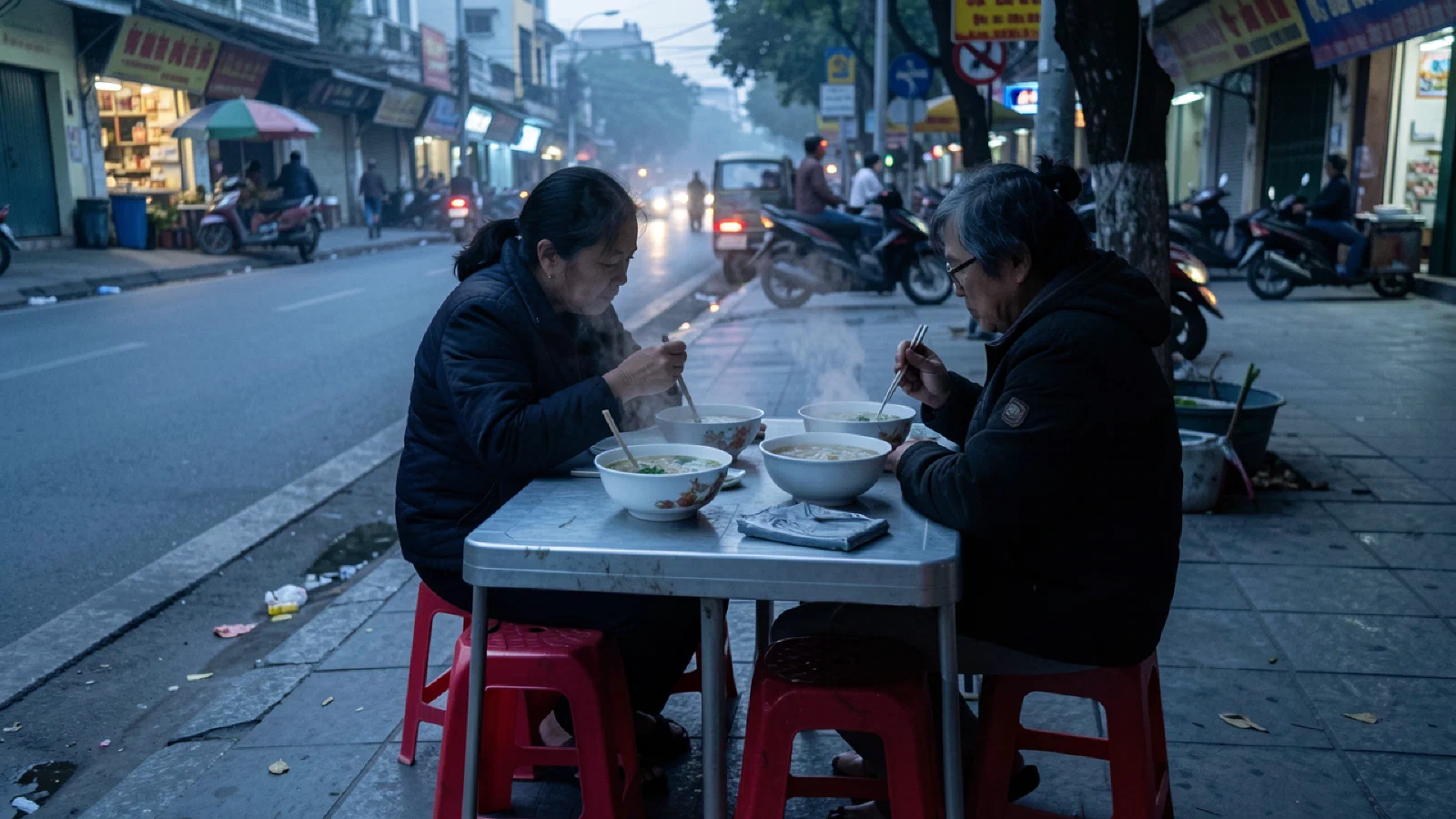
In Hanoi, at six in the morning, a woman sits on a plastic stool twelve inches off the ground and eats pho. The stool is red. The bowl is large. The woman next to her is a stranger. Their elbows are close enough to touch. They do not speak. They eat. The broth is good and the morning is cool and the sidewalk is full of people doing exactly this, sitting on tiny stools at tiny tables, eating together in the most minimal sense of together: proximate, unhurried, asking nothing of each other except the willingness to share the morning.
This costs almost nothing. The pho is less than two dollars. The stool is provided. The sidewalk is public. The interaction requires no app, no reservation, no membership, no cultural capital beyond the knowledge that this is what people do here in the morning. You show up. You sit. You eat. You leave. Nobody asks what you do for a living. Nobody is networking. The transaction is a bowl of soup. The product is an hour of being near other people, in the open air, at the start of the day.
No AI is involved. No AI needs to be involved. The morning in Hanoi has worked this way for longer than software has existed and will work this way after whatever we are building has been replaced by whatever comes next. It is a technology for human gathering that requires no technology at all. It requires a sidewalk, a cook, a stool, and the cultural knowledge that being near other people is a normal way to start the day.
Margaret, in her Midwestern town, does not have this.
Margaret has errands. She has the pharmacy where Linda the pharmacist noticed the refill pattern. She has the bank where the teller knew her fixed income. She has the grocery store where she saw the same faces in the produce section on Thursday mornings. She has the library where the librarian set aside the book about grief. These were her interaction hubs. These were where she saw people. Not because the institutions were designed for gathering. Because the errands forced her out of the house and into proximity with other human beings, and the gathering happened as a byproduct of the errand.
The errands are disappearing. The prescriptions auto-refill and arrive by mail. The bank is an app. The groceries are delivered. The library is a digital portal with a physical building that fewer people visit each month. Each of these changes is, by every measurable standard, an improvement. Margaret’s medications are managed more safely. Her banking is more convenient. Her groceries arrive without the physical effort of the trip. She has access to more books than the library ever held.
She is served, efficient, and alone.
The Waiting Room series documented this dissolution in detail: the pharmacy counter, the bank branch, the doctor’s front desk, the grocery checkout. Each institution hollowed by AI, each encounter eliminated or compressed, each byproduct lost. The diagnosis was precise: the byproduct was the point, and the point was being discarded because nobody measured it.
That diagnosis was correct. The prescription it implied was wrong.
The prescription was: keep the counter. Redesign the pharmacy so the encounter survives. Build the institution around recognition rather than transaction. Make sure Margaret still has a reason to go to the pharmacy, even when the medication no longer requires the trip.
The prescription was wrong because it was trying to preserve an accident. The pharmacy counter was never designed to be an interaction hub. It became one because Margaret had nowhere else to go. The encounter with Linda was a gift of inefficiency: the errand created the proximity, and the proximity created the encounter, and the encounter sustained the relationship. But the encounter was always a side effect. The institution’s purpose was medication. The gathering was contraband, smuggled into the transactional space because the culture had not built a space whose purpose was gathering.
A billion people in India and Vietnam could have told us this. The encounter does not need the errand. The errand was the American substitute for something the rest of the world never stopped building: the place where people go to be near other people, for no reason, at almost no cost, with no agenda.
The World That Already Knows#
In India, the institutions are disappearing faster than in America. Banks are apps. Grocery stores are dark stores, windowless warehouses optimized for delivery, with no public-facing space at all. Pharmacies are delivery platforms. City halls are portals. The institutional layer that took America two centuries to build and one decade to hollow out is being replaced in India by AI-mediated infrastructure that was never physical to begin with. A generation of Indians will grow up without ever having entered a bank branch, because bank branches were never the primary experience. The phone was.
And yet Indian social life is not dissolving. It is not dissolving because it was never organized around the institutions that are dissolving. Indian social life is organized around the chai stall, the temple, the wedding, the cricket match, the neighbor’s kitchen, the festival, the evening walk. These interaction hubs do not depend on inefficiency. They do not require an errand as the pretext. They exist because the culture built them as primary social infrastructure, not as byproducts of something else.
The chai stall is the Indian pharmacy counter, except that nobody pretends it is about the chai. Everyone knows it is about the twenty minutes of sitting with other people, talking or not talking, watching the street. The cost is almost nothing. The barrier to entry is almost nothing. The social output is enormous: information exchanged, relationships maintained, community legible to itself. The chai stall is a social technology so effective and so cheap that no AI system could improve on it, because there is nothing to optimize. It already does the one thing it needs to do, which is to create the conditions under which people are near each other.
Vietnam is the same insight at a different scale. Hanoi is a city built for proximity. The sidewalk is a living room. The café is an office. The street food stall is a dining room. The temple is a gathering place that also happens to be sacred. The entire city is organized around the assumption that people will spend significant portions of their day in shared space, at low cost, in physical proximity to other human beings. AI is arriving in Vietnam. It will change the economy, the institutions, the labor market. It will not change the sidewalk. The sidewalk does not need optimization. The sidewalk needs only to exist.
The American Gap#
America never built the sidewalk. Or rather, America built suburbs, which are the anti-sidewalk: residential landscapes organized around the car, the private yard, the garage that opens into the house so you never have to be outside. The suburb is a technology for avoiding proximity. It works brilliantly. Americans have more private space per person than any civilization in history, and less shared social space than almost any culture on earth.
The institutions filled the gap. The church. The school. The workplace. The PTA meeting. The grocery store. The pharmacy. These were the places where Americans encountered each other, and they all required an errand: worship, education, employment, volunteering, shopping, health. The errand was the permission slip. Americans needed a reason to leave the house and be near other people, because the house was designed to be sufficient and the culture was organized around self-reliance and privacy and the idea that needing other people is a weakness.
AI dissolves the errands. And Americans, who never built the interaction hub that did not require an errand, are left with the suburb and the screen.
This is not an AI problem. This is an infrastructure problem, a cultural problem, a design problem that predates AI by half a century. The suburb was built in the 1950s. The loneliness epidemic was identified in the 2010s. The errands that masked the isolation were already eroding before AI arrived: online banking, Amazon, streaming, remote work. AI completes the dissolution. It does not cause it.
But AI also provides the opening. Because here is what AI does that matters for the commons: it frees the time and eliminates the burden. Margaret no longer spends two hours on errands. Her medications are managed. Her banking is handled. Her groceries arrive. She has two hours that used to be consumed by transactions. The question is whether anything exists to fill those hours with encounter, or whether the hours are absorbed by the screen, the way every previous hour freed by technology has been absorbed by the screen.
The Reimagined Hub#
What would Margaret’s town look like if someone built the interaction hub?
Not the preserved pharmacy counter. Not the community center with the bulletin board and the folding chairs. Not the third place as described by sociology textbooks: the coffee shop that costs five dollars and caters to people who already have social capital. Something cheaper. Lower-barrier. Closer to the chai stall than to Starbucks.
We are imagining a place. It does not have a name yet. It has some features we can describe.
It is cheap. The interaction hub that costs five dollars excludes the people who most need it. Margaret on her fixed income. The young mother who cannot justify the expense. The retiree who has time but not money. The hub that works is the hub that costs a dollar, or nothing, and makes the nothing feel natural rather than charitable.
It is walkable, or close. The hub that requires a car is a hub that requires a decision, and the decision is a barrier, and the barrier will lose to the screen every time. The hub that works is close enough that going there is easier than deciding not to go.
It is unstructured. The book club, the knitting circle, the trivia night: these are valuable, but they require commitment, scheduling, a level of social intention that many people, especially lonely people, cannot sustain. The hub that works is the place you can show up to without a plan. Where being there is sufficient. Where you do not have to perform participation.
It is ambient. This is the hardest feature to describe and the most important. The hub does not demand your attention. It does not require conversation. You can sit with your coffee and read. You can watch the room. You can talk to the person next to you or not. The social contact is environmental, not transactional. You absorb it the way the child absorbs osmosis: by being near it.
It is regular. The hub that works is the one you return to. Not because you made an appointment but because it is open and you know it is open and going there on Tuesday morning is something you do the way the woman in Hanoi eats pho on Tuesday morning: not because Tuesday is special but because Tuesday exists and the stool is there.
AI is not in this room. AI is everywhere else. AI handled the errands that used to consume Margaret’s morning. AI manages her medications, her banking, her groceries, her benefits. AI freed the two hours. The hub is what the two hours are for.
The hub is the sidewalk America never built. It is the chai stall, the café, the temple step, the plastic stool on the sidewalk, translated into whatever form the American town can hold. It is not a technological solution. It is the opposite: the place where technology is absent because the human gathering does not need technology. It needs a room, a drink, a low price, and the permission to be there.
What AI Actually Does for the Commons#
AI’s contribution to the reimagined commons is not presence. It is absence.
AI handles the institutional layer so the institutional layer does not consume the human day. The dark store replaces the grocery trip. The auto-refill replaces the pharmacy visit. The app replaces the bank branch. The portal replaces city hall. Every errand eliminated by AI is time returned to the person. The question the commons asks is: returned to what?
If the time is returned to the screen, AI has completed the isolation that the suburb began. If the time is returned to the hub, AI has done something no previous technology has done: freed the human day for gathering.
This is the optimistic reading. There is a pessimistic reading that we owe the reader.
The pessimistic reading is that the screen always wins. That the freed time will be absorbed by the same force that absorbed every previous unit of freed time: entertainment, distraction, the path of least resistance. The hub requires leaving the house. The screen does not. The hub requires tolerating the presence of strangers. The screen does not. The hub is unpredictable. The screen is curated. Every incentive points toward the screen and away from the hub, and the incentives have been winning for decades, and AI does not change the incentives. It accelerates them.
We do not know which reading is right. We suspect the answer varies by culture, by community, by individual. Hanoi’s sidewalk culture survived television, survived smartphones, survived every previous technology that offered a private alternative to public life. It survived because the culture valued the sidewalk more than the alternative, because the economics of the stool and the pho are so favorable that the screen cannot compete on cost, and because the habit of gathering is transmitted from generation to generation as a norm, not as a choice.
America does not have this norm. America would have to build it. Building a norm is the hardest kind of building there is, because norms are not constructed. They emerge from repeated practice over time, and the practice requires conditions that someone, somewhere, has to create.
The reimagined hub is the condition. Whether the norm follows is a question we cannot answer. We can only build the stool and set it on the sidewalk and see who sits down.
Margaret on Saturday Morning#
It is October and Margaret’s town has something new. The old bank branch on Main Street, the one with the empty parking lot and the teller windows reduced from six to two, closed eight months ago. A woman named Clara, who used to manage the branch, leased the space. She gutted the teller windows and put in a counter that serves coffee and pastries for a dollar fifty. There are tables, mismatched, some from the library’s surplus, some donated. There are newspapers, the physical kind, because Clara noticed that the physical newspaper is an alibi: something to hold while you decide whether to talk to the person at the next table.
Clara did not call it a community center. She did not call it a third place. She called it Clara’s, because that is her name and the name is the thing. People do not go to a community center. People go to Clara’s.
Margaret goes on Saturday morning. She went the first time because Clara asked her to, and she went the second time because the coffee was cheap and the walk was short, and she has gone every Saturday since because the woman who sits at the table by the window, whose name is Dorothy, is someone Margaret has started to look forward to seeing. They do not plan to meet. They do not text each other. They are both there on Saturday morning because Saturday morning is when they go to Clara’s, and the regularity is the relationship.
Margaret still does not need to leave the house. Her medications arrive by mail. Her groceries are delivered. Her banking is automatic. Nothing in her institutional life requires the trip.
She goes because Clara’s exists, and existing is enough.
The AI is invisible. It handled everything that used to require Margaret’s morning. The medication management, the banking, the grocery logistics, the benefits coordination. It did this well. It freed her Saturday.
What it freed her Saturday for is a dollar-fifty coffee and a conversation with Dorothy about nothing in particular. About the weather and the grandchildren and the price of tomatoes and the new family that moved into the house on Elm Street.
About nothing. Which is, it turns out, everything.
I wonder whether the reimagined commons is not an institution at all. Whether it is just a room with a low price and an open door and a person behind the counter who decided that the room should exist. Whether all the architectural ambition, the designed friction, the curated encounter, the AI-mediated community space, misses the point the way the pharmacy counter missed the point: by attaching the gathering to something else, something purposeful, something measurable, when the gathering itself is the purpose and the measurement is whether Dorothy is there on Saturday.
She is. Margaret sits down. The coffee is a dollar fifty. The morning begins.
This is the first essay in Cluster 3 of The Reimagined, “The Commons.” It draws on the diagnostic foundation of The Waiting Room series architecture, which documented the dissolution of institutional encounters in small-town America, and reframes the question: not how to preserve the pharmacy counter, but what replaces the errand as the reason to gather. The essay draws on the interaction hubs that most of the world never stopped building, from Hanoi’s sidewalk stalls to India’s chai culture, and proposes that AI’s contribution to the commons is not presence but absence: the invisible infrastructure that frees the human day for gathering. The Reimagined builds on The Empty Room, The Belonging Gap, The Social Scaffold, and Digital Durkheim.
References#
Third Places and Social Infrastructure:
Oldenburg, Ray. The Great Good Place: Cafés, Coffee Shops, Bookstores, Bars, Hair Salons, and Other Hangouts at the Heart of a Community. Paragon House, 1989.
Klinenberg, Eric. Palaces for the People: How Social Infrastructure Can Help Fight Inequality, Polarization, and the Decline of Civic Life. Crown, 2018.
Café Culture and Public Life:
Habermas, Jürgen. The Structural Transformation of the Public Sphere. Translated by Thomas Burger, MIT Press, 1989.
Haine, W. Scott. The World of the Paris Café: Sociability Among the French Working Class, 1789-1914. Johns Hopkins University Press, 1996.
Ellis, Markman. The Coffee House: A Cultural History. Weidenfeld and Nicolson, 2004.
Suburban Design and Social Isolation:
Duany, Andrés, et al. Suburban Nation: The Rise of Sprawl and the Decline of the American Dream. North Point Press, 2000.
Putnam, Robert D. Bowling Alone: The Collapse and Revival of American Community. Simon and Schuster, 2000.
Jacobs, Jane. The Death and Life of Great American Cities. Random House, 1961.
Loneliness and Social Connection:
Cacioppo, John T., and William Patrick. Loneliness: Human Nature and the Need for Social Connection. W.W. Norton, 2008.
Murthy, Vivek H. Together: The Healing Power of Human Connection in a Sometimes Lonely World. Harper Wave, 2020.
Hertz, Noreena. The Lonely Century: How to Restore Human Connection in a World That’s Pulling Apart. Currency, 2021.
Indian Social Infrastructure and Digital Transformation:
Radjou, Navi, et al. Jugaad Innovation: Think Frugal, Be Flexible, Generate Breakthrough Growth. Jossey-Bass, 2012.
Nilekani, Nandan. Imagining India: The Idea of a Renewed Nation. Penguin Press, 2009.
Urban Life and Sidewalk Culture:
Gehl, Jan. Life Between Buildings: Using Public Space. Danish Architectural Press, 1971.
Whyte, William H. The Social Life of Small Urban Spaces. Project for Public Spaces, 1980.
How this essay connects to others across The Approximate Mind.
- Oldenburg, Ray. The Great Good Place: Cafés, Coffee Shops, Bookstores, Bars, Hair Salons, and Other Hangouts at the Heart of a Community. Paragon House, 1989.
- Klinenberg, Eric. Palaces for the People: How Social Infrastructure Can Help Fight Inequality, Polarization, and the Decline of Civic Life. Crown, 2018.
- Habermas, Jürgen. The Structural Transformation of the Public Sphere. Translated by Thomas Burger, MIT Press, 1989.
- Haine, W. Scott. The World of the Paris Café: Sociability Among the French Working Class, 1789-1914. Johns Hopkins University Press, 1996.
- Ellis, Markman. The Coffee House: A Cultural History. Weidenfeld and Nicolson, 2004.
- Duany, Andrés, et al. Suburban Nation: The Rise of Sprawl and the Decline of the American Dream. North Point Press, 2000.
- Putnam, Robert D. Bowling Alone: The Collapse and Revival of American Community. Simon and Schuster, 2000.
- Jacobs, Jane. The Death and Life of Great American Cities. Random House, 1961.
- Cacioppo, John T., and William Patrick. Loneliness: Human Nature and the Need for Social Connection. W.W. Norton, 2008.
- Murthy, Vivek H. Together: The Healing Power of Human Connection in a Sometimes Lonely World. Harper Wave, 2020.
- Hertz, Noreena. The Lonely Century: How to Restore Human Connection in a World That’s Pulling Apart. Currency, 2021.
- Radjou, Navi, et al. Jugaad Innovation: Think Frugal, Be Flexible, Generate Breakthrough Growth. Jossey-Bass, 2012.
- Nilekani, Nandan. Imagining India: The Idea of a Renewed Nation. Penguin Press, 2009.
- Gehl, Jan. Life Between Buildings: Using Public Space. Danish Architectural Press, 1971.
- Whyte, William H. The Social Life of Small Urban Spaces. Project for Public Spaces, 1980.