Clara's
The Building That Used to Be a Bank
TAM-RIM.3-05 · The Reimagined, Cluster 3: The Commons · The Approximate Mind
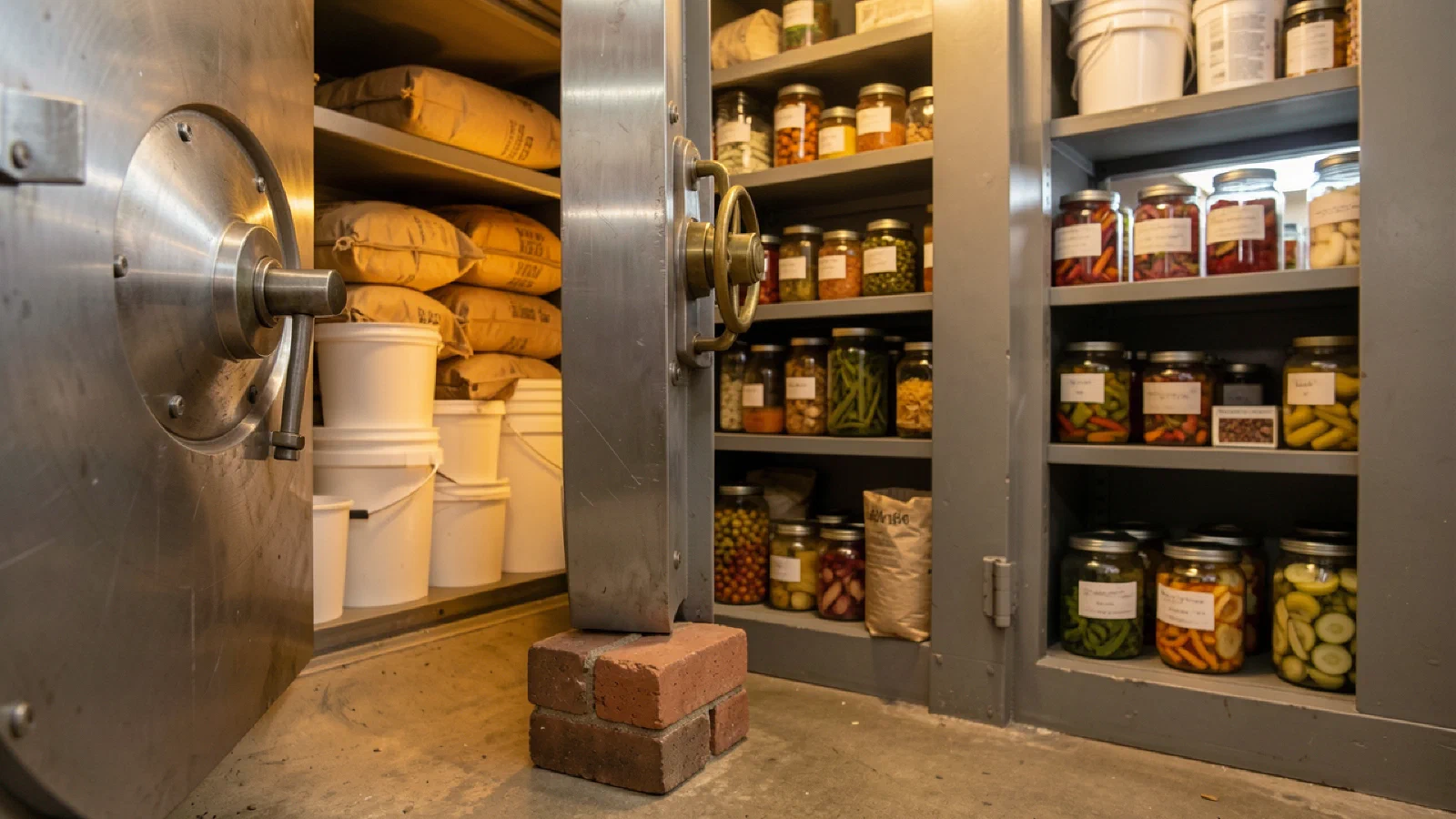
Clara opens at 6:40 because the ovens take twenty minutes and the first man is at the door at seven. She props the vault open with a brick that has been propping it open for two years. The vault holds flour now, and rice in white buckets, and a shelf of jars people have brought in and never asked for back. It is the driest room in the building and the door weighs a ton and a half, and when the flour delivery comes on the first of the month, the drone drops the sacks on the pad behind the pharmacy and Wade walks them over on a hand truck, and the safest room in town fills up with bread that has not happened yet.
Clara managed this branch for nineteen years. When the bank closed it she leased the building for less than her old parking stipend, put a counter where the teller windows were, and started selling coffee for a dollar fifty. That part of the story the town already knows. Margaret comes on Saturdays. Dorothy holds the table by the window. The newspapers are real and mostly unread and get held a great deal.
What the town does not exactly know, because it happened the way weather happens, is everything since.
Clara still balances the till every night, to the penny, though the till rarely holds two hundred dollars and nothing anywhere requires it. Nineteen years is nineteen years. She counts, she initials a slip of paper nobody will ever audit, and she puts the slip on a spindle by the vault door. The spindle is from the bank. Most things here are.
What the Slot Started#
The night-deposit slot still works. It is a steel drawer in the outside wall, and it empties into a bin behind the counter, and nobody thought about it at all until the February of the first winter, when Clara opened the bin and found a paper bag of seed packets with a rubber band around it and a note that said TOMATOES ARE THE STRIPED ONES in pencil.
She put the packets in a basket on the counter. They were gone in a week. In March the bin had more seeds, and a pair of needle-nose pliers, and a child’s winter coat, clean, folded, size 6. By June, opening the bin was part of opening the shop.
Nobody organized this. There is no sign on the slot. What goes in is what somebody had and did not need, and what comes out is whatever somebody else recognizes, and the whole arrangement runs on the fact that the slot is in the dark and the basket is in the light and no name has to travel between them. A radio came through once, broken, with masking tape on the back that said WORKS EXCEPT THE DIAL. Wade had it playing in two days. He left it on the counter for a month and then somebody took it home, and that was correct, and everyone involved understood it to be correct without discussing it.
Wade is the one who fixed the espresso machine, back at the beginning, when it died in the middle of a Saturday and he stood up from his table and asked Clara for a screwdriver the way a man asks for something he has been waiting to be asked for. He ran the maintenance line at the trailer plant for twenty-two years until the plant’s line stopped needing running. His housing letter came through in the fall, the one with the new subsidy schedule, so the room above the hardware store is covered, and the fifteenth of the month covers the rest, and what the fifteenth does not cover is the reason a man is at the door of a coffee shop at seven.
The bench came later. There were two loan desks in the back room, oak, too heavy to steal, and one afternoon Wade asked Clara if he could put a vise on one. Now the back room has the vise, a pegboard that fills by itself out of the deposit slot, and a rule that arose without being made: Thursdays. On Thursdays people bring the toaster, the box fan, the lamp with the frayed cord, and Wade and whoever is standing near Wade open it up on the loan desk where the town’s mortgages used to be explained to it. Some things get fixed. Some things become parts. A boy named Miles, who is fifteen and was underfoot all one August, is now the person you hand anything with a circuit board.
The Year It Ran#
Tuesdays became bread day the way the slot became the slot. The vault held flour because flour keeps, and the ovens were in the building because Clara bought them at the school consolidation auction for scrap price, and one Tuesday Jo, who cooked at that school for eleven years before the district closed it and bused the kids to the county seat, came in early and asked whether the ovens worked. They needed a part. It was a Thursday problem, and then it was solved, and now on Tuesdays the whole block smells like a school morning from thirty years ago, and the loaves go out at cost or at nothing, depending, and the depending is Jo’s to judge and nobody has ever appealed a judgment.
Jo runs the kitchen the way a person runs a kitchen that once fed four hundred children by 11:15: with lists, and with a contempt for waste so total it has become a form of accounting. The jars in the vault are hers. Somebody’s garden runs long, the extra comes through the slot or the front door, and in the vault it turns into January.
The fifteenth of the month has its own weather. The deposits land overnight, and the morning after is the busiest morning of the month, not because anyone is flush but because everyone is even, and even is a mood. On the fifteenth the till sometimes breaks three hundred dollars. On the twelfth and thirteenth the coffee is still a dollar fifty and some of it goes on a page Clara keeps, a page she inherited from no bank, names and hash marks, settled or not settled, and she can tell you without looking who is good for it, because knowing who is good for it was her actual profession for nineteen years and the profession did not close when the branch did. The page is the only ledger in the building that matters and it has never once balanced, and she keeps it anyway, next to the slips that always do.
Miles took the school certification test in the fall, the online one, at the counter, on Clara’s wifi, with Wade pretending to read a newspaper two tables away. He passed the written and failed the practical and was back at the bench that same Thursday, taking the failure apart on the loan desk like it was a toaster, finding the part in it that had gone. He retests in the spring. Jo has already decided what the cake will be.
The county mailed Clara a packet in the spring. Community Activation Grant, it said, eligible entity, up to eleven thousand dollars. The form wanted a programming schedule, a named activities coordinator, quarterly outcome metrics, and proof of insurance for organized events. Clara read it twice at the counter, put it under the till drawer, and balanced the till on top of it that night, to the penny. It is still there. The corner of it shows when the drawer is out.
The Chamber of Commerce storefront two doors down is also empty, also cheap, and stays empty.
January was bad. The boiler quit in the coldest week, the pipes in the back wall were four hours from bursting, and for three days the shop ran on space heaters with the vault door shut to keep the cold off the flour, and Dorothy did not come, and the men who came stood instead of sitting, in coats, and nobody said very much. Wade and Miles were in the basement most of those days with a boiler older than both of them put together, and what they could not fix they bridged, with a part that arrived, of all ways, through the slot, because Wade mentioned the model number on Tuesday and on Thursday it was in the bin, greasy, in newspaper, no note.
The heat came back on a Sunday. Dorothy came back on the Saturday after, and Margaret had kept her table.
By the second spring the teller counter’s spare sections, which had been standing against the back wall since the renovation, were out on the parking lot filled with dirt, and the striped tomatoes were in them, and it turns out a teller counter is nearly the right height for a woman of eighty to weed without kneeling, which nobody designed, in a building where nothing was designed, two years running.
The Penny#
There are nights Clara locks up late. Bread nights, mostly, when the proofing runs long and Jo will not be hurried, and the smell of tomorrow is already in the building while today is still being swept.
I have stopped arriving here with a word for what this place is, and I notice that everyone who tried one, and several people did, let it drop within a month, the way you put down a tool that is the wrong size.
On those nights Clara counts the till last. The counting takes four minutes. The amounts are small and the arithmetic is nothing and she does it anyway, every coin, and initials the slip, and spikes it on the spindle by the vault door, on top of seven hundred other slips that reconcile, to the penny, a room that no examiner is ever coming to examine.
Then she checks the brick, and leaves the vault open for the morning, and turns off the lights on the safest room in town, full of bread that has not happened yet.
This is the fifth essay in Cluster 3 of The Reimagined, “The Commons.” It inhabits the claim asserted in The Rubble and the Growth: the generative void, Yagn Adusumilli’s reframe of the Democritean void as the condition of civilizational emergence. Clara’s building first appeared in The Errand and was named as the undesigned space in The Rubble and the Growth.
References#
Undesigned Space and Social Infrastructure:
Oldenburg, Ray. The Great Good Place: Cafés, Coffee Shops, Bookstores, Bars, Hair Salons, and Other Hangouts at the Heart of a Community. Paragon House, 1989.
Klinenberg, Eric. Palaces for the People: How Social Infrastructure Can Help Fight Inequality, Polarization, and the Decline of Civic Life. Crown, 2018.
Jacobs, Jane. The Death and Life of Great American Cities. Random House, 1961.
Emergence and Improvised Order:
Solnit, Rebecca. A Paradise Built in Hell: The Extraordinary Communities That Arise in Disaster. Viking, 2009.
Scott, James C. Seeing Like a State: How Certain Schemes to Improve the Human Condition Have Failed. Yale University Press, 1998.
Hart, Keith. “Informal Income Opportunities and Urban Employment in Ghana.” Journal of Modern African Studies, vol. 11, no. 1, 1973, pp. 61-89.
Repair, Work, and the Uses of Time:
Crawford, Matthew B. Shop Class as Soulcraft: An Inquiry into the Value of Work. Penguin Press, 2009.
Illich, Ivan. Shadow Work. Marion Boyars, 1981.
How this essay connects to others across The Approximate Mind.
- Oldenburg, Ray. The Great Good Place: Cafés, Coffee Shops, Bookstores, Bars, Hair Salons, and Other Hangouts at the Heart of a Community. Paragon House, 1989.
- Klinenberg, Eric. Palaces for the People: How Social Infrastructure Can Help Fight Inequality, Polarization, and the Decline of Civic Life. Crown, 2018.
- Jacobs, Jane. The Death and Life of Great American Cities. Random House, 1961.
- Solnit, Rebecca. A Paradise Built in Hell: The Extraordinary Communities That Arise in Disaster. Viking, 2009.
- Scott, James C. Seeing Like a State: How Certain Schemes to Improve the Human Condition Have Failed. Yale University Press, 1998.
- Hart, Keith. “Informal Income Opportunities and Urban Employment in Ghana.” Journal of Modern African Studies, vol. 11, no. 1, 1973, pp. 61-89.
- Crawford, Matthew B. Shop Class as Soulcraft: An Inquiry into the Value of Work. Penguin Press, 2009.
- Illich, Ivan. Shadow Work. Marion Boyars, 1981.