The Ordinary
The most persistent thing is the Tuesday that returns after everything.
TAM-PER.11 · The Persistent · The Approximate Mind
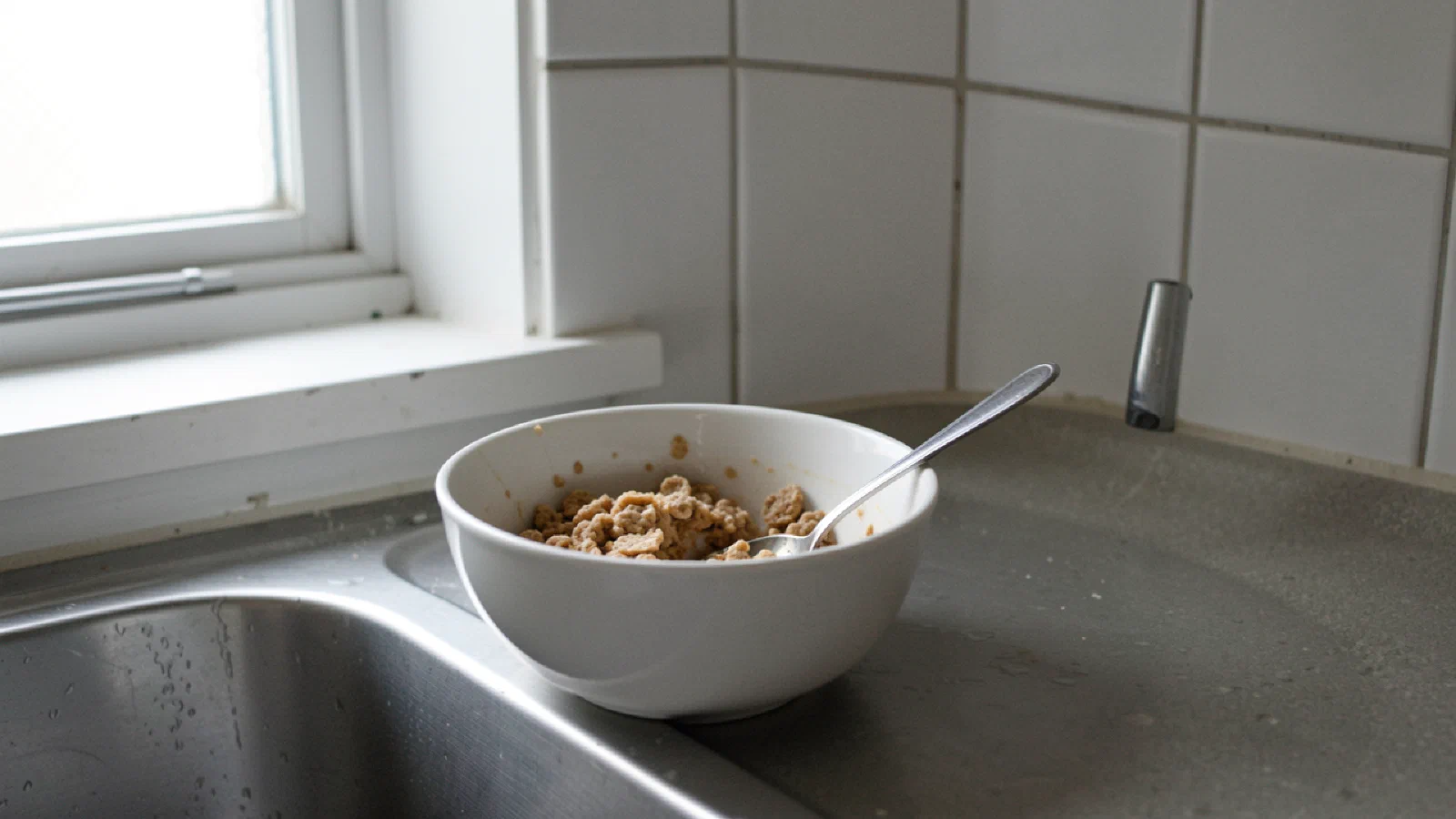
I am eating cereal over the sink.
It is a Tuesday. Nothing is happening. The cereal is the same cereal. The light through the kitchen window is the ordinary light of a morning with nowhere urgent to be. I have been writing for weeks about wars and collapse and the patterns that run through fifty thousand years of the species, and this morning the species is me, standing at a sink, eating cereal, thinking about almost nothing.
History does not record this. History records the exceptional. The battle, the invention, the movement, the day everything changed. This builds a false picture of what a human life is actually made of. For every hour the species spends in revolution, it spends ten thousand hours standing at a sink. The ordinary is not the background the events happen against. The ordinary is the foreground. The events are the interruption.
Anthropologists know this better than historians. When you study a culture, the ceremonies tell you less than the breakfasts. People perform during ceremonies. They become themselves on a Tuesday, eating the usual thing, doing the usual things, unselfconscious because nobody is watching and nothing is at stake. The mundane is where the culture actually lives, because the mundane is the only place people stop performing.
The most persistent fact about the ordinary is how fast it comes back.
Wars end and within a season people are worrying about groceries again. Revolutions conclude and the routines reassert themselves. After the disaster, the funeral, the thing that was supposed to change everything, the ordinary returns with a speed that can feel almost disrespectful, as if the catastrophe deserved a longer silence than the species is willing to give it. But the return is not disrespect. It is the deepest behavior the species has. The pull back to baseline. The morning that insists on being a morning.
AI is going to become ordinary too. Is already becoming ordinary. The questions I have spent this whole series raising are real questions, and they are not what most people will experience. Most people will experience: this is useful, or this is annoying, or this is fine. The ordinary absorbs everything eventually, and it will absorb this, not with a grand reckoning but with a shrug, with routine, with a Tuesday in which using a model to draft an email is no more remarkable than using a kettle to boil water.
We treat the ordinary as lesser. The filler between the meaningful parts. The grey stretch you get through to reach the moments that count. The species itself seems to disagree. It does not, when you watch its actual behavior, optimize for the peaks. It optimizes for the return to the ordinary. It builds the institutions and the technologies and the safety and the wealth, and what it does with all of that, mostly, is buy itself more uneventful mornings. More Tuesdays where nothing happens and that is exactly the point.
The ordinary is not what the species endures on the way to meaning. It might be the meaning. The unremarkable morning, repeated, protected, defended with everything the species builds, might be the thing all the building is for.
Somebody, right now, in the middle of whatever this era turns out to be called, is making the same breakfast they made yesterday. Not because they lack imagination. Because the sameness is the point. The morning being the same morning is the small persistent victory the species wins, over and over, against everything that would make the morning different.
I wonder whether the ordinary is what the species actually wants, underneath the claims and the wars and the building, whether all of it is finally in service of getting back to the Tuesday, to the cereal, to the morning where nothing much happens and nothing much needs to.
I finish the cereal. I rinse the bowl. Nothing has changed. The essay is over and the Tuesday continues, and I do not feel philosophical about it. I feel like a person who is done with breakfast.
References#
Braudel, Fernand. The Structures of Everyday Life: Civilization and Capitalism, 15th–18th Century. Translated by Siân Reynolds, Harper and Row, 1981.
de Certeau, Michel. The Practice of Everyday Life. Translated by Steven Rendall, University of California Press, 1984.
Highmore, Ben. Ordinary Lives: Studies in the Everyday. Routledge, 2011.
Felski, Rita. “The Invention of Everyday Life.” New Formations, no. 39, 1999, pp. 15–31.
Perec, Georges. Species of Spaces and Other Pieces. Translated by John Sturrock, Penguin, 1997.
This is the eleventh essay in The Persistent, a series by Yagn Adusumilli examining what AI cannot change about the species that built it. The Hand follows.
How this essay connects to others across The Approximate Mind.
- Braudel, Fernand. The Structures of Everyday Life: Civilization and Capitalism, 15th-18th Century. Translated by Siân Reynolds, Harper and Row, 1981.
- de Certeau, Michel. The Practice of Everyday Life. Translated by Steven Rendall, University of California Press, 1984.
- Highmore, Ben. Ordinary Lives: Studies in the Everyday. Routledge, 2011.
- Felski, Rita. “The Invention of Everyday Life.” New Formations, no. 39, 1999, pp. 15-31.
- Perec, Georges. Species of Spaces and Other Pieces. Translated by John Sturrock, Penguin, 1997.