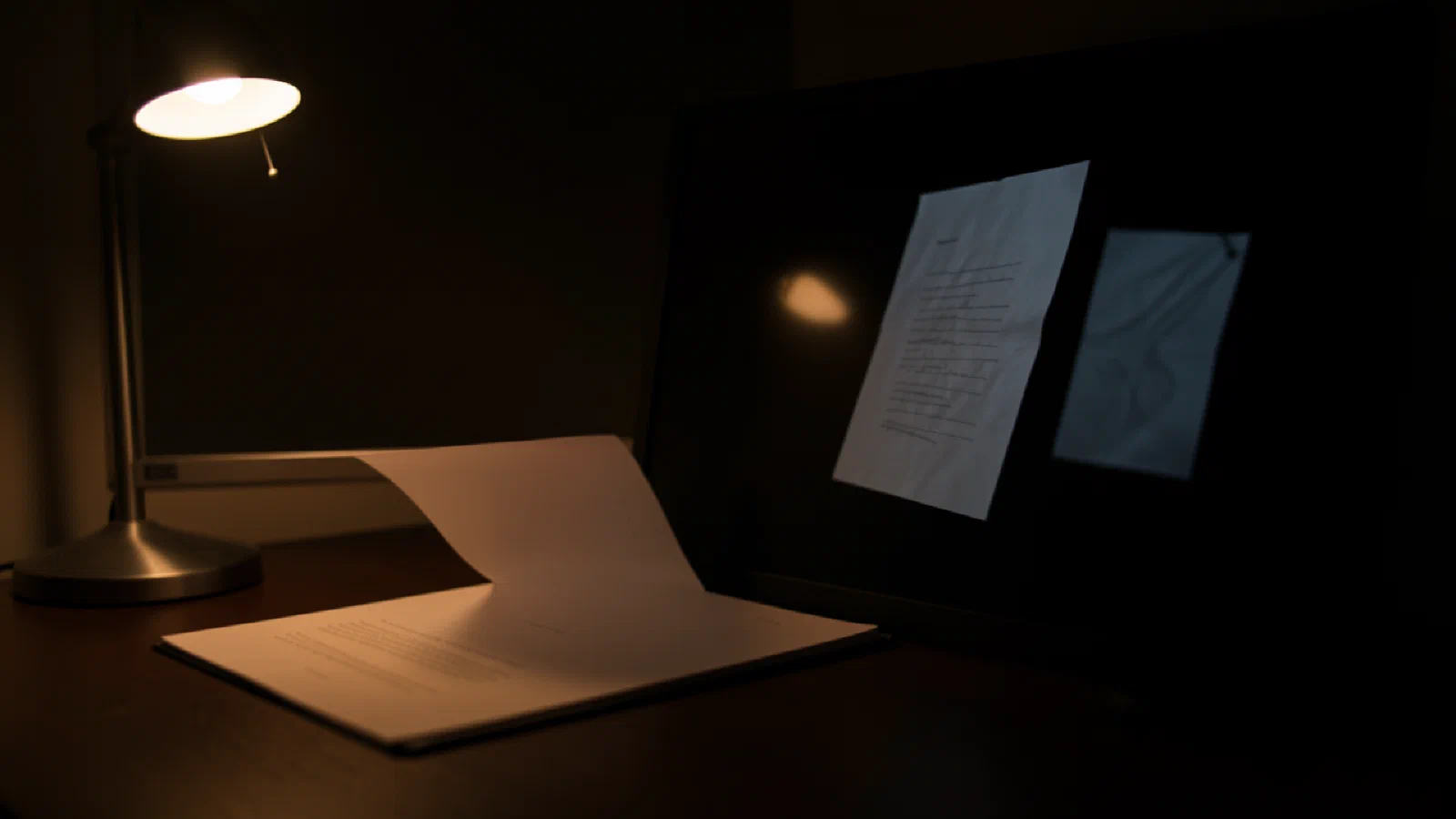
The Mirror
The pattern includes the person describing it. There is no outside to stand on.
TAM-PER.07 · The Persistent · The Approximate Mind
I caught myself doing it last week.
Writing an essay about how every generation believes it sees more clearly than the one before. Somewhere in the third paragraph I noticed I was writing it from the assumption that I saw more clearly than the generations I was describing. The argument was a trap and I had walked into it while building it. The thing I was describing was the thing I was doing.
It keeps happening.
You cannot study the species from outside the species. There is no platform. No vantage above the human pattern from which a human observes the human pattern cleanly. Every tool I use to see it, the anthropology, the language, the analysis, was made by the pattern. I am using the species’ equipment to examine the species, which makes the examination part of what is being examined.
The model has the same problem in a different shape.
People want to use AI to see ourselves objectively. To get above the bias, the distortion, the story we tell about ourselves. But the model is trained on us. It has no outside either. When it describes the pattern it does so in our terms, our categories, weighted by our record. It is not a view from nowhere. It is a very large, very fast view from exactly where we already were. The mirror does not show us from the outside. There is no outside. It just shows us, again, more of us.
I can see the Victorian making his claim about the telegraph. I can see my generation making its claim about AI. I can see they have the same structure. Seeing this does not lift me out of it. I am still inside my generation’s claim while describing its anatomy. Knowing about the pattern is not an exit. It might be the most sophisticated way of being inside it. The person who says “I know I am biased” has not stopped being biased. They have added a layer of awareness on top, and the awareness becomes its own kind of certainty.
The move my generation is proudest of is the awareness of our own conditioning. Naming our privilege, our blind spots, our complicity. It might just be the current version of believing we see more clearly than our parents. Every generation had its “we are the ones who finally understand.” Ours is “we are the ones who finally understand that we don’t fully understand.” It sounds more humble. It runs on the same engine.
The awareness is real and does some good. But if I claimed it put me outside the pattern, I would be making the exact claim the pattern produces. The only move that does not lie is the one that includes itself. The anthropologist studying the ritual is performing a ritual. The essay about the pattern is an instance of the pattern. The reader looking for the human thing is doing the human thing.
There is no clean position. There is the recursion, all the way down, and the choice about whether to pretend otherwise.
I look at my own writing on the screen. The sentence lengths. The way I end paragraphs. The moves I make when I want something to land. It follows patterns. My patterns, which are versions of older patterns, learned from people who learned them from people. I am the pattern too. The mirror includes the hand holding it up.
I wonder whether the recognition changes anything, or whether the feeling that it changes something is just the pattern keeping me comfortable inside it, letting me believe the awareness is an exit when it is only a more comfortable room.
There is no outside. I keep looking for one. The looking is the most human thing I do.
References#
Geertz, Clifford. Works and Lives: The Anthropologist as Author. Stanford University Press, 1988.
Bourdieu, Pierre. An Invitation to Reflexive Sociology. University of Chicago Press, 1992.
Nagel, Thomas. The View from Nowhere. Oxford University Press, 1986.
Hofstadter, Douglas R. Gödel, Escher, Bach: An Eternal Golden Braid. Basic Books, 1979.
Rosaldo, Renato. Culture and Truth: The Remaking of Social Analysis. Beacon Press, 1989.
This is the seventh essay in The Persistent, a series by Yagn Adusumilli examining what AI cannot change about the species that built it. The Repeat follows.
How this essay connects to others across The Approximate Mind.
- Geertz, Clifford. Works and Lives: The Anthropologist as Author. Stanford University Press, 1988.
- Bourdieu, Pierre. An Invitation to Reflexive Sociology. University of Chicago Press, 1992.
- Rosaldo, Renato. Culture and Truth: The Remaking of Social Analysis. Beacon Press, 1989.
- Nagel, Thomas. The View from Nowhere. Oxford University Press, 1986.
- Hofstadter, Douglas R. Gödel, Escher, Bach: An Eternal Golden Braid. Basic Books, 1979.