The Hand
Fifty thousand years of the same gesture.
TAM-PER.12 · The Persistent · The Approximate Mind
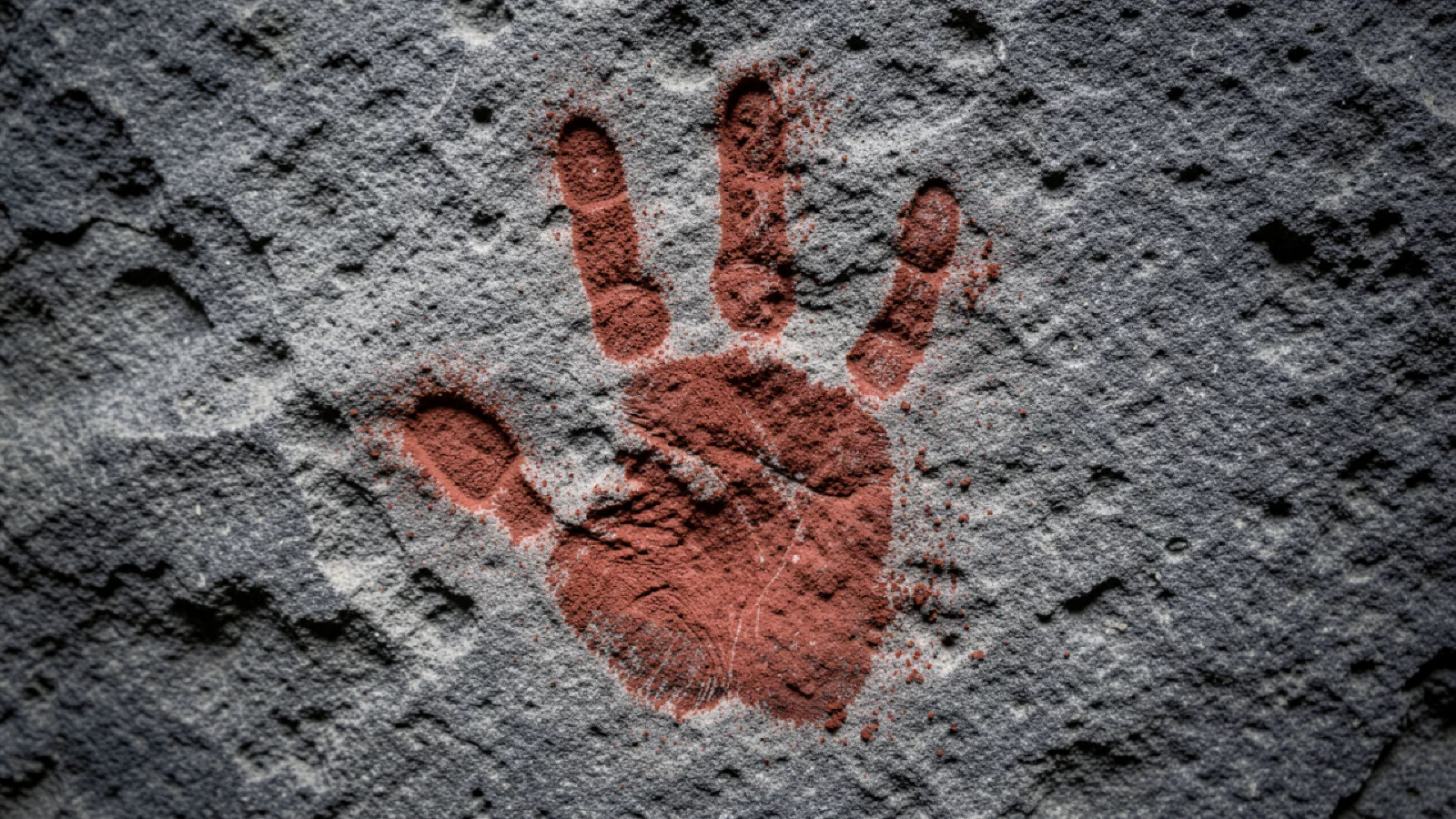
There is a hand on a cave wall in El Castillo, in northern Spain, and it has been there for around forty thousand years.
It is not a drawing of a hand. It is a hand. Someone placed their palm flat against the stone, took pigment into their mouth, and blew it around their fingers, so that when they lifted the hand away the stone kept the shape of the absence. The negative of a person. The fingers are slightly splayed. You can see where the pigment caught thicker at the edges. The stone was already ancient when the hand was pressed against it. The person who pressed it has been gone for four hundred centuries.
We do not know their name. We will never know it. The hand remains.
Before the species painted animals, before it carved figures, before it made anything we would call a picture of something, it did this. It put its hand on a wall and marked its presence. This is older than representation. It might be older than language as we would recognize it. It is the simplest possible creative act, stripped down to almost nothing: I will place myself on this surface, and the surface will hold me after I am gone.
That gesture has not stopped. Not once, anywhere, in forty thousand years.
The hand on the cave wall. The name a Roman soldier carved into a wall at the edge of the empire, bored, on watch, wanting the stone to know he had stood there. The mason’s mark cut into a cathedral block, a private signature on a stone that would be mortared into a wall where no one would ever see it, made anyway, because the maker needed the stone to carry him. The initials in the school desk. The tag sprayed on the side of a train. The username. The post. The prompt typed into a model at one in the morning by someone who could not sleep and needed to make something exist before the night was over.
The form changes constantly. The impulse does not waver at all. I am here. I was here. Let something carry that I was here.
Someone is doing it right now, with a model, while you read this. Making a poem no one asked for. Generating an image for the private pleasure of watching it appear. Writing a story alone, at night, for no audience, no payment, no requirement. They are using the newest tool the species has ever built, and the thing they are doing with it is the oldest thing the species does. The drive that moves their hand toward the keyboard is the same drive that moved the hand toward the cave wall. It picked up ochre then. It picks up the model now. It does not consult the tool before it acts. It reaches for whatever is there.
And this is the thing the model cannot do from inside itself.
The model can generate the poem. It can produce the image, write the story, make the mark in any style you name. What it cannot have is the thing underneath the mark. The hand on the cave wall means something because the hand’s owner knew, in some form, that they would not always be there. The gesture is an answer to mortality. I know I will disappear, so I will leave this, so that something of me persists past the disappearing. The model does not know it will disappear. It does not experience its own finitude. It has no night at one in the morning that it cannot sleep through, no sense of time running out that makes the marking urgent. It can reproduce the gesture perfectly. It cannot have the need that the gesture answers.
That need is not in the training data, not really. The record of the need is in the data. Every mark, every declaration, every I-was-here from forty thousand years of making. But the record of a need is not the need. The model holds the largest collection of presence-declarations ever assembled, and it holds them the way a museum holds the cave hand: completely, accurately, and from the outside. The species put the need there, in the cave, fifty thousand years before the model existed, and the species is the only thing that has it.
This is what persists.
Not the technology, which becomes the layer underneath the next technology. Not the institution, which falls and gets rebuilt on its own rubble. Not the civilization, which leaves ruins for the next one to build a city over. Not even the particular form of the mark, which goes from ochre to chisel to spray paint to electrons. What persists is the refusal to pass through the world without leaving a sign of the passage. The insistence on being known. The hand reaching for whatever surface and whatever pigment the era provides, to say the one thing the species has always needed to say, which is simply: I was here.
The series has been a list of these persistences. The claim every generation makes. The wars we said we would not fight. The extraction beneath the equity. The building we do knowing it will fall. The expression that never stops. The record that holds all of us. The mirror with no outside. The repeat. The adaptation. The contradiction we carry. The ordinary that returns. And underneath every one of them, this. The hand. The gesture that came before all the others and will outlast all the tools, because it is not a thing the species does. It is the species, doing the one thing that makes it the species.
The model learned the gesture from us. It can show it back to us at a scale and speed no cave painter could imagine. It cannot originate the need, because the need belongs to beings who know they are temporary, and the model does not know that it is anything at all.
I wonder what the people of some far era will make of us, whether they will dig through our data the way we dig through caves, and whether they will find, under the algorithms and the markets and the wars, the same thing we find under everything older than us: the evidence that someone was here, that they made something, that it did not need to exist, and that they made it anyway so the stone would remember.
The hand is still on the wall at El Castillo. The pigment held. The person is forty thousand years gone and their hand is still saying the only thing it ever said.
Somewhere a cursor is blinking. Someone is about to make something. The wall is new. The pigment is light. The hand is the same hand it has always been.
References#
Pike, A. W. G., et al. “U-Series Dating of Paleolithic Art in 11 Caves in Spain.” Science, vol. 336, no. 6087, 2012, pp. 1409–1413.
Lewis-Williams, David. The Mind in the Cave: Consciousness and the Origins of Art. Thames and Hudson, 2002.
Gell, Alfred. Art and Agency: An Anthropological Theory. Clarendon Press, 1998.
Becker, Ernest. The Denial of Death. Free Press, 1973.
Hyde, Lewis. The Gift: Imagination and the Erotic Life of Property. Vintage, 1983.
Dissanayake, Ellen. Homo Aestheticus: Where Art Comes From and Why. Free Press, 1992.
This is the twelfth and final essay in The Persistent, a series by Yagn Adusumilli examining what AI cannot change about the species that built it.
How this essay connects to others across The Approximate Mind.
- Pike, A. W. G., et al. “U-Series Dating of Paleolithic Art in 11 Caves in Spain.” Science, vol. 336, no. 6087, 2012, pp. 1409-1413.
- Lewis-Williams, David. The Mind in the Cave: Consciousness and the Origins of Art. Thames and Hudson, 2002.
- Gell, Alfred. Art and Agency: An Anthropological Theory. Clarendon Press, 1998.
- Hyde, Lewis. The Gift: Imagination and the Erotic Life of Property. Vintage, 1983.
- Dissanayake, Ellen. Homo Aestheticus: Where Art Comes From and Why. Free Press, 1992.
- Becker, Ernest. The Denial of Death. Free Press, 1973.