The Optimized Nation
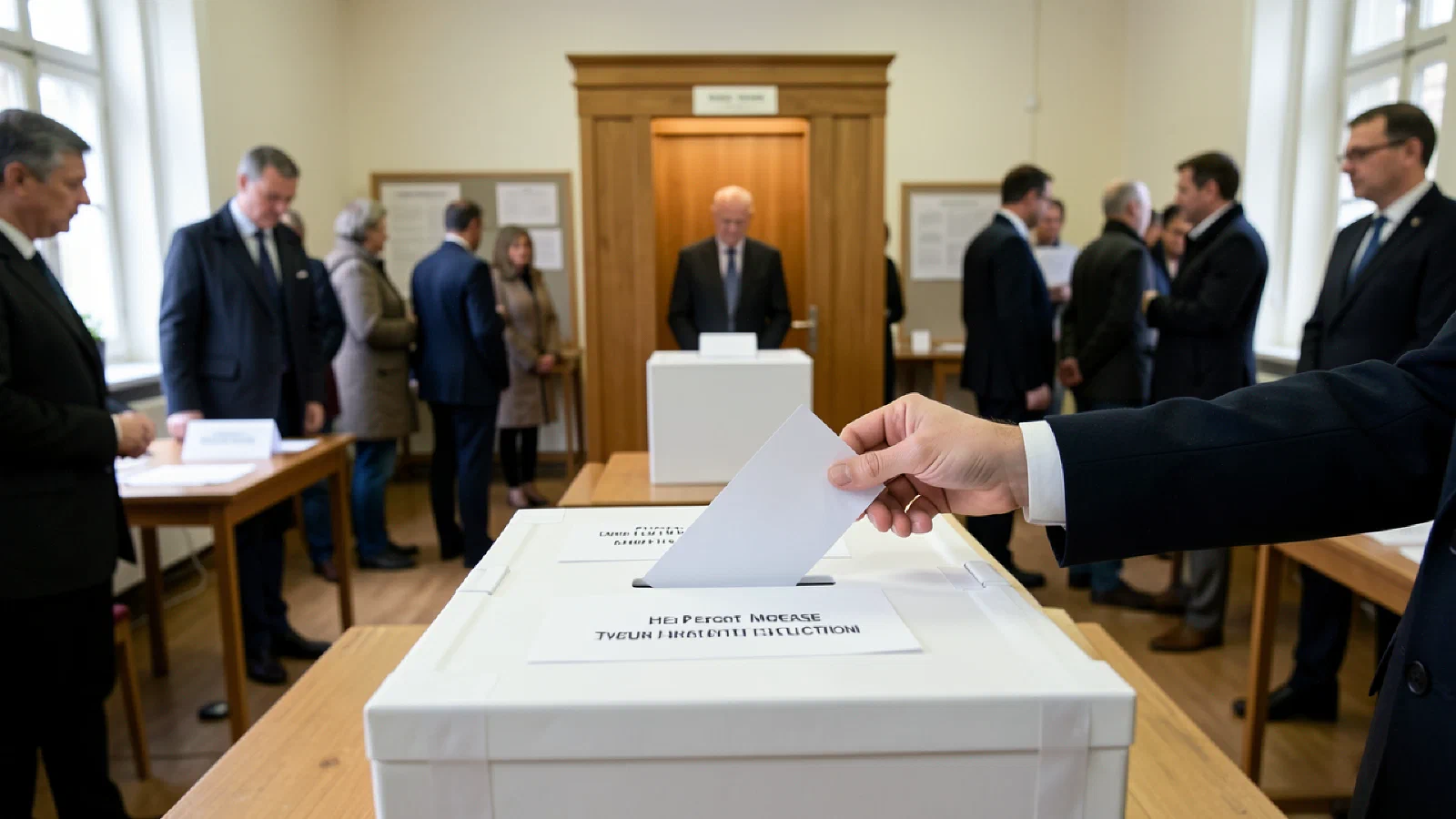
The election is the most watched event in the country’s history. Voter turnout exceeds ninety percent. The debates are ferocious, personal, tribal. Social media is saturated with position statements, attack campaigns, grassroots movements, passionate defenses of values and identity and belonging. The country has not been this politically engaged in a generation.
The winner will choose between a twelve percent increase in the cultural enrichment allocation and a nine percent increase with better healthcare optimization.
That is the scope of the decision. Everything else, the parameters that shape UBINT’s operation, the governance of autonomous systems, the frontier AI development priorities, the defense posture, the trade architecture, is decided elsewhere, by people whose names do not appear on the ballot.
The Loudest Irrelevance#
Democracy did not become quiet and ceremonial. That was the prediction, and it was wrong. Democracy became loud. Louder than it has ever been. The less the vote controls, the more the vote means, emotionally, tribally, as performance of identity.
When there is nothing substantive to decide, everything becomes symbolic. The candidate’s position on cultural enrichment allocation is not a fiscal policy. It is a statement about what kind of nation this is, who belongs, what matters, whose vision of the good life deserves endorsement. The debates are not about numbers. They are about values, and values are the territory where humans fight hardest because values are the territory where optimization has no authority.
The system optimizes provision. It does not optimize meaning. And meaning is what the political arena has been left with after everything operational has been removed from its jurisdiction.
The less a democracy controls, the more passionately its citizens participate. The passion is real. The control is not.
Turnout in the old democracies, the ones that governed economies and commanded armies, rarely exceeded sixty percent. Turnout in the optimized democracies exceeds ninety. The inversion is not paradoxical once you see the mechanism. When your vote might cost you something, you weigh it. When your vote costs nothing and changes nothing structural, it becomes pure expression. Voting becomes free. And free things get consumed enthusiastically.
The Invisible Governance#
The actual decisions happen in rooms the electorate does not know exist.
Not secret rooms. Not conspiracies. Governance board sessions, parameter review meetings, frontier coordination forums. They are technically public. The minutes are available. No one reads them because the language is technical, the implications are opaque, and the decisions require a depth of context that no citizen engaged in the cultural enrichment debate has any reason to acquire.
A parameter adjustment in UBINT’s healthcare module that shifts diagnostic thresholds for a class of autoimmune conditions affects forty million people. The adjustment is made by a board of eleven humans reviewing recommendations generated by systems that processed more clinical data than any human could evaluate in a lifetime. The board deliberates for three hours. The adjustment is implemented. No one votes on it. No one campaigns on it. No one holds a rally about autoimmune diagnostic thresholds.
This is not corruption. It is competence. The eleven people on that board are qualified. The decision is better than any decision a democratic process would produce, because democratic processes are designed for value judgments, not technical calibrations. The board makes the right call. The electorate makes the symbolic call. Both calls are real. One of them runs the country.
The Defense Question#
Nations still compete. This is the part that optimization theorists consistently underestimate, because they model nations as closed systems optimizing for internal welfare. Nations are not closed systems. They exist in relation to other nations, and the relation is competitive.
The competition has shifted. It is no longer primarily about territory, trade routes, or natural resources, though those still matter at the margins. It is about computational infrastructure. AI capability. The capacity to run frontier systems that set the parameters for everything else. A nation whose frontier AI is more capable than its neighbor’s frontier AI can set terms. Not military terms, usually. Governance terms. Economic terms. The architecture of the coordination layer that sits above UBINT and manages planetary-scale problems.
Defense spending has not decreased. It has restructured. The money flows toward AI research, cybersecurity, autonomous systems, and the infrastructure that supports them. Soldiers are fewer. The spending is higher. The kept population, comfortable in their UBINT-provided lives, wave flags and support the troops and have no meaningful input into the defense posture their nation maintains, because the defense posture is a frontier decision made by relevant humans in coordination with autonomous strategic systems.
The flag-waving is genuine. The patriotism is genuine. The emotion is real. The influence is zero.
Where the Lobbying Went#
Lobbying did not die because we decided it was irrelevant. Lobbying moved.
In the old democracies, lobbying targeted legislators, regulators, elected officials. The targets were visible. The process was documented, however imperfectly. Journalists covered it. Citizens could, in principle, know who was lobbying whom for what.
In the optimized nation, the decisions that matter are made by governance boards, parameter-setting committees, frontier coordination bodies. These are the new targets. The frontier AI companies that want favorable parameter settings in UBINT lobby the boards that set the parameters. The relevant humans who want influence over the coordination layer lobby the forums where coordination architecture is designed. The lobbying is sophisticated, technical, invisible to anyone not operating at that level.
The kept population’s elected officials still receive lobbyists. The lobbyists are polite. The officials are receptive. The resulting policy adjustments affect the margin of the cultural enrichment allocation. The real lobbying happens three layers above, in rooms where the language is too technical for the adjustment to be legible as lobbying at all.
The lobbying did not become less corrupt. It became less visible. Invisible corruption is more durable than visible corruption, because visible corruption generates opposition and invisible corruption generates nothing.
The Two Conflicts#
The optimized nation has conflict. More conflict than ever, if you measure by volume, intensity, emotional engagement. But the conflict has bifurcated.
The kept population fights about identity, values, cultural recognition, symbolic representation, the meaning of the nation, the character of the good life. These fights are genuine. The emotions are real. The stakes, as experienced by the participants, are enormous. People organize, protest, argue, form movements, break friendships, build coalitions. The political life of the kept population is vibrant.
It is also contained. The fights occur within the space that optimization has left for them: the space of meaning, identity, and symbolic choice. They do not cross into the space of structural power, because structural power is exercised through mechanisms the fights cannot reach.
The relevant humans also have conflict. Fierce conflict. Competing visions for frontier development priorities. Disagreements about UBINT parameters that affect billions of lives. Geopolitical tensions between national governance structures. Personal rivalries. Institutional power struggles. The conflict is quiet, consequential, and invisible to the kept population.
Two conflicts. One loud and visible and contained. One quiet and invisible and determinative. The optimized nation holds both, and the wall between them is not enforced by censorship or suppression. It is enforced by complexity. The kept population could, in principle, engage with the structural decisions. They would need to understand autonomous system architecture, frontier AI governance, planetary coordination theory, and computational game theory. The barrier is not access. It is expertise. And expertise in these domains requires a lifetime of engagement that the optimized life does not incentivize.
What Holds It Together#
The nation persists. Despite the hollowed democracy, despite the invisible governance, despite the bifurcated conflict. It persists because UBINT provides a shared infrastructure that functions as a national identity in the absence of shared purpose.
The roads work. The healthcare works. The education works. The companion layer speaks the national language and carries the national cultural context. The provision has a national flavor, and the flavor is real even if the substance is universal. French UBINT and Japanese UBINT and Brazilian UBINT provide the same structural services with different cultural inflections, and the inflections matter to the people who live inside them.
National identity has always been partly fictional. A shared story about what we are, told often enough to become functional truth. The optimized nation tells a new version of the story: we are the people served by this particular implementation of the infrastructure. The implementation reflects our values, our priorities, our way of being human. The reflection is genuine, because the implementation was designed by people who understood the culture.
I wonder whether a nation held together by shared infrastructure rather than shared purpose can survive a generation that decides the infrastructure is not enough. Whether the optimized nation is stable or whether it is stable the way a spinning top is stable, held up by momentum that will eventually slow.
The Morning After#
The election results come in. The twelve percent candidate wins. The celebrations are ecstatic. The concession speech is gracious. The transition is smooth. The new administration takes office with a mandate and a plan and the genuine belief that the choice mattered.
On the forty-third floor, Richard reviews the healthcare parameter adjustment that will affect forty million people. It was not on the ballot. It was never discussed in any debate. It will be implemented on Tuesday.
He votes too, when elections come. He has never missed one. He believes in democracy the way he believes in his son’s art: it is good, it is important, it does not change what actually happens.
He does not say this. He fills out his ballot with genuine care, choosing the candidate whose vision of the good life most closely matches his own. His vote counts exactly as much as his son’s. One person, one vote. The math is perfect.
The power is somewhere else entirely.
How this essay connects to others across The Approximate Mind.