The Perishable Stratum
The people who read the archive and never join it, and the missing majority the column cannot show
TAM-MDN.3-04 · The Midden · The Approximate Mind
In February of 1970, a winter storm came off the Pacific and tore at the bank above the beach at Cape Alava, the westernmost point of the contiguous United States, and when the storm passed, the ground had opened. Out of the exposed face of the slope came house planks, whalebone, and woven things, and hikers walking the coastal trail began carrying pieces of them away. Ed Claplanhoo, chairman of the Makah Tribal Council, knew what the slope held, because his people had never stopped knowing: the village of Ozette had stood there for two thousand years, and somewhere around the year 1700 a slide of liquid clay had come down the hill and buried several of its great cedar longhouses with their contents in place. Claplanhoo picked up the telephone and called Richard Daugherty, the archaeologist who had taught him at Washington State, and asked him to come.
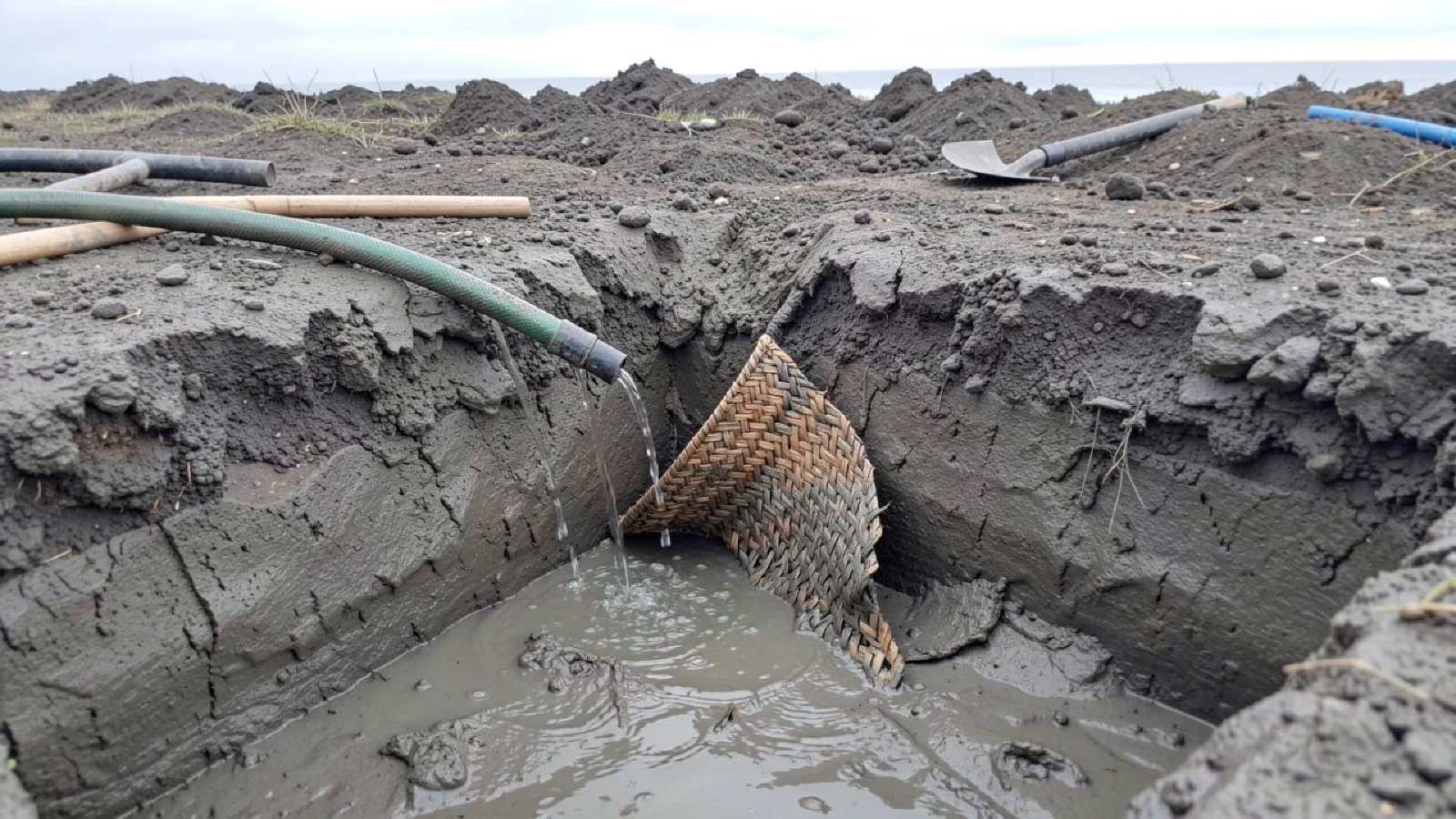
Daugherty had been waiting for the call longer than Claplanhoo could have known. In 1947, as a young man conducting a survey of the Olympic coast, he had walked that beach and recorded the site in his notes, and for twenty-three years he had gone on with a career, digging elsewhere, teaching, sitting on commissions, while the slope at Cape Alava kept what it kept. Now he came, and stayed, on the tribe’s terms, for eleven years. The mud that had crushed the houses had also sealed them: waterlogged clay admits no oxygen, and without oxygen the organisms that eat wood and fiber cannot work. So the excavation could not use trowels, which shatter softened wood, and the crews worked instead with seawater pumped through ordinary garden hoses, melting the clay away from what it held.
What it held changed the arithmetic of an entire field. Some fifty-five thousand artifacts came out of the slope, and the great majority were made of wood and plant fiber: cedar boxes with their contents, looms with weaving on them, mats, cordage, harpoon shafts, baskets by the hundreds, a conical rain hat woven of cedar bark and spruce root, and a carved cedar effigy of a whale’s dorsal fin studded with hundreds of sea otter teeth. Archaeologists have a name for this class of material. The perishable record is everything a people makes that does not survive ordinary burial: basketry, textile, cordage, netting, wood, hide, everything soft, which at most sites means most of everything. At an ordinary open site, the perishables are simply gone, and the collection that remains is stone, bone, and fired clay. The standing estimate in the literature is that the hard remainder represents somewhere under a tenth of what a living community actually made and used. The discipline calls the rest the missing majority, and Ozette is one of the very few places on the continent where the majority failed to go missing.
Nobody had believed the coastal peoples made less than other peoples. The point of Ozette was blunter than that: everyone had always known the majority was missing, and had gone on reasoning from the minority anyway, because the minority was what there was. The mud at Cape Alava did not reveal a richer culture. It revealed the size of the error term in every site without mud.
The new deposits have a perishable stratum, and it is not a class of material. It is a class of person.
The people who do not fossilize#
Consider who enters the column and how. The deposit is made of what was published, posted, filed, and scraped: the written, the public, the retained. The Frequency Column established the geometry, depth as repetition, the record ordered by how often a thing was said. Now ask what the geometry does to a person whose relation to these systems is entirely consultative. She asks; she is answered; she goes. Her questions live in a query log governed by a retention schedule, or in no log at all, and the retention schedule is not the deposit. The next model trains on the corpus, and her side of ten thousand exchanges is in no corpus. She has read the archive daily for years and joined it zero times.
She is not rare. She is, by construction, the common case among exactly the people who lean on the systems hardest, because for the well-documented, the model supplements writing, and for the undocumented, it substitutes for writing, which is the winnowing Taphonomic Bias traced as mechanism. This essay is the census of that mechanism’s population: the caregiver who asks in a second language and posts in none, the patient who queries symptoms she would never publish, the smallholder consulting a machine because there is no extension office, the teenager whose whole intellectual life runs through a private window. Their dependence is real, heavy, and rising. Their deposit is nothing.
And here the archaeological analogy, which this series has ridden for twelve essays, needs its screws tightened, because the ground is kinder than the column. Ordinary soil destroys the basket but keeps its impression in the clay of a hearth; it keeps the posthole, the stain, the chemistry of a floor. The excavators at sites with no preserved textile have reconstructed weaving from the dents fabric left in fired pots. The column keeps no impression. A query rolled off a retention schedule leaves no stain in the weights, no negative space, no place where an absence can even be seen to sit. The perishable record of the ground is recoverable in principle at its edges. The perishable stratum of the deposit is unrecoverable by construction.
The ground keeps impressions of what it destroyed. The column does not.
Covered is not held#
The obvious objection arrives on schedule: these people are not unrepresented. Ask the column anything on their behalf and it answers, fluently, at length. The objection is correct and is the problem. The answer the caregiver receives is assembled from her statistical neighbors, from the people demographically and linguistically adjacent to her who did publish, and the assembly is seamless, because seamlessness is a property of the neighbors’ prose. Nothing at the point of use marks the answer as a composite of other lives. There is no error bar on the reply that says: you, specifically, are not in here. The inversion of The Frequency Column runs to its limit case in her. Depth means repetition, and she repeats zero times, and the system’s fluency about people like her is precisely as good as the proposition that she is like the people it holds.
Sometimes she is. That is what makes the arrangement survivable, and what makes its failures unfindable. When the neighbors’ pattern fits her, the answer helps and no one learns anything. When it does not fit, the answer fails her quietly, in a private window, and the failure generates no record either, because the register in which she might have written up the failure is the register she does not produce. The covered life and the held life diverge exactly where coverage matters most, and the divergence is deposited nowhere.
The field this series is founding will want a word for such people, and the word it must refuse is already lying about in the ancestor discipline. Archaeology calls societies without pottery aceramic, and named a whole era the Pre-Pottery Neolithic, and both names concede a ladder: pottery as a stage, the unfired as earlier, everyone climbing toward the kiln. The people of that era built the tower of Jericho and plastered the skulls of their dead into portraits; they were not on their way to pottery, they were fully occupied being themselves. A person outside the deposit is not at an earlier stage of a path that ends in being harvested. She is not pre-anything. The stratum is perishable because the medium of her participation does not persist, and the medium is the apparatus’s choice, not her position on anyone’s ladder.
The two injuries#
The Unconsenting Stratum sat with the people in the column who never agreed to be there, and ended on a specification: standing without lineage, remedy at the point of use, reach into the living stratum. Hold that population against this one and the symmetry is exact and inverted. The unconsenting stratum holds people taken against their will. The perishable stratum holds people omitted against their need. One injury is presence without agreement; the other is absence without recourse; the apparatus commits both at once, with the same indifference, and nothing about remedying the first touches the second, because every mechanism The Unconsenting Stratum specified operates on strata that exist. You cannot constrain the excavation of a layer that was never laid.
Worse, the two injuries trade against each other, and the trade is the coldest fact in this essay. What keeps the perishable population out of the deposit is, in large part, privacy: the wall around the query, the retention schedule, the promise that the three-in-the-morning question will not be kept. That wall is real protection, honestly won, and the whole population of The Unconsenting Stratum would have been better served by more of it. And the wall is also the mechanism of erasure. The same clause that spares her the harvest guarantees that the next model knows her cohort only through its published neighbors. Protection from the first injury manufactures the second. A person cannot be both unharvested and held, and the apparatus offers no third setting.
I wonder whether any instrument can be built that measures what the deposit is missing without committing the original taking all over again, or whether this stratum’s size is a number the discipline will only ever borrow from its accidents.
Because accidents there will be, and the discipline should be told now what they will look like: they will look like Ozette. Somewhere the wall will fail, a crisis line’s transcripts released for research, a log subpoenaed into a public docket, a community’s private channel mirrored by mistake, and for one population, for one interval, the perishable stratum will lie exposed in the face of the slope. The temptation will be overwhelming, and it will be dressed as method: here at last is ground truth, the covered life visible beside its coverage, the error term measurable for the first time. Every measurement of the missing majority will be taken at the site of somebody’s mudslide. The excavators at Cape Alava had one thing the coming discipline will not be able to count on: a tribe with standing, on whose land the slope sat, who called the archaeologist rather than the other way around, kept the collection at Neah Bay, and closed the trench when they judged it was time. The accident sites of the perishable stratum will mostly have no Claplanhoo to place the call, because the population they expose is defined by not being organized into anything that can pick up a phone.
The hat is in the museum at Neah Bay, conical, tightly woven, its brim intact, a workday object that survived because clay is indifferent to what it seals. Daugherty walked above it in 1947 and recorded the site and could not have said what the ground held, and the ground did not care whether he could say; it kept the hat either way, for anyone, for no one. The new deposit is not indifferent. It keeps by policy and discards by schedule, and what it discards first, and completely, is the daily weave of the people who needed it most. Somewhere tonight a woman is asking it a question she will never write down anywhere else. The answer she receives is made of her neighbors. What she asked is already gone.
This essay closes the weighing arc at four and brings the series to its ruled thirteen. It stands beside The Unconsenting Stratum as its inversion, ruled a separate essay rather than a split because being taken without agreeing and never being taken at all are different injuries with different remedies, and this essay argues they trade against each other besides. Its mechanism is inherited from Taphonomic Bias in the main series, which supplies the winnowing; this essay is the winnowed population, and the two can be read as a pair across the series line, mechanism and census, though nothing in either requires the other. The synthesis was filed against twelve essays and its findings and its self-grade stand un-reopened; a thirteenth essay entering after the grade inherits it, and this one is, by the series’ own taxonomy, as placed a deposit as the rest.
How this essay connects to others across The Approximate Mind.
- Erikson, Patricia Pierce. Voices of a Thousand People: The Makah Cultural and Research Center. University of Nebraska Press, 2002.
- Kirk, Ruth, and Richard D. Daugherty. Ozette: Excavating a Makah Whaling Village. University of Washington Press, 2015.
- Samuels, Stephan R., editor. Ozette Archaeological Research Reports, Volume I: House Structure and Floor Midden. Washington State University Press, 1991.
- Adovasio, J. M., Olga Soffer, and Jake Page. The Invisible Sex: Uncovering the True Roles of Women in Prehistory. Smithsonian Books, 2007.
- Efremov, I. A. “Taphonomy: New Branch of Paleontology.” Pan-American Geologist, vol. 74, 1940, pp. 81-93.
- Hurcombe, Linda M. Perishable Material Culture in Prehistory: Investigating the Missing Majority. Routledge, 2014.
- Kenyon, Kathleen M. Digging Up Jericho. Ernest Benn, 1957.
- Kuijt, Ian, and A. Nigel Goring-Morris. “Foraging, Farming, and Social Complexity in the Pre-Pottery Neolithic of the Southern Levant: A Review and Synthesis.” Journal of World Prehistory, vol. 16, no. 4, 2002, pp. 361-440.
- Bender, Emily M., Timnit Gebru, Angelina McMillan-Major, and Shmargaret Shmitchell. “On the Dangers of Stochastic Parrots: Can Language Models Be Too Big?” Proceedings of the 2021 ACM Conference on Fairness, Accountability, and Transparency, 2021, pp. 610-623.
- Levine, Alexandra S. “Suicide Hotline Shares Data with For-Profit Spinoff, Raising Ethical Questions.” Politico, 28 Jan. 2022.