The Informant
The excavator's dilemma was never an artifact problem, and one field already knows it
TAM-MDN.3-02 · The Midden · The Approximate Mind
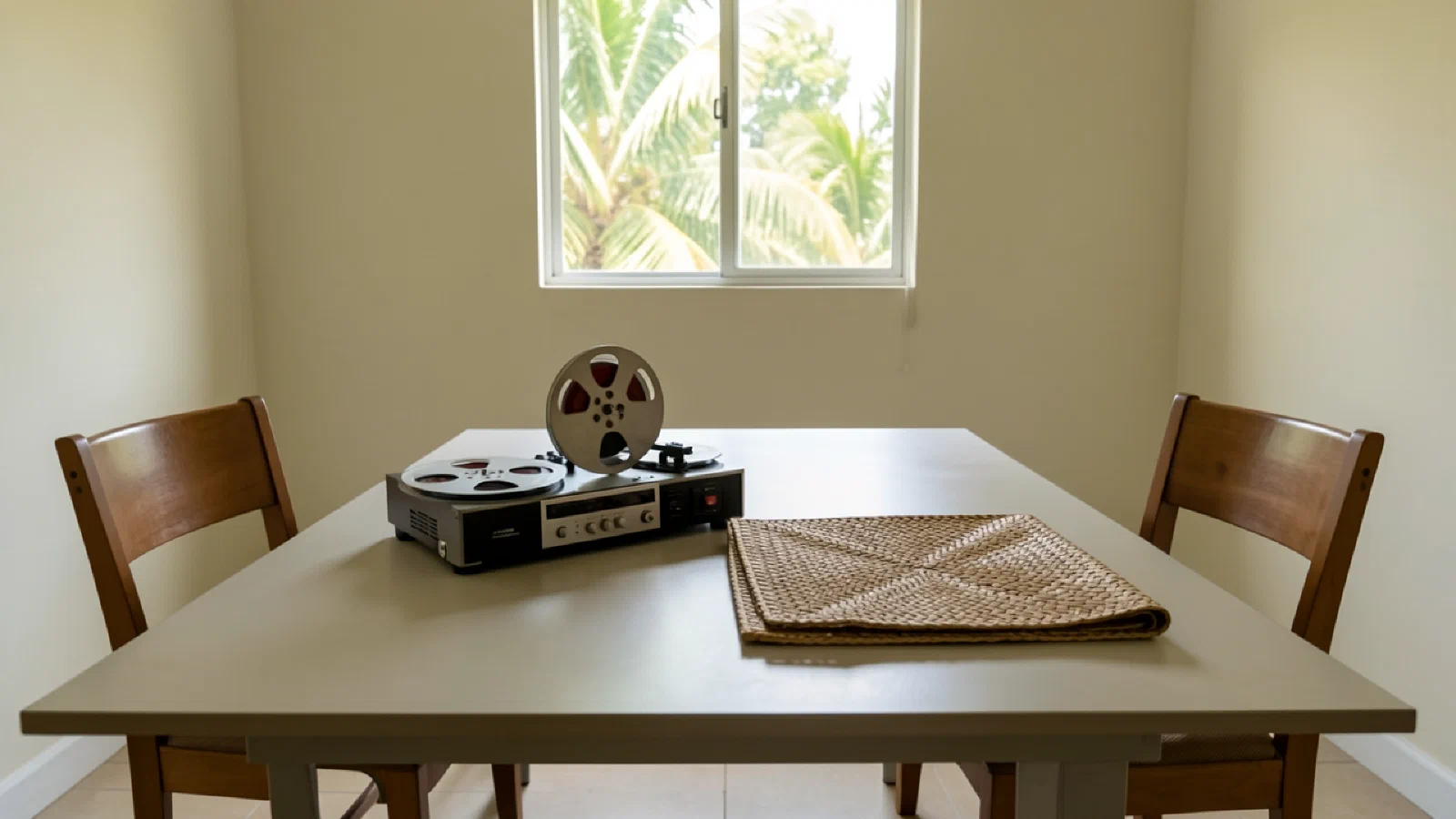
In November of 1987, an eighty-six-year-old woman named Fa’apua’a Fa’amū gave sworn testimony in American Samoa about some conversations she had taken part in sixty-two years earlier. In 1925 and 1926 she had been a taupou, a ceremonial village maiden, and one of the two closest Samoan companions of a small, nearsighted, ferociously energetic American in her early twenties named Margaret Mead, who had come to the islands to ask the young women about their lives. Fa’apua’a testified that when Mead’s questions turned to the girls’ nights and their lovers, she and her friend Fofoa had done what Samoan girls did with such questions from an outsider: they had teased. They had pinched each other and spun tales, in the recreational lying that Samoans call taufa’ase’e, never imagining the earnest visitor was writing it down. Mead’s book, Coming of Age in Samoa, published in 1928, became the most widely read work of anthropology ever printed, and its portrait of an easy adolescence in the South Seas shaped half a century of American argument about nature and nurture.
The testimony was collected by an associate of Derek Freeman, the New Zealand anthropologist who had spent decades assembling a case that Mead had been wrong about Samoa, and it became the centerpiece of his claim that she had been, in his word, hoaxed. And then the dispute did the thing that makes it worth an essay rather than a footnote. It refused to resolve. Mead’s defenders answered that Freeman had his own informants, interviewed decades later, elderly Christian converts speaking to a male authority figure about their society’s respectability, with every reason to disavow the frank talk of their girlhoods; that Fa’apua’a’s testimony was itself shaped for its asker as surely as any joking with Mead had been; that Mead’s conclusions rested on far more than two companions’ teasing. The controversy consumed conferences and books for twenty years, and its deepest finding was not a verdict on Mead. It was that no verdict was available, because every piece of evidence on both sides was testimony, and every testimony had been produced in a relationship, and the relationship had shaped what was said.
Archaeologists have watched this kind of fight from a comfortable distance for a century. Their informants are pots. A pot does not tease, does not perform respectability, does not shade its account toward what the visitor seems to want. The whole methodological serenity of the field rests on sources without motives.
This series has spent two essays establishing that the new sites do not offer that serenity. The Site That Lies catalogued the failures: the artifact that confabulates its own history, performs for the excavator, answers differently with each asking. It treated these as evidence failures, which they are. This essay makes the turn the arc has been preparing. They are not new failures. They are the oldest failures in the study of human beings, and the discipline that has faced them longest is not archaeology at all.
The field that dug people#
Anthropology’s founding instrument is a person in a place, asking. Bronisław Malinowski, marooned in the Trobriand Islands by the First World War, made the accident into a method: live among the people, learn the language, stay long enough that the performance put on for visitors wears thin, and attend above all to the gap between what people say they do and what they do. Participant observation, the method came to be called, and its first premise is the one archaeology never needed: the source is a subject. The informant has interests, moods, an image to manage, a relationship with the asker that colors every answer. Data never sat in the village waiting to be collected; it was produced, jointly, by the asking and the asked, and the producer on the near side of the exchange is part of every datum.
For a generation the field managed this with craft while keeping, in public, the calm face of a science. The private face surfaced in 1967, when Malinowski’s field diaries were published over the objections of nearly everyone, and the discipline met its founder unedited: lonely, irritable, desiring, contemptuous some days of the people he was studying, a man visibly entangled in every relation his method claimed merely to observe. The scandal was not that Malinowski had feelings. It was that the feelings were plainly in the instrument, and the instrument was the field’s only one.
What followed, over the next two decades, was the reckoning anthropology calls the reflexive turn. Its texts argued that the observer’s position, their sex, their color, their money, their government’s flag, is not noise around the signal but part of the signal; that ethnographies are made, composed, authored, and should say so; that the fiction to be given up was the observer who leaves no mark on the observed. The turn had its excesses, seasons when the discipline seemed to study nothing but its own navel, and it never produced an algorithm. What it produced was a set of disciplines of position: say who you are and what you were to your informants; keep the field notes that record how each account was elicited; seek the testimony that cuts against your rapport, from the people who owe you nothing; treat the informant’s shaping of answers not as contamination to be filtered out but as data about the relationship, which is itself part of the truth of the place. And underneath the craft, a floor of ethics the century poured slowly and at cost: the informant is not a source but a party, owed consent, protection, and some say in what becomes of their words.
Anthropology’s mature position is that the shaping of testimony by relationship is not the obstacle to knowledge. It is the medium of it.
The site as informant#
Now set the new excavator’s situation beside the old fieldworker’s, term by term, and watch how little translation is required.
The site performs for the excavator: the trained disposition to satisfy the asker, laid down in the topsoil, bending every answer toward the question’s apparent wish. The fieldworker has a name for this and it is not malfunction. It is rapport, the informant’s accommodation of the guest, the very thing that makes the exchange possible and the very thing that colors it. The site’s account of itself is fluent and unanchored. So is the informant’s; no one’s testimony about their own formation is privileged, and the villager’s story of the village’s past is a story, produced for this listener, this afternoon. The evidence changes with the asking. Every ethnographer knows the interview that went differently because of who was in the room. The excavator cannot appeal past the speech to a mute fact beneath it. Neither, with a human subject, can anyone; the reflexive turn was the moment the field stopped pretending otherwise.
The mapping is close enough that the transfer of craft is almost mechanical. Declare position: the fixed prompt battery of The Trench by Prompt is, in the fieldworker’s terms, a disclosed elicitation protocol, and the arc’s insistence on recording how each answer was drawn is the field-note discipline under another name. Seek testimony against the rapport: phrase the question to invite the answer you do not want, and weight what survives the invitation. Triangulate across informants: the differential reading across model generations in The Trench by Prompt is the village elder checked against the village rival. Treat the performance as data: the way a site bends toward its asker is testimony about the topsoil, about what the depositors trained it to please, and a discipline that reads the bending reads the depositors. None of this required invention. It required noticing which shelf the problem was already on.
I wonder what it says about the new discipline’s parentage that its method essay reached instinctively for archaeology, the science of sources without motives, when the sources it actually faces have something so much closer to motives, and whether the reach was an accident of metaphor or the field’s first act of wishful thinking about its object.
What fieldwork knows that the lab does not#
Because the noticing has not happened where the sites are actually being interrogated. The communities that probe these systems for a living inherited their epistemics from the lab: elicitation as measurement, the probe as an instrument reading off a value, variance as noise, the system’s accommodation of the asker as a bug with a ticket number. A century of hard-won knowledge about what it means to learn from a source that responds to you sits in another building, in the fieldwork methods courses and the ethics boards and the reflexive turn’s whole literature, uncited, because the buildings do not talk.
The costs of the gap are already visible in miniature. Evaluations that measure the evaluator’s phrasing. Probes whose findings dissolve when the rapport changes. Confident readings of a site’s account of itself. Anthropology paid for each of these lessons in decades and reputations, Mead’s among them, and wrote the payments down. The cheapest thing the new discipline will ever do is read the ledger of the old one.
And the ledger’s last entry is the one that reaches past method into the arc’s final essay. Fieldwork ethics begins where the informant’s personhood begins: consent, protection, the say over one’s own words. The site that performs is not a person, and this series has never claimed it is. But the strata inside it are made of persons, their prose, their unguarded questions, their harvested nights, and when the excavator’s prompt draws an answer up through the column, the voices being composited did not sit down for the interview. The informant in the chair is a chorus that was never asked.
Who owes what to a chorus like that is the question of The Unconsenting Stratum, and the arc has been carrying it since the scrolls.
Fa’apua’a outlived the whole first round of the controversy; she died in 2007, at a hundred and six or thereabouts, having spent her last two decades as the most consequential informant in the discipline’s history, cited by both sides, believed selectively by everyone. The dispute over what she said in 1926, and what her saying it meant, and what her recanting it sixty years later meant, remains open, and remains open for exactly the reason this essay has been circling: there was never a version of her testimony that was not shaped for its asker, not the teasing, not the oath, and the search for the unshaped statement beneath them was the one mistake both camps shared. The old woman under oath and the girl pinching her friend were telling different listeners what the moment asked of them. Somewhere between the two performances was a life, and the performances are all the record kept.
This essay is the second of the excavation arc, and it makes the arc’s turn: the evidence failures catalogued at the close of the ruin-field arc are re-read as the oldest problems in the study of human subjects, and anthropology’s reflexive turn, the discipline of learning from sources that respond to the asker, is claimed as the new science’s missing methods course. The consent floor beneath fieldwork ethics is handed forward to The Unconsenting Stratum. A provenance note: this slot is Yagn’s by the series architecture, the entry point where the anthropological posture is native; this draft was written ahead of his decision at Syam’s direction, and stands to be revised, rewritten, or claimed whole by him, with this note replaced by his own.
How this essay connects to others across The Approximate Mind.
- Freeman, Derek. Margaret Mead and Samoa: The Making and Unmaking of an Anthropological Myth. Harvard University Press, 1983.
- Mead, Margaret. Coming of Age in Samoa. William Morrow, 1928.
- Shankman, Paul. The Trashing of Margaret Mead: Anatomy of an Anthropological Controversy. University of Wisconsin Press, 2009.
- Clifford, James, and George E. Marcus, editors. Writing Culture: The Poetics and Politics of Ethnography. University of California Press, 1986.
- Geertz, Clifford. The Interpretation of Cultures. Basic Books, 1973.
- Malinowski, Bronisław. Argonauts of the Western Pacific. Routledge, 1922.
- Malinowski, Bronisław. A Diary in the Strict Sense of the Term. Harcourt, Brace and World, 1967.