The Backward Ear
The hearing turned around, and the deposits of the dead read without opening
TAM-MDN.3-01 · The Midden · The Approximate Mind
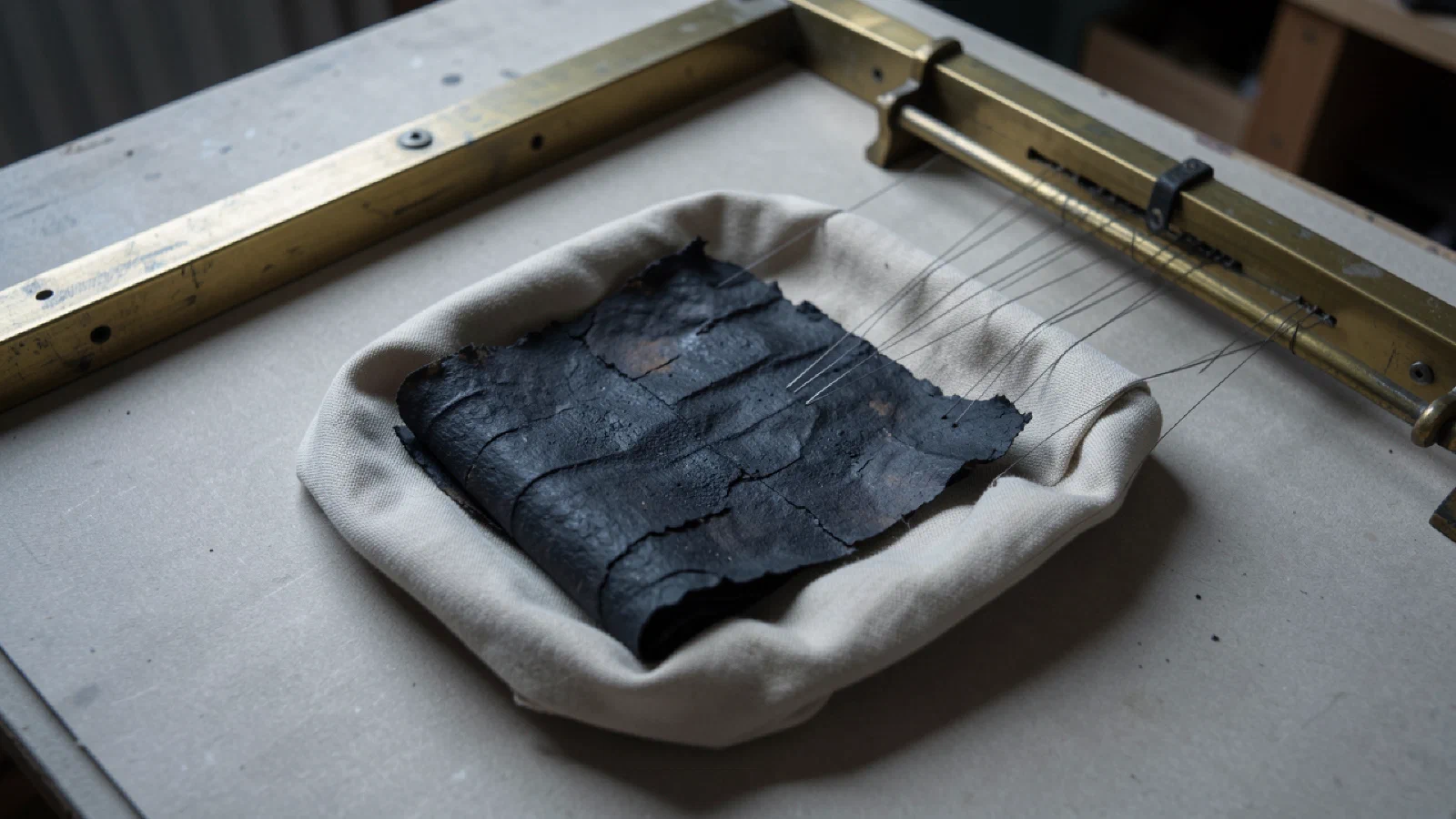
Antonio Piaggio was a Genoese monk who could draw anything, which is how a calligrapher and conservator from the Vatican library came to spend the second half of his life in Naples, bent over the most exasperating objects in the kingdom. In 1752, workmen tunneling into a buried villa at Herculaneum had brought up what they took at first for lumps of charcoal, cylindrical, crumbling, good for nothing, and some were burned for light before anyone noticed the letters. They were papyrus scrolls, an entire Greek library, carbonized in the heat of the eruption that sealed the town in the year 79, preserved by the same event that made them unreadable: the fire had saved them from rot and fused every layer to the next.
The king wanted them read. Every direct attempt destroyed what it touched; scrolls were sliced open, scraped layer by layer, ruined by the dozen. Piaggio, summoned in 1753, built a machine instead, a delicate rack of silk threads and weights that gripped the scroll’s outer skin with goldbeater’s membrane, the gossamer sheet beaten from ox intestine that gilders use, and unrolled it at a rate his patrons found insulting: a centimeter or so a day, four years for the first scroll. The court mocked the pace. The machine worked, more or less, sometimes, and Piaggio spent decades feeding scrolls into it and drawing what emerged, in a hand so exact his facsimiles are still consulted where the originals have since crumbled. Hundreds of scrolls remained that no one dared to open at all. They went into cabinets, intact, illegible, and waited.
They waited two hundred and seventy years, and then they were read without being opened, and the reading is the subject of this essay, because the thing that read them is the thing this whole corpus of essays has been circling.
The instrument turned around#
Everything the companion series established about the hearing was established facing forward. The new standard listens to the living: the queries, the captioned days, the vernaculars of populations currently speaking, harvested on the way in. And everything this series has established about the deposit faced the same direction, the harvest of the present laid down as strata for a future reader.
Point the same apparatus backward and something happens that neither series has yet accounted for. The hearing works on the dead.
The Herculaneum case shows the mechanics plainly. The carbonized scrolls could be scanned by X-ray tomography without harm, but the ink, carbon on carbonized papyrus, black on black, was invisible in the scans; a scroll could be virtually unrolled into a flat image that showed no writing at all. What found the writing was a trained model. The ink is not there as contrast, but it is there as texture, a faint cracking and thickening of the surface where the pen passed, too subtle and too distributed for any human eye, exactly the kind of diffuse statistical residue these systems were built to read. In 2023 a college student running such a model on scan data drew out of an unopened scroll a single Greek word, porphyras, purple, the first word read from inside the closed library since the eruption; within months, he and two collaborators had recovered thousands of characters of a lost Epicurean treatise, prose no living person had ever seen, from an object no one had touched.
And Herculaneum is one dig among many. The same family of instruments now restores the gaps in broken Greek inscriptions and proposes their dates and origins; it has deciphered small dead scripts from residue alone, learning Ugaritic and Linear B from nothing but their surviving corpora and their family resemblance to known cousins; it reads the erased underlayers of palimpsests and the crushed hands of documents too damaged for any paleographer. Where the philologists of the last two centuries needed a bilingual stone or a Ventris-grade intuition, the statistical reader needs what it always needs, pattern and volume, and the dead left pattern and volume.
The hearing reaches backward as easily as it reaches out, and the deposits of the dead are the first ones it has fully excavated.
Here, at last, the two companion series meet on ground rather than in a footnote. The series about the ears asked what the standard takes from the living. The series about the midden asked what the standard holds. This essay is about the third relation, the standard as excavator, and the practice arc it opens is where the discipline this series keeps founding stops being an account of an object and becomes an account of work.
The perfect population#
Because as an excavation instrument, the backward ear has one property that changes the character of everything it touches, and the property has been waiting in the companion series’ vocabulary all along.
The living swerve. That series established it as the vernacular’s oldest defense: populations bend their speech away from whatever is listening, drift out from under the standard, withhold, encode, go quiet. Every hearing aimed at the living is aimed at a moving target that knows it is being heard, and the knowing changes the sound. The whole economy of that argument, the harvest, the bending, the dark that might return, rests on a counterparty who can still respond.
The dead cannot swerve. Their registers are finished. The scribe of the Herculaneum treatise cannot adjust his prose for the machine now reading it; the accountants of Knossos cannot encrypt; no dead vernacular can retreat to the villages, because retreat is a thing the living do. Every defense the companion series catalogued presumes a population with a future, and the populations the backward ear excavates have none. They are, from the instrument’s side, the perfect informants: complete, candid by incapacity, available at any hour, incapable of the one move every living informant retains, which is to stop talking.
An excavator should feel the temperature of that sentence drop as it ends. Perfect availability is what a reader calls it. There are older words for reading what someone can no longer withhold, and the arc ahead will need them; for now the essay only marks the asymmetry and keeps its hands where they can be seen. The dead did not consent to the scan and cannot decline it, and neither could they consent to or decline the two hundred years of spades that preceded it. Archaeology has always excavated the unconsenting; the backward ear did not invent the condition. What it changed is the yield.
What the residue gives up#
Because the yield is no longer objects. It is voice.
The Amber Question established what a model holds: the productive surface of a register, speakable on request, a composite with no one inside. That essay’s amber was formed by accident, the side effect of the harvest. The backward ear makes amber on purpose, from deposits the harvest never touched. Train the reader on everything that survives of a dead language’s corpus, and what comes out the far side is not a dictionary or a grammar, the herbarium of the old philology, but the thing the first arc described: an interactive surface, a register that answers. Enough survives of some dead languages to raise their statistical ghost to conversation. More will follow, because the threshold falls as the readers improve, and beneath the languages sit the registers, the vanished professional jargons, the letter-writing conventions of particular decades, the spoken texture of any period that left enough residue, each of them inferable, composable, speakable.
I wonder where the line is between reading the dead and ventriloquizing them, and whether the instrument can be made to know the difference, since on its side of the exchange there is no difference: inference from residue is all it ever does, for the living and the dead alike, and the moral border that feels so plain from our side, between recovering what a person wrote and generating what a person like them would say, corresponds to nothing in the mechanism.
The practice will not wait for the answer. It has not waited. The lost treatise is being read paragraph by paragraph; the epigraphy models propose restorations that editors now weigh alongside human conjecture; somewhere in the pipeline already are the tools that will offer conversation with the reconstructed register of a period, marketed, no doubt, as bringing the past to life. Each step is continuous with the last, and continuity is exactly how a practice crosses a line without ever seeing one.
What the discipline can do, and what distinguishes a discipline from a capability, is refuse to let the continuity go unexamined. The Informant takes up the excavator’s relation to a source that shapes its answers, and learns from the one field that has spent a century on that problem. The Unconsenting Stratum takes up the stratum’s people, the harvested and the never-asked, and what the consent of the dead and the unconsulted could possibly mean. The instrument is running either way. The essays are about who is holding it.
Piaggio never learned what most of the library said. He died in 1796 with scrolls still on the machine, having spent forty years unrolling at a centimeter a day and copying every recovered line in that patient hand, and his reward from posterity was mixed: the facsimiles proved priceless, and the machine’s survivors, the scrolls too fragile even for silk threads, were locked away as failures. They turned out to be the treasure. Every scroll that was opened lost something in the opening, layers torn, margins crumbled; the ones that defeated Piaggio kept everything, sealed, complete, until a reader arrived that did not need them open. The failure of the gentlest instrument of one century became the perfect archive for an instrument gentler still. The scrolls in the cabinets had been waiting, it turned out, not to be unrolled, but to be heard.
This essay opens the excavation arc of The Midden and is the essay where the companion series meet: the hearing of The Standard with Ears, turned backward, becomes the discipline’s reading instrument, and the amber of the object arc becomes something the practice can make on purpose from the deposits of the dead. The swerve, the living population’s defense established in the companion series, is what the dead lack, and the perfect availability of the unconsenting is stated here as an asymmetry and handed, deliberately unresolved, to The Unconsenting Stratum. The excavator’s relation to a source that shapes its answers, raised at the close, belongs to The Informant and the informant problem.
How this essay connects to others across The Approximate Mind.
- Seales, W. Brent, et al. “From Damage to Discovery via Virtual Unwrapping: Reading the Scroll from En-Gedi.” Science Advances, vol. 2, no. 9, 2016.
- Sider, David. The Library of the Villa dei Papiri at Herculaneum. J. Paul Getty Museum, 2005.
- Assael, Yannis, et al. “Restoring and Attributing Ancient Texts Using Deep Neural Networks.” Nature, vol. 603, 2022, pp. 280-283.
- Luo, Jiaming, Yuan Cao, and Regina Barzilay. “Neural Decipherment via Minimum-Cost Flow: From Ugaritic to Linear B.” Proceedings of the 57th Annual Meeting of the Association for Computational Linguistics, 2019, pp. 3146-3155.
- Chadwick, John. The Decipherment of Linear B. Cambridge University Press, 1958.