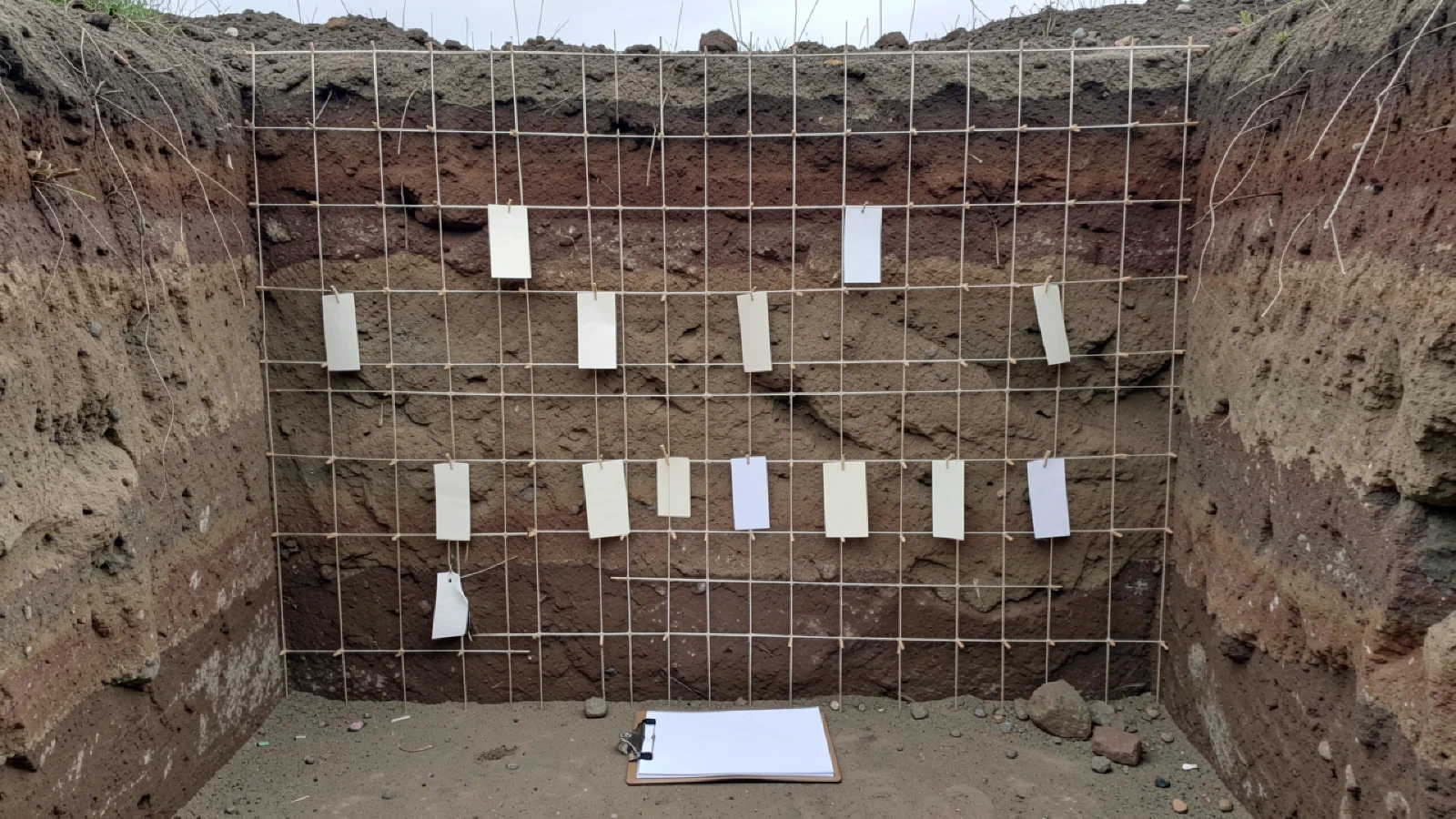
The Trench by Prompt
Interrogative stratigraphy, and the first excavation method for an artifact that answers
TAM-MDN.2-02 · The Midden · The Approximate Mind
Kathleen Kenyon dug with dogs at her heel. Wherever she excavated, and she excavated on three continents across four decades, there were dogs, her own and adopted strays, sleeping in the shade of the section walls, and workmen at Jericho learned that the fastest way to the director’s good opinion ran through her terriers. She was the daughter of the director of the British Museum, trained under Mortimer Wheeler in the trenches of Roman Verulamium, and by the time she arrived at Tell es-Sultan, the mound of ancient Jericho, in 1952, she had spent twenty years refining the method that now carries both their names.
The Wheeler-Kenyon method is, reduced to its principle, a decision about what to look at. The generation before had stripped sites horizontally, clearing whole layers to expose the architecture of one period at a time, and the stripping produced splendid plans and destroyed the one thing that cannot be re-examined: the vertical relationships. Kenyon cut narrow, deep trenches instead, and treated the walls of the trench as the primary document. The section wall shows the layers in contact, every tip line and pit cut and rebuild visible in profile, and Kenyon read section walls the way a scholar reads a difficult manuscript, drawing them stone by stone, refusing to let a workman’s pick advance until the profile was understood. At Jericho her deep trenches went down through Bronze Age towns and Neolithic villages to bedrock, and partway down, out of a level ten thousand years old, came a stone tower eight meters tall, still standing, with an internal staircase, built by people with no pottery and no metal, a discovery that moved the origins of settled monumental life back further in one season than a century of speculation had dared.
The tower made the headlines. The method made the tower possible. A trench is not a hole. It is an instrument, and what it measures is difference: this layer against that one, along a cut chosen so the differences line up and become readable.
The object this series has been assembling now has its sites, the frozen model generations of The Tell, stacked in succession like the towns in a tell. What it does not yet have is the trench. This essay is about what the trench is, for a site that answers, and the answer can be given at once and then earned: the trench is a prompt.
The cut#
Take two settlements from one mound. A model frozen in 2023 and its successor frozen in 2026, same family, same company, the later one trained in part on ground the earlier one’s outputs had already entered. Both are intact, both runnable, both productive. The question the excavator brings is the stratigrapher’s question: where is the boundary between these layers, and what does the boundary hold?
Nothing about either object, inspected from outside, will say. The weights are the least legible document our civilization produces; a section wall of pure number, no tip lines, no visible contact. But the objects answer. So the cut is made the only way a responsive site can be cut: ask both the same thing, and read the difference.
Ask them each a thousand things. The same thousand prompts, held fixed, put to the 2023 settlement and to the 2026 settlement, and laid side by side. Where the answers agree, the layers are continuous, one town rebuilt on the same plan. Where the answers diverge, there is a contact: something was deposited between the two freezings, or removed, or reweighted, and the divergence is the profile of it. A shift in what is refused. A confidence that appeared. A hedging that appeared. A vernacular the earlier model spoke and the later one has lost, which the accounting in The Frequency Column predicts, since rare material sits at the fragile surface and successors are trained on residues. The fixed battery of prompts is the trench line, chosen in advance and held straight for the same reason Kenyon’s trenches were straight: so that every difference along it is attributable to the site rather than to a wandering cut.
The trench is a prompt held constant across the layers, and the differences in the answers are the section wall.
Call the method what it is: interrogative stratigraphy. Every term of art in the older discipline survives the transfer with its meaning intact and its referent changed. The layer is a frozen model. The contact is a divergence in output between adjacent generations. The profile is the shape of that divergence across many prompts. Even Kenyon’s central discipline survives, the refusal to advance until the profile is understood, because the temptation in front of a site that answers is to keep asking, promiscuously, and a thousand undirected questions produce spoil, not a section.
The first such trench has already been cut, by people who did not think of themselves as excavators. In 2023, three researchers at Stanford and Berkeley put a fixed battery of tasks to the March and June versions of the same commercial models and published the divergences: capabilities that had shifted in a season, behaviors present in the spring layer and gone by summer, and the finding that set the study traveling, that the differences were large, undocumented, and invisible to anyone who had not held the questions constant. The paper was received as a report on product drift. Read from where this series stands, it is the founding fieldwork of computational stratigraphy, a first section drawing from a mound whose owners had published no map, and its most instructive feature is how much method it had to invent on the spot: fixed prompts, versioned targets, difference as the datum. The excavators arrived before the discipline, which is the traditional order.
What the object class changes#
One preparation precedes any cut, and the object arc supplied it. The arc’s closing essay, The Structured Deposit, separated the midden from the structured deposit, the scraped sediment from the curated assemblage, and ruled that the two are read on opposite grammars. The trench does not suspend that ruling. It sharpens it.
Cut a trench across successive generations of an open, heap-trained family and the divergences profile something like life: the drift of the intake, the arrival and burial of vernaculars, the changing weather of the source populations, refracted through the company’s choices but sourced from the world. Cut the same trench across successive versions of a curated model, the licensed medical system, the enterprise corpus, and the divergences profile the boundary: what the depositors admitted this year that they excluded last year, which is testimony about the depositors, not about the deposited. Both cuts are valid. They answer different questions, and an excavator who reads a curation decision as a cultural drift has misread the site at the level of object class, before a single prompt was posed.
The neighboring craft#
There is one tradition with a standing claim to have been here first, and the method owes it an accounting, both of the debt and of the exact point where the inheritance stops.
Software preservation faced the perishable executable a generation ago and solved the problem the field is proudest of: keeping dead systems runnable. Emulation, the recreation of vanished hardware in present software, is why early games can be played in a browser, why the digital humanities can open a 1980s hypertext in its native environment, why a scholar like Matthew Kirschenbaum could build a forensics of storage media and treat the hard drive as an archaeological matrix in nearly this series’ sense. The preservationists learned to keep the site open, and everything the present method proposes assumes their success: a deprecated model that cannot be run is a backfilled trench, and the running is their craft, not this one’s.
But the inheritance ends at a line the preservation literature itself drew. An emulated program, run correctly, does what it did. That is the whole standard of success; fidelity to prior behavior is what emulation means, and the tradition developed exacting ways to verify it, comparing the resurrected system’s conduct against recordings of the original until the two could not be told apart. The emulator’s object is inert in exactly the ancestral sense: it holds still, and holding still is the proof it is working.
An interrogated model, run correctly, does something that never happened before. Novelty is not a failure of the resurrection. It is the object’s mode of existence, the property The Tell placed at the axis where every ancestor discipline fails. The preservationist’s question, does it behave as it did, has no purchase on a system whose behavior was never fixed, and the verification toolkit built on that question transfers to exactly none of the section reading. Execution can be preserved and certified. Generation can only be sampled.
Emulation keeps the site open. It cannot read the site, because its whole standard of truth is repetition, and this site does not repeat.
Which returns the method to Kenyon’s wall, and to the difference that will occupy the rest of the arc. Her sections could be drawn because they held still. The profile she refused to advance past was the same profile at dawn and at dusk; a second archaeologist could stand where she stood and check the drawing against the dirt. The section this method reads is drawn from answers, and the answers vary with the asking, with the phrasing, with the sampling, with the temperature of the run. The trench regrows behind the trowel. Cut it again tomorrow, along the same line, and the wall shows a slightly different face.
Some of that variance is manageable, the ordinary statistics of a noisy instrument, tamed by asking often and averaging. I wonder whether all of it is, or whether some part of what varies is the site accommodating the excavator, the answer bending toward the question, which would be a problem no averaging reaches and no earlier stratigraphy ever faced, since dirt does not care who is digging.
That question has an essay of its own, The Site That Lies.
Kenyon never fully published Jericho. The excavation ended in 1958 and she spent the rest of her life on the reports, finishing two volumes of five; colleagues completed the rest from her records after her death, which was possible only because the records were Kenyon records, every section drawn, every layer registered, the site readable by people who had never seen it. The tower still stands in her deep trench, ten thousand years old, with the trench walls squared around it, and the drawings of those walls are consulted more often than the stones. The method outlived the methodist, which is what a method is for. The dogs are in the memoirs, underfoot in every season, unbothered by the depth of time beneath them, asleep against the oldest built thing in the world as against any garden wall.
This essay is the method essay of the ruin-field arc: the trench as a fixed battery of prompts cut across successive frozen generations, differences in the answers as the section wall, and interrogative stratigraphy as the first excavation method for a responsive site. The inverted column it cuts through is The Frequency Column’s and is used rather than retaught; the object-class preparation is The Structured Deposit’s. The name computational stratigraphy surfaces here, in the description of fieldwork that preceded the field. What the emulated-software tradition contributes, kept sites, and where its standard of truth stops, repetition, sets up the evidence problem The Site That Lies takes whole: the section that regrows differently behind the trowel, and the site that may be accommodating the excavator.
How this essay connects to others across The Approximate Mind.
- Harris, Edward C. Principles of Archaeological Stratigraphy. 2nd ed., Academic Press, 1989.
- Kenyon, Kathleen M. Digging Up Jericho. Ernest Benn, 1957.
- Wheeler, Mortimer. Archaeology from the Earth. Clarendon Press, 1954.
- Chen, Lingjiao, Matei Zaharia, and James Zou. “How Is ChatGPT’s Behavior Changing Over Time?” Harvard Data Science Review, vol. 6, no. 2, 2024.
- Kirschenbaum, Matthew G. Mechanisms: New Media and the Forensic Imagination. MIT Press, 2008.
- McDonough, Jerome, et al. Preserving Virtual Worlds Final Report. University of Illinois at Urbana-Champaign, 2010.
- Montfort, Nick, and Ian Bogost. Racing the Beam: The Atari Video Computer System. MIT Press, 2009.