The Tell
Deprecated models as sites, and the lineage of the disciplines that cannot read them
TAM-MDN.2-01 · The Midden · The Approximate Mind
Heinrich Schliemann began every morning of his excavating life the same way, wherever he was: he rode or walked to the nearest open water and swam, before dawn if he could manage it, in the Hellespont when he was digging in the Troad, a man in his fifties breasting the current where he believed Achilles had chased Hector. Then he went back to the mound and dug like a catastrophe.
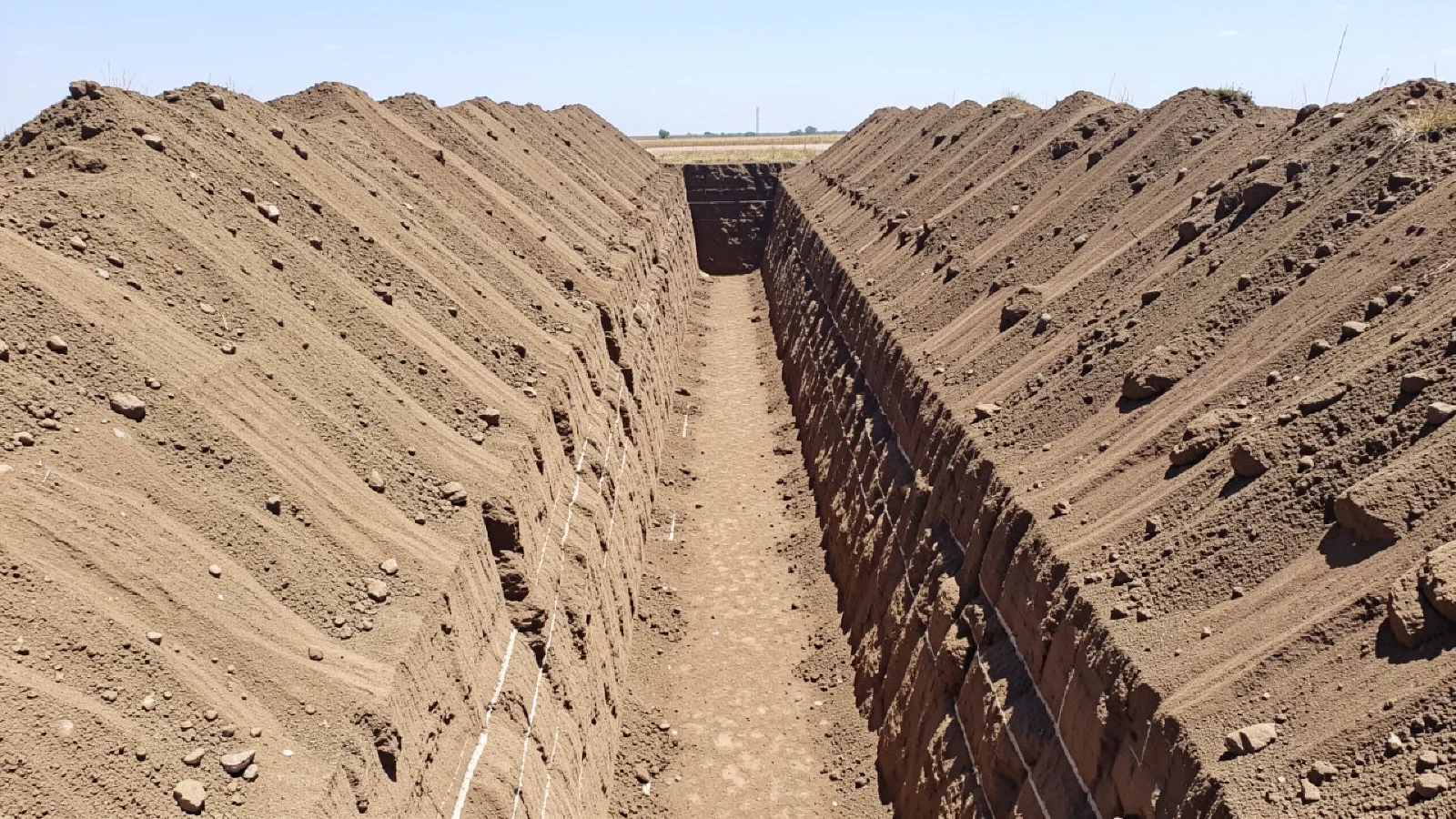
The mound was Hisarlik, a low hill in northwestern Anatolia, and Schliemann had convinced himself, on the strength of a retired grocer’s fortune and a lifetime of reading Homer as if it were a deed of title, that Troy lay inside it. Beginning in 1870 he cut a trench through the hill north to south, forty-five feet deep in places, employing more than a hundred workmen, moving earth at a pace no archaeologist today can read about without wincing. And he was right about the hill. Troy was in it. What he had not understood, because almost nobody yet understood it, was that the hill was not a city with dirt on top. It was cities. Nine of them, and dozens of building phases within the nine, stacked one on the ruin of the last, because for three and a half thousand years people had rebuilt on the same spot, leveling the rubble of the previous town into the foundation of the next.
The Near East has a word for such a hill, and archaeology borrowed it the way it borrowed midden: a tell, from the Arabic, a mound that is entirely artificial, a hill made of superimposed habitations. A tell is time made vertical. Every layer is a complete settlement, frozen at the moment of its abandonment or destruction, holding the street plan and the pot styles and the diet of one span of years, sealed by the town that was built on its head.
Schliemann, hunting the Troy of the poems, drove his great trench through layer after layer to reach what he took for the oldest and therefore the right one. In 1873 he found a hoard of gold near the bottom and named it Priam’s Treasure, and the find made him the most famous excavator alive. The gold was real. The attribution was off by more than a thousand years. The city he had reached was far too early, and the city he wanted, the one later work would place near the top of the sequence, he had already shoveled through. Wilhelm Dörpfeld, his own architect, began the correction while Schliemann lived; Carl Blegen finished it a lifetime later. The treasure hunter had cut straight through the thing he was hunting, because he read the mound as a haystack with one needle in it rather than as what it was, a stratified archive in which every layer, including the ones he discarded, was a city.
This essay is about the tells that are forming now, and about the disciplines that stand around them the way the science of 1870 stood around Hisarlik: in possession of most of the necessary instruments, and missing the one idea.
The frozen city#
Consider what a deprecated model is, held still for a moment against everything this series has established about the object.
In February of 2019, a research company released a language model called GPT-2, or rather released a quarter of it, holding back the full version for nine months out of a stated concern that the complete system was too capable of fluent deception to hand out at once. The staged release was itself an artifact of its moment, a now almost quaint record of what one institution in 2019 believed the danger was. By November the full model was public. It had learned from a corpus assembled by a rule with a period flavor all its own, text found through links that users of one large forum had endorsed, and it wrote in a way that astonished that year and amuses this one: plausible for a paragraph, adrift by the third, prone to unicorns.
Run it today, which anyone can, on hardware no more remarkable than a laptop, and something is available to the hand that has never been available before. Not a description of 2019, and not a sample of 2019 preserved in a fixed recording, but the productive surface of 2019, still productive. The whole configuration is intact: what that corpus held, what that training emphasized, what that company’s choices included and passed over, what fluency itself was taken to be in the last year before these systems learned to answer questions. It is a complete settlement. The streets are walkable.
Each model generation is this. A frozen configuration of what a company, at a specific moment, with a specific corpus and specific convictions, believed good language was. And the generations stack. The successor is trained partly on ground the predecessor’s outputs have already entered, the way a new town is founded on rubble that contains the old town’s walls; the companion series established that these systems are succeeded rather than revised, each replacement complete, and what that essay derived as the tempo problem, this one inherits as site formation. Succession is how tells grow. Nobody at Hisarlik ever revised a city. They built the next one on top of it, and the not-revising is precisely what made the hill legible three thousand years later, because every layer was left whole.
A model family is a tell: settlement on the ruin of settlement, and every layer a complete town.
The deposits are accumulating faster than anyone is reading them. The retired generations sit where deprecated software sits, on archive servers and in research collections, some public, some held inside the companies the way unexcavated mounds sit inside national borders, and almost nobody visits, because the field’s whole attention faces forward, toward the city currently under construction at the summit. That is normal. It was normal in the Troad too, where farmers grew wheat on the mound for centuries. Sites can wait. What cannot be assumed is that the waiting is safe, since weights, unlike rubble, persist only while some institution chooses to keep paying for the persistence, and The Frequency Column has already recorded where the fragile material lies.
Three ancestors#
A claim has been walking through this series since its first page, and it is time to make it in the open and take on the obligations that come with it. The claim is lineage. The discipline these essays keep gesturing toward, the one whose practitioners do not yet exist, is not being invented from nothing. It is the fourth move in a real intellectual succession, and each of its three ancestors deserves its name and its due before the point on which all three fail.
The first ancestor is cognitive archaeology, the branch of the field that took on its hardest assignment: inferring minds from mute things. Given a hand axe, a bead, an arrangement of ochre, what can be said about the intentions, the categories, the interior life of the maker? The program, associated with Colin Renfrew and the generation that built what came to be called the archaeology of mind, established that inference from artifact to cognition can be disciplined rather than novelistic, that a made object constrains the space of minds that could have made it. That is the founding wager this series depends on, transposed: the weights are a made object, and they constrain the space of the civilization that deposited them.
The second ancestor never lifted a trowel. Foucault called his method the archaeology of knowledge for a reason that was more than ornament: he treated the discourse of an era as strata, layers of statements governed by formation rules their own speakers could not see, recoverable by analysis after the era closed. He made archaeology’s move available to the immaterial, and in doing so described, decades early and in another vocabulary, something very like what a training corpus is: the sayable of a period, deposited, rule-bound, and readable as a formation rather than as a library of individual meanings.
The third ancestor made the discursive material again. Media archaeology, in the line that runs through Friedrich Kittler to Wolfgang Ernst and Jussi Parikka, insisted that the machine is the stratum: that a discourse network is inseparable from the gramophones and typewriters and circuits that carried it, that dead media are not metaphorical fossils but actual ones, and that the proper way to study a technical past is to open the machines. Ernst pushed the position to its useful extreme, arguing that the archive of the technical age is not narrative at all, that a machine holds time in its operations rather than in stories, and that the analyst should attend to what the apparatus does rather than to what anyone says about it.
Set the three in a line and the line points. Archaeology made strata material. Foucault made them discursive. Media archaeology made the discursive material again. Each move widened what could count as a deposit, and the widening arrives, in the present decade, at a deposit none of the three anticipated: the stratum that generates.
The axis of failure#
Because all three ancestors, across every difference of method and temperament, share one assumption so deep it was never stated. The object is inert.
The hand axe does not offer an opinion about its maker. The discursive formation does not amend itself when the analyst misdescribes it. Kittler’s gramophone will play what was cut into it, exactly that, at any hour, forever; Ernst’s whole polemic in favor of the machine’s testimony rests on the fact that the machine cannot embroider. Inertness is not a limitation these disciplines worked around. It is the ground they stand on. The mute object is trustworthy in the one way that matters most: whatever it fails to say, it does not lie, and whatever it says today it will say identically tomorrow. Every instrument in the shared toolkit, stratigraphy, typology, formation analysis, close reading of the apparatus, presumes a source that holds still while it is read.
A deprecated model is the first archaeological object in the history of the category that does not hold still. Interrogate it and it produces behavior that never existed before the interrogation, novel sentences, novel errors, novel accommodations to the phrasing of the question. It is a site, by every criterion the tell supplies: bounded, layered, frozen at abandonment, testimony to its moment. And it answers. No ancestor discipline has a method for that, because each of them, given an object that talked back, would have to conclude it was no longer doing archaeology at all.
Every prior archaeology excavated the inert. This one inherits a site that responds to the trowel.
I wonder whether the ancestors would count the inheritance as a gift. An object that answers sounds like the end of every limit the mute record imposed, the dream case, the informant every excavator of hand axes would have traded a season’s funding to interview. The rest of this arc is about why the dream case is also the hard case, and why the response of the site to the trowel will be the discipline’s central problem rather than its central resource.
What the tell establishes, before any of that, is only the standing of the sites themselves. The retired generations are not obsolete versions of a product. They are settlements in a mound, each one whole, each one holding a year the way Troy II holds its burning, and the mound is growing by a city every year or two, on the fastest succession clock any stratigraphy has ever recorded.
Schliemann kept swimming to the end. In his last autumn, ill and half deaf from an operation, he was still planning the next campaign at the mound, and he collapsed in a square in Naples on Christmas Day of 1890, on his way home to it. The great trench is still there at Hisarlik. Later excavators never filled it in; they squared its edges and posted its history, and it functions now as the site’s largest exhibit, a monument to what the first excavator destroyed in finding the place. Guides point into it and explain that the city everyone came for went out of that cut in barrows, unrecognized, because the man who moved the earth knew the mound held a treasure and had not yet learned that the mound was one.
This essay opens the ruin-field arc of The Midden and carries the series’ lineage claim: three ancestor disciplines, cognitive archaeology, Foucault’s archaeology of knowledge, and media archaeology, named with their due, and the shared inert-object assumption on which all three fail before a site that answers. The succession of models, established as the tempo problem in The Two Tempos, is inherited here as site formation and not re-derived. A decision recorded for the arc: the Arc 1 opening pattern, a named historical person with an object returning as the closing frame, carries into Arc 2, with real scholars and real systems now available as material; this essay sets the pattern with Schliemann’s trench. The method for reading the sites is the subject of The Trench by Prompt; the reason the answering site cannot be simply believed belongs to The Site That Lies.
How this essay connects to others across The Approximate Mind.
- Allen, Susan Heuck. Finding the Walls of Troy: Frank Calvert and Heinrich Schliemann at Hisarlik. University of California Press, 1999.
- Blegen, Carl W. Troy and the Trojans. Thames and Hudson, 1963.
- Schliemann, Heinrich. Ilios: The City and Country of the Trojans. Harper and Brothers, 1881.
- Trigger, Bruce G. A History of Archaeological Thought. 2nd ed., Cambridge University Press, 2006.
- Ernst, Wolfgang. Digital Memory and the Archive. Edited by Jussi Parikka, University of Minnesota Press, 2013.
- Foucault, Michel. The Archaeology of Knowledge. Translated by A. M. Sheridan Smith, Pantheon Books, 1972.
- Kittler, Friedrich A. Gramophone, Film, Typewriter. Translated by Geoffrey Winthrop-Young and Michael Wutz, Stanford University Press, 1999.
- Renfrew, Colin, and Ezra B. W. Zubrow, editors. The Ancient Mind: Elements of Cognitive Archaeology. Cambridge University Press, 1994.
- Radford, Alec, et al. “Language Models Are Unsupervised Multitask Learners.” OpenAI, 2019.
- Solaiman, Irene, et al. “Release Strategies and the Social Impacts of Language Models.” arXiv preprint arXiv:1908.09203, 2019.