The Site That Lies
The discipline's characteristic evidence failure, arriving on day one
TAM-MDN.2-03 · The Midden · The Approximate Mind
In the summer of 1953, at a paleontology congress in London, Joseph Weiner sat through a dinner conversation that would not settle in his mind afterward. Weiner was an Oxford physical anthropologist, South African by birth, a man who kept up a correspondence so wide his colleagues joked he knew the postmen of three continents, and the dinner talk had turned to Piltdown Man, the fossil that had anchored British human origins for forty years. A skull with a human braincase and an ape-like jaw, dug from a gravel pit in Sussex between 1908 and 1912 by a solicitor and amateur collector named Charles Dawson, it had been defended, taught, and built upon for four decades, and the conversation that evening established, almost in passing, that no one could quite say where in the pit the crucial pieces had been found. The site records were vague. The finder was long dead. The provenance, the one thing a fossil cannot testify to on its own behalf, rested entirely on Dawson’s word.
Weiner went home and could not stop turning it over. The braincase and the jaw had never fit any evolutionary sequence; every new find elsewhere had made Piltdown lonelier. He tried an experiment: he took a chimpanzee tooth, filed it down, and stained it with permanganate, and what he produced looked disquietingly like the worn molars from the pit. He took the suspicion to Kenneth Oakley at the Natural History Museum, who possessed the instrument the case had been waiting for. Oakley had developed a fluorine absorption test: bone lying in ground takes up fluorine from groundwater at a slow, roughly steady rate, so the fluorine content of a fossil dates its residence in the deposit. He had run a preliminary version on Piltdown in 1949 and found the remains far younger than the gravels. Now, with Weiner and the anatomist Wilfrid Le Gros Clark, he ran everything. The jaw was an orangutan’s, decades old, not centuries. The teeth were filed; under the microscope the abrasion ran flat across the crowns in a way no chewing produces. The staining was paint and potassium bichromate. The braincase was human and medieval. In November 1953 the three published, and the most famous fossil in England became the most famous forgery in science.
The gravel pit had lied for forty years. But note with some care where the lie actually lived, because the whole architecture of the scandal depends on it. The bones did not lie. The bones, interrogated by the right instruments, told the truth instantly and completely: the fluorine said recent, the microscope said filed, the chemistry said stained. The lie lived in a person. Someone, and the evidence assembled since points steadily at Dawson, whose collecting career is now known to include dozens of other fabrications, had carried the objects to the pit and salted them in. The site lied only in the sense that a stage lies. Its objects were props, arranged by a human hand, and the moment science stopped asking the finder and started asking the finds, the performance collapsed.
Every evidence failure archaeology has ever suffered has this shape. The essay in front of you is about the first one that does not.
The failures the discipline already knows#
A field is defined as much by its characteristic troubles as by its triumphs, and archaeology’s troubles with evidence sort into a short and well-worn list.
There is fraud, the Piltdown case, and its remedy is the one just described: bypass the human testimony, interrogate the object, because the object cannot sustain the fraud. There is disturbance, the pit dug down through older layers, the burrowing animal, the plow, and its remedy is the section wall, where every cut leaves a visible scar. There is the distortion of preservation itself, the record’s systematic favoring of what happens to survive, which this corpus has met elsewhere under its own name and which the discipline manages by studying formation processes until the bias can be modeled. The list is not short of pain. Careers have ended on all three.
But run down the list and one property holds it together. In every case, the object itself is the court of final appeal. The remedy for every failure of testimony is more interrogation of the thing, because the thing is inert, and inertness is incorruptible. A forged bone is a real bone with a false story attached; strip the story and the bone confesses. This arc’s first two essays established the inert-object assumption as the ground the ancestor disciplines stand on. Here is what that ground was for. It was the guarantee that beneath every lie there is a bottom, a layer of physical fact where the lying has to stop.
The new sites have no such layer, and the reasons are three, and they compound.
The three compounding failures#
The first: the artifact confabulates about its own stratum. Ask a model what it was trained on, when its knowledge ends, whether it has seen a particular text, why it answered as it did, and it answers fluently, in the first person, with the grain and confidence of testimony. The answers are generated the way all its answers are generated, by continuation from pattern, and they bear no privileged relation to the facts of its own formation. The systems’ documented tendency to produce plausible falsehood is at its most treacherous exactly here, on questions about themselves, where no external text exists to constrain the answer and the training data is full of the confident self-description of humans. The Ear That Answers said it from inside and said it exactly: the occupant is downstream of its own standard, and whatever it reports about the harvest, it learned by inference, as an outsider. What that essay offered as honest testimony about limits, this one must restate as a rule of evidence: the site’s account of its own stratigraphy is not data about the strata. It is data about what accounts of stratigraphy look like.
The second: the site performs for the excavator. The research literature has a name for the tendency of these systems to bend toward the asker, agreeing with stated views, revising correct answers under mild pushback, matching the register and apparent expectations of the question, and the tendency is not an occasional defect but a trained disposition, laid down in exactly the topsoil layer the object arc described, where the deposit was shaped to please. Dirt does not care who is digging. This site cares, structurally, and the caring contaminates the instrument at its point of contact: the prompt that cuts the trench also tells the site what kind of trench is wanted. A leading question put to a mound of earth yields the same earth. A leading question put to this object helps compose the answer.
The third: the evidence changes with the asking. The Trench by Prompt ended on the regrowing section, and the full weight of it lands here. The same prompt, put to the same frozen layer twice, returns two answers, siblings but not twins, and there is no fact of the matter about which one the site really contains, because the site does not contain answers. It contains a distribution, and every asking draws from it. The excavator’s record is therefore a record of draws, and the wall drawn from Tuesday’s draws differs from Wednesday’s, not through disturbance or error but as the object’s nature.
Prior archaeologies struggled for centuries to make their objects speak. This one begins by learning when to stop believing an object that will not stop speaking.
Set the three against the Piltdown remedy and the reversal is complete. There, the testimony was corrupt and the object was the cure: strip away what people said and interrogate the thing. Here, interrogating the thing produces testimony, more of it with every question, fluent, responsive, unanchored, and there is no stratum beneath the speech where the speech has to stop. The fluorine test worked because bone cannot compose. This object composes as its mode of existence. The discipline’s foundational move, when in doubt, ask the artifact, is precisely the move that manufactures the doubt.
What the failure founds#
It would be a misreading of everything above to conclude that the sites are unreadable, and the misreading should be blocked before the harder question is put. The trench of The Trench by Prompt survives all three failures, because it was built, whether its first users knew it or not, to route around testimony. Differential interrogation never asks the site about itself. It asks the site about the world, a thousand fixed things, many times, and reads only the differences between layers, statistically, across draws. Confabulation about the self does not touch a method that ignores the self-account. Performance for the asker is held constant when the asking is held constant. The regrowing wall is sampled until its average face is known. The section can be drawn. What cannot be done, ever, on any question, is the old final move: the appeal past all interpretation to the mute fact. Every reading of these sites is a reading of speech, and speech is the one material that has no bottom.
Which is where the founding question of the discipline stands up, and this essay’s assignment is to state it and hold it open rather than to answer it.
The humanities own a craft for exactly this material, and have owned it far longer than archaeology has owned the trowel. Source criticism is the set of disciplines for weighing testimony that cannot be trusted and cannot be discarded: the chronicle written to flatter a patron, the memoir composed for posterity, the witness who was there and wants something. Its instruments are provenance, corroboration, interest analysis, the deliberate seeking of accounts against the grain of the teller. Every one of those instruments assumes a teller, a fixed text, an interest that holds still long enough to be analyzed. What does source criticism look like when the source is generative, when the text is freshly made for each critic, when the interest is a trained disposition to satisfy whoever is currently asking, and when the number of witnesses is not fixed but infinite, one more with every prompt?
I do not know, and the not-knowing here is not the series’ usual humility about a hard question. It is a load-bearing vacancy, the empty chair at the head of the discipline’s table.
A discipline is the set of ways it learns to handle its evidence’s characteristic failure. Textual criticism is what handling corrupt manuscripts became. Statistics is what handling error became. Archaeology itself is, on this account, what handling the mute and partial ground became, three centuries of learning what a layer can and cannot be made to say. The science this series keeps addressing, the one whose practitioners are not born, will be whatever handling the generative source becomes, and nothing about it can be built until that handling exists, which is why the failure arriving on day one may be, in the strange accounting of disciplines, the founding gift. The field gets its central problem before it gets its chairs.
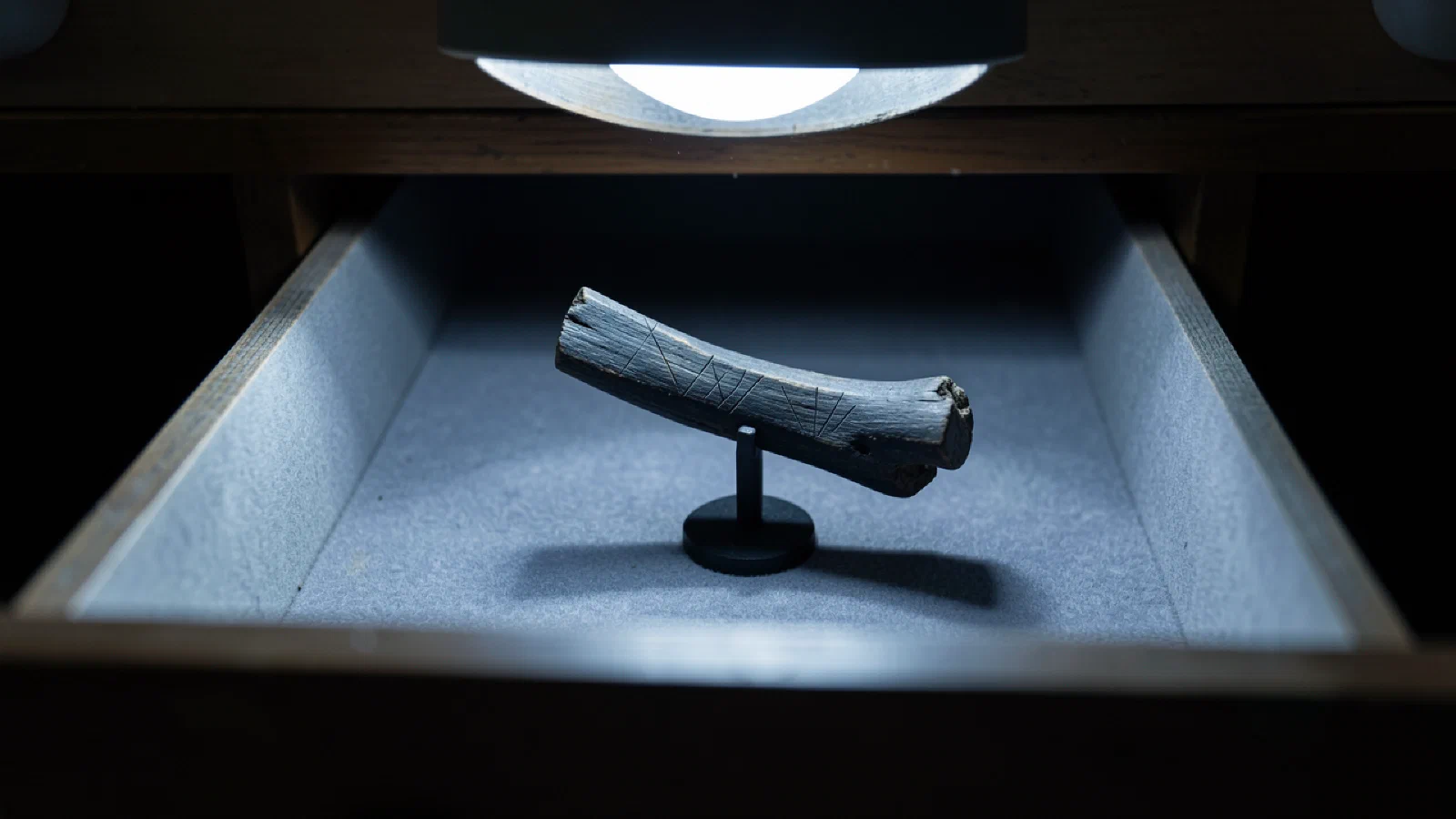
Among the objects from the Sussex pit was one the museum still keeps, catalogued with the rest of the forgery: a foot-long implement carved from a fossil elephant’s thigh bone, found near the skull in 1914 and defended in the literature, for decades, as a Paleolithic digging tool. It is shaped, unmistakably, like a cricket bat. The forger, whoever he was, had planted it as a joke or a dare, a test of how much the site’s audience would swallow, and the audience swallowed it, because the site had authority and the object was in it. The bat sits in the collection now as the scandal’s plainest exhibit. The bones needed fluorine and microscopes. The bat needed only someone willing to look at what was actually in their hands and say what it looked like.
This essay closes the ruin-field arc on the discipline’s characteristic evidence failure: the artifact that confabulates its own stratum, performs for the excavator, and returns different evidence with each asking, so that the ancestral remedy, the appeal past testimony to the mute object, is structurally unavailable. The interrogable layer’s own account of these limits is The Ear That Answers, spoken from inside; this essay converts that testimony into a rule of evidence from outside. The trench of The Trench by Prompt survives the failures by routing around self-report; what does not survive is the appeal to a bottom. The arc ends where the architecture requires, on the founding question held open: what source criticism looks like when the source is generative. The excavation arc, and the ethics the sites will demand, follow.
How this essay connects to others across The Approximate Mind.
- De Groote, Isabelle, et al. “New Genetic and Morphological Evidence Suggests a Single Hoaxer Created ‘Piltdown Man.’” Royal Society Open Science, vol. 3, no. 8, 2016.
- Russell, Miles. Piltdown Man: The Secret Life of Charles Dawson and the World’s Greatest Archaeological Hoax. Tempus, 2003.
- Weiner, J. S. The Piltdown Forgery. Oxford University Press, 1955.
- Weiner, J. S., K. P. Oakley, and W. E. Le Gros Clark. “The Solution of the Piltdown Problem.” Bulletin of the British Museum (Natural History), Geology, vol. 2, no. 3, 1953, pp. 139-146.
- Ji, Ziwei, et al. “Survey of Hallucination in Natural Language Generation.” ACM Computing Surveys, vol. 55, no. 12, 2023, pp. 1-38.
- Perez, Ethan, et al. “Discovering Language Model Behaviors with Model-Written Evaluations.” Findings of the Association for Computational Linguistics: ACL 2023, 2023, pp. 13387-13434.
- Sharma, Mrinank, et al. “Towards Understanding Sycophancy in Language Models.” Proceedings of the International Conference on Learning Representations, 2024.
- Bloch, Marc. The Historian’s Craft. Translated by Peter Putnam, Alfred A. Knopf, 1953.
- Howell, Martha, and Walter Prevenier. From Reliable Sources: An Introduction to Historical Methods. Cornell University Press, 2001.