The Structured Deposit
The counter-case: deposits that were placed, and what placement testifies to
TAM-MDN.1-04 · The Midden · The Approximate Mind
Barry Cunliffe began digging at Danebury in 1969 and did not stop for twenty years. The site is a hillfort in Hampshire, a chalk hilltop ringed with Iron Age ramparts, and Cunliffe, who had excavated a Roman palace by the age of twenty-three and would spend his career alternating grand syntheses with long muddy seasons, returned to it every summer for two decades, a campaign of a length almost nobody attempts. What the hilltop mainly contained was holes. The people of Danebury had cut thousands of pits into the chalk, most of them for storing grain, and over twenty seasons the excavation emptied some two thousand four hundred of them.
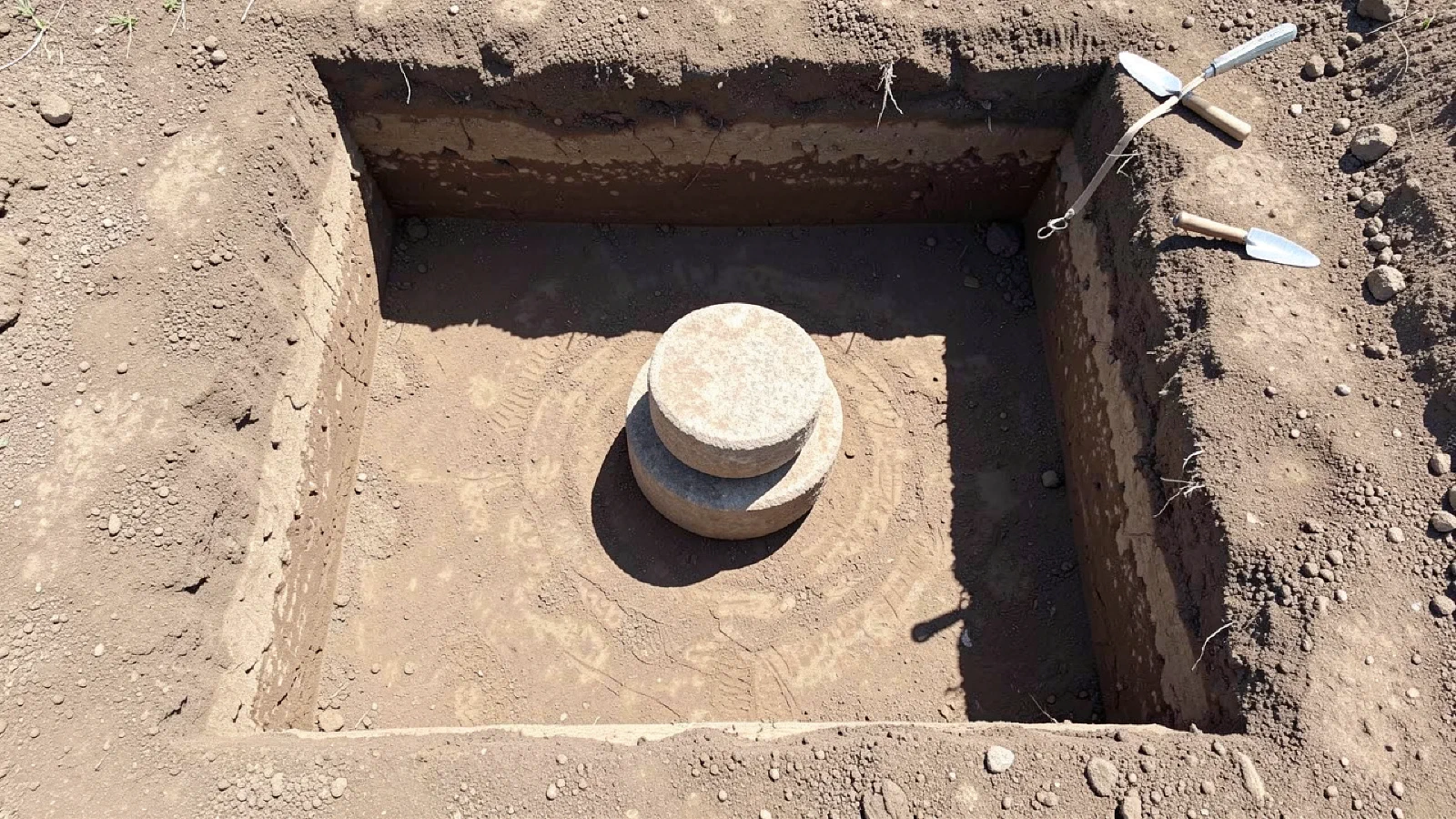
Most held the ordinary ends of ordinary things, the fills an excavator expects, rubbish and rubble and silt. But a persistent minority held something else. A horse’s skull set upright on the pit floor. Dogs, whole, carefully laid. Articulated joints of meat that no hungry community forgets to eat. And again and again, quern stones, the paired grinding stones that turned grain into flour, buried unbroken, sometimes stacked, perfectly good tools placed at the bottom of a hole and covered over.
Archaeology had long owned a word for material like this and had long used it loosely: ritual, the discipline’s traditional name for whatever it could not otherwise explain. The sharpening came in 1984, when Colin Richards and Julian Thomas, analyzing patterned finds at the great Neolithic enclosure of Durrington Walls, gave the phenomenon a colder and more useful name, structured deposition. The claim under the name was that deposits divide. Some material enters the ground casually, as discard, and some enters it deliberately, as placement, and the two kinds can be told apart by pattern: what was chosen, what was arranged, what co-occurs too consistently to be chance. A decade later J. D. Hill tested the idea statistically against the Wessex pits, Danebury’s among them, and found the patterning real, and found something else that matters here: the two kinds are not two piles. They are two ends of a gradient, and most real deposits sit between them, discard shading into decorum, placement diluted with rubbish.
The distinction earned its keep because of what it changes about reading. A midden testifies to how people lived. A structured deposit testifies to what people wanted seen, by gods, neighbors, posterity, whoever the imagined audience of the placement was. Same ground, same trowel, opposite grammar of evidence.
The object arc’s first three essays read the trained model as the first kind of deposit. This one is about the second kind, because the second kind is being deposited right now, at commercial scale, and the difference between the two is about to become one of the more consequential distinctions in the economics of knowledge.
The placed corpus#
Not every model is a heap. A growing class of systems is trained or grounded on corpora that were assembled the way a hoard is assembled: licensed material, vetted material, commissioned material, chosen piece by piece by a depositor with a purpose. The medical model built on the licensed journals and nothing else. The legal model grounded in the authorized reporters. The enterprise system trained on the company’s own approved documents. The education product built from a curriculum. Each of these is an assemblage rather than a sediment, and everything archaeology learned about the difference transfers with uncomfortable precision.
A structured deposit is honest about its contents and silent about its boundary. The horse skull on the pit floor is really a horse skull; nothing about the object lies. What the placement does not disclose, cannot disclose, is the principle of selection, everything considered and not placed, the entire negative space that gave the placement its meaning. The excavator recovers the chosen and can only infer the rejected, and the inference is the hard nine tenths of the interpretation. Hill’s statistics could show that some species went into pits and others almost never did; why, and what the exclusions meant to the people doing the excluding, the pattern alone will not say.
A curated corpus has exactly this structure. Its contents are, if anything, more trustworthy item by item than the heap’s, vetted, provenanced, cleared. Its boundary is where the silence lives. What was offered and declined, what was never sought, which sources were priced out, which perspectives no depositor thought to want: none of that is in the deposit, and the deposit is all a user ever touches.
The curated corpus testifies to what its depositors wanted seen, and the wanting is the one thing it cannot be made to show.
The spread on provenance#
The corpus of essays this series belongs to has spent a great deal of ink on arbitrage, the capture of spreads by whoever stands between what something costs and what someone will pay. Curation is an arbitrage of a particular elegance, and naming its spread precisely is worth a paragraph of care.
What the buyer of a curated model is told they are buying is quality: better material in, better answers out. Sometimes that is even the transaction. But the heap has grown very good. The frontier systems trained on the open sediment are, on most tasks, more capable than the walled deposits, and they improve on a clock the walled deposits cannot match, for reasons the companion series has already given: the sediment is bigger, and bigness is most of the game. So the quality story thins year by year, and what remains under it is the real product. The curated model’s durable offer is not that its answers are better. It is that its answers are warranted. Every statement traces to a licensed, vetted source; nothing in the system came from anywhere disreputable; the provenance is clean and the cleanliness is certifiable.
Look at that offer squarely and its object comes into focus. What is being sold is not the presence of the good material, most of which is in the free heap too, deposited there by the same journals’ preprints, pirated copies, summaries, and echoes. What is being sold is the absence of everything else. The buyer pays for what is not in the deposit.
And an absence is the one thing no audit reaches. Every instrument of verification humanity has built runs on presence: you can test what a system says, benchmark what it does, trace what it contains. The claim that nothing objectionable is in there, that the boundary was drawn where the seller says it was drawn, is checkable only by trusting the depositor’s own records of their own selections, which is not an audit but a testimonial. The spread lives in that unreachable place, and rent always settles where verification cannot follow.
I wonder whether a discipline of reading deposits can ever have much to say about a deposit whose value is its negative space, or whether the structured deposit marks the edge of the readable, the place where the trowel gives way to the subpoena.
Where the placed deposit persists#
The inversion this essay turns on can now be stated in one motion. As knowledge, the curated model is poor, poorer every quarter, against a free alternative that knows more, reasons better, and is more willing, less fenced by the caution a liability-bearing product must carry. As rent, the curated model is durable, and it is durable exactly where exclusion can be enforced.
Map where those places are and the map is familiar. Syllabi, where an institution decides what a student may be taught from. Licensure, where a profession decides what an answer must be traceable to. Procurement, where a purchasing rule decides what a government or hospital or firm may buy. Liability chains, where an insurer decides what a defendant must be able to say they relied on. In each of these the walled deposit does not have to outperform the heap. It has to be the thing the rule permits, and rules change on the slowest clock in the economy. Everywhere else, in the open country where a person just wants the best answer available, the free sediment wins and keeps winning, and the placed deposit loses the argument by never being consulted.
That is the shape of the market: not a victory for either deposit, but a partition, with the boundary drawn by enforceability rather than by quality.
Which raises the question of whether the placement is ever the right thing, and here the essay owes its reader one instrument, stated once and then left alone. Curation earns its keep when the value lies in what was included. It takes rent when the value lies in what was excluded.
Two live deposits, held against it.
A professor who has taught the same subject for twenty-five years builds a course model. Into it goes the accumulated map no publisher owns: where students get lost, in what order the confusions arrive, which example finally makes the third week’s idea land, the misreadings she has watched three thousand students make and can now anticipate by name. Nothing in that deposit is valuable because something else was kept out. The general material is freely available everywhere, better explained by the frontier systems than by any course notes. The value is the placed material itself, the inclusions, a quarter century of witnessed difficulty that exists nowhere else. The test passes, and passes easily.
An enterprise buys the authoritative corpus: the licensed model, certified free of everything unvetted, sold to the general counsel as the system whose answers can be defended in a deposition. Ask what the buyer is paying for and the honest invoice reads: the exclusions. The knowledge inside is a subset of the free heap. The premium is for the boundary, and the boundary’s value exists only because a rule somewhere makes the boundary mandatory. The test fails, and the failure is not a scandal, it is a description: this is rent on provenance, purchased because verification cannot reach an absence and a liability chain demands something purchasable in its place.
The same act of placement, run through the same test, comes out as stewardship in one pit and as toll collection in the other.
Which is why the essay refuses the ending its own setup keeps offering. It would be tidy to close on a two-class future, the free sediment for the many and the walled deposits for the institutions, honest heap below, rent-bearing hoard above. The tidiness should be distrusted, and Hill’s gradient says why. Deposits do not divide into two classes; they distribute along a line, and almost everything real sits in the middle. The professor’s model rests on a foundation of open sediment. The enterprise corpus leaks, because its authors read everything before writing the approved documents. The heap is full of placed material, press releases and sponsored prose deposited into the open precisely to be harvested, structured deposits dressed as rubbish. And the great foundation systems are themselves middens with increasingly structured upper layers, licensed strata laid deliberately over the scraped deep. The dichotomy is the frame, not the finding. What the finding says is only this: for any given deposit, ask where its value sits, in the contents or in the boundary, and read it accordingly.
The querns are the part of Danebury that stays in the mind. A quern was not refuse and not treasure; it was the tool that stood between grain and bread, the most ordinary indispensable object a household owned. Somebody carried them to the empty pits whole, in working order, and set them down, and filled the holes. Twenty seasons of excavation recovered them by the dozen and could establish everything about them except the reason, which was the only thing the deposit was for. The people of the hilltop placed exactly what they meant to place. What they meant by it went wherever meanings go, and the stones have been holding the gesture ever since, mute, deliberate, and perfectly preserved.
This essay closes the object arc of The Midden by establishing the object-class distinction the method arc requires: the midden against the structured deposit, casual discard against deliberate placement, with curated corpora read as the second kind. It carries the series’ knowledge-arbitrage claim, the spread priced on provenance and the absence no audit reaches, and states the legitimacy test once. The toll structure it describes belongs to The Gatekeepers in the Arbitrage series; who specifies a commissioned corpus belongs to The Commissioner; what a sorted corpus does to variety is The Monoculture’s subject; and what the open heap already omits is The Borrowed Voice’s. The gradient between the two deposit classes, taken from the structured deposition literature itself, is why the essay declines the two-class future its argument keeps offering.
How this essay connects to others across The Approximate Mind.
- Cunliffe, Barry. Danebury: Anatomy of an Iron Age Hillfort. B. T. Batsford, 1983.
- Garrow, Duncan. “Odd Deposits and Average Practice: A Critical History of the Concept of Structured Deposition.” Archaeological Dialogues, vol. 19, no. 1, 2012, pp. 85-115.
- Hill, J. D. Ritual and Rubbish in the Iron Age of Wessex: A Study on the Formation of a Specific Archaeological Record. BAR British Series 242, Tempus Reparatum, 1995.
- Richards, Colin, and Julian Thomas. “Ritual Activity and Structured Deposition in Later Neolithic Wessex.” Neolithic Studies: A Review of Some Current Research, edited by Richard Bradley and Julie Gardiner, BAR British Series 133, 1984, pp. 189-218.
- Bradley, Richard. The Passage of Arms: An Archaeological Analysis of Prehistoric Hoards and Votive Deposits. Cambridge University Press, 1990.