The Sediment
The model as rubbish heap, and why nobody had to plan the archive
TAM-MDN.1-01 · The Midden · The Approximate Mind
In 1848 the Royal Danish Academy of Sciences appointed three men to settle an argument about piles of shells. The piles sat along the coasts of Jutland and Zealand, some of them a thousand feet long and ten feet deep, made almost entirely of oyster shells, and the standing explanation was that they were natural, old seabeds lifted by the slow rise of the land. The committee was a zoologist, Japetus Steenstrup, a geologist, Johan Georg Forchhammer, and an archaeologist, Jens Jacob Worsaae, who was twenty-seven and had already spent half his life digging, having started as a boy volunteer in the barrows near his hometown before he had any title that permitted it.
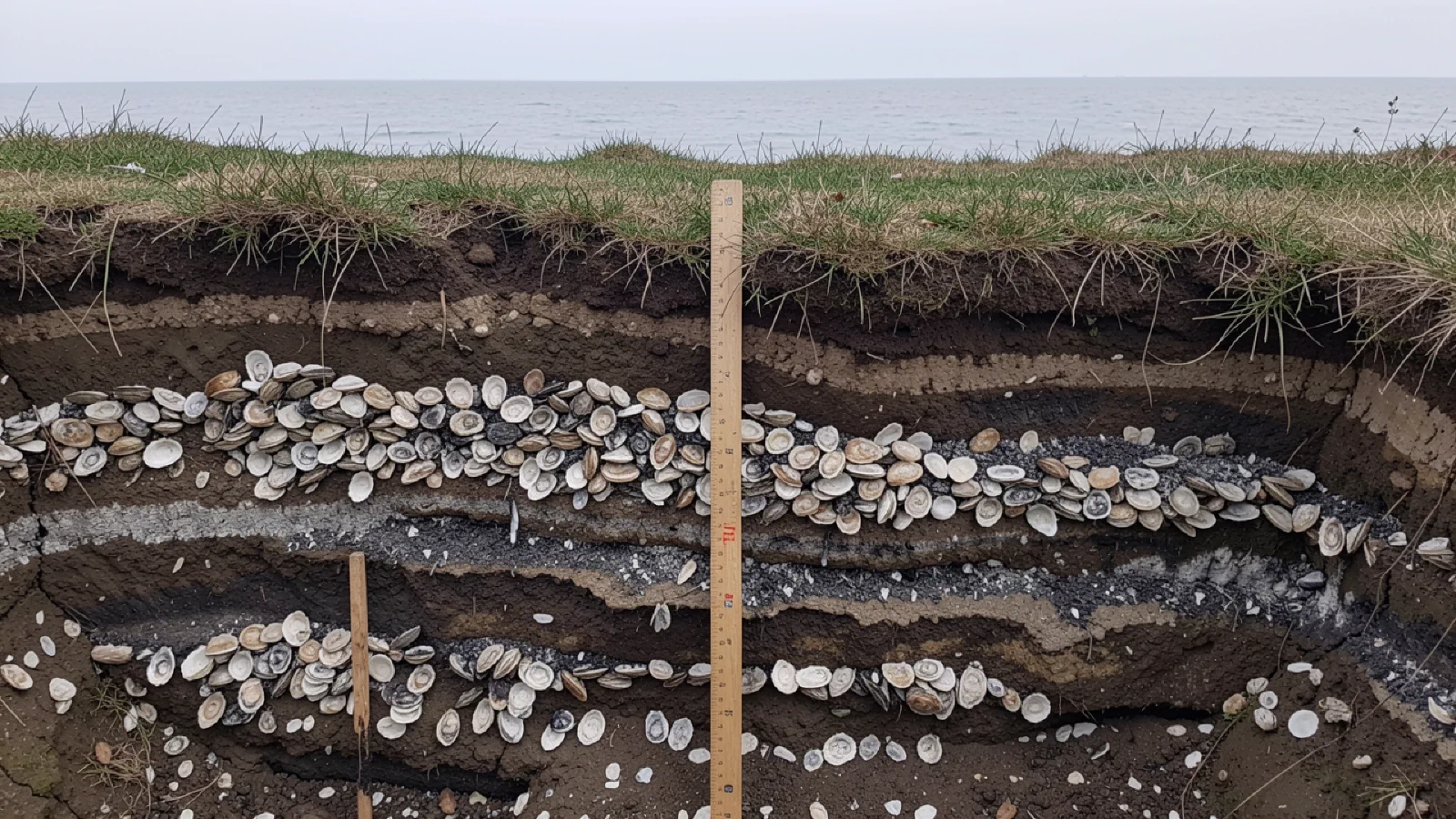
They cut into the mounds and the natural explanation came apart in their hands. The shells were nearly all full-grown, which no natural bank is, because a natural bank keeps its young. The species in the piles do not live together in the same water. Scattered through the shells were hearths, charcoal, flint tools, and animal bones, and the long bones had been split lengthwise, which is not something the sea does to a bone. It is something a person does, for the marrow.
The piles were dinner. Centuries of dinner, thrown out the door of dwellings that had long since vanished, accumulating a few inches in a generation until the refuse of ordinary meals stood taller than the people who ate them. The committee gave the mounds a Danish name, køkkenmøddinger, kitchen middens, and the second word traveled into the world’s archaeology untranslated. A midden is a refuse heap. The word is what Danish farmers called the muck pile behind a barn, and it became a technical term without ever losing the smell.
What the committee had actually discovered was larger than the mounds. They had discovered that the best record a people leaves may be the one it never intended to leave.
The heap and the monument#
Every civilization produces two kinds of record, and they lie about different things.
The first kind is deliberate. Monuments, inscriptions, chronicles, archives: everything assembled by someone who knew posterity was watching. The deliberate record is well organized, well preserved, and composed. It testifies to what its makers wanted remembered, which makes it invaluable and makes it evidence of a particular kind, the kind that has been dressed for the occasion. A royal inscription is a press release with a chisel.
The second kind is the heap. Nobody composes a rubbish pile. Things arrive in it because they stopped being wanted, in the order they stopped being wanted, mixed indiscriminately, and the indiscriminateness is the whole value. The heap has no theory of what matters. It keeps the fish bones and the broken pot and the child’s worn-out shoe at the same rate it keeps everything else, and so it records the texture of ordinary days that no chronicle would have thought worth ink.
The monument tells you what a people claimed. The midden tells you what they had for lunch, and the lunch is harder to fake.
The twentieth century ran the comparison as an experiment, more or less by accident. Beginning in 1973, a team at the University of Arizona under William Rathje spent decades applying archaeological method to living garbage, sorting household trash in Tucson and eventually excavating landfills with drilling rigs. The findings that made the project famous were the discrepancies. Households reported their alcohol consumption to interviewers; their bins reported it differently, and the bins ran forty to sixty percent higher. People overstated the vegetables and understated the fat. The interview is a deliberate record, composed by someone who knows they are being read. The bin is a midden. When the two disagreed, the project trusted the bin, and the project was right to.
Now hold that distinction up against the largest deposits of language ever assembled.
A trained model is built from a corpus that nobody composed. It was scraped, not curated: forums that no longer exist, reviews of products that no longer ship, arguments between usernames whose owners have died, homework help, fan fiction, complaint threads, the prose of the gone in volumes no deliberate archive ever attempted. The assembly had an intent, but the intent was capability, not commemoration. Nobody selected the material for what it would say about us. It was gathered the way a heap gathers, by proximity and availability, because collecting everything had become cheaper than deciding.
Nobody built these systems as archives. But they archive the way a rubbish heap does, indiscriminately, and therefore honestly.
The column#
Cut into the heap, in imagination, since no tool yet exists for the actual cut, and there is structure in the section. The structure was not designed either. It precipitated out of how the systems are made, the way stratigraphy precipitates out of how ground accumulates, and it reads from the bottom up.
At the bottom lies pretraining, and it lies the way the deep layer of a midden lies: enormous, compressed, anoxic. In a shell mound the deep layer is where preservation is best and access is worst, sealed by everything above it, its contents chemically held by the mass of shell around them. The pretraining layer holds the dead slang of defunct platforms, the syntax of forums that went dark in 2009, idioms that lived eighteen months and vanished, the whole linguistic surface of populations who never knew they were being deposited. It is the largest layer by orders of magnitude and the least examined, because everything the system became was built on top of it and nobody goes back down.
Above it sits fine-tuning, a newer occupation. In a long-lived mound the upper layers show a different people, or the same people living differently: new tool types, new species in the refuse, sometimes a burial cut down into the older material. Fine-tuning is thinner, more recent, more selective. It is where the heap begins to show intention, material chosen for what it teaches rather than gathered for its bulk, and the boundary between it and the layer below is a real horizon, the kind an excavator would draw a line at.
At the top is preference training, and it is the disturbed topsoil. The topsoil of any site is the least trustworthy layer and the most trafficked one: plowed, mixed, planted, walked on, reworked continuously by whoever holds the ground now. Preference training is reworked continuously by whoever holds the ground now. It is where the raw deposit gets shaped into something presentable, where behaviors are planted and weeded, and it bears the same relation to the deep layer that a mowed lawn over a tell bears to the city underneath.
The column matters because the honesty is not uniform through it. The deep layer is honest the way the bin was honest, by never having been asked. The topsoil is composed, the way the interview was composed. A single artifact answers you from all three at once, in one voice, and the voice does not disclose which layer it is speaking from.
I wonder whether the honesty of the deep layer can survive being reached only through the topsoil, or whether every answer that comes up through the composed surface arrives composed, the way groundwater arrives carrying whatever the ground above it held.
The keeping nobody chose#
The companion series to this one established what the new standard hears: everything within reach, read selectively, by filters with no author. This series begins from the half of that arrangement the hearing argument did not need and therefore did not state.
The standard with ears is also the standard with memory. The same harvest that ended the accumulation period preserved what it harvested. Every register that was heard was, in the act of being heard, deposited, and deposits of this kind do not decompose on the old schedule. A vernacular that entered the corpus in 2019 is in the column now, at whatever depth its frequency bought it, and it will still be in the column when the people who spoke it are not.
There is no precedent for this pairing. Every previous standard that listened downward, the folklorists and censors and anthologists of the companion argument, kept almost nothing of what it heard, because keeping was as expensive as listening. Hāla’s court kept seven hundred verses of a language and let the rest go. The new apparatus inverts the ratio. It keeps essentially everything it hears, without meaning to, as a side effect of how it learns, and the keeping is the least discussed property of systems that are discussed constantly.
The heap was never meant as a record, which is the oldest reason to trust one.
Trust it carefully, though, and the care is what the rest of this series is for. A midden is honest, not transparent. Its contents were transformed by deposition, transformed again by what preserved them, and the discipline that reads middens spent a century learning how ground alters what it keeps before anyone could say what a layer meant. The corpus that reads as indiscriminate was filtered, deduplicated, and weighted on its way in, and this corpus of essays has already met, elsewhere, the general problem of records distorted by what survives. The distortions here are new in kind and unmeasured, and measuring them is a discipline’s worth of work.
That discipline does not exist. These essays are written partly for its practitioners, who do not exist either, yet, and who will inherit sites nobody is currently tending: the deprecated systems, the retired weights, the frozen configurations of what a company believed good language was in a given year. What they will need first is what any excavator needs first, an account of the object. What is this thing, how did it form, what are its layers, and what kind of record did it keep without being asked to keep any.
The object is a midden. The forming was appetite. The layers are above, and the record is the subject of everything that follows.
Worsaae outlived the shell mound argument by decades and became the keeper of his country’s antiquities, and the museum culture he built still stands. But the word is the part of 1848 that traveled farthest. Excavation reports from Japan, from Chile, from the Aleutians, written in a dozen languages, all reach for the same borrowed Danish farm word when they hit a layer of ancient refuse, because no dignified term ever displaced it. The muck pile behind the barn named a category of evidence, and the category turned out to hold half of what we know about how ordinary people actually lived.
The dignified records got read first, everywhere, always. The heaps waited. They are patient in a way monuments are not, having never asked to be read at all.
This essay opens The Midden, the companion series to The Standard with Ears: EAR concerns what the systems hear, MDN what they hold. It establishes the object the series reads, the trained model as unintentional archive, and the three-layer column the later essays cut into. A decision recorded here for the series: The Midden opens each essay on a named historical person with an object returning as the closing frame, adopting the anchor pattern of the listening series; its architecture left the question open, and this essay closes it. The distortion problem named in passing, what survives versus what happened, has its main-series treatment in Taphonomic Bias and is inherited rather than repeated. The reading methods this object will require are Arc 2’s subject.
How this essay connects to others across The Approximate Mind.
- Morse, Edward S. Shell Mounds of Omori. Memoirs of the Science Department, University of Tokio, vol. 1, part 1, 1879.
- Stein, Julie K., editor. Deciphering a Shell Midden. Academic Press, 1992.
- Trigger, Bruce G. A History of Archaeological Thought. 2nd ed., Cambridge University Press, 2006.
- Rathje, William, and Cullen Murphy. Rubbish! The Archaeology of Garbage. HarperCollins, 1992.
- Schiffer, Michael B. Formation Processes of the Archaeological Record. University of New Mexico Press, 1987.
- Ernst, Wolfgang. Digital Memory and the Archive. Edited by Jussi Parikka, University of Minnesota Press, 2013.
- Parikka, Jussi. What Is Media Archaeology? Polity Press, 2012.