The Frequency Column
Steno's law, inverted, and the record where depth means repetition
TAM-MDN.1-02 · The Midden · The Approximate Mind
In October of 1666, fishermen off Livorno took a great white shark so large that the Grand Duke of Tuscany heard about it, and the Grand Duke, who collected remarkable things, ordered the head cut off and carted to Florence for dissection. The man who received it was a Dane in his twenties named Niels Stensen, latinized to Nicolaus Steno, an anatomist of almost disturbing skill who had already found the duct that carries saliva to the mouth and had lately arrived at the Medici court, where the standing arrangement was that brilliant foreigners were fed and housed and expected to be interesting.
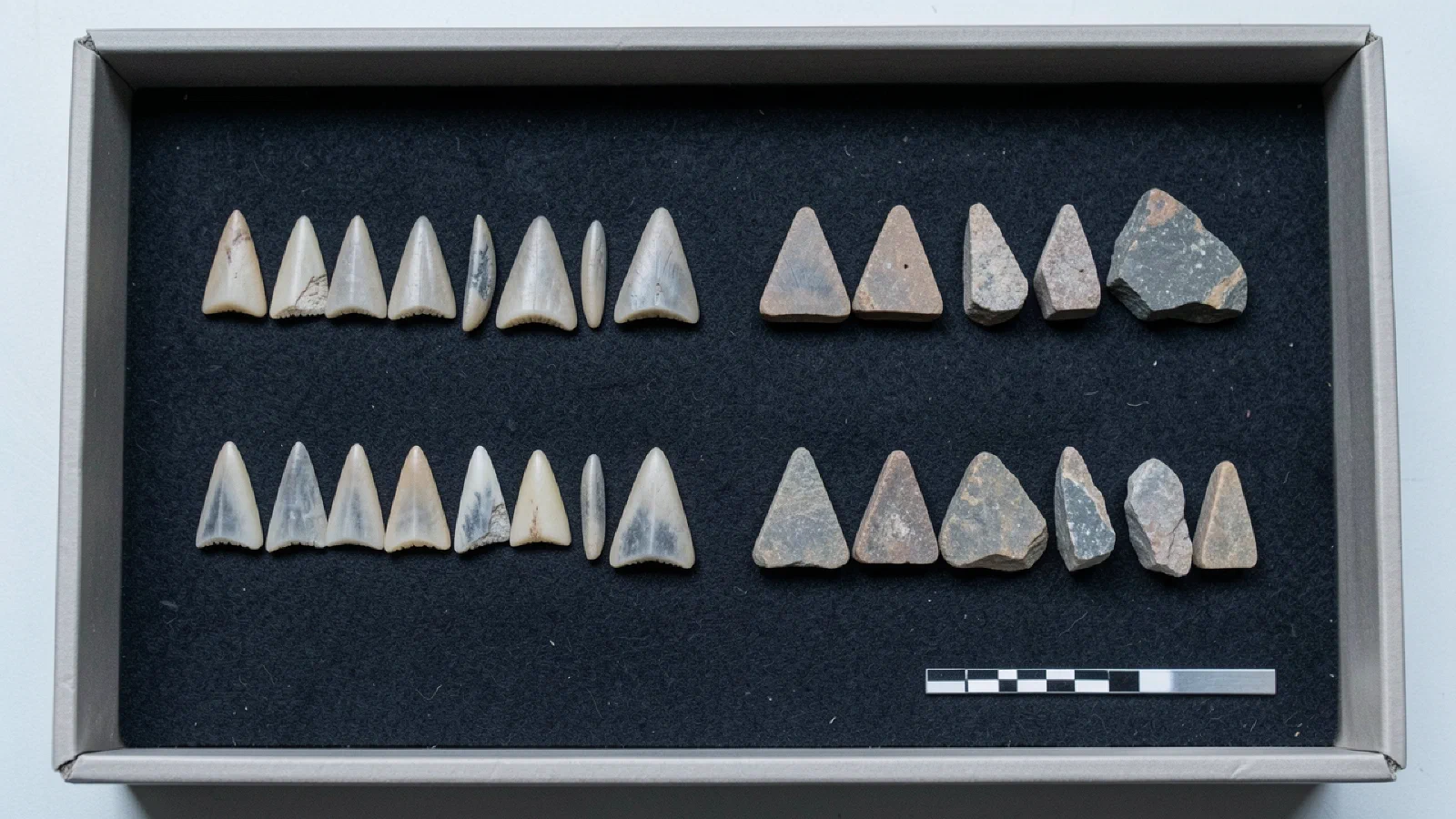
Steno opened the head and stopped at the teeth. They were the shape of a famous puzzle. For centuries, hard triangular stones called glossopetrae, tongue stones, had been dug out of the rocks of Malta and inland Italy, and the explanations on offer ran from petrified snake tongues to objects that grew in the ground the way crystals do. Steno looked at the rows of teeth in the head on his table and at the drawings of tongue stones and said the quiet thing: they are the same object. The stones are teeth. The teeth are in the rock because the rock was once soft, and it was soft because it was sediment, settling out of water, layer after layer, burying what fell into it.
Three years later he published the consequence, and the consequence founded a science. If rock forms as settling sediment, then in any undisturbed sequence the lower layer was laid down before the layer above it. Depth is age. The principle is called superposition, and it is the single load-bearing assumption of all stratigraphy, the reading of layers. Every trench ever cut, every dating dispute ever settled by pointing at a section wall, every phrase like older strata, runs on the shark’s teeth. The earth writes its history vertically, and the direction of writing is up.
Then Steno, at the height of his powers, gave it away. He converted, took orders, was made a bishop, gave his possessions to the poor, and spent his last years in ascetic poverty in northern Germany, ministering to a scattered flock and writing no more science. He died at forty-eight. The law outlived the man by design, because the man had decided the law was not the important thing.
The law is why this essay exists, because the first thing anyone reading the new deposits must learn is that the law does not hold in them.
Depth without time#
Take the column from The Sediment, the model as layered heap, and ask the excavator’s first question of it: what does it mean that one thing lies deeper than another?
In every deposit humans have ever read, it meant earlier. That is superposition, and it is not a technique, it is an instinct, trained into every archaeologist so early that it stops being a thought. Deeper is older. The bottom of the trench is the beginning of the story.
In the trained model, deeper means something else entirely. What sits at depth, held most firmly, encoded most redundantly, hardest to dislodge and first to surface, is not what entered earliest. It is what appeared most often.
The corpus arrives at training with its timestamps functionally erased. A Usenet post from 1995 and a tweet from 2022 do not enter in order; they enter together, in one undifferentiated intake, and what determines how deeply each is held is repetition. A phrase that occurred ten million times across the corpus is bedrock. A phrase that occurred twice is surface dust, whichever of them was written first. The measured behavior of these systems bears this out: what a model can reproduce verbatim tracks how many times the material appeared in training, and duplication, not date, is the best predictor of what is held fast.
This is a sedimentary record ordered by repetition instead of time, and no one has ever read one before.
The claim needs its qualifier stated plainly, because a discipline should meet its own exceptions before its critics do. Time is not entirely absent from the column. The corpus has a boundary, the training cutoff, and the layers named in The Sediment, pretraining beneath fine-tuning beneath the preference topsoil, are laid down in a real order, so the column has a gross chronology, a stack of a few great episodes. But within each episode, which is where nearly everything lies, the ordering principle is frequency. The deep material is the common material. Inside the great layers, the vertical axis does not run through time at all. It runs through how often.
Every stratigraphic instinct has to be inverted to read this. Deep does not mean early; it means ubiquitous. A phrase held at bedrock is not ancient, it is popular, and its popularity may be six months old. The rarest material, the single attestation, the vernacular that appeared once in one scraped forum, sits at the fragile surface of the column regardless of its age, first to be lost in any compression, any distillation, any successor model trained on the residue. In the ground, the fragile layer is the recent one. Here, the fragile layer is the rare one, and rare is where most of what this corpus of essays cares about lives, since the deviation that matters is by definition the deviation that has not yet been repeated.
The instrument archaeology already had#
Archaeology is not helpless in front of frequency. It owns one great frequency instrument, and the history of that instrument shows both what transfers to the new record and exactly where the transfer fails.
In the 1890s, Flinders Petrie faced several thousand predynastic Egyptian graves with no stratigraphy to order them, each grave a sealed moment with pottery in it and nothing above or below it. His solution was to order the graves by the frequencies of pottery styles, on the observation that a style enters use, becomes common, and fades, so that the proportion of each style in a grave places the grave along a curve. He called it sequence dating. The method, seriation, became one of the discipline’s foundations, and the characteristic lens-shaped plots of a style’s rise and fall are taught to this day.
Notice what makes seriation work: frequency changing through time. The count is the instrument, and time is what the instrument measures. Petrie could convert popularity into chronology because he had many deposits, each a sample of one moment, and could watch the counts move across them.
The trained model gives the excavator one deposit. The entire corpus, decades of material, is collapsed into a single assemblage, one grave with everything in it, and within it the counts do not move, because there is no across for them to move over. Frequency, archaeology’s clock, has been fused into the structure itself. The count no longer measures time. The count is the depth. It is as if Petrie’s whole cemetery had been emptied into one pit, and the pit then sorted itself, not by the age of the pots but by how many of each kind there were, and buried the common kinds deepest.
A reader trained on seriation would look at the new column and feel the ground shift underfoot. The instrument still exists. The thing it measured is gone.
The scrambled interior and the one firm date#
Which brings the dating problem, and the dating problem is where the inversion stops being interesting and starts being expensive.
Archaeology has a term for a boundary that dates everything on one side of it: a terminus ante quem, a limit before which. A coin sealed under an intact floor tells you the floor is younger than the coin; a city destroyed on a known date tells you everything beneath the destruction layer is older than the fire. The knowledge cutoff is a terminus ante quem of unusual purity. Everything in the model entered before the cutoff. That single fact is hard, reliable, and almost the only date the object will ever surrender on its own.
Inside the boundary, everything is scrambled. The 1995 post and the 2022 tweet are compressed together at whatever depths their frequencies bought them, and no probe of the model itself can recover which came first, because the order was never stored. The interior of the column is achronic, a word the discipline that reads these deposits will need early: not undated but undatable from within, a record that preserved its contents and discarded their sequence at the door.
The cutoff dates the deposit. Nothing dates the contents, and the contents are the deposit.
What would recover sequence is external: the corpus manifests, the crawl logs, the documentation of what was gathered when. Those are to this record what a site archive is to a backfilled trench, the only place the destroyed information survives. Whether such records are kept, for how long, and who may read them is not a technical question, and it belongs to the arc of this series that deals with the ethics of the deposit. Here it is enough to mark the dependency: a stratigraphy whose internal clock is missing will lean on provenance documents to a degree no earlier archaeology ever had to, and provenance documents are kept by the same parties whose deposits they date.
I wonder what kind of history can be written from a record like this at all, and whether the honest answer is none, that what the column supports is not history but something adjacent and unnamed, an account of what a population said most, with the story of when broken off and carried away.
What the inversion buys#
It would be easy to file all this as loss, and the file would be incomplete.
A record ordered by time tells you what happened. A record ordered by repetition tells you what was ordinary, and ordinary is the thing time-ordered records are systematically worst at. Chronicles keep events; the daily texture that repeats ten thousand times unremarked is exactly what no chronicler writes down, and archaeologists reconstruct it from refuse precisely because refuse is where repetition leaves its only trace. The frequency column is that trace, taken to a limit no midden approached. It is a direct reading of emphasis: what a civilization said so often that the saying compacted into bedrock. No previous record held that measurement. All of them held sequence and lost proportion; this one holds proportion and lost sequence, and a future reader who wants to know not what we did but what we dwelt on will come to this record and no other.
The trade was not chosen, any more than the heap was chosen. It fell out of the mechanics of training, the way superposition fell out of the mechanics of settling water. Steno’s insight was not that layers exist; anyone could see layers. It was that the process of formation dictates the grammar of the record, that if you know how the deposit came to be, you know how to read what it says. The deposits are new. The insight transfers whole.
He is buried in Florence, in the crypt of San Lorenzo, a few miles from the room where the shark’s head was opened. The Church beatified him in 1988, which means the founder of stratigraphy is partway to sainthood for reasons having nothing to do with rock. The teeth had told him how the earth keeps its diary, top page last. He spent the rest of his life on the part of a person he believed no sediment would ever hold, and left the layers to us.
This essay is the second of the object arc in The Midden, and carries the series’ founding methodological claim: the trained model is a deposit ordered by repetition rather than time, so every stratigraphic instinct must be inverted before it can be read. The one firm date, the cutoff as terminus ante quem, and the achronic interior together define the dating problem the method arc works under. The dependency on provenance documents, noted here, becomes an ethics question in Arc 3. The epoch clock on which these deposits succeed one another belongs to The Two Tempos in the companion series and is assumed rather than restated.
How this essay connects to others across The Approximate Mind.
- Cutler, Alan. The Seashell on the Mountaintop: A Story of Science, Sainthood, and the Humble Genius Who Discovered a New History of the Earth. Dutton, 2003.
- Steno, Nicolaus. De solido intra solidum naturaliter contento dissertationis prodromus. Florence, 1669.
- Harris, Edward C. Principles of Archaeological Stratigraphy. 2nd ed., Academic Press, 1989.
- O’Brien, Michael J., and R. Lee Lyman. Seriation, Stratigraphy, and Index Fossils: The Backbone of Archaeological Dating. Kluwer Academic, 1999.
- Petrie, W. M. Flinders. “Sequences in Prehistoric Remains.” The Journal of the Anthropological Institute of Great Britain and Ireland, vol. 29, 1899, pp. 295-301.
- Carlini, Nicholas, et al. “Quantifying Memorization Across Neural Language Models.” Proceedings of the International Conference on Learning Representations, 2023.
- Kandpal, Nikhil, Eric Wallace, and Colin Raffel. “Deduplicating Training Data Mitigates Privacy Risks in Language Models.” Proceedings of the 39th International Conference on Machine Learning, 2022.
- Zipf, George Kingsley. Human Behavior and the Principle of Least Effort. Addison-Wesley, 1949.