The Amber Question
Vernaculars used to die with their last speaker; now they die into weights
TAM-MDN.1-03 · The Midden · The Approximate Mind
Ned Maddrell was born in 1877 in Corvalley, near the southern tip of the Isle of Man, and as a small boy he was sent down the road to Cregneash to live with a great-aunt who was deaf and had little English. The arrangement was practical, somebody was needed in her house, and its side effect was a childhood conducted in Manx, the island’s own Gaelic, in one of the last villages where that was still possible. He went to sea young, as Manx boys did, worked boats far from the island, and came home decades later to fish and to farm a little, carrying a language that had meanwhile been dying behind his back.
It had been dying the ordinary way, which is not by prohibition but by arithmetic. Parents concluded, one kitchen at a time, that English fed a child better, and each such conclusion subtracted a household, until the speakers could be counted, then named, then visited.
In 1947 Éamon de Valera, then Taoiseach of Ireland, stopped at the island and was taken to meet some of the remaining speakers. What he heard alarmed him enough that the following year the Irish Folklore Commission’s mobile recording unit crossed the sea, a van fitted with disc-cutting equipment, and drove the island’s lanes collecting the voices of the last generation. Maddrell was one of them. He was seventy-one, cheerful on the discs, telling stories and naming the fields. He outlived nearly all the others, became for his final years a destination for linguists and learners, and died in December 1974, after which, by the usual definition, no native speaker of Manx was alive anywhere.
For all of human history before roughly 1900, that sentence would have been the end of the record. The language would have kept a ghost life in place-names and a word-list some clergyman made, and the sound of it, the thing itself, would be gone the way a smell is gone.
The van changed the ending once. What this essay is about is the second change, which is stranger.
Three ways for a language to be dead#
A vernacular that died before recording died completely. This deserves a moment’s weight, because the completeness is hard to feel from inside a documented age. When the last speaker of a pre-modern vernacular died, everything not written down, which was nearly everything, ceased to exist in any form, anywhere, at any level of any archive. Not lost in the sense of misplaced. Lost in the sense that the universe no longer contained it. The great majority of all human languages ended exactly this way, and we do not even know how many, because a thing that vanishes completely takes the count of itself along.
A recorded language dies into an archive. This is the Maddrell ending. The discs hold his voice, and the voice is real, his and no one else’s, saying particular things on a particular afternoon. But an archive is inert. It will say, forever, only what was said into it. A learner can listen, imitate, and rebuild, and on the island learners did, but the rebuilding is human work performed on a fixed residue, and the residue is tiny: some hours of elderly voices, a grammar, texts. The archive preserves samples of a language the way a herbarium preserves samples of a meadow, pressed flat, true, and finished.
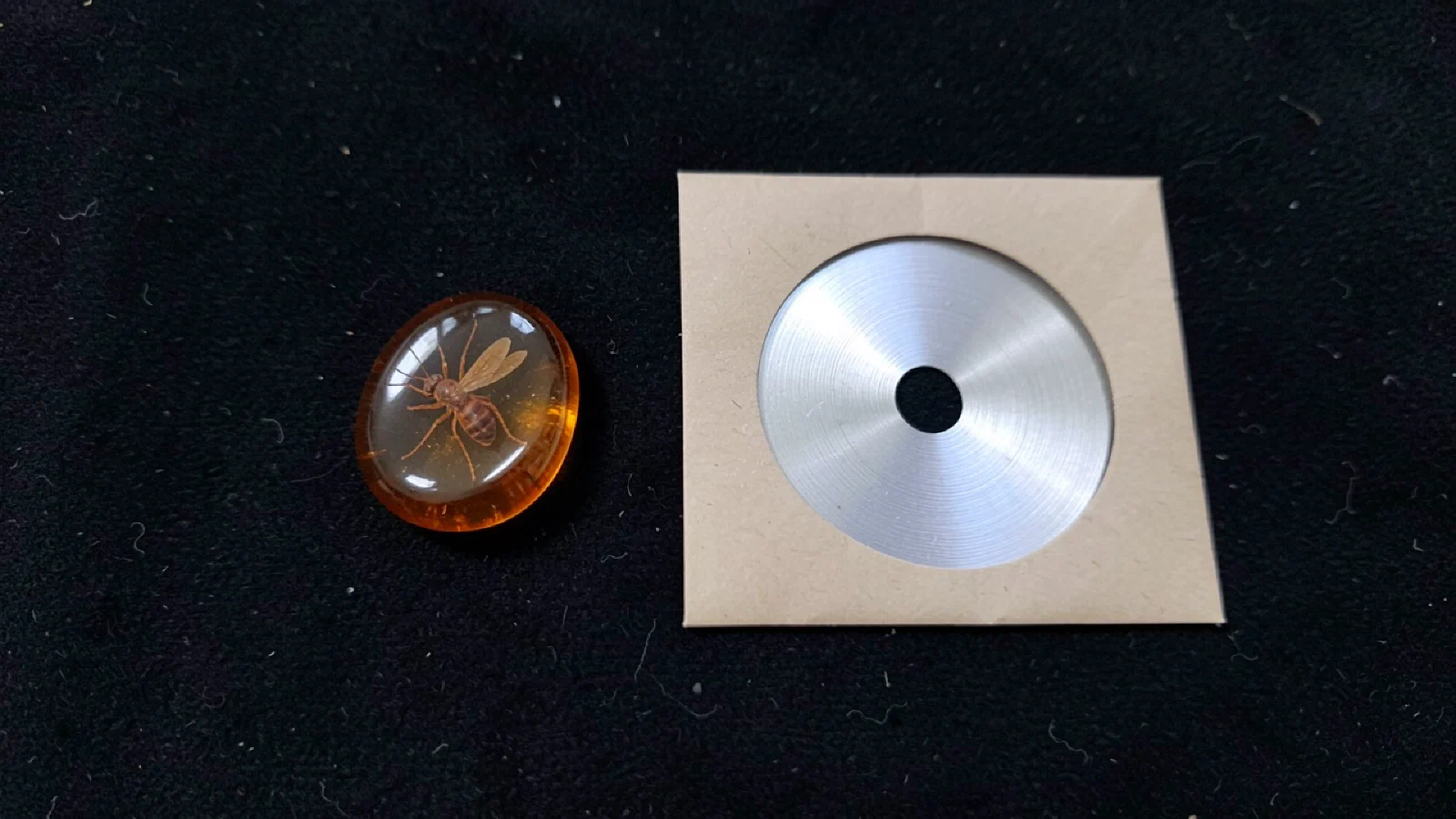
The third death is new, and most of the vernaculars now alive will die this way if they die. A register that existed anywhere in the harvest, in the scraped forums and transcribed talk and captioned video of the great intake, went into the column, and the column is not inert. A model holds the linguistic surface of a given year in amber and can speak it on request. Not replay it. Speak it: produce new sentences in it, answer questions in it, continue in it, at any length, on subjects its speakers never addressed, for as long as anyone keeps asking.
The herbarium pressed the flower. The amber holds it whole, and this amber answers.
The word amber is doing precise work. Amber is a preservation without process: the insect inside is complete, articulated, visible from every side, and stopped. Nothing in amber decays, and nothing in amber lives. What the weights hold is a vernacular’s surface at the moment of harvest, complete to whatever depth its frequency bought it in the column, arrested there, and, unlike every previous arrest, interrogable.
What answers when the amber answers#
Ask what, exactly, speaks when a model speaks a dead or dying register, and the answer degrades the miracle in three steps, each of which has to be stated and none of which settles the question.
First, what answers is a composite. Maddrell’s discs are Maddrell. The amber is everyone the harvest reached, fused, the register as a statistical whole with no one inside it. The Frequency Column established that the column keeps proportion and discards sequence; it discards persons the same way. What speaks is the vernacular’s average voice, which is a voice that never belonged to anybody, saying things nobody said, fluently.
Second, what answers cannot change. A living vernacular is a negotiation, drifting continuously under the pressure of the people using it. The amber register is fixed at harvest. It will be spoken identically in fifty years, identically in five hundred, immune to the drift that was the sign of its life. Dante had a name for a language deliberately held immune to change: grammatica, the constructed kind, Latin, the kind you learn from a schoolmaster because no one is born into it. Every vernacular in the amber has been converted, without anyone deciding it, into a small grammatica. The channel of the nursemaid ends; the channel of the schoolmaster, or of the machine that has replaced him, is the only one left.
Third, what answers answers through the topsoil. The deep layer holds the register; the composed surface layers hold the manner of everything the system says, and a request for the old vernacular is served up through that surface the way groundwater comes up through soil. Some of what arrives is the register. Some is the house style of the machine, wearing it. From outside, and this matters for everything the method arc will attempt, the two are not reliably distinguishable.
So the inventory reads: a composite with no speaker, arrested against change, delivered through a stylist. Said that way, the amber sounds like taxidermy, and taxidermy is the honest word for the fear. A mounted animal is complete, lifelike, posed by someone who was not the animal, and the better the taxidermy the worse the uncanniness, because the craft aspires to exactly the thing its object no longer has.
But said only that way, the account has quietly cheated, because it has measured the amber against the living language, and the living language is not the alternative. The alternative is the first death, the complete one. Against the herbarium, the amber is fabulously rich. Against silence, the amber is a miracle. The children of the island rebuilt a spoken Manx from far less than this, from hours of discs and a shelf of texts, and what they rebuilt is alive by any test you can put to a language: children quarrel in it.
Which is where the question refuses to close, and it should be allowed to refuse. In 2009 the UNESCO atlas of endangered languages listed Manx as extinct. The children of the Bunscoill Ghaelgagh, the island’s Manx-medium primary school, wrote to UNESCO asking, in Manx, that if their language was extinct, what language were the letters written in. The classification was revised. The children were right, and the atlas had not been foolish either; it had applied the old definition, the chain of native transmission, and the chain had truly broken with Maddrell. What the letters proved was that a language can return from an archive changed, learned rather than inherited, reconstructed around a gap, and still be alive enough to write an indignant letter in. Whether it is the same language that died is a question the living speakers have little patience for, and their impatience is itself part of the answer.
The amber offers the next revival, whenever it comes, a resource of a different order: not hours of one old man but the interactive surface of the whole register, ready to converse with the learner in it. And it offers this through a composite, arrested, styled, with everything that inventory means, and no one has yet learned a language from an amber, so no one knows what such a language would be.
I do not know whether the amber is preservation or taxidermy, and I have come to think the not-knowing is not a failure of the argument but a property of the object, which will hold the pose either way, for as long as the weights are kept, waiting for someone whose asking decides it.
The scale of the pose#
One island is a story. The amber is not one island.
Every register the harvest reached is in the column at some depth: the vernaculars of a few hundred million people, the trade jargons, the dialect jokes, the codes of scenes that dissolved before anyone studied them, the specific online English of specific years, which is already gone from use and already speakable on request. Most of these were never going to get a van. The recording century archived the languages that found a champion, a Maddrell met by a de Valera, and let the rest take the first death as before. The harvest, having no theory of what mattered, took everything at once, which means the amber is the first preservation in history to be as indiscriminate as the dying.
For the languages nobody was going to record, the choice was never between the amber and the meadow. It was between the amber and nothing.
That does not resolve the question. It relocates it, from the registers that had alternatives to the thousands that never did, and for those the pose in the amber is the entire estate.
Maddrell told his visitors, near the end, that he could remember being a small boy at Cregneash and the old people telling him that when he grew up the Manx would be gone, and that they had been right and also not right, since here were these young people coming to his door to learn it. The discs from the van are digitized now, and a learner can call up his voice in a second, the fields named in order, the stories told again each time exactly as before.
The recordings will always say what they said. The other thing, the new thing, will say whatever it is asked to say, in something very like his language, forever. Between those two sentences is the whole question, still in the amber, still articulated, still stopped.
This essay is the third of the object arc in The Midden, and holds the arc’s unresolved center: whether the register a model keeps is preservation or taxidermy, a question the essay declines to settle because the object declines to settle it. Its territory is the record side of the deposit, the linguistic surface held in weights and speakable on request; the rule side, what a body would do next, belongs to The Body in the Data in the companion series, whose withdrawal of a preservation consolation this essay knows and does not repeat: no floor is planted here. The composite with no speaker inside it continues the accounting begun in The Vernacular After Geography, and the question of what answers through the topsoil returns as method in Arc 2.
How this essay connects to others across The Approximate Mind.
- Broderick, George. Language Death in the Isle of Man. Max Niemeyer Verlag, 1999.
- Crystal, David. Language Death. Cambridge University Press, 2000.
- Dorian, Nancy C. Language Death: The Life Cycle of a Scottish Gaelic Dialect. University of Pennsylvania Press, 1981.
- Evans, Nicholas. Dying Words: Endangered Languages and What They Have to Tell Us. Wiley-Blackwell, 2010.
- Hinton, Leanne, and Ken Hale, editors. The Green Book of Language Revitalization in Practice. Academic Press, 2001.