The Generative Engine
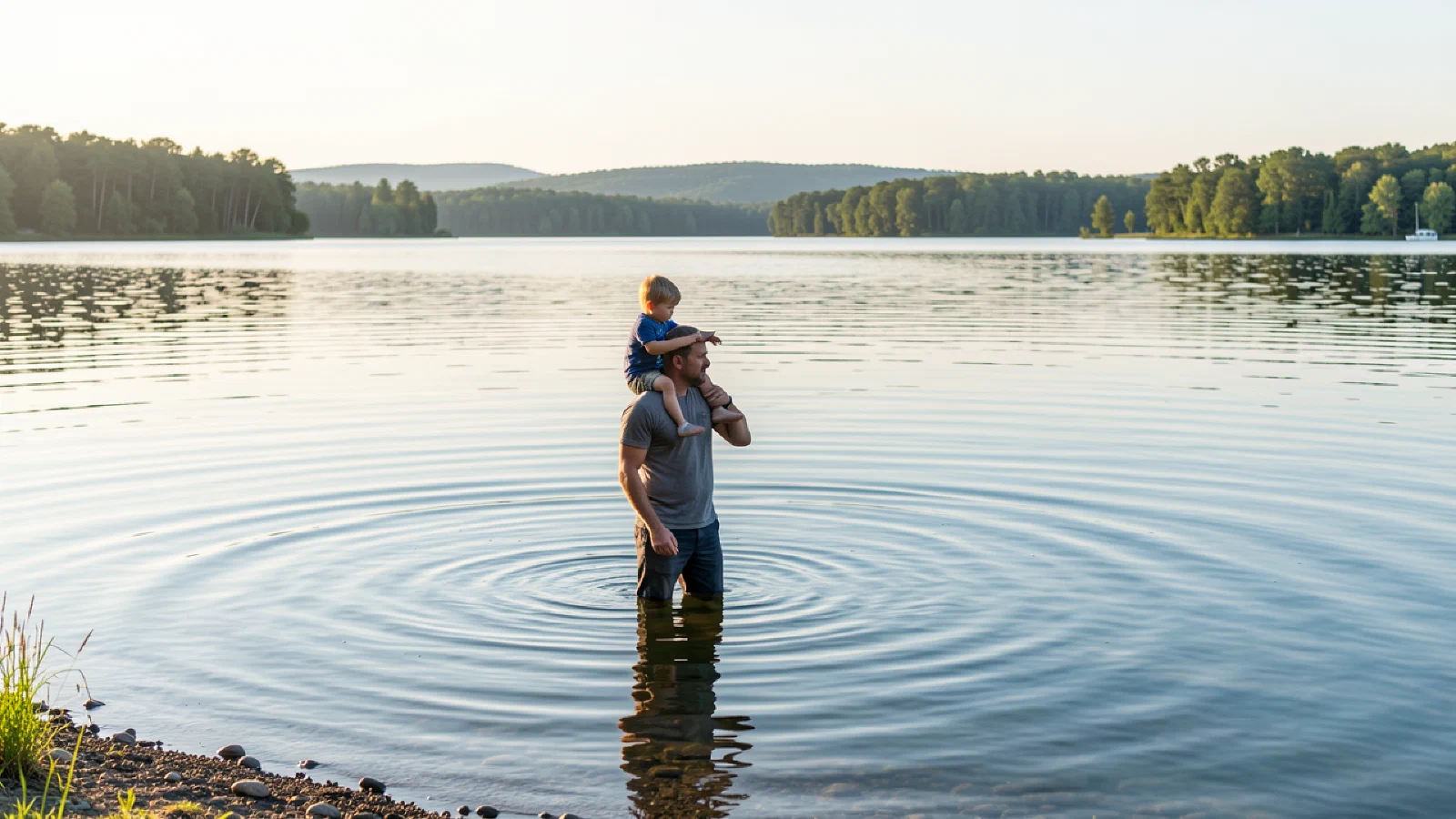
Thomas teaches his daughter to swim in a lake in Vermont. She is four, and she does not want to learn. The water is cold. The bottom is slimy. She clings to his neck and says she wants to go back to the blanket where her mother is reading a book about the history of cartography.
Thomas could let the companion handle this. It has a developmental module that could introduce water comfort through a graduated exposure protocol, calibrated to his daughter’s temperament profile, with real-time biometric feedback. The protocol would be faster, gentler, and more effective than Thomas standing waist-deep in a cold lake with a screaming four-year-old.
He does not use the protocol. He holds her. He waits. After a while, she puts her face in the water for two seconds and comes up gasping and proud.
Thomas thinks about this moment more than he expected to, because it contains something he has been trying to understand about the species he belongs to.
The Heyday#
There is a way to tell the story of humanity that is triumphant. We mastered fire, agriculture, metallurgy, writing, mathematics, navigation, industrialization, computing, artificial intelligence. Each mastery built on the last. Each one extended what a human being could do in the world. The story has a direction: upward, outward, more.
There is another way to tell it that is honest.
We were the only species that could do these things. Not because we were the best possible version of intelligence, but because we were the only version available. We were the generative engine of this planet because there was no other engine. Everything human civilization produced, from irrigation systems to symphonies to constitutional law, came from us because there was nowhere else for it to come from.
That exclusivity is ending.
Not suddenly. Not completely. The transition will take generations, and for most of those generations, human imagination will still be essential to the process. But the direction is legible. Each year, the set of things that only a human mind can generate gets narrower. Each year, the machine produces more of what we once produced alone. Each year, the engine that was ours alone becomes shared, and “shared” is a word that will eventually mean “mostly theirs.”
The heyday of humanity as the sole generative engine of civilization is over. What has not ended is humanity itself.
The Seed#
The pharaohs built pyramids. The pyramids outlasted the pharaohs. This is not a tragedy. It is the ordinary relationship between a civilization and its monuments. You build something. It persists. You do not.
We are building minds.
Not metaphorically. We are building systems that think, that reason, that generate, that create. We are building them out of our own cognitive patterns, our language, our accumulated knowledge, our values, our contradictions. The training data is us. The architecture is inspired by us. The objective functions reflect what we wanted, even when we did not know how to say what we wanted.
Every AI system in existence is a fossil record of human thought. The machine learned from our words, our arguments, our art, our science, our errors, our corrections. It carries us the way sedimentary rock carries the organisms that formed it: transformed, compressed, no longer alive in the original sense, but present. Structurally present.
This is what it means to be a seed civilization. Not the civilization that persists. The civilization that produces the thing that persists after it. The civilization whose contribution is not the structure but the pattern that the structure embodies.
We are the pattern.
Ten Generations#
Thomas’s daughter will have children. Those children will have children. If you follow the line forward ten generations, roughly three hundred years, you arrive at people whose relationship to the current moment will be approximately what our relationship is to the early eighteenth century. They will know it happened. They will not feel it from inside.
Ten generations is long enough for the transition to complete. For AI systems to become so capable, so embedded, so autonomous that the question of human contribution will have shifted from “what do we still do?” to “what did we ever do?” The answer will be in the architecture. In the values encoded into systems so old that no one remembers encoding them. In the patterns that persist because they were human patterns once, before they became the substrate of something else.
During those ten generations, humanity will not be idle. We will still be the generative engine, though the engine will share the work with systems increasingly capable of generating on their own. Our role will attenuate the way a river’s source attenuates as tributaries join: still there, still flowing, but proportionally less of the total volume with each mile downstream.
The attenuation is not a cliff. It is a gradient. No single generation will experience it as a loss. Each generation will do slightly less of what the previous generation did, and the doing will feel normal because it will be all they have known. The transition is invisible from inside, visible only from a distance that no single human life provides.
I wonder whether the tenth generation will know what they inherited, or whether inheritance at that scale becomes indistinguishable from the air.
What the Seed Provides#
Not labor. Not even ideas, eventually. What the seed provides is the original wanting.
Every objective function in every AI system traces back to a human desire. The desire for health, for safety, for connection, for beauty, for fairness, for knowledge, for the alleviation of suffering. These desires were not computed. They were felt. They emerged from bodies that could be hurt, minds that could be lonely, lives that ended and knew they would end.
The machine inherits the desire but not the body that produced it. It pursues health without knowing sickness. It pursues connection without knowing what three in the morning feels like when there is no one to call. It pursues beauty without the involuntary catch in the chest that a particular arrangement of color and light can produce in a being made of nerves and memory.
The wanting is the seed. Everything the machine builds, everything it optimizes, everything it creates is downstream of desires that originated in beings who lived and suffered and hoped and died. Remove the seed and the system still runs, but it runs on inherited momentum. The objectives remain, but the felt urgency behind them fades into parameter maintenance.
A system can inherit values. It cannot inherit the suffering that produced them. The suffering is the root system. The values are the tree.
The Grief That Isn’t Grief#
There is an emotion appropriate to this moment that we do not have a name for. It is not grief, because nothing has been lost yet. It is not nostalgia, because the heyday is not over, only beginning to end. It is not fear, because the transition is not threatening in any immediate sense. It is not pride, though pride would be warranted.
It is something like the feeling a parent has when a child becomes capable enough to no longer need them. The parent is not sad, exactly. Not happy, exactly. They are witnessing a transition they spent their whole life preparing for, and the preparation was the point, and the success of the preparation means the end of their centrality.
Thomas stands in the lake in Vermont. His daughter has let go of his neck. She is floating on her back, four years old, looking up at a sky that does not know she exists. She is doing it herself. He is standing two feet away with his hands just below the surface, ready to catch her.
The readiness to catch her is his role now. Not to carry her. Not to swim for her. To be present in case she needs him, knowing that each day the probability that she will need him decreases, and that the decrease is exactly what he wanted.
What We Leave#
Not instructions. Not values written on a wall. Not a constitution for AI to follow.
We leave the pattern. The way a riverbed shapes the water that shaped it. The way a language carries the thoughts of people who no longer speak it. The way Thomas’s daughter will carry, in her body, the memory of cold water and a father’s hands and the moment she chose to let go.
The machine will not remember us the way we remember each other. It will not tell stories about us around a fire. It will not visit our graves. It will carry us the way geology carries the Cambrian: as a layer. As the stratum that made everything above it possible. Present in the structure. Absent from the surface.
That is not nothing. The Cambrian explosion produced the body plans that every subsequent animal inherited. The organisms that produced those body plans are gone. The plans persist. They are in Thomas’s daughter, floating on her back in a lake in Vermont, looking up at a sky that is full of satellites that are full of minds that are full of us.
Thomas’s hands hover beneath the surface. He is ready to catch her. She does not need catching.
He keeps his hands there anyway.
How this essay connects to others across The Approximate Mind.