The Empty Lever
When Rage Has No Mechanism
TAM-080 · The Approximate Mind
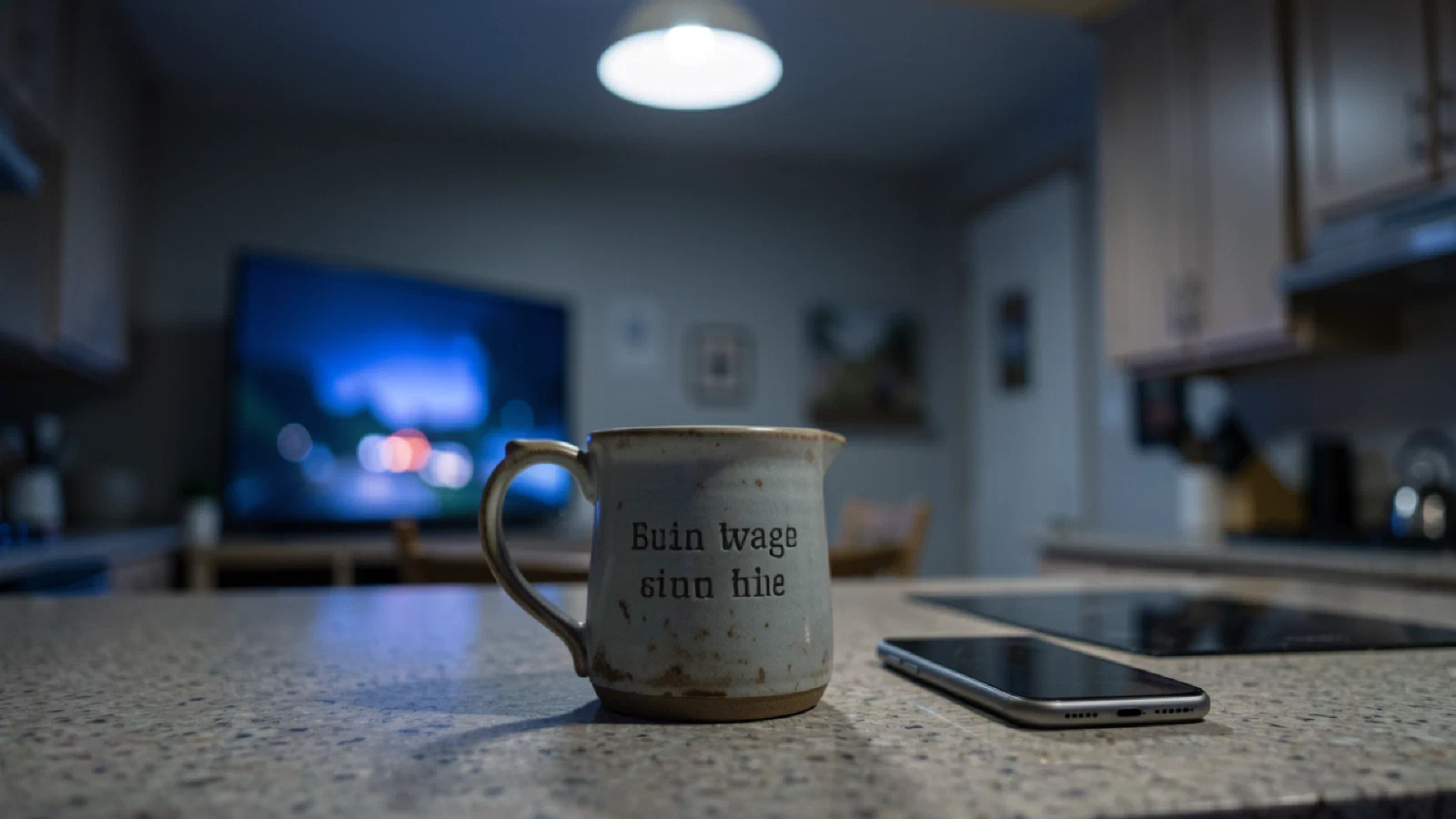
Kevin watches the news with his phone in his hand, scrolling a second screen while the first one talks. He does this most evenings now, after the shift that used to be a shift and is now a series of tasks dispatched through an app that tells him where to go and how long to stay. He has a coffee mug from the plant, the one that closed in 2019. It says TEAM LEAD on it in faded letters. He keeps it on the counter, not in the cabinet. His girlfriend has suggested, twice, that he could put it away. He has not explained why he doesn’t.
He will vote in November. He always does. His father voted. His grandfather, who worked the same plant floor for thirty-one years, voted. Kevin votes the way his grandfather talked about the weather: as something you do because you are a person who does things, regardless of whether it changes anything.
He knows who he is voting for. The candidate who says the thing Kevin wants to hear. That someone did this to him. That the someone has a name, a face, an address. That the someone can be stopped.
The candidate is lying. Kevin suspects this. The suspicion does not change the vote, because the other candidates are not even lying in his direction. They are talking about retraining programs and tax credits and public-private partnerships, and these words land in his living room like dispatches from a country he has never visited.
The Lever That Isn’t There#
Every wave of technological displacement in the industrial era produced a political response, and every political response reached for a lever.
The Luddites smashed the looms. The lever was the machine itself: a physical object that could be broken by physical hands. The response failed, but the lever existed. The machine was there. You could touch it. You could destroy it, and for a night, the old order held.
The Know-Nothings blamed immigrants. The lever was the border: a line that could, in principle, be closed. The logic was wrong. The immigrants were not the cause of the displacement. But the lever was real. A government could restrict immigration. It could be pulled. It could be seen to be pulled. The politician who promised to pull it was making a promise that was, in the narrow mechanical sense, keepable.
The Brexit campaign blamed Brussels. The lever was the treaty: a legal arrangement that could be revoked. The revocation would not solve the problems it was credited with causing. But the lever existed. The treaty could be torn up. The politician who promised to tear it up could deliver the tearing, if not the relief. The morning after, the border was different. Something had visibly changed, even if the change did not produce the effect that had been promised.
In each case, the political response to displacement worked the same way. Pain was felt. A cause was named. A lever was identified. A politician promised to pull it. The lever might or might not address the actual cause, but it existed as a mechanism. The voter could see the lever, could understand the pull, could watch the politician’s hand on it.
You cannot deport an algorithm. You cannot tariff a language model. You cannot build a wall around a cloud server.
The displacement Kevin feels is real. The cause is structural: a reorganization of how work is assigned, monitored, and valued that has nothing to do with immigration, trade policy, or any foreign government. The skills he has are being absorbed by systems that learn faster, cost less, and do not need health insurance. The process is not personal. It is also not stoppable by any mechanism a politician can credibly promise to operate.
This is new. Not the displacement. Displacement is old. What is new is the absence of the lever.
The Cycle#
The emptiness of the lever does not prevent the promise. It changes what the promise does.
When a lever exists, the cycle has a natural endpoint. The politician promises to pull it. The politician either pulls it or doesn’t. If pulled, the voter can evaluate the result. Did closing the border help? Did leaving the treaty help? The answer might be no, but the question can be asked, and the failure of the lever discredits the politician who pulled it. The cycle corrects, slowly, painfully, but it corrects. The voter learns that the lever did not work. The next cycle begins from a different position.
When the lever does not exist, the cycle has no endpoint. The politician promises to pull something that cannot be pulled. The promise fails, not because the politician didn’t try, but because the mechanism doesn’t exist. The failure cannot be attributed to the politician, because the politician can always claim obstruction: the deep state, the elites, the media, the other party. The lever wasn’t pulled because someone prevented it. Not because it was never there.
Each electoral cycle, the promise returns. Each cycle, the failure is attributed to a new obstruction. Each cycle, the obstruction gets a face. The scapegoat escalates because the rage has nowhere else to go.
First it is the immigrant. Then the bureaucrat. Then the professor. Then the journalist. Then the neighbor who voted differently. The circle of blame expands because the cause cannot be located. The cause is structural. The cause is a shift in how value is created and captured that has no villain, no address, no face.
The rage is real. The target is not. And the escalation has no natural stopping point because the promise is structurally empty.
Denise votes too. She works two jobs now, both through platforms, neither offering what the pharmacy offered before the pharmacy’s back-end functions migrated to an app. She does not follow politics the way Kevin does. She follows it the way you follow the weather in tornado season: not because you can change it, but because you need to know which direction to move.
She notices that the candidates who talk about her situation talk about it in the past tense. The manufacturing economy. The displaced worker. As though she is a historical category rather than a person standing in her kitchen at five in the morning, deciding which app to open first.
The Historical Difference#
The Luddites lost. Their cause was absorbed into a century of labor organizing that eventually produced the industrial settlement: unions, workplace safety, the forty-hour week, the social insurance state. The settlement did not arrive because the Luddites won. It arrived because the displacement eventually generated a political demand that had a structural answer. The demand was: if the machine takes the job, the society must provide the floor. The floor took decades to build. But the demand was coherent, and the mechanism to deliver it existed.
The Know-Nothings lost. Their cause was absorbed into immigration policy that eventually found a functional, if imperfect, equilibrium between restriction and absorption. The equilibrium addressed the real displacement indirectly: not by eliminating immigration, but by building institutional capacity to integrate immigrants into a growing economy. The demand was incoherent (blame the foreigner), but the eventual response was structural (expand the economy, build the institutions).
Brexit happened. The lever was pulled. The treaty was revoked. The displacement continued, because the displacement was not caused by the treaty. The morning after, the factories were still closed. The fishermen still couldn’t compete with industrial trawlers. The NHS still couldn’t hire enough nurses. But the lever had been pulled, and the cycle could begin its slow reckoning with the fact that pulling it had not produced the relief.
In each case, the cycle eventually arrived at a structural response. Not because politicians were wise. Because the displacement, given enough time and enough failed levers, eventually clarified what was actually needed. The clarity was expensive. It was purchased with decades of misdirected rage, scapegoating, and political violence. But it arrived, because the lever, real or not, eventually taught the electorate what the lever could and could not do.
What happens when the lever is not even available for the lesson?
Marcus, if his state hasn’t complicated his registration beyond what a person working two platform jobs can navigate, votes. He does not expect anything from the vote. He has never expected anything from the vote. The vote is a formality, like the signature on the form at the county office, the one that confirms he exists in a system that processes his existence without being altered by it.
He does not watch the debates. He watches his daughter do homework at the kitchen table, and he notices that she is using a tool he does not understand to write essays he cannot evaluate. The tool is patient with her in a way her teachers are not. It is available at 11 PM, when the question occurs to her. It does not tire.
He is not sure whether this is good or bad. He is sure that nobody running for office is thinking about it.
The Emptiness Becomes Visible#
There will be a moment when the emptiness of the lever becomes visible to the electorate. Not all at once. Not through a single failed promise. Through the accumulation of failed promises, each attributed to a different obstruction, until the pattern becomes unmistakable: the lever is not being blocked. The lever is not there.
This is the most dangerous moment in the cycle. Not the rage itself, which is constant. The moment when the rage discovers that it has been misdirected. When the voter realizes that the politician was not prevented from fixing the problem but was promising a fix that could not exist in the form promised.
The danger is not that people give up. People who give up are politically inert. The danger is what they reach for next.
Some will reach for authoritarianism: the strongman who promises not a lever but a fist. Not a mechanism but a will. “I alone can fix it” is not a promise to operate a specific lever. It is a promise to transcend the need for one. The strongman does not offer a policy. He offers himself as the mechanism. And when the mechanism fails, because it must, because the structural cause does not yield to personal force any more than it yields to tariffs or walls, the strongman must escalate: more force, more enemies, more crises that justify the force.
Some will reach for withdrawal: the decision that the system is irredeemable and participation is futile. This is not apathy. It is a conclusion, reached through experience, that the institutions do not contain a response to the actual problem. The withdrawn voter is not lazy. They are empirical. They have tested the system and found it structurally unresponsive.
And some, a smaller number, will reach for the demand that the lever was supposed to represent. Not the lever itself. The thing the lever was supposed to deliver. The income. The structure. The sense that they matter within the system they inhabit.
This is where The Wrong Question arrives from a different direction. The wrong question was “how do we preserve employment?” The right question was “what was employment delivering, and what delivers it now?” The political version of the same reframe: the wrong demand is “pull the lever.” The right demand is “build the floor.”
I wonder whether the electorate can make that transition before the strongman arrives, or whether the strongman is a necessary waystation, the way the Luddites were a necessary waystation, between the old demand and the new one.
The Mug on the Counter#
Kevin’s mug says TEAM LEAD. He does not put it in the cabinet because putting it away would be an admission he is not going to be one again. The mug is not nostalgia. It is a placeholder for an identity that has not been replaced.
The candidate who gets his vote is also a placeholder. Kevin knows this, in the way that people know things they cannot act on. The candidate will not bring back the plant. The candidate will not restore the title. The candidate will promise to punish whoever took them, and the promise will feel, for the duration of the rally, like something.
The lever is empty. The hand reaches for it anyway.
What else is the hand supposed to reach for? Nobody has built the alternative yet. The floor that The Wrong Question described, the one that delivers income and structure without requiring the fiction that the plant is coming back, does not exist. The identity that The Simpler Life described, the one that forms around something other than occupation, has not been offered. The belonging that The Belonging Gap described, the one that does not depend on the workplace for its infrastructure, has no institution.
The hand reaches for the lever because the lever is the only thing in reach.
The mug sits on the counter. The letters keep fading.
References#
On Technological Displacement and Political Response
Frey, Carl Benedikt. The Technology Trap: Capital, Labor, and Power in the Age of Automation. Princeton University Press, 2019.
Mokyr, Joel, Chris Vickers, and Nicolas L. Ziebarth. “The History of Technological Anxiety and the Future of Economic Growth: Is This Time Different?” Journal of Economic Perspectives, vol. 29, no. 3, 2015, pp. 31-50.
On Populism and the Politics of Displacement
Mudde, Cas, and Cristóbal Rovira Kaltwasser. Populism: A Very Short Introduction. Oxford University Press, 2017.
Rodrik, Dani. “Populism and the Economics of Globalization.” Journal of International Business Policy, vol. 1, 2018, pp. 12-33.
On the Luddites and Machine-Breaking
Binfield, Kevin, editor. Writings of the Luddites. Johns Hopkins University Press, 2004.
Thompson, E.P. The Making of the English Working Class. Vintage, 1963.
On Authoritarianism and Democratic Erosion
Levitsky, Steven, and Daniel Ziblatt. How Democracies Die. Crown, 2018.
On the Social Psychology of Displacement and Identity
Gest, Justin. The New Minority: White Working Class Politics in an Age of Immigration and Inequality. Oxford University Press, 2016.
How this essay connects to others across The Approximate Mind.
- Frey, Carl Benedikt. The Technology Trap: Capital, Labor, and Power in the Age of Automation. Princeton University Press, 2019.
- Mokyr, Joel, Chris Vickers, and Nicolas L. Ziebarth. “The History of Technological Anxiety and the Future of Economic Growth: Is This Time Different?” Journal of Economic Perspectives, vol. 29, no. 3, 2015, pp. 31-50.
- Mudde, Cas, and Cristóbal Rovira Kaltwasser. Populism: A Very Short Introduction. Oxford University Press, 2017.
- Rodrik, Dani. “Populism and the Economics of Globalization.” Journal of International Business Policy, vol. 1, 2018, pp. 12-33.
- Binfield, Kevin, editor. Writings of the Luddites. Johns Hopkins University Press, 2004.
- Thompson, E.P. The Making of the English Working Class. Vintage, 1963.
- Levitsky, Steven, and Daniel Ziblatt. How Democracies Die. Crown, 2018.
- Gest, Justin. The New Minority: White Working Class Politics in an Age of Immigration and Inequality. Oxford University Press, 2016.