The Demand That Splits
What Happens When the Revolt Discovers What It Actually Needs
TAM-081 · The Approximate Mind
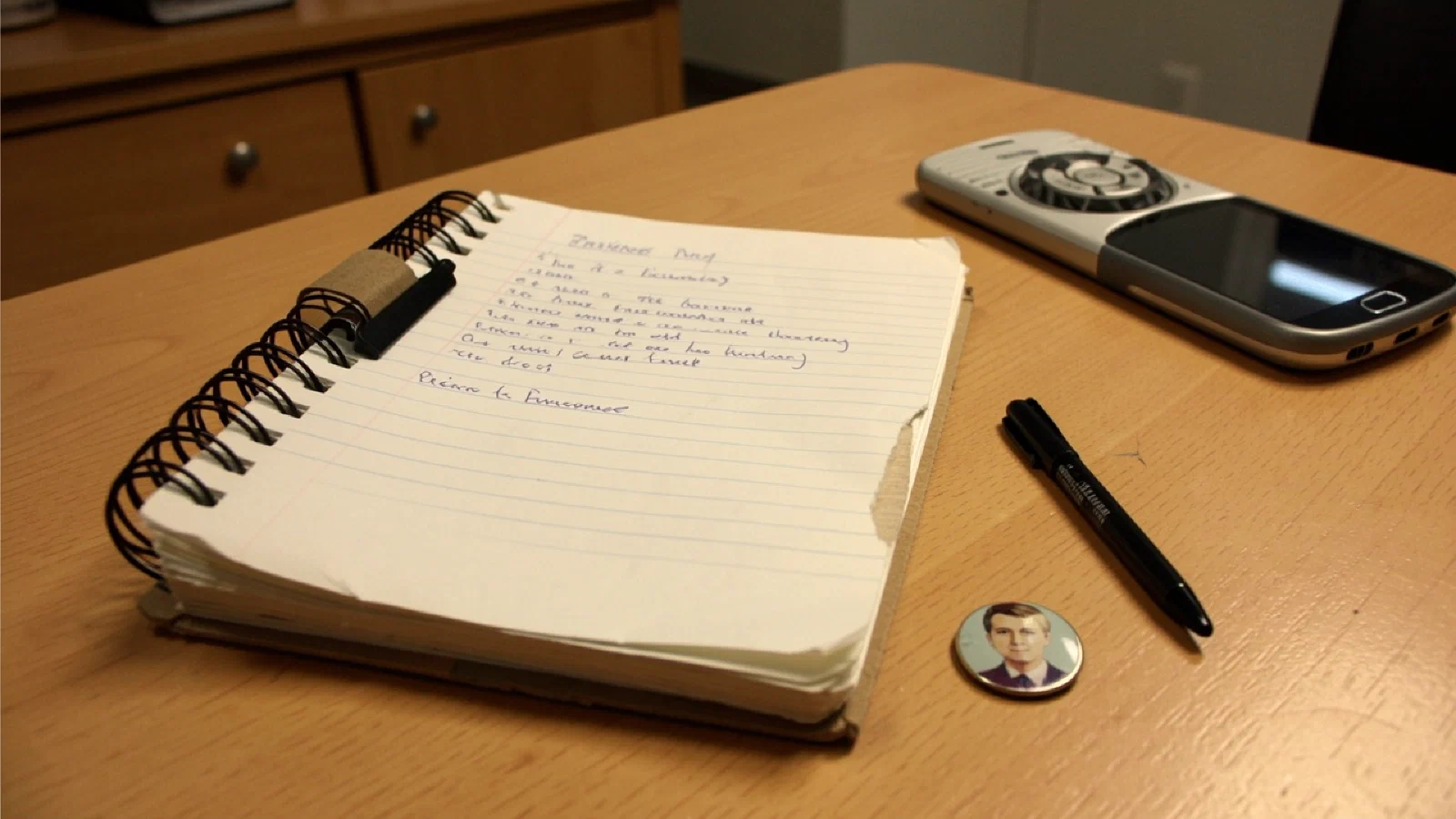
There is a woman in Denise’s building who organizes. Not politically. Practically. She is the one who knows that the county health department moved its walk-in clinic from Tuesday to Thursday. She is the one who told Denise about the food bank that doesn’t require proof of income. She keeps a spiral notebook in her purse, the kind with the wire binding that catches on the zipper, and she writes things down in it: phone numbers, addresses, the name of the man at the workforce development office who actually returns calls.
Her name is Linda. She is sixty-three. She worked in accounts payable at a regional hospital for twenty-two years until the system that processed invoices learned to process invoices. She has a pin on her jacket from the hospital’s twenty-year service recognition, a small enamel thing with the hospital’s logo, and she wears it every day, not on the jacket she wore to work but on the denim jacket she wears now, the one for errands and bus rides and the Tuesday meetings at the community center that she started attending because Tuesday was the day the clinic used to be open and she was already in the habit of going out.
Linda is not angry the way Kevin is angry. She is past the stage where anger has a direction. She is in the stage where you start building the thing that doesn’t exist yet because waiting for someone to build it has used up all the time you were willing to give.
The Discovery#
The revolt, when it comes, always begins with a simple demand: give us back what we had. The factory. The job. The town the way it was before. The demand is powerful because it is rooted in memory, in a world the voter has actually lived in, and the nostalgia is not false. The world they remember was real. The job did provide what the job provided. The loss is genuine.
The demand is also impossible. Not because the politicians are corrupt, though some are. Not because the system is rigged, though parts of it are. Because the structural conditions that produced the old arrangement have changed in ways that do not reverse. The factory closed because the economics of production changed. The job disappeared because the task was absorbed. The town emptied because the town existed as a consequence of the factory, and the factory existed as a consequence of an economic logic that no longer operates.
The revolt discovers this. Not immediately. Not willingly. Through the accumulation of pulled levers that produce nothing. The Empty Lever traced the cycle: the promise, the pull, the failure, the escalation. Eventually the cycle exhausts itself. Not because the rage disappears. Because the rage, having tried every available scapegoat, arrives at the recognition that the scapegoat was not the cause.
This is the moment the demand splits.
It splits because the single word “job” was carrying four different things, and when the word breaks, the four things scatter.
The Four Parts#
The Wrong Question named them. Income. Structure. Identity. Belonging. Employment was a delivery mechanism that bundled all four into a single package, and the bundling was so efficient that the components were invisible. You did not go to the factory for income plus structure plus identity plus belonging. You went to the factory for a job, and the job delivered all four without requiring you to name them separately.
When the job disappears, the demand for the job is really four demands wearing one coat. And the coat tears, because the four demands require different responses, different institutions, different timescales, and different levels of political difficulty.
The first demand is income. This is the loudest and the most legible. People need money. The mechanisms exist: transfers, tax credits, universal basic income, negative income tax, earned income supplements, the entire apparatus of the modern welfare state. The arguments against these mechanisms are political, not technical. The money can be moved. The question is whether the political will exists to move it, at what scale, to whom, under what conditions, with what strings.
The income demand is solvable. Not easily. Not without political cost. But the mechanism is understood. The policy tools are available. A government that chose to ensure that no citizen fell below a livable income floor could do so with existing fiscal and administrative capacity. The constraint is not knowledge. It is will.
The second demand is structure. People need somewhere to be, something to organize the day around, a rhythm that is not self-generated. This is the demand that UBI conversations consistently underestimate. A check in the mail does not tell you what to do with Tuesday. The factory told you what to do with Tuesday. The check does not.
Structure can be provided. Public works. Community infrastructure. Maintenance economies that employ people in the upkeep of the built environment, the stewarding of the commons, the care of the aging population. The infrastructure of daily life requires tending, and the tending is work, and the work provides structure. This is not make-work. It is the work the market does not price because the market does not price maintenance until the unmaintained thing fails.
Call it the maintenance economy. It is real, it is needed, and it could absorb millions of people in roles that provide genuine structure and genuine social value. The political difficulty is that maintenance is unglamorous. It does not photograph well. It does not produce the ribbon-cutting. It produces the bridge that does not collapse, the park that does not deteriorate, the elder who does not fall. The absence of failure is invisible, and invisible outputs are hard to fund in political systems that reward visible ones.
But the mechanism exists. Between income and structure, the state has tools. The fiscal capacity is present. The institutional models exist, in the Civilian Conservation Corps, in the NHS, in the Scandinavian social democratic infrastructure, in a hundred precedents that demonstrate governments can deliver income and structure to populations that the market has stopped serving.
The solvable half is expensive but achievable. The unsolvable half is what keeps the cycle turning even after the checks arrive.
The Third Demand#
Identity. Who am I, now that I am not what I did?
This is the demand that no policy can deliver. Not because governments are incapable. Because identity does not arrive through a program. It forms through participation, through being needed, through the accumulation of daily evidence that your presence in the world alters the world’s shape.
Kevin was a team lead. The title organized not only his workday but his self-understanding. He managed people. He solved problems. He was the person others came to when the line went down. The title was not vanity. It was the outward expression of an inward fact: he was competent at something that mattered, and other people knew it.
The check replaces his income. The maintenance economy, if someone built it, might replace his structure. Nothing replaces the feeling of being the person others come to. That feeling was a byproduct of the job, not a feature anyone designed. It arrived with the work the way warmth arrives with friction: incidentally, reliably, noticed only in its absence.
The Simpler Life traced how the consumption identity dissolves when the occupation dissolves: the wardrobe, the neighborhood, the car, the lunch place. The friend who kept buying things she didn’t need because she didn’t know what kind of person she was buying for. The external markers of identity were downstream of the occupation, and when the occupation went, the markers drifted, unanchored.
Linda’s hospital pin is this in miniature. She wears it on the wrong jacket. It signifies a role that no longer exists, in an institution that has already forgotten her name. But she wears it, because the alternative is to have nothing on the jacket that says who she is. The pin answers a question that nobody is asking her anymore, but she keeps the answer visible in case someone does.
I wonder whether the identity problem has a solution at all, or whether it is the kind of problem that dissolves only when a new generation forms without the old frame. The people who lost the factory will carry the factory’s absence for the rest of their lives. Their children might not. Their grandchildren almost certainly won’t. The identity crisis of displacement may be, at bottom, a generational wound: unresolvable for the generation that bears it, invisible to the generation that inherits what comes after.
This is not comfort. It is the honest limit of what institutional design can do. You can give people money. You can give people structure. You cannot give people a self. The self forms, over years, through the interaction between the person and the world. When the world changes faster than the self can follow, the gap is not a policy problem. It is a human one.
The Fourth Demand#
Belonging. The experience of being embedded in a group that notices whether you show up.
This is the demand the pharmacy was delivering before the pharmacy closed. The Dissolved Middle traced it. The pharmacist who knew Denise’s mother’s medication schedule was not providing pharmaceutical expertise, though she was providing that too. She was providing the experience of being known. Of walking into a room where someone said your name without checking a screen.
Belonging is the most diffuse of the four demands and the hardest to see as a demand at all. People do not march for belonging. They do not vote for belonging, at least not consciously. They vote for the candidate who makes them feel like they belong to something, which is different and more dangerous, because the belonging the rally provides is the belonging of the crowd, not the belonging of the known.
The crowd says: you are one of us. The pharmacy said: you are you, and we know which you.
The difference matters. The belonging of the crowd is available on demand, at scale, through any movement that offers membership in exchange for loyalty. It addresses the loneliness. It does not address the recognition. Kevin at the rally feels less alone. He does not feel more known.
Linda’s Tuesday meeting at the community center is the other kind. Eight people. Folding chairs. Bad coffee. Someone brought cookies last week, the kind from the package, and nobody mentioned that they were stale. Linda knows everyone’s name. She knows that Robert’s daughter is applying to nursing school and that Theresa’s landlord is threatening eviction again and that James, who never says much, was a machinist for twenty-six years and sits in the same chair every week with his hands folded, as though he is waiting for a meeting to be called to order.
This is belonging at the scale where belonging actually works. Small. Specific. Built on the accumulated knowledge of particular people in a particular room. It cannot be delivered by a program. It can be enabled by an institution: the community center, the library, the church, the gathering place that gives the group a room to meet in. The institution does not create the belonging. Linda creates the belonging. The institution provides the floor.
A person with income and healthcare who has no answer to “what are you for” is still in crisis. A person with income and healthcare and structure who has no one who would notice if they stopped coming is still alone.
What the Split Means#
The demand splits, and the split clarifies. The solvable part is large. Income and structure are within reach of institutional design. The political obstacles are real, but they are the ordinary obstacles of democratic politics: cost, will, coalition-building, the slow persuasion of electorates that what is being proposed is worth what it costs.
The unsolvable part is also large, and its unsolvability is what makes the political combustion dangerous. Because the politician who delivers the income and the structure has not solved the voter’s problem. The voter who receives the check and the assignment and the schedule and still feels purposeless and unknown will not credit the politician with the delivery. The voter will credit the politician who names the feeling. And naming the feeling, in the absence of a mechanism to address it, looks like the same empty lever.
The cycle does not end with the check. That is the hardest thing about this analysis, and I am not confident the political system can absorb it. The check is necessary. It is not sufficient. The insufficiency does not discredit the check. It means the check must be accompanied by something the state cannot manufacture: the slow, patient, unglamorous work of building the rooms where Linda’s Tuesday meeting happens. The community centers. The libraries. The gathering places. The institutions that do not deliver belonging but provide the conditions under which belonging can form.
This is what the friction was doing. The pharmacy, the factory floor, the office break room, the morning commute where you saw the same faces on the same platform. These were not efficient. They were habitats. And habitats, once destroyed, do not regrow on command. They regrow slowly, from the edges, through the efforts of people like Linda who start showing up on Tuesday because Tuesday was already the day they went out, and who keep showing up because showing up is what they know how to do.
The Pin and the Notebook#
Linda’s pin says who she was. Her notebook says who she is becoming. The pin is twenty years of service to an institution that replaced her with a system. The notebook is the phone numbers and the addresses and the name of the man who returns calls. The pin faces backward. The notebook faces forward.
She did not choose this transition. She does not describe it in these terms. She would say she is just helping out, the way she always helped out, the way the woman in accounts payable helps out because someone has to keep track of the invoices and she is the kind of person who keeps track.
The gravity, as The Gravity named it, is the same. The institution changed. The skill changed. The identity is still forming. But the orientation, the thing she cannot not do, the keeping-track, the knowing-where-things-are, persists. It has relocated from the hospital’s accounting system to the spiral notebook in her purse. The venue is smaller. The gravity is the same.
The demand that splits will not be resolved by the politician who promises to reunify it. The four pieces require four different responses, operating at four different timescales, through four different kinds of institution. The income is fiscal. The structure is institutional. The identity is generational. The belonging is personal, built one Tuesday at a time, in rooms the state can provide but cannot fill.
Linda opens her notebook. She writes down the new address for the walk-in clinic. The wire binding catches on the zipper as she puts it back.
She will be there on Tuesday.
References#
On the Bundled Nature of Employment
Jahoda, Marie. Employment and Unemployment: A Social-Psychological Analysis. Cambridge University Press, 1982.
Standing, Guy. The Precariat: The New Dangerous Class. Bloomsbury Academic, 2011.
On Universal Basic Income and Its Limitations
Lowrey, Annie. Give People Money: How a Universal Basic Income Would End Poverty, Revolutionize Work, and Remake the World. Crown, 2018.
Van Parijs, Philippe, and Yannick Vanderborght. Basic Income: A Radical Proposal for a Free Society and a Sane Economy. Harvard University Press, 2017.
On Community, Belonging, and Social Infrastructure
Klinenberg, Eric. Palaces for the People: How Social Infrastructure Can Help Fight Inequality, Polarization, and the Decline of Civic Life. Crown, 2018.
Putnam, Robert D. Bowling Alone: The Collapse and Revival of American Community. Simon and Schuster, 2000.
On Identity and the Loss of Occupational Role
Sennett, Richard. The Corrosion of Character: The Personal Consequences of Work in the New Capitalism. W.W. Norton, 1998.
On the Maintenance Economy and Care Work
Mattern, Shannon. “Maintenance and Care.” Places Journal, November 2018.
The Care Collective. The Care Manifesto: The Politics of Interdependence. Verso, 2020.
How this essay connects to others across The Approximate Mind.
- Jahoda, Marie. Employment and Unemployment: A Social-Psychological Analysis. Cambridge University Press, 1982.
- Standing, Guy. The Precariat: The New Dangerous Class. Bloomsbury Academic, 2011.
- Lowrey, Annie. Give People Money: How a Universal Basic Income Would End Poverty, Revolutionize Work, and Remake the World. Crown, 2018.
- Van Parijs, Philippe, and Yannick Vanderborght. Basic Income: A Radical Proposal for a Free Society and a Sane Economy. Harvard University Press, 2017.
- Klinenberg, Eric. Palaces for the People: How Social Infrastructure Can Help Fight Inequality, Polarization, and the Decline of Civic Life. Crown, 2018.
- Putnam, Robert D. Bowling Alone: The Collapse and Revival of American Community. Simon and Schuster, 2000.
- Sennett, Richard. The Corrosion of Character: The Personal Consequences of Work in the New Capitalism. W.W. Norton, 1998.
- Mattern, Shannon. “Maintenance and Care.” Places Journal, November 2018.
- The Care Collective. The Care Manifesto: The Politics of Interdependence. Verso, 2020.