The Valid Ticket
A True Model, Applied One Domain Over
One Working Cell#
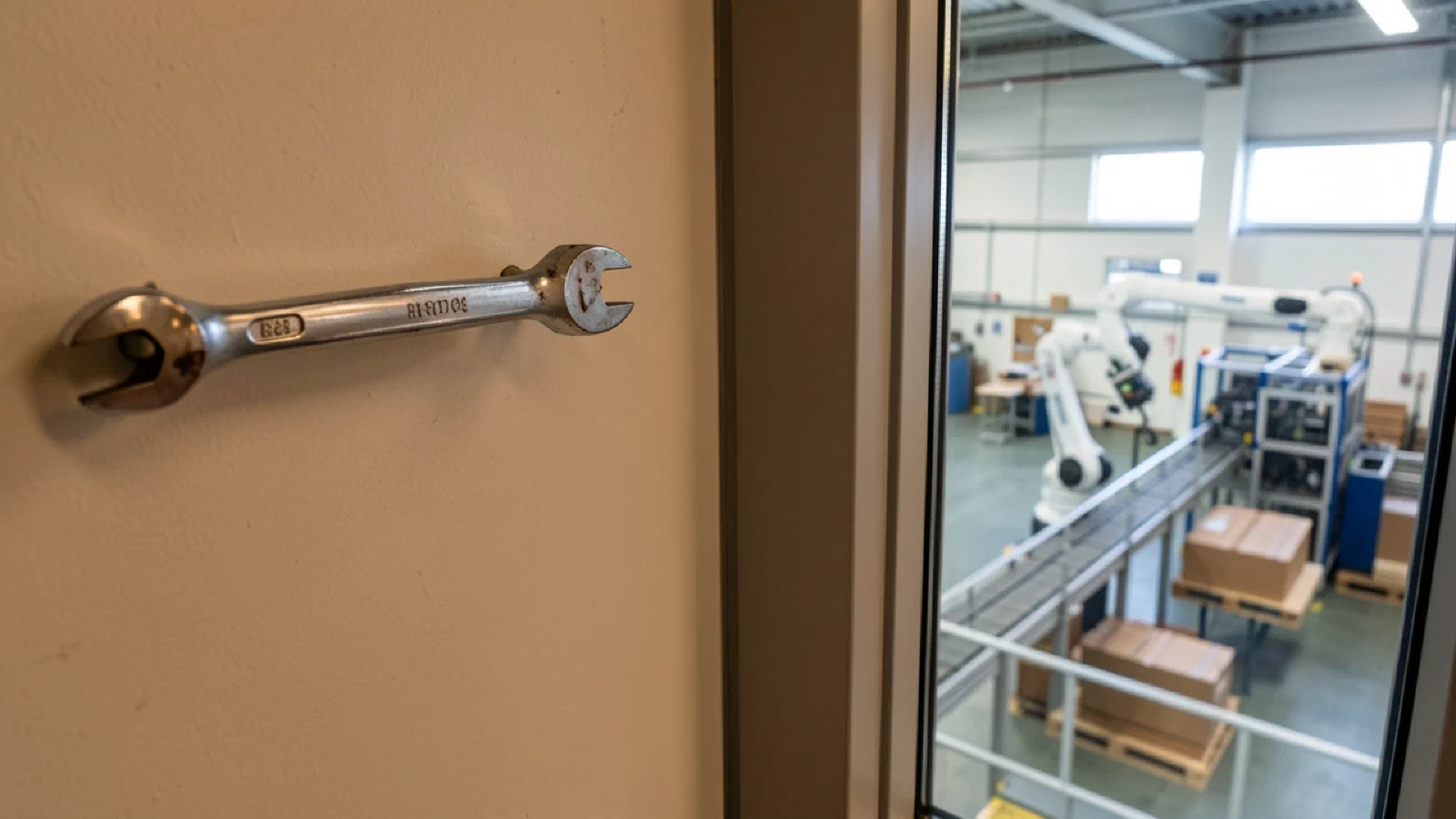
Estela runs operations at a contract packaging plant outside Toledo, and this morning she is standing where she stands most mornings, at the rail above the floor, watching the one robotic cell the plant owns do the thing it does. It picks cartons off a conveyor, squares them, and builds pallets in a pattern that used to take two people a shift each and now takes nobody. The cell has run for nineteen months. It has paid for itself once already, by the plant’s own accounting, and will pay for itself again by spring.
On her office wall, mounted on two nails, is a torque wrench that belonged to her father. He spent thirty-one years at a stamping plant in Lorain that closed in 2006, and the wrench is the only thing of his work she kept. It is a good wrench. It still clicks true at the setting stamped on its collar.
The decision in front of her is whether to buy the second cell. The conveyor line the second cell would serve was installed in 2011 and has four to six years of book life left, and rebuilding its outfeed to present cartons the way the robot needs them presented means writing off part of that. The maintenance contract on the first cell runs eleven percent of purchase price a year, and the vendor’s service tech drives in from Columbus, which was fine the two times the cell went down on a weekday and would not have been fine had it gone down on a Saturday during the December run. The third shift has one person qualified to clear a fault, and he has put in his notice. The insurance carrier wants an updated safety case for a second machine because the second one would sit closer to a walkway.
Notice what is not on the list. Nobody in the building doubts what the machine can do. The capability question was settled nineteen months ago, on the floor, in front of everyone. The questions that remain are about depreciation, coverage, and who answers the phone at two in the morning, and every one of them is a real question with a dollar figure attached.
Estela is not resisting anything. She is reading her balance sheet, and the balance sheet says: probably yes, probably in the next capital cycle, not this quarter.
The Cliff, Itemized#
The corpus corrected itself once on this subject and the correction is on record, so it gets one paragraph. The forty-year lag between the electric motor and the productivity it promised was substantially a capital problem: unit drive required rebuilding the factory itself, and no firm razes a working building before it depreciates. The excuse was true. When the same forty-year story gets told about AI whose entire capital requirement is a subscription, the excuse has been imported into a regime where nothing material holds the gate, and what remains doing the waiting is the organization itself.
That is the cognitive case. Physical AI is not the cognitive case, and the difference deserves its full itemization rather than a gesture.
Sensors, first, and not the sensor on the robot but the sensing the site must grow around it: the fixtures, the presentation, the lighting the vision system needs, the tolerances the incoming product was never held to because a human hand absorbed the variance. Actuators and the structure that carries them: floors rated for the load, power dropped where no power was, guarding, interlocks. The safety case, which is not paperwork but engineering, and which the insurer, the fire marshal, and the union each read with different eyes. The maintenance regime: a contract, a parts shelf, a person trained on this machine and not machines in general, and a plan for what runs while the machine does not. The spare-parts chain, which for a young vendor is a promise and for a plant manager is a risk with the vendor’s survival inside it. The people, who must be trained not to operate the thing but to work near it, which is a different training and a slower one.
Every item on that list is capital or capital-adjacent. Several are bolted to a specific place and cannot be piloted somewhere easy and shipped in. And nearly all of them are governed by the slowest clock the corpus has examined, depreciation time, because the honest form of most physical AI decisions is not “should we adopt” but “should we destroy something that still works,” and the arithmetic of that question was settled long before the robot arrived. A facility waiting for its line to wear out before rebuilding it is doing what facilities have correctly done for a century.
Where the machine has a body, the dynamo case fits, and waiting is what reading the numbers looks like.
So the delay in the physical regime needs no theory of institutional psychology, no account of professional identity, no diagnosis at all. It has a sufficient explanation in the capital structure, and the explanation is honorable. That has to be said plainly, and first, because the rest of this essay is about what happens to that honorable explanation when it travels.
The Ticket#
The corpus has already described the alibi: the organization that declines a working cognitive tool for reasons wearing the costume of arithmetic, where the stated objection shifts shape each time it is answered and the constant underneath is the conclusion. An alibi in that form is at least detectable, because sooner or later the objections contradict each other.
The physical regime produces something harder to detect, because it hands the organization an objection that is true. A board member tours a sister company’s robotics pilot and comes back having learned, correctly, that these deployments take years, that the integration is the hard part, that the pilot is the cheap part and the rollout is the expensive part, that prudent firms sequence this against their capital cycle. Every sentence of that is right. It was right on the floor where he learned it. Then the documentation model comes up on the agenda, the one that runs on the laptops the company already owns, and he applies what he learned, sincerely, with the authority of someone who has recently stood next to an actual robot: we are not ready, these things take years, look at what it took next door.
Nothing in that room is a lie. The model of deployment being applied is accurate. It is accurate about a regime one domain over, where the machine has a body and the cliff is real, and it has been carried across the border into a regime where the capital requirement is a login and the only thing standing between the organization and the tool is the organization. The excuse arrives with a valid ticket, issued in another country.
A true model applied one domain over does not feel like an excuse from the inside, and that is what makes it one of the durable ones.
This is a different animal from the shape-shifting objection. The shape-shifter can be caught by its own inconsistency. The imported model is consistent, evidenced, and endorsed by the person’s own eyes, and arguing with it means arguing with something that is true. The only available correction is jurisdictional: not “you are wrong about deployment” but “you are right about a different deployment.” That correction is precise, it is unwelcome, and in most rooms nobody is standing there holding the map that shows where the border runs.
The confusion is not helped by the fact that the border is genuinely blurry on the ground. Most real deployments are mixed. Estela’s cell is a cognitive system wearing an arm; the vision model that squares her cartons updates over the network on the software clock while the arm it drives wears out on the capital clock, and the interesting decisions in her building are exactly the ones where a cognitive layer wants to land on physical infrastructure that predates it by decades. A scheduling model that would route her existing forklifts better touches no steel and could run next month. A model that requires the forklifts to be different forklifts is a capital program. The two proposals will arrive in the same meeting, from the same vendor, on the same slide, and the model of deployment that is true for one of them is false for the other.
I wonder how many rooms the ticket is being shown in this season, and how many of the people presenting it could say, if asked, which regime they are standing in.
The Sorting#
What follows from naming the mechanism is a discipline, not a verdict, and it is a discipline for both sides of the table.
For the organization, the discipline is to sort every proposal by what it actually touches. Does this require destroying something that still works? Then the capital reasoning applies in full, the depreciation clock governs, and waiting may be exactly right. Does it touch nothing but attention and workflow? Then the capital reasoning is a visitor here, and if it is doing the talking, something else is doing the deciding. The sorting question is almost never asked, because the word deployment covers both cases and the imported model answers for the pair.
For the reader of organizations, the discipline runs the other way: the presence of a true capital objection somewhere in a firm’s world says nothing about the decision in front of it. A company can be prudently slow on its floor and merely slow at its desks, and the first fact will be offered, sincerely, in defense of the second. The offering is what a mind does with a hard-won model, which is apply it, and the application will keep happening for as long as the physical cliff exists to be learned from, which is to say for decades.
Estela has the sorting right without ever having named it. The second cell waits for the capital cycle. The scheduling software went in last March, over a weekend, because it touched nothing but the whiteboard, and she saw no reason to let one decision borrow the other’s clock.
The wrench on her wall clicks true at the setting her father left it on. The plant it was bought for is gone; the tool outlasted the building it served, the way tools do, the way the building could not. She is not sentimental about this, or not only sentimental. She keeps it where she can see it from her desk, on the wall between the window and the door, roughly where a clock would go.
References:
The Lag and Its Capital Structure:
David, Paul A. “The Dynamo and the Computer: An Historical Perspective on the Modern Productivity Paradox.” The American Economic Review, vol. 80, no. 2, 1990, pp. 355-361.
Devine, Warren D. “From Shafts to Wires: Historical Perspective on Electrification.” The Journal of Economic History, vol. 43, no. 2, 1983, pp. 347-372.
Feldstein, Martin, and Michael Rothschild. “Towards an Economic Theory of Replacement Investment.” Econometrica, vol. 42, no. 3, 1974, pp. 393-424.
Adoption, Integration, and the Firm:
Brynjolfsson, Erik, Daniel Rock, and Chad Syverson. “The Productivity J-Curve: How Intangibles Complement General Purpose Technologies.” American Economic Journal: Macroeconomics, vol. 13, no. 1, 2021, pp. 333-372.
Bresnahan, Timothy F., Erik Brynjolfsson, and Lorin M. Hitt. “Information Technology, Workplace Organization, and the Demand for Skilled Labor: Firm-Level Evidence.” The Quarterly Journal of Economics, vol. 117, no. 1, 2002, pp. 339-376.
Perrow, Charles. Normal Accidents: Living with High-Risk Technologies. Princeton University Press, 1999.
Series Anchors:
The Approximate Mind, TAM-106 (The Alibi): the objection that keeps changing shape, and the layer this essay adds to it, the objection that does not need to.
The Approximate Mind, TAM-105 (Not Yet): the tail-risk arithmetic that makes the same tool get two answers, which is the cognitive regime’s honest half.
The Approximate Mind, TAM-095 (The Many Clocks): depreciation time, the clock that governs every decision in this essay’s first half.
How this essay connects to others across The Approximate Mind.
- David, Paul A. “The Dynamo and the Computer: An Historical Perspective on the Modern Productivity Paradox.” The American Economic Review, vol. 80, no. 2, 1990, pp. 355-361.
- Devine, Warren D. “From Shafts to Wires: Historical Perspective on Electrification.” The Journal of Economic History, vol. 43, no. 2, 1983, pp. 347-372.
- Feldstein, Martin, and Michael Rothschild. “Towards an Economic Theory of Replacement Investment.” Econometrica, vol. 42, no. 3, 1974, pp. 393-424.
- Brynjolfsson, Erik, Daniel Rock, and Chad Syverson. “The Productivity J-Curve: How Intangibles Complement General Purpose Technologies.” American Economic Journal: Macroeconomics, vol. 13, no. 1, 2021, pp. 333-372.
- Bresnahan, Timothy F., Erik Brynjolfsson, and Lorin M. Hitt. “Information Technology, Workplace Organization, and the Demand for Skilled Labor: Firm-Level Evidence.” The Quarterly Journal of Economics, vol. 117, no. 1, 2002, pp. 339-376.
- Perrow, Charles. Normal Accidents: Living with High-Risk Technologies. Princeton University Press, 1999.