The Second Line
What the Center Cannot Gather, It Can Franchise
Forty-Three Rooms#
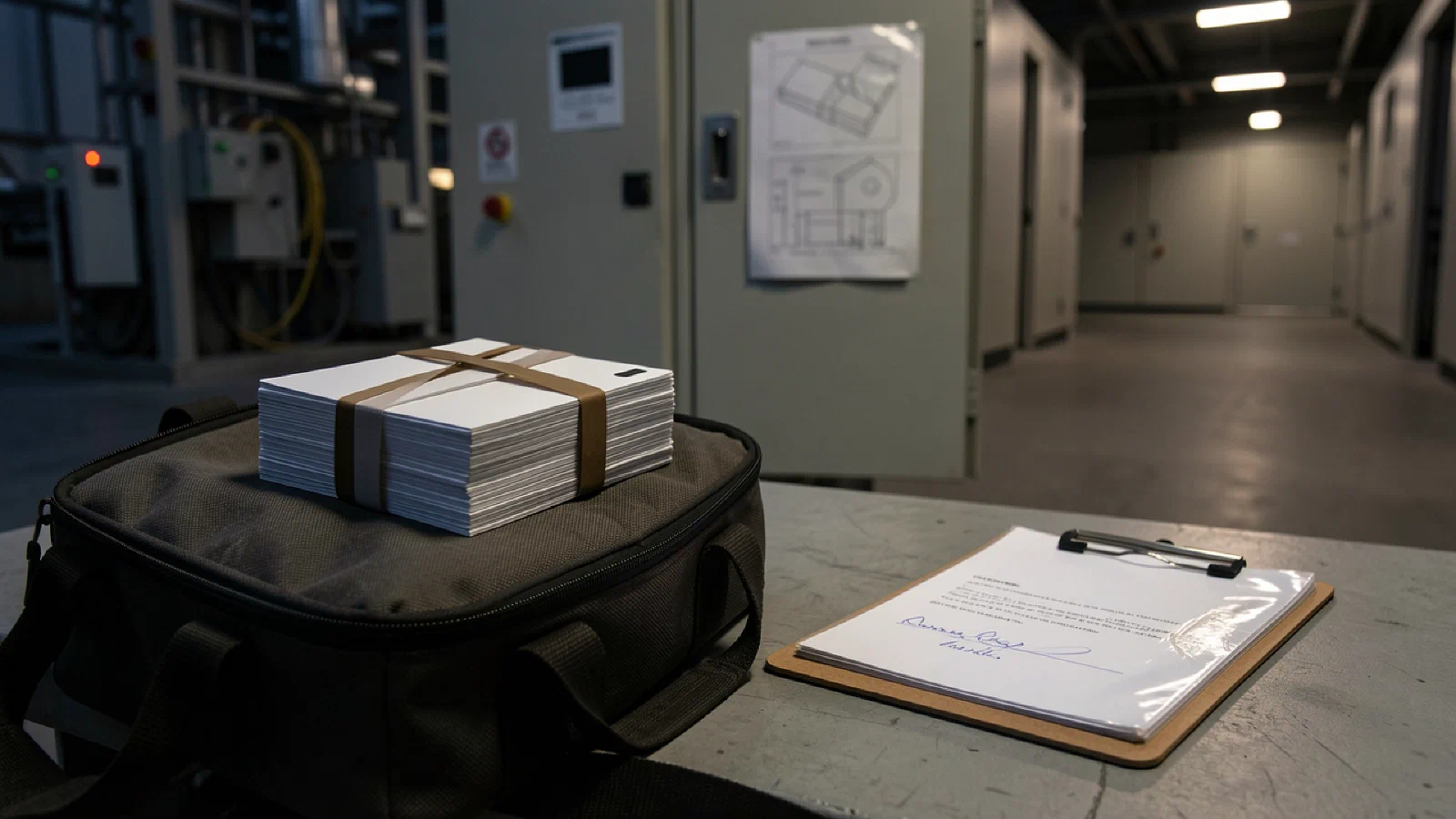
Tomas commissions palletizing cells for an integrator based in Rotterdam, and the cell he is starting up this week, in a juice plant near Zaragoza, is the forty-third copy of the same design he has installed. He keeps the hotel key cards. It began as a joke with his wife, one card from every town the machine took him to, and there is a rubber-banded stack of them in his kit bag now, Gliwice and Tilburg and Lleida and a hotel in Kent whose card is just a magnetic stripe on white plastic with no name at all. Forty-two cards. Zaragoza will make it forty-three.
The design is frozen. Same arm, same gripper family, same vision package, same control cabinet with the same drawings in the same door pocket. The engineering that made it work was done once, four years ago, on installs one through six, which each took a quarter of a year and a team. Install forty-three is scheduled for nine days, and Tomas will do most of it alone.
Ask him whether the forty-three cells are the same machine and he gives the answer of a man who has stood in all forty-three rooms. The machine is the same. The rooms have never once been the same. In Gliwice the cartons came in wet because the plant washed its floors on a schedule the line had been designed around for twenty years. In Kent the cell had to be walled differently because the fire route ran where the cabinet wanted to stand. In two plants the night shift quietly fed the machine by hand for months, for reasons that took him a long time to learn and that had to do with what the machine’s counting made visible about the shift before. None of that is in the drawings. All of it is in Tomas, and in the people at each plant who absorbed the machine into their particular building.
This essay exists to run a test the corpus has been avoiding, and Tomas and his key cards are the test’s two halves standing in one room.
The Claim and Its Challenger#
The corpus’s standing claim about deployment is that it cannot concentrate. Capability can: a model is trained in one place and copied everywhere. But deploying it means fitting it into tens of thousands of specific contexts, and the knowledge of each context lives in the people standing in it, in this plant’s floor-washing schedule and that county’s fire code, and knowledge of that kind cannot be gathered to a center no matter who wants to gather it. On that claim a good deal of the corpus now rests, including its account of where states still matter and what the smallest capable institutions are worth.
The physical regime puts a challenger in front of that claim, and the challenger deserves to be stated at full strength.
Physical systems have a property cognitive deployments lack: a solved configuration can be manufactured. Once the cell works, the cell is a drawing, a bill of materials, and a test procedure, and copies can be made of it. This is not a speculative mechanism. It is how every previous industrial technology actually spread. Nobody solved the tractor separately on each farm; a working configuration was frozen into a product, and the product diffused. If that is what physical AI deployment becomes, then the deployment frontier is not a frontier here at all. It is an engineering backlog, it clears the way backlogs clear, and the corpus has nothing distinctive to say about it, because economics has described ordinary industrial diffusion perfectly well for a century.
I do not know, walking into this test, which way it comes out, and the essay is written under a standing instruction that if the challenger wins cleanly, the finding gets logged and the essay dies. That is the honest way to run it.
What the Product Absorbs#
So run it. What actually happened between install one and install forty-three?
The engineering compressed. The thousand decisions of installs one through six, gripper geometry, light placement, fault recovery logic, became the frozen design, and no site has had to make them since. That is concentration, real and large. The part of deployment that was solving the machine has left the sites entirely and lives in Rotterdam.
And the boundary of what the product absorbs is not fixed. It moves, in one direction. Each generation of the design eats a little more of the surrounding work: the newer vision package tolerates worse lighting, so the lighting survey came off the checklist; the newer commissioning software auto-tunes what Tomas used to tune by hand. The vendors are not mysterious about their ambitions here. The configuration they want to sell next is not a machine but an outcome, the cell, its maintenance, its uptime, and its parts, priced together as a service, so that what the plant buys is pallets stacked per month and everything else is Rotterdam’s problem. Where that offer lands, even the maintenance regime, which the corpus has treated as irreducibly local, gets pulled across the boundary into the product.
Score the challenger’s half honestly: in the physical regime, the deployment frontier is not a fixed line. It erodes, from the product side, continuously, and pretending otherwise would be the corpus defending a claim instead of testing one.
What the Rooms Keep#
Now the other half, and it is not the sentimental half.
Follow what the tractor precedent actually shows, because the challenger leaned on it. The tractor was a product, and it still did not diffuse as a box in a crate. It diffused through the largest deliberate construction of local deployment capacity in industrial history: dealer networks, one in nearly every farming town, each carrying parts, a mechanic, credit, and a man who knew which fields flooded. The product crossed the country; the fit was rebuilt, locally, thousands of times, at enormous expense, on purpose. The same is true of the machine tool, the elevator, the diesel truck. Manufacturing the configuration never abolished the local layer. It industrialized the local layer.
And look again at what install forty-three still requires. Nine days is not zero days. The nine days are precisely the residue the product cannot absorb: this plant’s cartons, this plant’s fire route, this plant’s night shift and what the counting will make visible about it. The residue is smaller than it was at install one, and it is a different kind of thing from the engineering that compressed. The engineering was knowledge about the machine, and knowledge about the machine ships. The residue is knowledge about the room, and the room does not ship. What erosion actually does is strip the machine-knowledge out of the sites until what remains at each site is purely the part that was never movable.
So the finding, and it constrains the corpus in both directions at once.
The deployment frontier is two claims riding as one, a claim about knowledge and a claim about value, and in the physical regime they come apart.
The knowledge claim survives, narrowed and sharpened: what cannot concentrate is knowledge of rooms, and the physical regime, far from being the exception, is where that category gets refined to its pure form, because everything else gets pulled into the product. But the corpus has been letting a second claim ride silently on the first, that where the knowledge stays local, the value and the control stay local with it. The tractor’s dealer knew the fields, and the franchise agreement, the parts pricing, and the credit terms were written in Chicago. The service-contract cell keeps a technician near the plant, employed by Rotterdam, driving Rotterdam’s margin. The plant’s own people still learn the machine, still clear its small faults, still know what its counting shows about the room; what they no longer hold is any share of what that knowledge earns. Concentration found a way to happen without the knowledge moving an inch: it concentrated the account the knowledge is billed to.
What the center cannot gather, it can franchise, and franchising the frontier pays almost as well as holding it.
One dated claim follows, entered in the corpus’s register with its horizon. By September 2031, in at least one established category of physical AI, the majority of new deployments will be bought as service contracts, machine, maintenance, and uptime priced together, rather than as capital equipment the buyer owns and holds. That is the visible form the franchised frontier takes, and it is checkable. If 2031 arrives and physical AI is still overwhelmingly sold as boxes the buyer must learn to hold, then the local layer is keeping more than this essay concedes, and the correction gets entered where the claim is entered.
The Scope Line the Corpus Owes#
What the corpus must now say, and has not said, is that its deployment-frontier claim is a claim about the cognitive regime first and the physical regime only in a restricted sense. In the cognitive regime the claim holds whole, because there the context is not a floor plan but a procedure, a meaning, a set of people and what they will accept, and none of that can be frozen into a drawing even in principle. Nobody will ever crate up a hospital’s documentation culture, test it in Rotterdam, and install it in nine days somewhere else; there is no product for the boundary to advance from, and so nothing erodes. In the physical regime the claim holds only for the shrinking residue of room-knowledge, and says nothing about where the value goes, which is mostly up. Letting the claim read as general was a comfortable ambiguity, and this essay ends it.
The challenger, for its part, does not win. A regime where the local layer must be industrially rebuilt at every site, staffed forever, and billed from elsewhere is not ordinary diffusion with nothing left to say; it is a specific structure with a specific beneficiary, and the corpus’s arbitrage series has been describing that structure under other names for some time. The essay lives. It just comes back with less than either side wanted.
In Zaragoza, on the last evening, Tomas signs the acceptance sheet with the plant’s production manager, a woman who has run this floor for eleven years and who spent the nine days telling him, item by item, what the room would and would not tolerate. The cell is Rotterdam’s design and Rotterdam’s contract. The nine days were hers. He puts the hotel key card in the rubber band with the others, forty-three rooms nobody in Rotterdam has ever stood in, and drives to the airport in the dark, past the loading bays going quiet for the night.
References:
Diffusion and the Product:
Rogers, Everett M. Diffusion of Innovations. 5th ed., Free Press, 2003.
Olmstead, Alan L., and Paul W. Rhode. “Reshaping the Landscape: The Impact and Diffusion of the Tractor in American Agriculture, 1910-1960.” The Journal of Economic History, vol. 61, no. 3, 2001, pp. 663-698.
Hounshell, David A. From the American System to Mass Production, 1800-1932. Johns Hopkins University Press, 1984.
Local Knowledge and the Firm:
Polanyi, Michael. The Tacit Dimension. University of Chicago Press, 1966.
von Hippel, Eric. “‘Sticky Information’ and the Locus of Problem Solving: Implications for Innovation.” Management Science, vol. 40, no. 4, 1994, pp. 429-439.
Dyer, Jeffrey H., and Kentaro Nobeoka. “Creating and Managing a High-Performance Knowledge-Sharing Network: The Toyota Case.” Strategic Management Journal, vol. 21, no. 3, 2000, pp. 345-367.
Series Anchors:
The Approximate Mind, TAM-LEV.04 (The Hinge) and TAM-LEV.05 (The Serving Units): the deployment-frontier claim this essay tests, and the institutions that hold what cannot ship.
The Approximate Mind, TAM-ARB.14 (Owning the Instrument): where value goes when it stops accruing to the hand that does the work.
The Approximate Mind, TAM-ARB.21 (Supply Chain and Logistics): the physical regime the arbitrage series priced from the other end.
How this essay connects to others across The Approximate Mind.
- Rogers, Everett M. Diffusion of Innovations. 5th ed., Free Press, 2003.
- Olmstead, Alan L., and Paul W. Rhode. “Reshaping the Landscape: The Impact and Diffusion of the Tractor in American Agriculture, 1910-1960.” The Journal of Economic History, vol. 61, no. 3, 2001, pp. 663-698.
- Hounshell, David A. From the American System to Mass Production, 1800-1932. Johns Hopkins University Press, 1984.
- Polanyi, Michael. The Tacit Dimension. University of Chicago Press, 1966.
- von Hippel, Eric. “‘Sticky Information’ and the Locus of Problem Solving: Implications for Innovation.” Management Science, vol. 40, no. 4, 1994, pp. 429-439.
- Dyer, Jeffrey H., and Kentaro Nobeoka. “Creating and Managing a High-Performance Knowledge-Sharing Network: The Toyota Case.” Strategic Management Journal, vol. 21, no. 3, 2000, pp. 345-367.