Someone Hauls the Wood
On the friction that never left, the question still rationed, and the lower tier we learned to hide
TAM-090 · The Approximate Mind
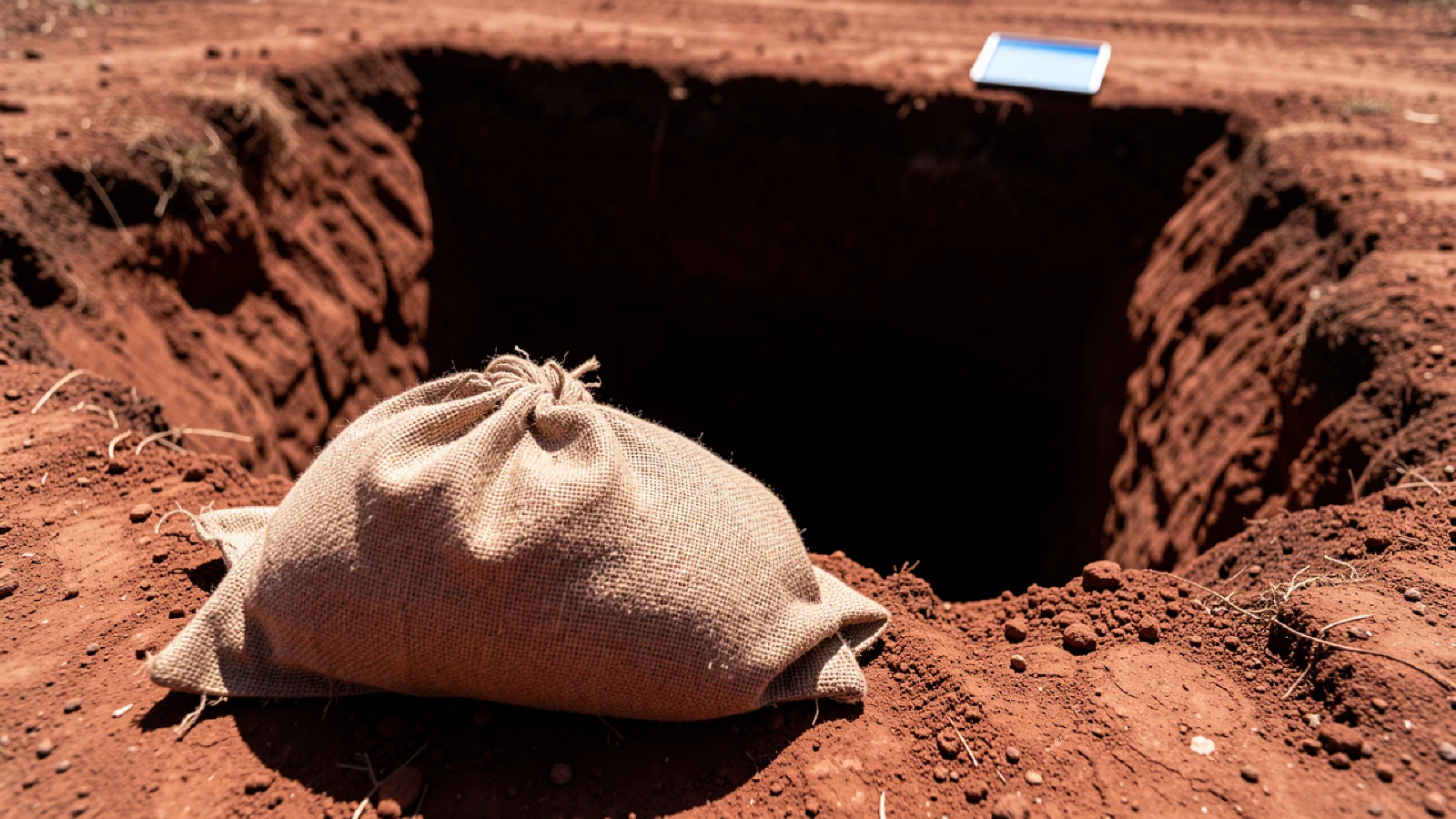
There is a boy in the Lualaba province of the Democratic Republic of the Congo who wakes before five. No system chose the hour for him. He wakes because the cooperative pays by the sack and the good seams fill early, and a boy who arrives late finds the easy ground already worked. He climbs down into a hand-dug shaft that no engineer approved, scrapes cobalt-bearing ore into a sack, hauls it up, and carries it to a buyer who pays him a few dollars for a day that would be illegal in every country where the mineral ends up. The cobalt goes into a battery. The battery goes into a device. The device, eventually, sits on a nightstand in an optimized apartment on the other side of the world, where it wakes someone gently, at the moment their body is ready, having decided that the question of when to rise was a friction worth removing.
The friction was not removed. It was relocated. It is in the shaft, on the boy’s back, in the dark he climbs down into so that someone he will never meet can climb out of theirs.
The Emperor’s New Virtues told the story of Rosa, the seamstress who woke at five for forty years, and her descendants, each generation handed a little more freedom from necessity, until the great-grandchildren inherit the condition of emperors. That essay made an argument about virtue, and the argument holds. But it granted the optimized world its best case and marked the grant with three words it did not cash. AI, it said, might be the slave that does not bleed. The labor transfers not onto a person but onto a system with no inner life to violate. If that is true, it is the moral difference between the villa and the optimized apartment.
If it is true.
It is not true. This essay is about the part the other one only pointed at.
The Constant#
Every economic revolution has promised to end extraction, and every one has relocated it instead.
The abolition of slavery did not end forced labor. It moved it into sharecropping, into the company town, into the convict-lease system that rented prisoners to the same plantations under a different name. The industrial revolution promised to free humanity from drudgery and built the most concentrated drudgery in history, in mills that consumed children faster than the farms had. The green revolution promised to feed the world and bound a generation of farmers to seed and fertilizer they had to buy from the people who sold them the promise. The digital revolution promised to connect everyone and built its connection on cobalt seams and assembly lines ringed with suicide nets and content-moderation rooms where workers in Nairobi and Manila watch the worst images humanity produces, all day, so that the feed stays clean for everyone else.
The pattern is not that extraction never improves. It does improve, at the margins, sometimes substantially. The pattern is that it never ends. It moves. It goes where the light is dimmest and the wage is lowest and the consumer is least likely to see it. And each new arrangement arrives wrapped in a language of liberation sincere enough that the people speaking it believe it, which is exactly what makes the relocation so smooth. You cannot relocate something efficiently if everyone is watching. The genius of each new form is that it persuades the beneficiaries they are living in the form that finally ended the thing.
The optimized world makes the oldest version of this promise. It says the machine will haul the wood. And in the room where the promise is made, it is almost true. The apartment really does run on something that does not bleed. The coffee really is made by a system with no childhood being spent to make it. Inside the frame, the slave of Meno is gone.
The frame is the trick. It always was.
The Geography of the Unseen#
The aristocrat’s frictionless life rested on a slave he could see. The boy hauling the wood was in the house. The senator who chose, like Marcus Aurelius, to philosophize about duty did so within sight of the people whose unfree labor heated the room, and the philosophy mostly declined to notice them, but the declining was active. You had to look away. The slave was there to be looked away from.
The optimized life rests on a slave nobody has to look away from, because the arrangement has been engineered so that he is never in the frame to begin with. He is four thousand miles away. He is in a tier of the supply chain that has its own subcontractors, who have their own subcontractors, so that no single company can be said to employ him and no single consumer can be said to have hired him. He is real, and traceable, and documented in reports that circulate among the people who write reports. He is simply not present at the point where the benefit is enjoyed. The distance is not an accident of global trade. The distance is the product. We did not abolish the lower tier. We refined our ability to keep it offstage.
This is worse than the senator’s arrangement in one specific and uncomfortable way. The senator’s slave imposed a moral cost that was at least available to be felt. The senator could, in principle, look at the boy hauling the wood and know what his comfort cost. The knowledge was painful and that pain was the beginning of every movement that eventually ended the arrangement. Visible extraction organizes its own resistance. The slave knew he was a slave. The abolitionist could point at the thing being abolished.
Invisible extraction organizes nothing, because there is nothing in the frame to organize against. The optimized consumer feels no draft from the cold kitchen that produced the coffee, because the kitchen is on another continent and the supply chain is designed so that the draft never reaches the apartment. The moral cost has not been paid. It has been exported, along with the labor, to a place where the person bearing it has no standing to present the bill. A clean conscience and a clean supply chain are not the same thing. The optimized world has perfected the first and called it the second.
The Question, Still Rationed#
The Emperor’s New Virtues ended on a question it said the machine could not take. The necessity of being a self that has to choose. The burden of authoring a life when nothing requires you to be anything. It called this the one master that cannot be delegated, and it said the optimized world would hand this kingly question to everyone, the way it was once rationed to emperors.
To everyone. That was the word that did not cash either.
The boy in the shaft does not face the kingly question. He cannot. The question of what to make of yourself when nothing requires you to be anything is a question that only opens once everything that requires you to be something has been cleared away, and for him nothing has been cleared away. The shaft requires him. The sack requires him. The seam that fills early requires him to wake before five, and the requirement is not negotiable, and it leaves no room above itself for the luxury of asking what a life is for. He has the older question, the one Rosa had, the one the species has had for almost all of its existence. Not what shall I become. Just: will there be enough today.
So the optimized world does not, in fact, universalize the condition of emperors. It universalizes it for the tier that can see it from the apartment, and it funds that universalization out of a tier that cannot. The kingly question remains exactly what it has always been. A luxury good. Rationed. The optimized world did not democratize it. It widened the gate a little, let in a larger aristocracy than Rome ever managed, and built the gate out of the same material as always, the labor of the people left outside it.
The cruelty here is quiet and structural and worth naming precisely. The boy is not exploited by anyone’s malice. No one in the optimized apartment wishes him harm. Most of them, if shown him, would be moved, would donate, would want the arrangement to be otherwise. The extraction is not personal. It runs through ordinary transactions, through access pricing and supply-chain depth and the simple fact that the cheapest cobalt comes from the least regulated ground. Personal cruelty can be reformed by appealing to the person. Structural extraction cannot, because there is no person to appeal to, only a system doing what the incentives reward, and the incentives reward exactly the invisibility that keeps the appeal from forming.
The Farmer Who Did Not Get a Turn#
There is a second figure, less dramatic than the boy in the shaft, and in some ways the more important one, because he represents the larger number.
He is a farmer in a country that was promised the ladder. The ladder was the path every developed nation climbed: move from the field to the factory, from the factory to the office, each generation a rung higher, the agrarian poverty of the grandparents becoming the manufacturing wage of the parents becoming the professional salary of the children. It worked. It worked for England and then America and then Japan and Korea and most recently and most spectacularly for China, which moved more people up the ladder in forty years than the whole prior history of development combined.
The farmer’s country was supposed to be next. It built the factories. It formed the urban labor markets around the expectation of industrial employment. It moved its young people from the village to the city to stand at the bottom rung and begin to climb.
The rung is not there. It is being automated away at the moment his country reaches for it, by the same capital that is funding the factories he was supposed to work in. He is building the infrastructure of the economic city precisely as the economic logic that made that city a path to the middle class is being dismantled. He will not get the turn his grandparents’ equivalents in other countries got. The ladder was real. It was retracted, by the country that climbed it last, before he could set his foot on it.
He does not face the kingly question either. He faces a worse one, the one this whole arc has been circling. Not what shall I make of myself in a world that needs nothing from me. But what becomes of a person whom the new world has classified, without malice and without appeal, as surplus. The optimized apartment does not need his labor. The shaft needs the boy’s labor and pays him nothing for it. Between the two of them they cover most of the people on the planet, and neither of them has been handed the emperor’s question, because the emperor’s question is what is left over after the world has stopped extracting from you, and the world has not stopped. It has only stopped extracting visibly, and only from the few.
What This Does Not Conclude#
There is a version of this essay that ends in despair and a version that ends in indictment, and both are too easy, and both let the reader off.
Despair says nothing changes, the extraction is eternal, the tiers are permanent, so the boy in the shaft is simply the price of the apartment and there is nothing to be done. This is false. Extraction has improved, repeatedly, at the margins, and the margins are where actual people’s actual lives get better or worse. The child labor in the cobalt seam is not a law of physics. It is a supply-chain choice, traceable, addressable, already being fought by people who refuse to accept that the boy is the price of anything. The ladder being retracted is not a law of physics either. The data that trains the systems came from somewhere, the minerals came from somewhere, and the populations whose ground and whose labor and whose lives feed the optimized world are not without leverage, only without the arrangement that would let them use it.
Indictment says the optimized are monsters feasting on the suffering of the unseen, and this is also false, and it is the more comfortable falsehood, because it locates the problem in the wickedness of individuals rather than the architecture of the system. The optimized consumer is not a monster. She is Rosa’s great-granddaughter, kind by disposition, troubled when shown the shaft, living inside a frame that was built specifically so the shaft would not be shown. The architecture is the thing. The architecture does what architectures do. It reproduces itself, and it reproduces the invisibility that protects it, and no amount of individual virtue inside the frame reaches the labor outside it, because the frame is precisely the mechanism that keeps the two from touching.
The honest end is the one that refuses both exits and holds the two figures in the same sentence. The great-granddaughter waking gently, at the optimal hour, into a life of almost perfect optionality. The boy waking before five, into a shaft, so that her hour can be optimal. They are connected by a supply chain that runs between them like a nerve, and the whole genius of the arrangement is that she cannot feel it and he cannot reach her, and the thing that would change this is not her guilt and not his patience but a redesign of the frame itself, which no one inside the frame is incentivized to undertake.
I wonder whether the optimized age will ever produce its own abolitionist, or whether the achievement of invisibility is now complete enough that the thing requiring abolition can no longer be pointed at by anyone standing close enough to matter.
We have spent the whole of our history trying to free ourselves from the slave who hauls the wood. We are very close, for some of us, to a world where the wood is hauled by something that does not bleed. The achievement is real. It is also, for now, a local achievement, true inside the apartment and false four thousand miles away, and the distance between the two is not the distance the supply chain has to cross. It is the distance we have learned, with great sophistication, not to look across.
Someone still hauls the wood. The only thing the optimized age has changed is how completely we have arranged not to see him.
This is the second essay in a three-part sequence on life, purpose, and virtue in the optimized age, following The Emperor’s New Virtues and preceding Distilled. It is the counterweight to the first: where that essay granted the optimized world its best case, this one examines the friction that case leaves out.
How this essay connects to others across The Approximate Mind.
- Kara, Siddharth. Cobalt Red: How the Blood of the Congo Powers Our Lives. St. Martin’s Press, 2023.
- Rivoli, Pietra. The Travels of a T-Shirt in the Global Economy. John Wiley and Sons, 2005.
- Crawford, Kate. Atlas of AI: Power, Politics, and the Planetary Costs of Artificial Intelligence. Yale University Press, 2021.
- Blackmon, Douglas A. Slavery by Another Name: The Re-Enslavement of Black Americans from the Civil War to World War II. Doubleday, 2008.
- Beckert, Sven. Empire of Cotton: A Global History. Alfred A. Knopf, 2014.
- Roberts, Sarah T. Behind the Screen: Content Moderation in the Shadows of Social Media. Yale University Press, 2019.
- Rodney, Walter. How Europe Underdeveloped Africa. Bogle-L’Ouverture Publications, 1972.
- Studwell, Joe. How Asia Works: Success and Failure in the World’s Most Dynamic Region. Grove Press, 2013.