Pax Oblivionis
On the peace nobody is keeping, and why there is no way to complain about it
On the peace nobody is keeping, and why there is no way to complain about it#
Around the year 100, at a fort called Vindolanda on the northern edge of the Roman province of Britain, a woman named Claudia Severa dictated a short letter to a friend. Her husband commanded a garrison somewhere nearby. Her friend, Sulpicia Lepidina, was married to the prefect at Vindolanda. The letter is an invitation. Severa’s birthday falls on the eleventh of September and she would like Lepidina to come, and says the day will be better if she does.
A scribe wrote most of it in a practiced hand. Then Severa took the pen herself for the last few lines, and her writing is less elegant, and what she adds is that she will be expecting her, and calls her sister, which they were not. Those few lines are the earliest surviving writing in Latin by a woman that anyone has found.
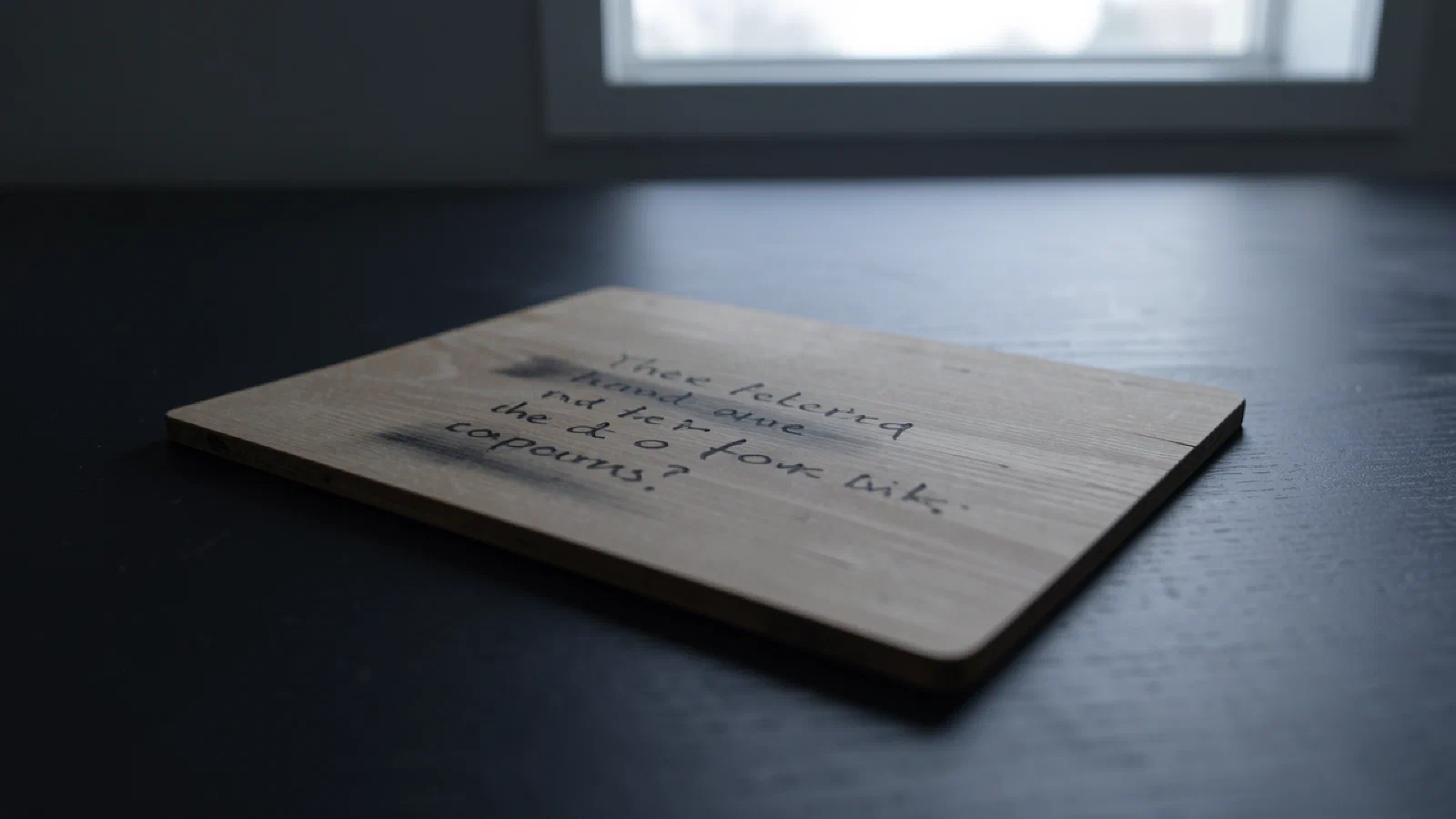
The letter is a slice of wood about the size of a postcard, written in ink. It survived because somebody threw it out.
Vindolanda’s deposits are waterlogged and anaerobic, which is a technical way of saying the ground there is wet clay that keeps air out, and wood dropped into it does not rot. The tablets come out of rubbish layers. Nobody filed them. Nobody thought a birthday note from an officer’s wife was an object with a future. It went into the heap with the broken sandals and the discarded lists of who was present and correct, and the heap held it for nineteen hundred years, and in 1973 an archaeologist pulled it out of the mud.
The peace nobody is keeping#
Every peace in the tradition of pax names is a peace somebody holds. Romana, Britannica, Americana, Sinica, Silica. Each names a party whose power produces the quiet, and each carries the implicit terms: the peace is real, the peace is not free, and the peace ends when the holder can no longer hold it. Even the critique fits the shape. When Tacitus put the line about the wasteland into a Caledonian’s mouth, the sentence needed a they. They make a desert. Somebody did it.
Pax oblivionis has no they.
It is the condition of not being worth the trouble. Not conquered, not liberated, not protected, not suppressed, and not defended by anyone including yourself. Simply outside the set of things that anyone with power has a reason to act on. The quiet is real and total and nobody produced it.
History is full of this and rarely names it, because the naming requires noticing an absence. The province that Rome released rather than lost, when a rescript told the Britons to see to their own defenses and the machinery of the empire simply turned elsewhere. The port that stopped mattering when the sea lanes moved, whose harbor was never blockaded and never needed to be. The town the railway missed by nine miles. The language nobody bothered to suppress, which survived the century in which its neighbors were legislated out of existence, and survived it by being spoken in a place with nothing under it worth extracting.
A desert somebody made is a crime. A desert that was simply never visited is a climate.
The instruments do not fit#
The reason this condition sits outside political thought is not that it is rare. It is that every tool we have for thinking about peace assumes a counterparty.
The tradition offers deterrence, which works by making the cost of acting exceed the benefit, and requires an actor doing the calculation. Balance of power, which requires at least two parties with interests. Law, which requires a sovereign that can be bound and a subject that can be summoned. The social contract in every version anyone has written, which begins with parties who could harm each other and choose otherwise. Rights, which are claims against somebody. Even revolution, which requires an incumbent.
Each of these is a theory of restraint, and restraint is a behavior. It has an agent. The whole apparatus of political reasoning is built to work on the question of what a powerful party will choose to do, and it is very good at that question.
Indifference is not a behavior. Nobody is restraining themselves toward Vindolanda. You cannot deter an absence of interest, because there is no calculation being run in which your deterrent could appear. You cannot negotiate with it, because negotiation requires someone on the other side of the table who wants something from you, and wanting nothing from you is the entire condition. You cannot shame it, because shame attaches to a decision and no decision was made. You cannot overthrow it. There is no incumbent.
Every peace we know how to reason about is a peace somebody decided to keep, which is why we have no instruments for the one nobody decided anything about.
The grievance with no grammar#
Injury by an agent is sayable. The sentence exists and has always existed, in every political vocabulary anyone has developed: they took it, they burned it, they would not let us, they came in the night. Those sentences do work. They can be repeated, gathered, brought somewhere, turned into a demand. A demand can be refused, which is still a form of being answered. Whole traditions of law, protest, testimony and repair are built on top of that basic sentence and none of them function without it.
Now try to construct the corresponding sentence for the other condition.
Nobody came. Nobody asked. Nobody wanted what we had. The work went on and no one ever found a use for it. These are true statements and they are not claims. There is no addressee. You cannot bring them anywhere, because bringing a grievance requires a body that receives grievances, and a body that receives grievances is by definition a body that has taken an interest.
So the injury is real and politically unrepresentable, and the unrepresentability is not an oversight anyone could fix. It follows from the structure of what a claim is.
And from outside, the condition is unreadable. A population under an agent’s boot generates noise: petitions, riots, samizdat, exile literature, atrocity reports. A population nobody wants anything from generates none of that, because there is nothing to generate it against. From any distance, the second silence and contentment are the same reading. The people who are fine and the people nobody came for produce identical data.
We wonder how much of what gets recorded as social peace in any period, ours included, is the second thing wearing the appearance of the first, and whether there has ever been a method for telling them apart that did not require going there.
The terms that were never written#
None of the historical cases required anybody to decide anything, and all of them ran on distance. Rome did not skip the far side of the province out of disinterest alone; getting there was expensive, and expense and disinterest were the same fact wearing one face. That is what has come apart.
The apparatus now operating is already at the desk. It is in the clinic, the classroom, the depot, the second shift. It has the addresses, the networks, the records, and the capacity to read any of it, and it reads what converts into a product and what generates a reaction, and the rest sits addressable and unopened. A nephrologist who has spent twenty-two years learning something true about a particular kind of patient is not remote from the apparatus in any sense a Roman would recognize. She is inside it, logged, reachable, and of no interest.
Vindolanda was far away. The new version of it is down the hall, and being down the hall makes no difference at all.
So the condition has come loose from geography, which is the one property that used to make it predictable. It can now fall on anyone, anywhere, including people at the exact center of everything, and what determines where it falls is not distance but whether there is a reason.
Whether this is a good condition or a bad one is not settled by anything above, and the honest answer runs both ways hard enough that the essay would be lying to pick.
Most people in most of history wanted exactly this. To be outside the attention of whoever was collecting. The bypassed town is very often the free town. Being unread is being unmanaged, and the tax assessor who never comes is the best news a village can get. The whole appeal of the frontier, in every civilization that had one, was that the center’s arm was short there. There is nothing romantic about wanting the empire to look elsewhere; it is one of the most reasonable preferences a person can have, and for most of the species, most of the time, it was the only form of freedom on offer.
Against that stands one structural fact, and it is not a moral objection. It is an engineering one.
A peace held by a hegemon has terms. Bad terms, usually, extracted under duress, but terms: a tribute, a garrison, a treaty, a border, an understanding about what is tolerated. Terms can be read. They can be relied on for planning. Their violation is a recognizable event, and a recognizable event can be responded to.
A peace held by nobody has no terms at all. It lasts precisely as long as the indifference lasts, and indifference is not a commitment. It has no duration, no notice period, and no threshold that would count as a breach. It ends on the day somebody finds a reason, and the reason can be anything: a mineral discovered underneath, a route that now makes sense, a model that finds the data useful after all. Nothing will have been violated. Nothing was ever promised.
It is the only peace that cannot be broken, because nothing was ever agreed, and the only peace that can end without anyone having done anything wrong.
That is the shape of the thing, and it is worse than being ignored and better than being taken, and it is not stable in either direction.
Some of the quiet in the world is defended, by people who built a wall around something and pay to maintain it, and what grows behind a maintained wall is a different question with a different answer. That is not this. This is the quiet of nobody arriving, which costs nothing to keep because nothing is trying to enter.
Severa’s birthday was the eleventh of September. We do not know whether Lepidina went. There is no record either way, and there was never going to be one, because a woman going nine miles to a friend’s party on the northern frontier of a province the empire would eventually release was not the sort of event anybody was writing down.
What we have instead is the invitation, which survived by being discarded into wet ground by someone who had no opinion about it, and which is now the earliest thing anyone has found in a woman’s Latin. Everything about that outcome was accidental. The clay, the throwing away, the nineteen hundred years, the archaeologist in 1973.
The record of a peace nobody was keeping turns out to consist entirely of what nobody thought worth keeping, and there is no way to know what proportion of it we have.
This essay stands with Part 099 (Pax Artifica) as a pair, and completes the pax framing: the peace that is named while it is being built, and the peace that has no holder to name. Its terminal form, a civilization recorded and not read, is developed in The Closed Window in The Standard with Ears. It stands in conversation with The Quiet Irrelevance and The Counterparty in the main series, and with The Uncounted and The Rubble and the Growth in the Reimagined series, the latter’s account of the void as conditional rather than automatic being the argument this essay inherits.
How this essay connects to others across The Approximate Mind.
- Birley, Robin. Vindolanda: A Roman Frontier Fort on Hadrian’s Wall. Amberley, 2009.
- Bowman, Alan K. Life and Letters on the Roman Frontier: Vindolanda and Its People. British Museum Press, 1994.
- Bowman, Alan K., and J. David Thomas. The Vindolanda Writing-Tablets (Tabulae Vindolandenses II). British Museum Press, 1994.
- Halsall, Guy. Barbarian Migrations and the Roman West, 376-568. Cambridge University Press, 2007.
- Galtung, Johan. “Violence, Peace, and Peace Research.” Journal of Peace Research, vol. 6, no. 3, 1969, pp. 167-191.
- Hobbes, Thomas. Leviathan. Edited by Richard Tuck, Cambridge University Press, 1996.
- Schelling, Thomas C. The Strategy of Conflict. Harvard University Press, 1960.
- Fricker, Miranda. Epistemic Injustice: Power and the Ethics of Knowing. Oxford University Press, 2007.
- Lyotard, Jean-François. The Differend: Phrases in Dispute. Translated by Georges Van Den Abbeele, University of Minnesota Press, 1988.
- Trouillot, Michel-Rolph. Silencing the Past: Power and the Production of History. Beacon Press, 1995.
- The Approximate Mind, TAM-099 (Pax Artifica): the peace named while it was being built.
- The Approximate Mind, TAM-EAR.C1 (The Closed Window): the recording that nobody plays.
- The Approximate Mind, TAM-060 (The Quiet Irrelevance): what happens when nothing needs you.
- The Approximate Mind, TAM-094 (The Counterparty): the deviation that is neither profitable nor loud.