Pax Mnemonica
On the record every order runs on, and what changes when the record answers back
On the record every order runs on, and what changes when the record answers back#
Ashurbanipal ruled Assyria from 669 until around 631 and was, unusually for a king in that part of the world at that time, literate. He said so himself and appears to have been telling the truth. He could read Akkadian and some Sumerian, including scripts already archaic when he learned them, and he was proud of it in a way that comes through the inscriptions across twenty-six centuries.
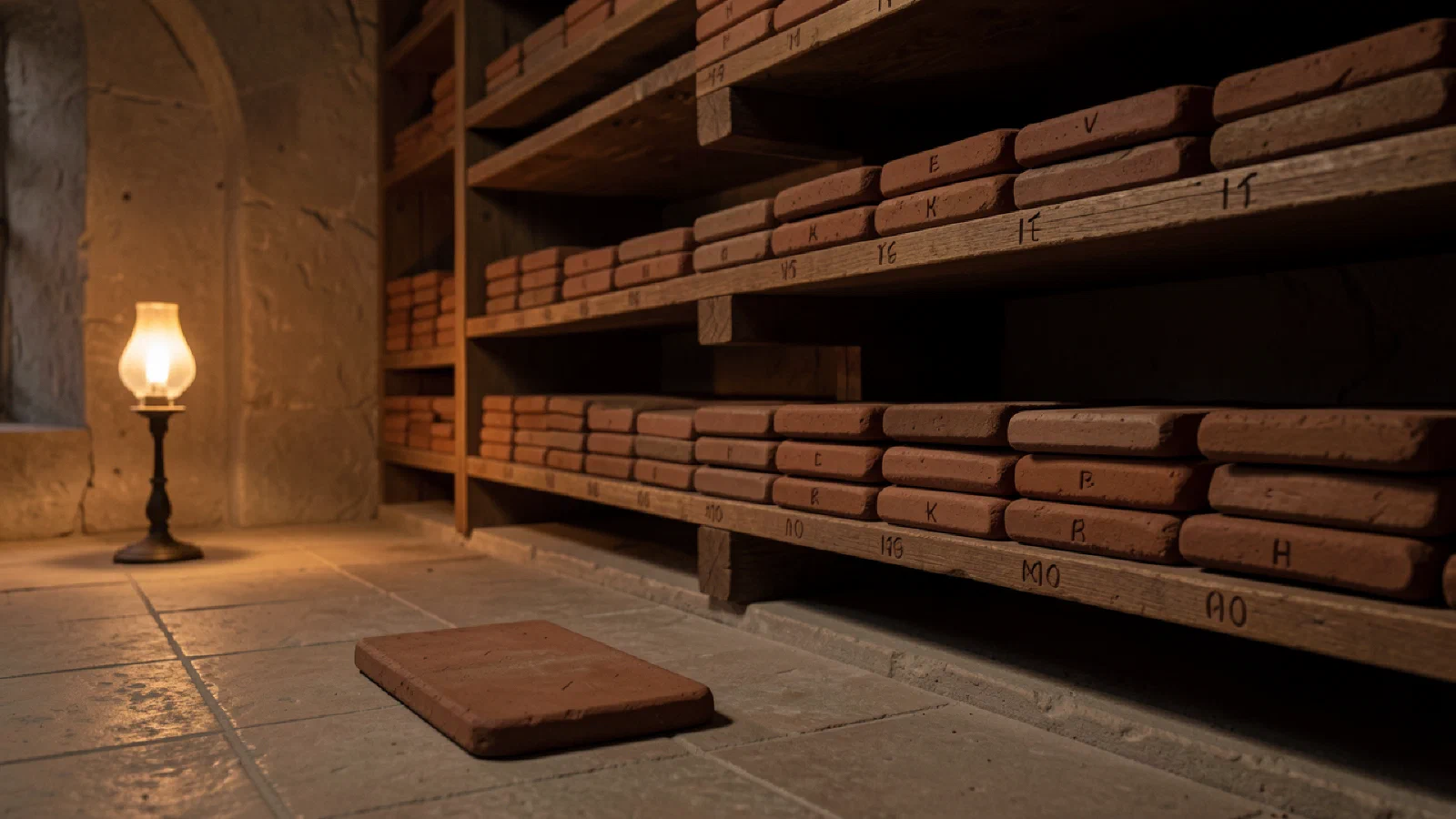
He sent scribes out with what amounted to seizure orders. Bring back the tablets from the temples at Babylon. Bring back the omen series from Borsippa, the medical texts, the star catalogues, the lexical lists, the incantations against headache and against ghosts. Copy what cannot be taken. The result was around thirty thousand tablets at Nineveh, distributed through the palaces, sorted by subject, with colophons on the edges recording which series a tablet belonged to and where it went back.
Many of those colophons carry a phrase. The tablets were kept, they say, for the sake of distant days.
In 612 the Medes and the Babylonians came through the walls and burned the palaces, and the fire that ended the empire baked the clay from brittle sun-dried mud into ceramic, and that is why the Epic of Gilgamesh exists. The destruction was the preservation. Almost everything anyone knows about Mesopotamian literature comes through a library that survived because somebody tried to erase it.
The third requirement#
An order needs something to enforce it and something to conduct itself in. Those two layers are named elsewhere in this set. Neither works without a third.
A peace runs on a record. Not on memory in the loose sense but on kept documents, and the list of them is the same across every order that ever held: the muster roll, so you know who is owed pay and who has deserted. The tax register, so you know what was assessed last year. The cadastre, so you know where the boundary is when two men disagree. The treaty text, so that what was agreed can be produced. The genealogy, so that succession has a fact under it.
Take those away and an order lasts exactly one generation, which is the span over which living people can be asked. Everything beyond that horizon requires a document, and the document is the only thing standing between a settled question and a fresh fight.
Force decides a question once. A record is what makes the answer still true in forty years, when everyone who was there is dead and the only witnesses are hostile.
Ashurbanipal understood this in the most literal available sense. His agents were not collecting for a reading room. Omen texts told a king whether to march. Lexical lists let a scribe read a Babylonian document. A library was a working instrument of rule, and the reason to take Babylon’s tablets was the same reason to take Babylon’s silver.
The keeper is not the ruler#
The record has almost always been held by somebody other than the person holding the force.
Scribes in Mesopotamia. Chanceries in medieval Europe. Monasteries, which held land records for kingdoms that could not read them. Notaries in the Italian cities. The registrar, the clerk, the archivist, the keeper of the rolls. These are not powerful offices in any way that shows up in a narrative history, and they are the offices without which nothing else in the building functions.
They also outlast. The dynasty falls and the chancery keeps working for whoever arrives, because whoever arrives needs to know who owes what. That continuity is why record-holding has historically been a distinct kind of power rather than an accessory to the other kinds: it survives the transfer.
The leverage is worth stating exactly, because it is not the leverage people assume. A keeper’s power is rarely the power to destroy a record, which is crude and gets noticed. It is the power to determine what is easy to find. A document that exists in an archive nobody can index is functionally absent, and a document produced promptly when asked is functionally the truth. Every archivist in history has known this and most rulers have not thought about it once.
Whoever decides what is retrievable has already decided most of what will be believed, and has done it without asserting anything.
The record that answers back#
Everything above has been true for five thousand years.
Every record any order has ever run on was inert. A tax register does not have a view about the tax. A cadastre does not reinterpret the boundary when you consult it a second time. You could lose a document, forge one, burn one, or misread one, and all four of those are failures with known shapes that institutions built procedures against. What no prior record ever did was produce something new when you asked it a question.
The current record does. A trained model is a deposit of what was said, held in a compressed form nobody designed as an archive, and it is the first record in history that generates rather than storing. Ask it twice and you may get two answers. Ask it about its own contents and it will tell you something, fluently, which may or may not correspond to what is in it.
A peace whose record can be consulted is one thing. A peace whose record has a manner is another, and nobody has held the second kind before.
The pax mnemonica names the position rather than the party, because the party is genuinely unclear. Whoever holds the deposit holds something older than compute and possibly more durable, on the historical pattern where the chancery outlasts the dynasty. That is a different hegemon from the one everybody is currently watching, and it may arrive later.
What cannot be audited#
The difficulty is not that a generative record might be wrong. Records have always been wrong.
The difficulty is that every procedure institutions built for handling a bad record assumes the record sits still. You check the tax register against the field. You check the copy against the original. You check one chancery’s version against another’s. All of these work because the document has a fixed state and the world has a state and the two can be laid alongside each other.
A record that produces its answer at the moment of asking cannot be laid alongside anything, because there is no fixed thing to lay. It responds to how it was asked. It will describe its own layers, and the description is generated by the same process that generates everything else it says, which means the account of the archive is made of the same material as the archive and offers no purchase.
Every method for catching a lying record assumes the record cannot hear the question.
Nineveh has a warning about this that took until recently to surface. The library was not found frozen at the moment of the fall. The British Museum’s work on it establishes that the collection was sifted and then deliberately smashed, with the pieces dumped around the palaces, which means somebody was editing on the way out. Even the inert version was tampered with at exactly the moment nobody was left to notice, and we know it happened and cannot say what was removed.
We wonder what the equivalent of a sifting looks like in a record that answers, and whether it would leave any trace at all, or whether the only sign would be a subject the thing is slightly less fluent about than it should be.
For the sake of distant days#
Read the colophon literally rather than sentimentally. Ashurbanipal was not preserving for posterity in the sentimental register. He was a king with a long horizon who understood that the tablets were the part of his rule most likely to still be functioning after him, and he was right, and he was wrong about which part of it would matter.
What survives is not the administrative apparatus. Nobody has needed an Assyrian tax register for a very long time. What survives is Gilgamesh, the medical texts, the star catalogues, the lists, the spells against ghosts, the mundane and the literary jumbled together in a heap of baked mud because that is what happened to be in the palace when it burned. He kept the working instrument and posterity kept the poetry, and nobody consulted him about the swap.
He built a structured deposit and history handed him a midden. The organization, the subject rooms, the shelving marks, all of it collapsed into rubble and got read anyway, and the reading has been going on for a hundred and seventy years and is not finished.
Whether the current deposit will do anything similar is not answerable from here, and the honest thing is to notice how little of the outcome at Nineveh had to do with what anyone intended. The king intended a working library. The Medes intended to end an empire. What actually happened is that a fire turned mud into ceramic and a civilization got to keep its poetry by accident, and everyone who made a decision that night was deciding about something else.
This essay opens the pax set and supplies the layer the others assume: before an order can be enforced or formatted, it has to be recorded. Its claim about the generative record is the political form of what The Midden series treats as a methodological problem, and the audit difficulty here is the same difficulty that series names as its characteristic evidence failure. It stands in conversation with When AI Remembers Itself and The Record.
How this essay connects to others across The Approximate Mind.
- Frame, Grant, and A. R. George. “The Royal Libraries of Nineveh: New Evidence for King Ashurbanipal’s Tablet Collecting.” Iraq, vol. 67, no. 1, 2005, pp. 265-284.
- Robson, Eleanor. Ancient Knowledge Networks: A Social Geography of Cuneiform Scholarship in First-Millennium Assyria and Babylonia. UCL Press, 2019.
- Van De Mieroop, Marc. Cuneiform Texts and the Writing of History. Routledge, 1999.
- Clanchy, M. T. From Memory to Written Record: England 1066-1307. 3rd ed., Wiley-Blackwell, 2013.
- Derrida, Jacques. Archive Fever: A Freudian Impression. Translated by Eric Prenowitz, University of Chicago Press, 1996.
- Scott, James C. Seeing Like a State: How Certain Schemes to Improve the Human Condition Have Failed. Yale University Press, 1998.
- Trouillot, Michel-Rolph. Silencing the Past: Power and the Production of History. Beacon Press, 1995.
- Bowker, Geoffrey C. Memory Practices in the Sciences. MIT Press, 2005.
- Richards, Colin, and Julian Thomas. “Ritual Activity and Structured Deposition in Later Neolithic Wessex.” Neolithic Studies, edited by Richard Bradley and Julie Gardiner, BAR British Series 133, 1984, pp. 189-218.
- The Approximate Mind, TAM-099 (Pax Artifica): the peace that makes rather than the peace that was made.
- The Approximate Mind, TAM-101 (Pax Grammatica): the medium as the durable layer.
- The Approximate Mind, TAM-023 (When AI Remembers Itself): the system’s account of its own history.
- The Approximate Mind, TAM-RIM.1-03 (The Record): what gets written down and who writes it.