The Undifferentiated
Identity Without a Before#
Elena draws buildings in the margins of her notebooks.
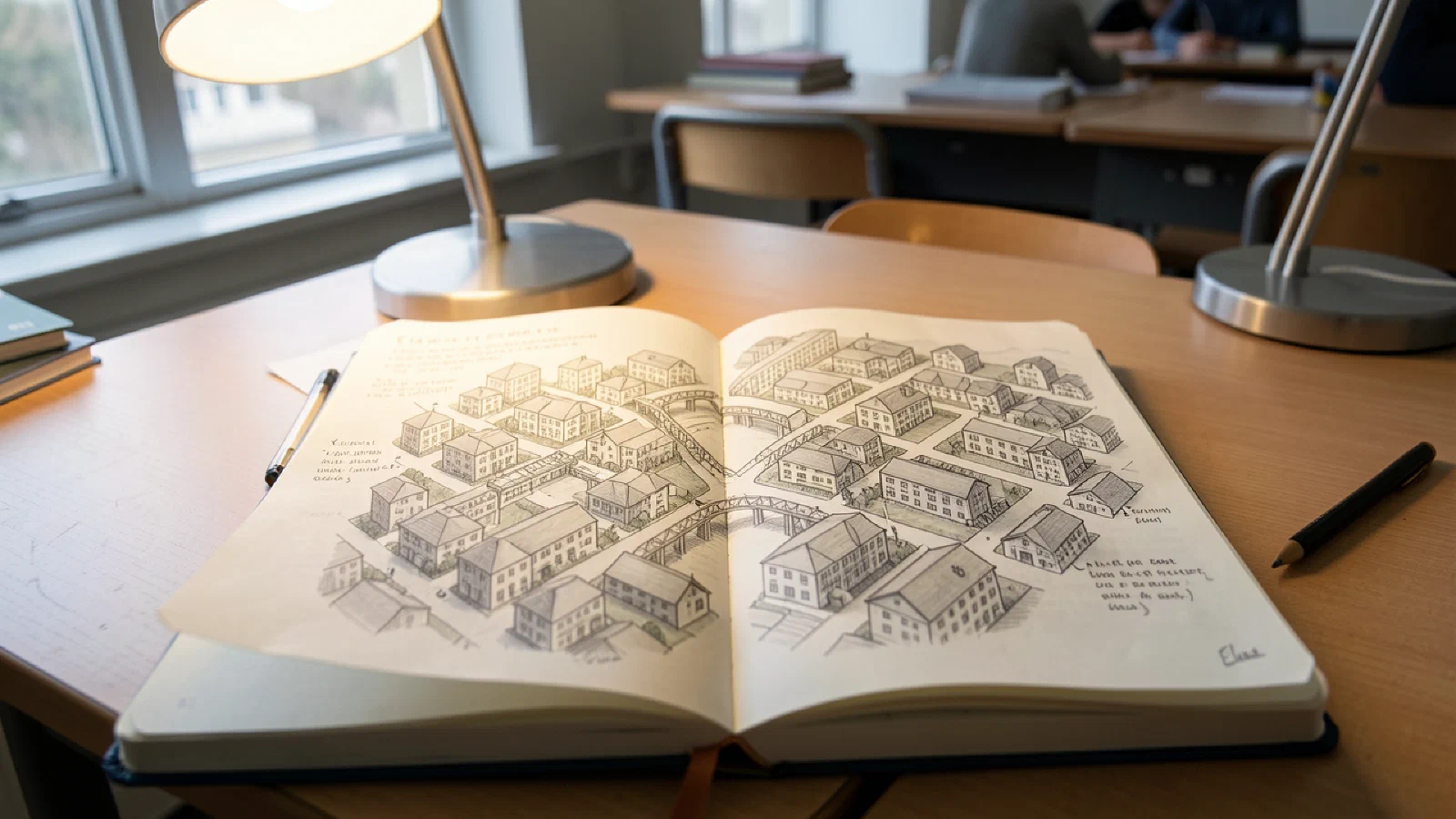
Not houses. Cities. Tiny precise structures seen from above, with courtyards and bridges and rooftop gardens connected by walkways that follow no grid she has been taught. She has been drawing them since she was twelve. She does not know where the cities come from. They arrive in her pen when she is supposed to be taking notes, and they are intricate and strange and entirely hers.
She has a dry humor that catches people off guard. She listens more than she talks, and when she talks, the thing she says is usually the thing no one else was going to say. She prefers mornings. She reads slowly and remembers what she reads. She is, by any measure, a particular person.
Here is what I keep circling back to. What makes Elena’s particularity matter?
Not to Elena. Of course it matters to her. She is herself and the self is vivid from the inside. But to the world. What does the world need from Elena specifically, from this exact configuration of humor and observation and imaginary cities, that it could not get from someone else or from no one at all?
She is sixteen. She does not ask this question in these words. But it sits underneath her days like a low hum, the way the refrigerator hum sits underneath the kitchen: always there, rarely noticed, shaping the silence.
How We Became Distinct#
Humans have always differentiated themselves. Through work, knowledge, creation, survival, choice, relationship. Each of these mechanisms carried a double weight. They made you distinct, and they connected your distinctness to something beyond yourself. What you did mattered to someone. What you knew was needed somewhere. What you made entered a world that received it. The distinctness was not self-contained. It radiated outward.
I want to trace what is happening to each of these, not as an argument but as a noticing.
What you do. When AI handles the work, the remaining human role is often supervisory: reviewing, approving, flagging exceptions. Supervision is valuable. But supervisors of the same system tend to look alike. The work that once differentiated, that made this accountant different from that one, this writer’s voice different from that one’s, was the work itself. The doing was the distinguishing. Remove the doing and the distinction thins.
What you know. Expertise used to be a marker. The doctor, the lawyer, the engineer carried their knowledge as identity. “I am a person who understands this domain” was both a social position and a sense of self. When anyone can access equivalent expertise through a conversation with an AI, the knowledge is still there, but it belongs to everyone and therefore to no one in particular. Margaret’s neighbor can look up the same pharmacological interactions that once required a pharmacist’s training. The pharmacist does not disappear. But what made the pharmacist the pharmacist has shifted to something harder to name.
What you have made. Every human creation now exists in a context. The novel, the business plan, the piece of code, the lesson plan. The context is a question that hovers without quite being asked: could AI have done this? The question does not need to be answered. Its presence is enough to change the weight of the making. The painter who knows that an AI can generate images in any style still paints, but the painting carries a different gravity than it carried when the painter was the only entity capable of producing it.
What you choose. Part 51 (The Choreographed Market) traced how the choreographed market shapes preferences before the choosing happens. Your taste, which feels like the most personal expression of who you are, turns out to be partly a reflection of what was surfaced for you. The choosing is real. The range of what you choose among has been curated. This is not conspiracy. It is architecture.
What survives? Two things, maybe. Your history, which AI cannot touch because it already happened. But history is backward-looking. A self built on what you have already survived is a self oriented entirely toward the past, and a sixteen-year-old has not yet accumulated enough past to build on.
And your relationships. Though the connected loneliness of The Quiet Irrelevance, the people present but the purpose absent, suggests these are thinning too.
Something is happening to the mechanisms by which people become distinct. Not all at once. But steadily, and in sequence, from the most visible markers to the most intimate ones.
The Native#
This is where the piece arrives at something I have been thinking about for a while and do not fully understand.
Every analysis of AI displacement, including the ones in this series, assumes a subject who lost something. Margaret had a career and watched it become unnecessary. James had professional aspiration and watched the entry-level rungs disappear. Even Elena, as I have written her across these articles, carries the memory of a world where her parents’ work organized their lives and gave them structure. She remembers the before, even if the before is fading.
But there is a version of Elena, or her younger sibling, or her future child, who has no before.
No career that was taken, because none was ever expected. No expertise that was devalued, because none was ever accumulated. No creative output that AI overshadowed, because the output and the shadow arrived together, and the shadow was always there, and it was never experienced as shadow but simply as the way things are.
I want to call this person the Native. Not as a label. As a way of noticing a distinction that I think matters enormously and that we have been talking around without naming.
Margaret is a person who lost something. The loss produces grief, bewilderment, the quiet closing of a ledger. These are painful, but they are recognizable. We have words for them. We have frameworks. Grief counselors and support groups and a long literary tradition of elegizing what was lost.
The Native did not lose anything. The Native is forming a self inside the conditions The Tolerance of Existence described, comfortable poverty, material provision, existential subsistence, and has never known anything else. The empty room of The Empty Room, the space where contemplation happens, is not a room the Native entered. It is the room the Native was born in.
Every generation before this one had a path. The path might be work, craft, parenting, community, faith, rebellion, adventure, vice. It might be hard. Parts of it might be awful. But it existed, and walking it was the becoming of a self. You accumulated experience that was specifically yours. You did things that changed what you could do next. The path was the differentiation.
The Native has no path. Not because paths are blocked, the way poverty blocks paths, or discrimination blocks paths, or disability without accommodation blocks paths. Because paths require a destination, or at least the felt sense that walking leads somewhere different from standing still. And the Native has never lived in a world where that sense was confirmed by experience.
This is not despair. Despair is what you feel when the path you were on collapses. The Native was never on a path. The feeling is something else, something quieter, something we may not have a word for. The condition of forming a self in an environment that does not require one.
What Takes the Place#
So how do Natives differentiate? This is not a hypothetical question. I think we are seeing the early forms now, and they are worth looking at honestly rather than dismissively.
Through pathology. My anxiety is different from your anxiety. My diagnosis is mine. There is a version of this that is healthy: understanding your mind, naming what you experience, finding community with others who experience it similarly. But there is also a version where the diagnosis becomes the identity, where the specific texture of your damage is the primary thing that distinguishes you from others. This is not because young people are fragile or self-indulgent. It is because when the constructive mechanisms of becoming a distinct person are unavailable, the destructive ones remain. Your wound becomes your name. The wound is real. The naming is real. What concerns me is not the naming but the absence of anything else to name.
Through performance. Not achievement but visibility. Content creation as identity. The currency is not “I made something that matters” but “I am seen.” This fills a genuine need. Being seen is not trivial. But the performance is shaped by the same algorithmic systems that dissolved the other mechanisms of differentiation. You become visible by becoming what the algorithm rewards, and what the algorithm rewards is what generates engagement, and engagement optimizes for reaction, not for the slow development of a self. You differentiate by performing, but the performance is curated from outside. It is a strange loop.
Through microculture. Hyper-specific aesthetic tribes. The person who inhabits a very particular visual world, collects very particular objects, listens to music that three thousand people on earth listen to and feels, in that smallness, a belonging that larger identities cannot provide. This is real. The belonging matters. But the market choreography of The Choreographed Market means the microculture was surfaced to you by a recommendation system that assembled your tribe before you arrived. The sense of discovery, I found my people, is genuine. The architecture that arranged the finding is invisible.
Through the body. Tattoos, piercings, fitness regimes, modifications, appearance as the last undeniably personal territory. Your body is yours. What you do with it is yours. In a world where everything else can be replicated, generated, or curated, the physical self remains stubbornly particular. This is why the body has become so central to identity for young people in ways that previous generations sometimes find confusing. It is not vanity. It is the last frontier of distinction.
Each of these is real. Each provides something. None of them provide what the older mechanisms provided.
Margaret’s work differentiated her and mattered to someone. Her competence as a school librarian was hers and it served the students and readers who needed it. The differentiation pointed outward. James’s aspiration differentiated him and pointed somewhere. He was becoming something, and the becoming connected him to a future.
The Native’s substitutes differentiate without contributing. They say I am different without being able to say and the difference changes something beyond me.
Not the absence of a self. The presence of a self that has no consequence.
The Question She Cannot Ask#
Here is what I find most difficult about all of this, and I want to sit with it rather than push through to a conclusion.
The person who never knew anything else cannot recognize that something is missing. You cannot miss what you never had. You cannot grieve the absence of purpose if purpose was never part of your lived experience. The condition is not painful in any way Elena would identify as pain. It is simply the shape of being alive. The water she swims in.
Elena draws her buildings. She has her humor. She cares about specific things in specific ways. She is herself, recognizably and vividly. There is no crisis here. No suffering to point to. No deficit a program could address.
But the self she is does not connect to anything that needs her to be that self. Her particularity is real and, as far as she can tell, inconsequential. Like a signature on a document no one will read. Like the specific pattern of a snowflake falling into a river.
The Empty Room, years ago in this series, asked about the empty room. The space where contemplation happens. Where something can arise that could not arise otherwise. The mind at play rather than at work. I argued that the empty room matters, that what grows there is worth protecting, that the instant answer forecloses the open question.
I still believe that. But I wonder now about something I did not consider then. What if the empty room is still there, but the person sitting in it has no reason to believe that what arises will matter to anyone? What if contemplation requires not just emptiness but the faith that the emptiness is generative, that the wandering leads somewhere, that the question you find in the silence is a question the world needs you to ask?
Without that faith, the empty room is just a room. And the person in it is just sitting.
Elena’s Evening#
Elena is on her bed with her notebook open. She is not doing homework. She is drawing one of her cities, this one built on a slope with terraced levels connected by covered stairs. She does not know why she draws these. She does not think about why. The pen moves and the buildings appear and for the minutes she is drawing, something in her is quiet and focused and entirely present.
She does not know that this, the absorption, the specificity, the thing that comes from her and no one else, is what an earlier generation would have called a vocation. A calling. Not in the religious sense but in the sense of a direction that is yours and not interchangeable.
She does not know this because nothing in her world has told her that callings matter. Nothing has connected the private act of drawing to any public need. The cities in her margins are beautiful and they are hers and they dissolve into the notebook when the page turns.
She is not unhappy. She is not suffering. She is distinctly, specifically, recognizably Elena.
She is a self that the world does not require.
I do not know what to do with this. I do not think anyone does yet. The honest thing is to say so, and to keep thinking, and to notice that the question, what would it mean for my particular existence to matter?, is one that Elena has not been given the framework to ask.
Maybe the framework is something we need to build. Maybe it already exists in places we have not looked. Maybe the drawing itself, the cities that come from somewhere Elena cannot name, is the beginning of an answer that has not yet found its question.
I don’t know. But I think it matters. And I think Elena, in her way, already knows something that the rest of us are still trying to articulate. The cities she draws are not for anyone. They are not useful. They do not optimize anything.
They are hers. And she makes them anyway.
That may be where it starts.
This is Part 62 of The Approximate Mind, a series exploring how AI reshapes human experience, identity, and society. Part 61 (The Tolerance of Existence) examined comfortable poverty: the stable condition of material provision without purpose. This piece asks a harder question: what happens to the person who forms entirely inside that condition, who never had a before, and who builds a self without the mechanisms that once made selves consequential?
How this essay connects to others across The Approximate Mind.
- Erikson, Erik H. Identity: Youth and Crisis. W.W. Norton, 1968.
- Taylor, Charles. Sources of the Self: The Making of the Modern Identity. Harvard University Press, 1989.
- Durkheim, Emile. Suicide: A Study in Sociology. 1897. Translated by John A. Spaulding and George Simpson. Free Press, 1951.
- Frankl, Viktor E. Man’s Search for Meaning. Beacon Press, 1946.
- Han, Byung-Chul. The Burnout Society. Stanford University Press, 2015.
- Twenge, Jean M. iGen: Why Today’s Super-Connected Kids Are Growing Up Less Rebellious, More Tolerant, Less Happy, and Completely Unprepared for Adulthood. Atria Books, 2017.
- Baumeister, Roy F. “The Need to Belong: Desire for Interpersonal Attachments as a Fundamental Human Motivation.” Psychological Bulletin, vol. 117, no. 3, 1995, pp. 497-529.
- Arendt, Hannah. The Human Condition. University of Chicago Press, 1958.
- Graeber, David. Bullshit Jobs: A Theory. Simon and Schuster, 2018.
- Crawford, Matthew B. The World Beyond Your Head: On Becoming an Individual in an Age of Distraction. Farrar, Straus and Giroux, 2015.
- Storr, Anthony. Solitude: A Return to the Self. Free Press, 1988.
- Winnicott, D.W. “The Capacity to Be Alone.” International Journal of Psychoanalysis, vol. 39, 1958, pp. 416-420.