The Simpler Life
Think about what work costs. Not in wages foregone, but in spending required. The commute. The car, or the transit pass, or both. The wardrobe that exists because the office has expectations the closet must meet. The childcare that exists because both adults are gone from eight to six and someone has to receive the children at three. The lunch out, because you’re not home. The coffee, because you need to be functional by nine. The dry cleaning. The parking. The house in the right district, close enough to the right employer, in the right school zone for the children whose schedule the job made necessary to outsource. These are not luxuries. They are the overhead of employment. The cost of participation in a labor market. The price, quite literally, of having a job.
I have been thinking about what happens to all of this when the job changes.
There is a kind of spending that disappears so quietly when work recedes that most people don’t notice it going. A friend who left a demanding consulting role a few years ago told me that in the first three months she spent almost nothing. Not through discipline. Through the absence of the occasions the job had been generating. The client dinners. The airport meals. The car service at six in the morning. The dry cleaning she dropped off every Tuesday. The gym membership she’d bought to manage the stress of the schedule the job required. When the schedule dissolved, so did the spending. Not all of it. But more than she’d expected. She said it felt less like saving money and more like discovering how much of her spending had been the job’s spending, billed to her account.
This is the consumption bundle of work, and we almost never examine it directly.
What Work Requires Us to Buy#
The economists have a term for some of this: work-related expenses. Childcare, transportation, professional clothing. But the category is narrower than the reality. It captures the obvious costs and misses the ecosystem. The lunch economy around office districts. The coffee shops that exist because there are morning commuters who don’t have time to make coffee at home. The parking structures. The second car in households where one person’s job requires geographic flexibility the other can’t provide. The house with the spare bedroom that became a home office that required the house to be in a neighborhood with the right proximity to the employer who required the office.
Strip work out of the schedule and something unexpected happens to the weekly spending. Not all of it shrinks. Some of it was always yours, not the job’s. But a surprising fraction was the job’s overhead, running on your card.
What’s left, when that overhead goes, is something closer to what you actually need. And what people actually need, it turns out, is somewhat simpler than what the working life had required them to provision for.
I find this interesting not as a financial observation but as a civilizational one. We built an enormous amount of the economy around the working consumer. The commuter’s car, the employee’s lunch, the professional’s wardrobe, the dual-income household’s childcare. These are not marginal spending categories. They are the substrate of entire industries. And they are, in a specific sense, artifacts of the labor market’s structure, not of human need.
The Industries Built for the Worker#
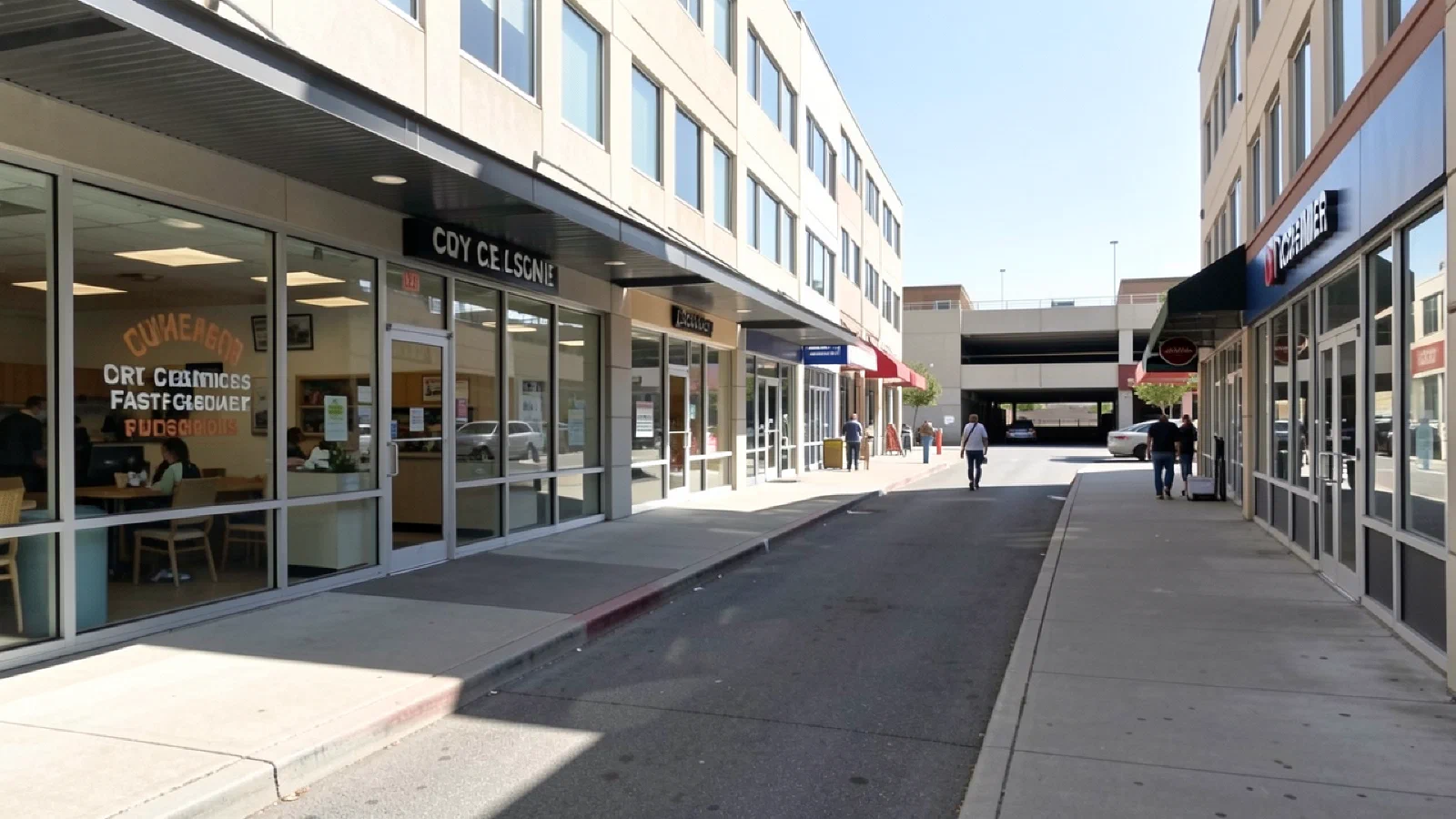
Drive through the commercial corridor around any office park and look at what’s there. The fast-casual restaurants, the dry cleaners, the gas stations, the coffee chains, the daycare centers, the parking structures, the car dealerships. All of it oriented toward the working adult who is moving through space on a schedule determined by an employer. The stores are open when workers pass through. The menus are calibrated to the lunch hour. The portions are sized for the person eating alone at their desk. The services exist because the job generates the needs they solve.
Now imagine a neighborhood where most of the adults are home most of the time, with more flexible schedules, with fewer mandatory transit points in their day. The commercial infrastructure they need is different. Not necessarily less. Possibly just different. More grocery, less food service. More leisure, less dry cleaning. More of what they choose, less of what the job required them to provision for.
This shift is already happening in the places where remote work took hold. The office district lunch economy hollowed out. The dry cleaners near the train stations closed or shrank. The gas station traffic flattened as commutes disappeared. In their place, neighborhood grocery stores did more business. Home improvement retailers saw sustained growth. The spending didn’t vanish. It redistributed, toward what people wanted when they had the time to want it rather than the time to grab what the commute allowed.
This is a preview. A partial, voluntary preview of a shift that will arrive more broadly, less voluntarily, over the next decade.
The Identity Dimension#
There is a version of this story that is purely economic, and it misses what matters most. Consumption is not only about acquiring things. It is about signaling who you are and where you stand. The professional wardrobe is not just clothing. It is the uniform of a category. The business lunch is not just a meal. It is a ritual of belonging to a class that conducts its relationships over food someone else prepared. The neighborhood, the school district, the car: all of these are not simply purchases. They are statements, addressed to others, about what kind of person you are and what kind of life you have constructed.
When occupation was the primary organizing principle of social identity, consumption followed it. You spent like your profession required you to spend, because the spending was part of inhabiting the professional role. The consultant dressed like a consultant. The physician drove the physician’s car. The teacher lived in the neighborhood where a teacher’s salary could afford a house, and the neighborhood told a story about the teacher that the teacher did not entirely choose.
Strip the occupation, and the consumption signals lose their referent. This is more disorienting than the spending itself. A friend who left her law firm partnership and started a small design practice told me that for the first year she kept buying things she didn’t need because she didn’t know what kind of person she was buying for. The partner’s wardrobe, the partner’s car, the partner’s neighborhood: these had been anchored to an identity that was no longer operative. The simpler life wasn’t just simpler financially. It required her to figure out, from something closer to scratch, what she actually wanted when the occupation wasn’t doing the wanting for her.
I think this is the transition’s most underexamined psychological task. Not income replacement. Identity reconstruction.
The Belonging Dimension#
Work also organized consumption socially. You went to the lunch place near the office because that’s where the colleagues went. You drank at the bar near the office on Fridays because that’s where the team unwound. You lived near the employer because proximity was expected, and proximity to the employer meant proximity to the people the employer had collected. The consumption venues were the social venues. The commercial infrastructure of the working life was also, quietly, the social infrastructure.
When work recedes, this disappears along with the dry cleaning.
The coffee shop near the office was not just a coffee shop. It was where you ran into the colleague you hadn’t seen since the last all-hands. It was where the sidewalk conversation happened that turned into the project that defined the next two years. The consumption venue was doing work that no one had named it to do, and no one noticed it was doing until it closed.
This is the connected loneliness argument applied to commerce. The technology to order anything without leaving the house exists and is excellent. It does not replicate the accidental encounter in the aisle, the neighbor you saw every Saturday at the farmers market, the regular at the coffee shop who knew your name. The simpler life is quieter in ways that feel peaceful at first and isolating later.
I wonder about this. Not about whether it is bad (the loneliness epidemic does not need another diagnosis) but about what we actually want. Whether the consumption complexity of the working life was mostly overhead we resented or partly community we didn’t know we were purchasing. Probably both, in proportions that varied by person and that none of us chose. The honest answer is that we didn’t choose the bundling, and we won’t choose the unbundling either. It will happen, and we will figure out, afterward, what we had.
The Supply Chain Nobody Planned For#
Behind all of this is an infrastructure problem that nobody designed and nobody is currently responsible for addressing. The supply chains that move goods are built for the consumption profile of the working consumer. Distribution networks optimized for bulk food delivery to office districts. Retail locations placed where commuter traffic flows. Inventory systems calibrated to lunch hour demand spikes and end-of-workday shopping. Commodity contracts that hedge agricultural and manufacturing output against a demand profile assumed to be stable.
When the demand profile shifts, the infrastructure built for it becomes mispriced. Not dramatically, not overnight. But the dry cleaner that made its lease payment on commuter volume can’t make that payment on neighborhood volume. The commodity contract hedging denim fabric for professional-wear manufacturers is less valuable when the wardrobe requirement dissolves. The trade agreement that protected the workers making the suits is negotiated for a market that is reorganizing.
None of this catastrophizes. It adjusts, over time, with friction, with costs paid by people who didn’t cause the adjustment. That is the characteristic signature of a transition: the costs distribute to those who cannot exit the old configuration.
What I find worth sitting with is that the simplification is not optional. It is not a lifestyle choice being made by people who have decided to consume less. It is a structural consequence of a labor market reorganizing in ways that change what the labor market requires workers to provision for. The spending required to participate in the old configuration drops. The spending that remains is what you would spend anyway, for your own purposes, on your own terms.
That is a different relationship to consumption than the one the working life produced.
What Remains#
The simpler life is not an ascetic life. People who work less do not want less. They want differently. More leisure, more relationship, more time for the things the working schedule had crowded out. The spending shifts toward experience, toward quality over volume, toward things that fill the time the job had claimed.
This is the transition’s most optimistic face, and I hold it carefully. It is true for people who have savings, skills, relationships, and health. The person who financed the car on the assumption of a commuting salary has a different relationship to the simpler life than the person who paid cash. The simplification is real for everyone. The capacity to absorb it gracefully is not.
What remains, stripped of the job’s overhead, is something like a question. About what you actually want when the job is no longer doing the wanting for you. About what your life would organize itself around if it weren’t organized around where you have to be by nine.
Most people who have faced this question report that the first months are disorienting. The spending drops and the identity follows it, and then comes the work of figuring out what comes next. Not financially. Existentially.
The history of displaced workers suggests that people reach for the nearest substitute for structure more often than they sit with the question. I don’t think that’s weakness. I think that’s what it looks like when a transition arrives faster than the culture around it can prepare people for. The question is real. The space to sit with it is a privilege not everyone gets.
What would you spend on, if the job stopped requiring what the job requires? And what would you become, in the absence of what the job had been requiring you to be?
How this essay connects to others across The Approximate Mind.
- Rowe, Jonathan, and Judith Silverstein. “The GDP Fetish.” The American Prospect, vol. 10, no. 45, 1999, pp. 16-24.
- Ibarra, Herminia. Working Identity: Unconventional Strategies for Reinventing Your Career. Harvard Business School Press, 2003.
- Oldenburg, Ray. The Great Good Place: Cafes, Coffee Shops, Bookstores, Bars, Hair Salons, and Other Hangouts at the Heart of a Community. Paragon House, 1989.
- Ramani, Arpit, and Nicholas Bloom. “The Donut Effect of Covid-19 on Cities.” NBER Working Paper no. 28876, National Bureau of Economic Research, 2021.
- Schor, Juliet B. The Overspent American: Why We Want What We Don’t Need. Harper Perennial, 1999.