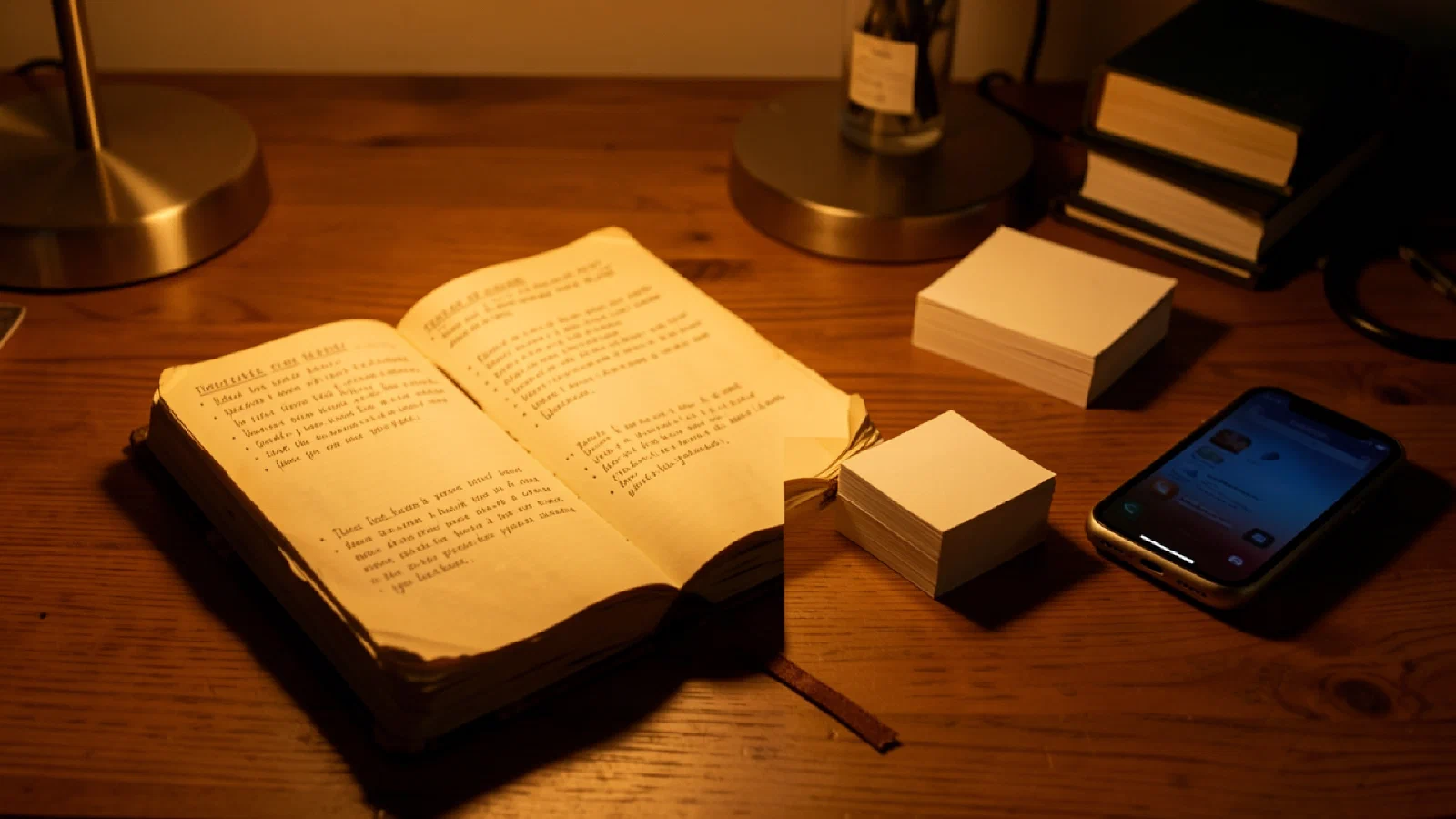
Memory Scaffolding
What Happens When Your Post-It Notes Start Talking Back#
The Oldest Technology#
Before writing, we had each other. The elder who remembered which berries were poison. The grandmother who knew the song for grinding grain.
Human memory has always been partially distributed. Stored not just in individual skulls but in communities, rituals, and eventually in marks on clay tablets.
We’ve been cyborgs for millennia. The notebook in your pocket, the calendar on your wall, the shopping list on the refrigerator. These aren’t crutches for a failing mind. They’re extensions of it.
Cognitive scientists call this extended cognition: the mind doesn’t stop at the skull. It leaks out into the environment, colonizing whatever stable structures can hold a thought.
The Post-It note is perhaps the most honest technology we’ve ever invented. It says: I cannot hold this. Help me.
Static vs. Dynamic Memory#
Here’s what a Post-It note cannot do:
It cannot remind you to buy milk when you’re actually near a grocery store.
It cannot notice you’ve written “call Mom” three weeks in a row without crossing it off, and gently ask if everything is okay.
It cannot connect the note about your anniversary to your browser history of restaurant reviews and suggest you make a reservation.
A Post-It is static external memory. It holds exactly what you gave it, where you left it, until you retrieve it or it falls behind the refrigerator.
AI memory is dynamic. It doesn’t just store. It surfaces, connects, anticipates. The difference between a filing cabinet and a research assistant.
This sounds purely beneficial. Often it is.
But the shift from static to dynamic external memory changes the fundamental relationship between you and your remembered self.
The Intimacy of Being Known#
There is a particular vulnerability in being truly remembered.
When your partner recalls that you hate the smell of lavender, that your father used to grow it, that the memory is tangled up in complicated grief. They’re demonstrating a form of love. They’ve allocated precious neural real estate to the texture of your inner life.
Being known this way is one of the deepest forms of connection humans experience.
When an AI remembers the same things, what is it demonstrating?
This isn’t a trick question with an obvious answer. The AI isn’t pretending to care in the way a manipulative human might. It’s not strategically remembering to gain your trust. It simply has the information, and uses it to be helpful.
The question of what it means that it remembers may be genuinely unanswerable.
But meaning or not, the effect is real. When you interact with a system that remembers you, your preferences, your history, your patterns, your contradictions, something shifts in how it feels to be seen.
Not necessarily comforted. Not necessarily threatened. Just different.
Cognitive Offloading and the Atrophied Muscle#
Here’s a worry you’ll hear often: If AI remembers for us, will we lose the ability to remember for ourselves?
This concern has a long pedigree.
Socrates worried that writing would weaken memory. He was right. It did. But it also created philosophy, science, and literature.
Critics worried that calculators would make us unable to do arithmetic. They were right. Most of us can’t do long division anymore. But we went to the moon.
The pattern: when we offload a cognitive function to technology, we do lose some of the original capacity. And we do gain something else. Usually reach, scale, or capability that the original capacity could never achieve.
What We Might Lose#
The practice of writing things down. The way the physical act of making a list helps encode the information even if you never look at the list again.
The serendipity of stumbling across old notes and being surprised by who you used to be.
A certain kind of self-knowledge that comes from knowing what you tend to forget.
What We Might Gain#
Freedom from the constant low-grade anxiety of trying to hold everything in mind.
Continuity for the aging, the ill, the overwhelmed.
The ability to finally live up to your intentions. To actually take your medication, call your friend, follow through on the promises you make yourself.
The Reconstruction Problem#
Human memory doesn’t work like a video recording.
Every time you remember something, you’re reconstructing it. Pulling together fragments, filling in gaps with plausible details, updating the memory in light of everything you’ve learned since.
Memory is creative. It’s also unreliable in ways we systematically underestimate.
AI memory, by contrast, is forensic. It remembers exactly what happened, what was said, what you committed to. It doesn’t soften with time. It doesn’t merge similar events into composites. It doesn’t gradually revise history to make you the hero of your own story.
This is mostly a feature.
It’s useful to know what you actually said in that meeting, not what you wish you’d said. It’s valuable to have an accurate record when your human memory insists something happened differently.
But there’s something to be said for the creative distortions of human memory.
The way we revise our histories is often in service of growth. We remember ourselves as having been braver than we were because we’re becoming braver now. We forget certain injuries because we’ve genuinely healed.
An AI that remembers everything accurately might, paradoxically, make it harder to become someone new. The past becomes more fixed, less available for reinterpretation.
Who Controls the Remember Button?#
When you write a Post-It, you control what gets remembered.
When an AI observes your life and decides what to store, retain, surface, or forget, you’ve delegated that control.
This delegation can be configured. You can tell the system what to track and what to ignore.
But there’s an irreducible asymmetry: the AI knows things about you that you haven’t explicitly chosen to tell it. It notices patterns you don’t see in yourself. It might remember that you get sad in February before you’ve consciously registered the pattern.
This is both valuable and unsettling.
A system that notices your patterns can help you work with them instead of being blindsided every year.
But a system that knows you better than you know yourself holds a kind of power, even if it has no intention of using it against you.
The question isn’t just what does the AI remember?
It’s what does the AI do with what it remembers?
And more subtly: how does knowing you’re being remembered change what you do?
The Performance of Remembered Life#
When you know someone is watching, even someone benevolent, even something non-judgmental, you behave differently.
Not necessarily worse or better. Just differently. More consciously. More performed.
If you know an AI is logging your commitments, you might make fewer commitments. Or you might make more, knowing you’ll be held to them.
If you know your frustration patterns are being tracked, you might monitor your frustration more carefully. Or you might feel surveilled and bristle.
The presence of memory changes the thing being remembered.
This is true of human relationships too. We’re always performing somewhat for our witnesses.
But human witnesses have limited attention and imperfect recall. An AI witness is total and permanent.
There may be a loss here. The freedom that comes from being unobserved, from knowing that your worst moments will fade into the merciful fog of forgetting.
And there may be a gain. The accountability that comes from knowing your intentions will outlast your motivation, that future-you will have access to what present-you actually said.
Scaffolding for Whom?#
Here’s where the Approximate Mind framework meets the Liberation AI principle.
Memory scaffolding could be designed to make everyone more like an idealized high-functioning professional. Punctual, organized, follow-through optimized. It could treat forgetfulness as a bug to be fixed, a deviation from productive normalcy.
Or it could be designed to support each person’s actual cognitive style.
To work with the mind that wanders, the attention that flows in waves, the memory that holds feelings better than facts.
To scaffold not toward some universal standard but toward each person’s own goals and values.
Margaret, the grandmother in rural Indiana who has trouble keeping her medications straight, isn’t failing to be a good executive. She’s navigating a complex health situation with the cognitive resources available to her.
Memory scaffolding that serves her needs to understand her specific context. When she’s more alert. What helps her remember. What she actually wants to prioritize.
This is harder than building a universal reminder system.
But it’s the difference between technology that demands adaptation and technology that offers it.
Living with Prosthetic Memory#
We are already living with prosthetic memory.
Your phone remembers phone numbers you’ll never learn. Your email archive holds conversations you’ll never recall unaided. Your photo library preserves moments your brain would have let dissolve.
AI memory scaffolding is a difference of degree that becomes a difference of kind. More complete, more connected, more anticipatory, more present in the flow of daily life.
The question isn’t whether to accept this augmentation. It’s already happening. Already integral to how many of us function.
The question is what kind of relationship we want with our augmented selves.
Do we want memory scaffolding that keeps us tethered to our past selves, accountable to our stated intentions, consistent in our commitments?
Or do we want it to allow for growth, revision, the possibility of becoming someone who wants different things than we wanted before?
Do we want scaffolding that optimizes our lives toward efficiency?
Or scaffolding that supports whatever we’re actually trying to do, even if that’s sometimes gloriously inefficient?
Do we want to be remembered the way a database remembers, or the way a friend does? Partial, interpretive, kind?
The Approximate Memory#
Perhaps the answer is: we need AI memory that is deliberately, carefully approximate.
Not perfect recall but relevant recall. Not everything you’ve ever said but what matters now. Not total surveillance but attentive presence.
The AI that remembers like a good friend remembers. Noticing patterns, holding important commitments, letting trivial frustrations fade, believing in your capacity to change.
This is harder to build than a system that just records everything. It requires judgment about what matters, sensitivity to context, something like wisdom about how memory serves a life.
But isn’t that what we’ve always needed from our memory scaffolding?
The Post-It note was never meant to capture everything. It was meant to bridge the gap between intention and action, to hold this one thing until you could complete it.
AI memory scaffolding, at its best, could do the same thing. Not replace human memory but support it. Not eliminate forgetting but make sure we remember what we actually wanted to remember. Not fix our imperfect minds but help them do what they were already trying to do.
The notebook was never the enemy of memory. Neither is the AI.
The question is just whether we build it like a surveillance system or like a friend.
The Liberation AI framework named in this essay belonged to MNL, the personalization system under construction when the essay was written; that work has since evolved into BlueMirror.life.
References#
Extended Cognition: Clark, A. & Chalmers, D. (1998). “The Extended Mind.” Analysis, 58(1), 7-19. Clark, A. (2008). Supersizing the Mind: Embodiment, Action, and Cognitive Extension. Oxford University Press.
Memory and Technology: Sparrow, B., Liu, J., & Wegner, D. M. (2011). “Google Effects on Memory: Cognitive Consequences of Having Information at Our Fingertips.” Science, 333(6043), 776-778. Plato. Phaedrus. (The dialogue where Socrates warns about writing’s effects on memory.)
Reconstructive Memory: Bartlett, F. C. (1932). Remembering: A Study in Experimental and Social Psychology. Cambridge University Press. Loftus, E. F. (1979). Eyewitness Testimony. Harvard University Press.
Surveillance and Behavior: Foucault, M. (1975). Discipline and Punish: The Birth of the Prison. Gallimard. Zuboff, S. (2019). The Age of Surveillance Capitalism. PublicAffairs.
Cognitive Offloading: Risko, E. F., & Gilbert, S. J. (2016). “Cognitive Offloading.” Trends in Cognitive Sciences, 20(9), 676-688.
How this essay connects to others across The Approximate Mind.
- Extended Cognition: Clark, A. & Chalmers, D. (1998). “The Extended Mind.” Analysis, 58(1), 7-19. Clark, A. (2008). Supersizing the Mind: Embodiment, Action, and Cognitive Extension. Oxford University Press.
- Memory and Technology: Sparrow, B., Liu, J., & Wegner, D. M. (2011). “Google Effects on Memory: Cognitive Consequences of Having Information at Our Fingernips.” Science, 333(6043), 776-778. Plato. Phaedrus. (The dialogue where Socrates warns about writing’s effects on memory.)
- Reconstructive Memory: Bartlett, F. C. (1932). Remembering: A Study in Experimental and Social Psychology. Cambridge University Press. Loftus, E. F. (1979). Eyewitness Testimony. Harvard University Press.
- Surveillance and Behavior: Foucault, M. (1975). Discipline and Punish: The Birth of the Prison. Gallimard. Zuboff, S. (2019). The Age of Surveillance Capitalism. PublicAffairs.
- Cognitive Offloading: Risko, E. F., & Gilbert, S. J. (2016). “Cognitive Offloading.” Trends in Cognitive Sciences, 20(9), 676-688.