The Choreographed Market
Margaret did not choose the turkey bacon.
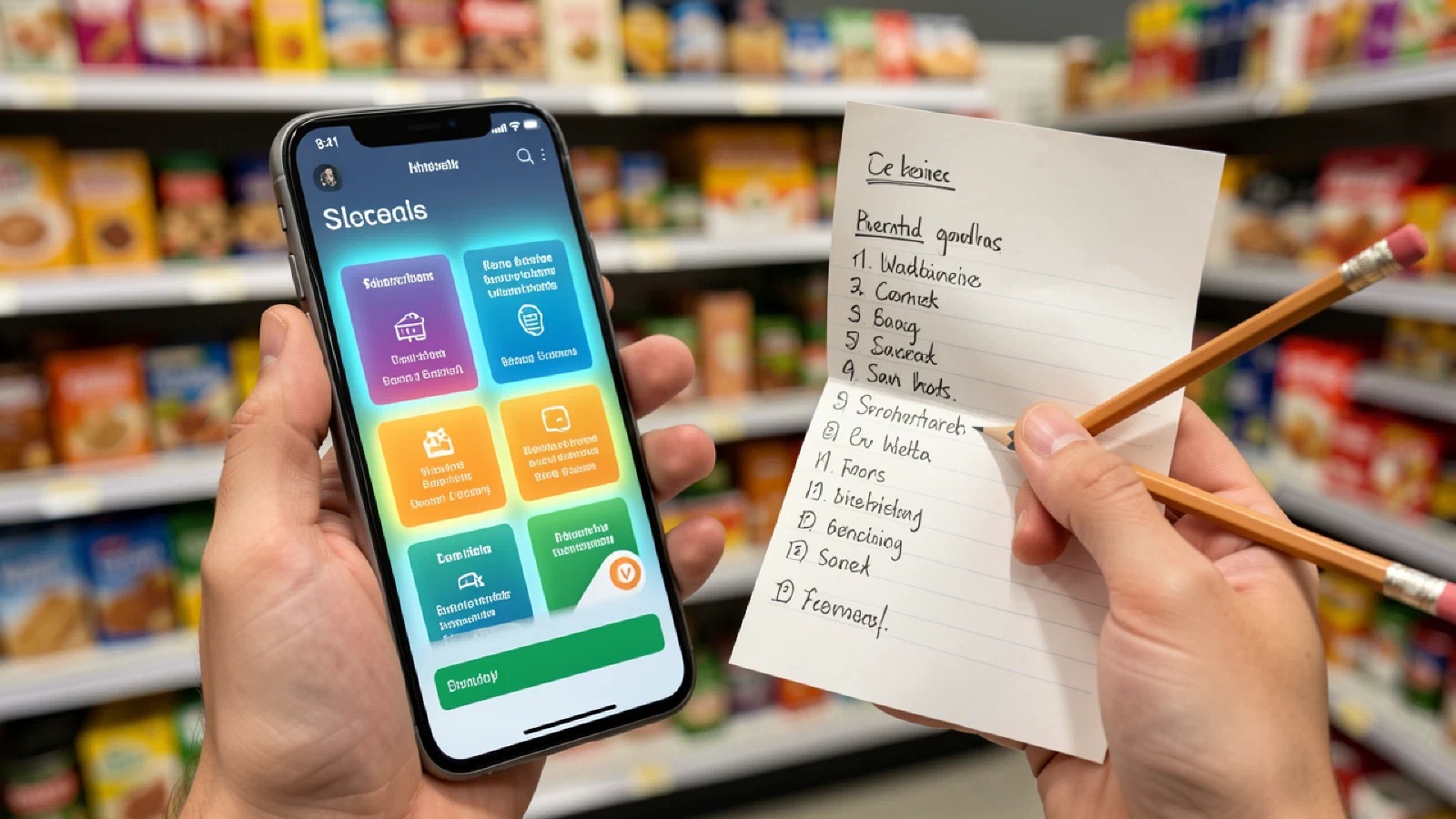
She opened her grocery delivery app on Tuesday morning, as she does every week, and the turkey bacon was already in her cart. Her wellness profile, linked to the health monitor that flagged her blood pressure overnight, had triggered an automatic substitution. Lower sodium. Leaner protein. A note at the top of the cart read: “Adjusted based on your wellness profile.” Margaret scrolled past it the way you scroll past anything that appears often enough to become invisible.
She could have removed the turkey bacon. She could have searched for her regular brand and added it manually. The option was available. Nobody prevented her from choosing pork. But the architecture of the choice had shifted. The default was turkey. Choosing pork required an active decision, a small act of will against a system that had already decided what was best for her. Most weeks, Margaret does not perform that act. Most weeks, she accepts the cart as presented, adjusts a few items, and checks out. Most weeks, she experiences this as choosing.
The Confluence of Influence described this moment as one node in a confluence of influences. The Monoculture examined what the recommendation system’s preferences do to producers like Dot who exist outside its field of vision. The question here is different, one that sounds simple but opens into something vast.
When did Margaret’s desire for turkey bacon begin?
She does not remember wanting it. She does not recall a moment of considering her options and concluding that turkey bacon better served her needs. What she recalls, if she recalls anything, is that turkey bacon appeared in her cart and she did not remove it. After several weeks of not removing it, she began to think of herself as a person who eats turkey bacon. After several months, the preference felt native. She might tell her daughter Sarah: “I’ve switched to turkey bacon.” As though she had switched. As though there had been a decision.
Curation, experienced over time, becomes preference. Preference, experienced as one’s own, becomes identity. The system did not change Margaret’s mind. It changed her cart, and her mind followed.
The Arrow Reverses#
Classical economics tells a clean story about desire and production. People want things. The economy organizes itself to provide them. Demand is the cause, supply is the effect. The consumer is sovereign, expressing preferences through purchasing decisions, and the market responds by producing what is demanded. Adam Smith’s invisible hand coordinates this process without central direction. The result, in theory, is an economy that serves human want.
This story was always an idealization. Galbraith observed in 1958 that the affluent society had already partially inverted the relationship: corporations did not merely respond to demand but manufactured it through advertising. The assembly line produced the car, and the advertisement produced the desire for the car, and the consumer experienced the desire as arising from within rather than from the billboard.
But advertising, for all its influence, was a blunt instrument. A television commercial reached millions of people with a single message. Most of them ignored it. The ones who didn’t had their attention for thirty seconds. The persuasion was visible. You knew you were being sold to, even when the selling worked. You could roll your eyes at the jingle, mock the copy, resist the appeal. Advertising operated through a channel clearly labeled “someone is trying to get you to buy something,” and that label, however insufficient as a defense, preserved a kind of transparency.
AI-mediated demand is not like this.
When Margaret’s grocery app adjusts her cart based on her wellness profile, nobody is selling her turkey bacon. There is no pitch, no jingle, no thirty-second spot. There is a default, presented as the rational response to her own health data, placed there by a system that has access to her biometric readings, her purchase history, her dietary patterns, and the margin structure of the products it recommends. Margaret does not experience this as persuasion. She experiences it as her app being helpful. The difference between these two experiences, between being persuaded and being helped, is the distance that separates advertising from curation.
Advertising says: you should want this. Curation says: here is what you want. The first is an argument you can reject. The second is an environment you inhabit.
The demand inversion that Galbraith described was partial and visible. What AI enables is something closer to completion. Not in every category, not for every person, but across enough of Margaret’s economic life that the exceptions prove the rule. Her grocery cart is curated. Her news feed is curated. Her entertainment options are curated. Her insurance offerings are curated. Her search results, when she does search, return options ranked by algorithms whose criteria she does not set and cannot see.
In this environment, demand is not the input to the economy. It is the output. The economy does not produce what Margaret wants. It produces Margaret’s wants.
The Performance of Markets#
There is a word for a system in which both supply and demand are coordinated by a central intelligence rather than emerging from independent actors: it is not a market. It is a planned economy. But the coordination here is not governmental. It is algorithmic. And the planners are not bureaucrats serving a public mandate. They are platforms serving their own revenue models.
This is not the Soviet Union. The inefficiencies of central planning, the inability to process dispersed information, the absence of feedback from prices, these are not present. AI systems process dispersed information with extraordinary facility. They respond to price signals in real time. They are, in many ways, better at the informational functions that Hayek attributed to markets than markets themselves have ever been.
What they do not do is serve dispersed interests.
A market, in Hayek’s conception, works because prices aggregate information from millions of independent actors, each pursuing their own ends. No single actor needs to understand the whole system. The butcher, the brewer, and the baker serve your dinner not from benevolence but from self-interest, and the price system coordinates their self-interest with your need. The beauty of the arrangement is that it requires no one to understand or direct it.
But when a platform mediates between the baker and the diner, something changes. The platform decides which bakers the diner sees. The platform decides what price the diner encounters. The platform decides, through its recommendation logic, which dinner the diner is most likely to order. The baker, meanwhile, adjusts what she bakes to match what the platform’s data says diners want. The platform sits between supply and demand and shapes both, not through coercion but through curation.
The invisible hand was always a metaphor. Now it is a literal algorithm. And the algorithm has owners.
What remains looks like a market. Buyers choose among options. Sellers compete for customers. Prices fluctuate. Products rise and fall. All the surface behaviors of market activity are present. But the underlying dynamic, independent actors pursuing independent ends with prices coordinating the result, has been hollowed out. Buyers choose from curated options. Sellers compete within algorithmic constraints. Prices are shaped by platform incentives. The market is not gone. It is choreographed.
James experiences this choreography every day without recognizing it. When he searches for an apartment, the listings he sees are ranked by an algorithm that weighs the landlord’s advertising spend alongside the apartment’s suitability. When he shops for clothes, the brands surfaced reflect a combination of his engagement history and the brands’ platform fees. When he orders dinner, the restaurant options presented are filtered by delivery logistics, margin structures, and promotional arrangements he cannot see.
James believes he is making choices. And he is, in the narrow sense that no one forces him to click on any particular option. But the menu from which he chooses was constructed by systems whose interests are not his, whose criteria he did not set, and whose logic he cannot inspect.
Can you be sovereign over choices you did not construct?
The Philosophical Problem#
Consumer sovereignty is the bedrock assumption of market economics. It means that the consumer’s preferences are given, not determined by the system that serves them, and that the market’s legitimacy derives from its responsiveness to those preferences. If I want apples, the market provides apples. My wanting is the cause, the apple is the effect, and the market is justified because it served my genuine desire.
But if the market shapes what I want, the justification collapses into circularity. The market is legitimate because it serves my preferences. My preferences are shaped by the market. The market is legitimate because it serves the preferences it shaped. This is not an argument. It is a loop.
Philosophy has grappled with the authenticity of desire for centuries. Rousseau distinguished between natural wants and manufactured ones. Mill worried about “higher” and “lower” pleasures. Frankfurt drew a line between first-order desires (what you want) and second-order desires (what you want to want). Each of these frameworks assumes that some desires are more authentic than others, and that the distinction matters.
AI-mediated curation makes the distinction nearly impossible to draw.
Margaret’s preference for turkey bacon is not coerced. Nobody forced her. It is not exactly manufactured, in the way that a cigarette craving is manufactured by nicotine. It is something more subtle: a preference that emerged from an environment constructed around her, shaped by data about her, and optimized for objectives that are not hers. She did not arrive at turkey bacon through deliberation. She arrived through default. And the default was set by a system that profits from her acceptance.
Is this preference authentic? Margaret would say yes. She eats turkey bacon. She is used to it. She might even say she likes it. But “authentic” implies origination, and this preference did not originate with Margaret. It originated with a recommendation engine that calculated the intersection of her health data, the retailer’s margin targets, and the substitution patterns of similar customers.
The turkey bacon is not a lie. It is also not quite a choice. It exists in a new category that our vocabulary has not yet named: a preference that is genuine and constructed at the same time.
The Bidirectional Problem described the bidirectional loop at the cognitive level: AI shapes humans who shape AI who shape humans. You Think, Therefore I Am showed how algorithmic classification constructs identity: being seen as a particular kind of person makes it easier to become that person. Here the loop extends to desire itself. Not just who you are but what you want is being shaped by systems that present their shaping as service.
Who Benefits#
If the choreographed market does not primarily serve consumers, and does not primarily serve producers, whom does it serve?
Follow the money.
Margaret buys turkey bacon. The retailer earns a higher margin on turkey bacon than on her original brand, which is why the substitution algorithm favored it. The grocery platform earns a percentage of the transaction. The health app that provided the biometric data earns a licensing fee from the grocery platform for the wellness integration. The turkey bacon manufacturer paid a promotional fee for preferred placement in the algorithm’s substitution logic.
Margaret paid roughly the same price. She received a product she did not originally want but has learned to accept. The value she lost is not monetary. It is something harder to measure: the erosion of the relationship between her desires and her purchases.
Now scale this across every category of Margaret’s spending. Her streaming service recommends shows produced by studios that have licensing agreements with the platform. Her news app surfaces stories optimized for engagement, which correlates with emotional intensity, which correlates with anxiety, which correlates with further engagement. Her pharmacy app recommends generic substitutions that happen to be manufactured by the platform’s partner. Each substitution is defensible. Each serves Margaret “well enough.” None is a scandal.
The choreographed market does not rob you. It skims. A fraction of a cent on every intermediated desire, a small redirection on every curated choice, a gentle tax on every moment of attention. The skim is invisible because it is measured not in money taken but in alternatives foreclosed.
Dot’s honey, from The Monoculture, is one such foreclosed alternative. The Ethiopian restaurant James never visited is another. The independent bookshop Margaret used to browse on Saturday mornings before the recommendation engine learned what she reads is a third. Each is a small loss. Together they constitute a world.
What a Market Is For#
There is a deeper question beneath the economic one.
Markets are not just allocation mechanisms. They are, or were, arenas of human agency. The act of choosing, of walking through a market, of encountering the unexpected, of spending your money on the thing that caught your eye rather than the thing that was placed in your path, this was a form of self-expression. Not the most important form. Not the deepest. But a real one.
Margaret remembers grocery shopping before the app. She remembers walking the aisles of the Safeway on Elm Street, picking things up and putting them back, discovering a new cheese because it was next to the cheese she always bought, impulse-buying strawberries because they looked good. She remembers the mild pleasure of agency, of navigating a space full of options and constructing a cart that felt like hers.
She does not romanticize this. The Safeway was fluorescent and crowded and she sometimes forgot what she came for. The app is more efficient. The delivery saves her knees. She is not nostalgic for the old way in any simple sense.
But something is different, and she feels it without being able to name it. The cart that arrives at her door is correct but not hers. It contains what she needs but not what she chose. The distinction sounds trivial until you multiply it across every domain of economic life and extend it across years. A lifetime of receiving correct carts is not the same as a lifetime of building your own.
Karl Polanyi argued that the market is not a natural phenomenon but a social construct, an institution that societies create and embed within broader structures of meaning. When the market was “disembedded” from social life, treated as a self-regulating system independent of human values, the result was social catastrophe. The great transformation of the nineteenth century, Polanyi wrote, was not industrialization itself but the attempt to subordinate all of social life to market logic.
The choreographed market represents a different kind of disembedding. Not the market freed from social constraint but the market freed from human agency. The consumer remains, but consumer sovereignty does not. The choice remains, but the choosing does not. What is left is a performance of market behavior, efficient, personalized, frictionless, in which the only actor with genuine agency is the platform itself.
We have not abolished the market. We have produced a simulation of the market so convincing that the participants do not notice the difference. And the difference, felt but unnamed, is the distance between choosing and being chosen for.
We do not know whether this distance matters in the way Polanyi would have predicted, whether the disembedding of agency from commerce will produce the social disruptions that the disembedding of the market from society produced two centuries ago. We do not know whether humans need economic agency the way they need political agency, or whether the convenience of curation will prove sufficient compensation for the loss.
What we can observe is that Margaret puts her regular bacon in the pan on the mornings she remembers to resist. That James sometimes walks a different route to work and notices things the algorithm would not have shown him. That these small acts of non-compliance, unmonitored and uncaptured, represent something the choreographed market cannot account for: the stubborn human preference for preferences that are actually one’s own.
Whether that stubbornness will survive its environment is the question this arc keeps asking. We do not yet know the answer. But we know the question matters, because a world in which desire is manufactured and satisfaction is guaranteed and nobody notices the difference is not the dystopia anyone predicted. It is something quieter, and for that reason, harder to resist.
This is Part 51 of The Approximate Mind, a series examining how AI might serve human flourishing rather than human extraction. Part 50 (The Monoculture) explored how recommendation algorithms erode the friction on which economic diversity depends. This article asks what happens when AI mediates both supply and demand at once, and whether what remains can still be called a market.
How this essay connects to others across The Approximate Mind.
- Galbraith, John Kenneth. The Affluent Society. Houghton Mifflin, 1958.
- Scitovsky, Tibor. The Joyless Economy: The Psychology of Human Satisfaction. Oxford University Press, 1976.
- Hayek, Friedrich A. “The Use of Knowledge in Society.” American Economic Review, vol. 35, no. 4, 1945, pp. 519-530.
- Polanyi, Karl. The Great Transformation: The Political and Economic Origins of Our Time. Farrar & Rinehart, 1944.
- Frankfurt, Harry G. “Freedom of the Will and the Concept of a Person.” Journal of Philosophy, vol. 68, no. 1, 1971, pp. 5-20.
- Rousseau, Jean-Jacques. Discourse on the Origin of Inequality. 1755.
- Baudrillard, Jean. Simulacra and Simulation. University of Michigan Press, 1994.
- Srnicek, Nick. Platform Capitalism. Polity Press, 2017.
- Zuboff, Shoshana. The Age of Surveillance Capitalism. PublicAffairs, 2019.
- Rahman, K. Sabeel, and Kathleen Thelen. “The Rise of the Platform Business Model and the Transformation of Twenty-First-Century Capitalism.” Politics & Society, vol. 47, no. 2, 2019, pp. 177-204.
- Thaler, Richard H., and Cass R. Sunstein. Nudge: Improving Decisions about Health, Wealth, and Happiness. Penguin, 2008.
- Ariely, Dan. Predictably Irrational: The Hidden Forces That Shape Our Decisions. Harper, 2008.