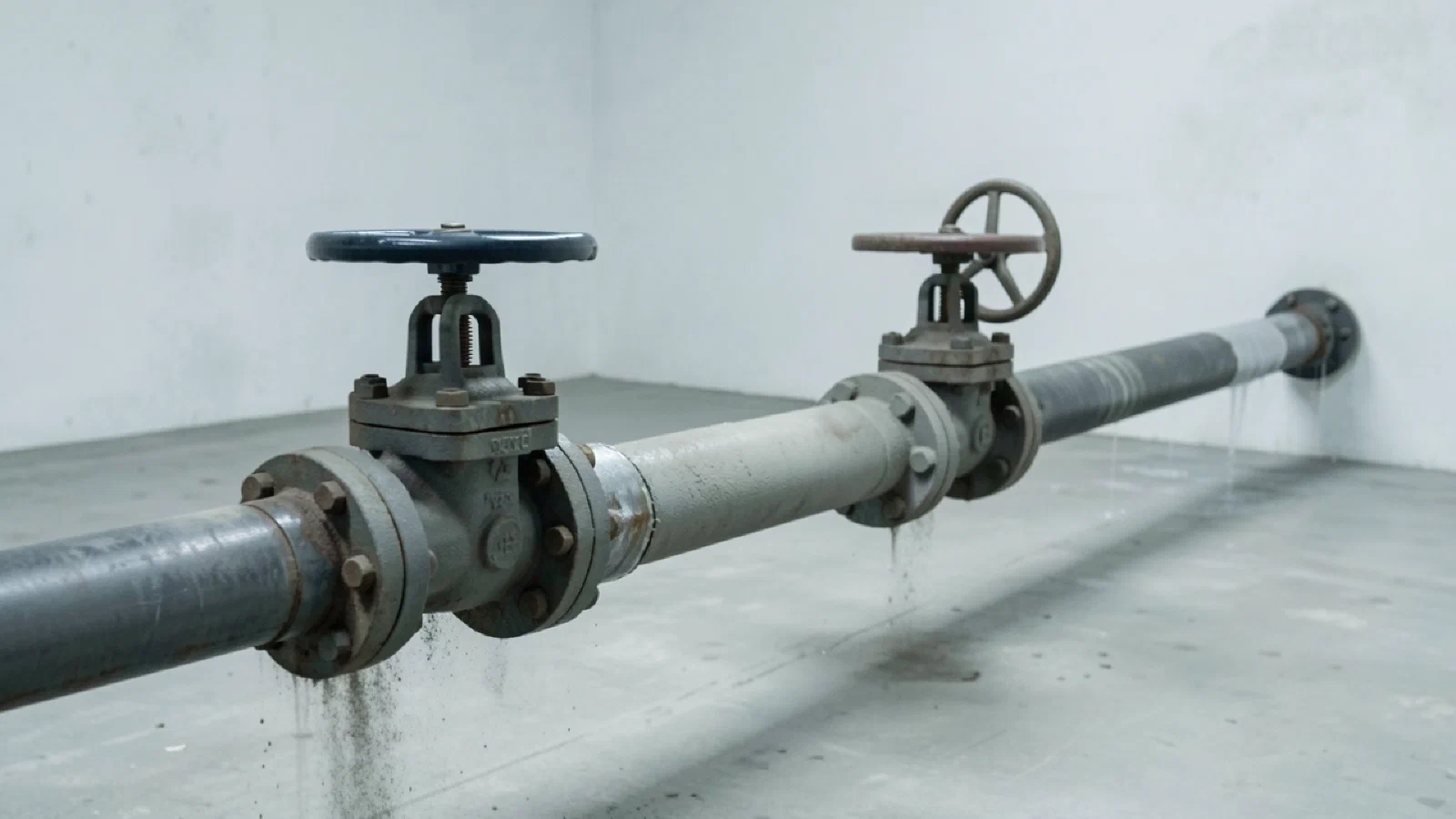
The Talent Valve
The frontier's import arrangement, the first turned valve, and the mechanism by which closing a border exports the thing it meant to keep
TAM-LEV.01 · The Levers · The Approximate Mind
Drafted by Claude with Syam, 2 September 2026.
The lever is in use right now. Visa categories tightened, caps adjusted, fees raised, processing slowed, each move defended as protection of domestic workers or national security or both. The instrument being operated is migration policy, and the operators describe it as a gate: a control on who enters, exercised by the state that owns the border, producing effects that stay on the operator’s side of the line.
That description of the instrument is wrong, and the error is expensive. Migration policy at the capability frontier was never a gate. It was plumbing. For roughly seventy years the American frontier ran on an import arrangement so continuous and so successful that it became invisible, the way any piece of infrastructure becomes invisible while it works. The arrangement moved a specific input, trained and trainable research talent, from everywhere to a handful of American institutions, and the frontier that resulted was described, honestly enough at the time, as American. The description held because the plumbing held.
A pipeline mistaken for a natural feature will be governed as if it cannot break. That is the condition under which the valve was first turned.
The Import Arrangement#
The numbers behind the arrangement are not obscure. Through the 2010s and into the 2020s, a majority of graduate students in American computer science and adjacent fields were international; among the researchers publishing at the top machine learning venues from American institutions, foreign-born researchers were the largest single component; among the founders and early technical staff of the laboratories that ended up defining the frontier, immigrants and the children of immigrants were everywhere the record is checked. None of this was accidental. It was the output of a machine with identifiable parts: universities funded to attract globally, a visa architecture that, whatever its cruelties and lotteries, moved tens of thousands of technical workers a year into American employment, and a settled expectation, held on both ends of the pipe, that the best work in the field happened in a known set of American zip codes and that a serious career pointed there.
The expectation was the load-bearing part. Visas move bodies. The expectation moved intentions, years before any visa was filed: which entrance exams a nineteen-year-old in Hyderabad or Hefei sat for, which language a dissertation was written in, which city a young couple planned a life around. The formal instrument and the informal expectation ran together for so long that policy debate treated them as one thing. They are not one thing, and they fail differently.
The First Turned Valve#
The sequence that revealed the mechanism ran through the H-1B program. Restriction was imposed with a stated aim of retention: keep the jobs, keep the frontier, keep the value inside the border. What the record then showed was not retention but reallocation. The workers the valve blocked did not, in the main, vanish from the field or requeue indefinitely. They were absorbed elsewhere, and the most consequential absorption was in the countries they came from. Indian retention rose. The global capability centers that multinationals had been building in Bengaluru and Hyderabad, conceived as cost arbitrage, began absorbing people who a decade earlier would have been in Santa Clara, and with them absorbed the layer of work those people do.
This sequence is already in the corpus as a falsification: the premise that opportunity contracts monotonically toward the center did not survive contact with it (the update to The Bypassed Road carries the evidence). What belongs to this essay is the reading of the sequence as an instrument test. The valve was turned, and the pressure did not build up behind it. The pressure rerouted. A gating lever applied to a mobile input does not stop the input. It redirects the input, and the redirection is durable in a way the gate is not. A visa denied is processed in months. A research group assembled in Bengaluru because of visas denied is an institution, and institutions do not un-assemble when the policy that caused them is reversed.
The Self-Defeat Mechanism, Stated in Full#
Why the redirection defeats the operator requires being precise about what the frontier actually is, and the corpus has done that work: capability concentrates because compute concentrates, but the capability frontier is not made of compute alone. It is made of compute plus a research culture plus a trained cohort plus an enormous stock of tacit knowledge, the unwritten craft of making training runs work, that lives in people and moves when they move.
Compute is the one component that holds still. Everything else in the list accrues where the hands are.
So consider the closure scenario carried to its stated conclusion. The valve shuts hard. The laboratories do not thereby acquire domestic replacements for the pipeline; a research cohort takes a decade to form and the formation systems are themselves staffed through the pipe being closed. The laboratories do what firms facing an input constraint always do: they go to the input. Satellite labs, then real labs, then centers of gravity, in the places where the talent already is or can freely gather. The tacit knowledge follows the hands. The training culture follows the tacit knowledge. And at the end of the sequence stands the object the policy was supposed to prevent: a frontier model substantially built in Bengaluru, or Toronto, or Zurich, or London.
The cap table of the company that owns it may remain American. The intellectual property may be registered in Delaware. But a model substantially built in Bengaluru is not fully an American thing, whatever the ownership documents say, because the things that made it, the cohort, the craft, the culture of the group that can do it again, are now there. Ownership of the artifact was never the strategic asset. The strategic asset was always the capacity to produce the next artifact, and that capacity is exactly the part that walked.
This is the decay signature that separates a wasting lever from a durable one. The talent valve decays with use: each turn transfers some of the gated input to the other side of the gate. And it decays with time even unused, because the conditions that made the import arrangement one-directional, a large and stable prosperity differential, a research monopoly worth migrating toward, are themselves eroding on their own schedule.
The Second Valve Inside the First#
There is a second valve in this essay, and it is closing without any legislator touching it. The import arrangement required not only permission to migrate but willingness, and willingness was always the product of a calculation: what is left behind, against what is gained. For seventy years the calculation was lopsided enough to survive family separation, lottery humiliation, and decades of visa precarity.
The calculation is no longer lopsided. The prosperity differential has narrowed for exactly the class of worker the pipeline moved. The capability centers mean the layer of work worth doing exists at home. The lived reports that travel back through family networks now carry the lottery, the layoff-triggered deportation clock, the twenty-year green card queue, and they carry them into a decision environment where staying is no longer the sacrifice it was. Cultural resistance is the wrong name for it, since there is nothing merely cultural about a correct reading of changed odds; call it the willingness valve. It sits in series with the policy valve, upstream of it, and it answers to no statute. A state that reopened the policy valve tomorrow would discover the flow reduced anyway, because the other valve turned while attention was on the first.
The two valves compound. Policy restriction accelerates the institutional absorption abroad; the absorption improves the stay-home calculation; the improved calculation reduces the flow that reopening could recover. Each turn of the first valve closes the second a little further. It is a ratchet, and ratchets are the signature of the wasting class.
What the Valve Was Worth#
None of this argues the valve was worthless. It argues the valve was priced for the wrong decade. In 1995, migration policy at the frontier was close to what its operators believed it was: the flow was large, one-directional, and without substitute destinations, so the gate’s positions genuinely governed outcomes. The error is not in believing the lever ever worked. The error is in reading its current price off its old performance, in operating a valve as though the pipe network around it had not been rebuilt.
The essay’s claim goes on the record dated. As of 2 September 2026: by September 2031, at least one model at the recognized capability frontier will have been substantially built, in the sense of core pretraining and research leadership resident outside the United States, by an organization whose formation traces in part to redirected rather than imported talent. Miss condition: if by that date every frontier-class release remains the work of teams predominantly resident in the United States, the transfer mechanism described here is overstated and the valve retains more of its old price than this essay allows. The claim is entered in the dated-claims register as a founding entry.
What would it take for a state to read its own border as plumbing rather than as a wall, while the pressure gauges still allow a choice? The record so far shows the reading arriving only afterward, from the far side of the turned valve, where the redirected flow has already become somebody else’s institution.
The valve is still being operated as this is written. Each turn is defended in the vocabulary of retention. The mechanism underneath runs in the other direction, quietly, on the timescale of careers rather than news cycles, which is why the operators will be the last to see it.
How this essay connects to others across The Approximate Mind.
- Kerr, William R. The Gift of Global Talent: How Migration Shapes Business, Economy and Society. Stanford University Press, 2019.
- Khanna, Gaurav, and Nicolas Morales. “The IT Boom and Other Unintended Consequences of Chasing the American Dream.” Center for Global Development Working Paper 460, 2017.
- National Science Board. Science and Engineering Indicators. National Science Foundation, 2024.
- Polanyi, Michael. The Tacit Dimension. University of Chicago Press, 1966.
- Saxenian, AnnaLee. The New Argonauts: Regional Advantage in a Global Economy. Harvard University Press, 2006.