The Tide
The unvisited, and no envy in the light
Rosaria has never asked what her life is for, and she has been asked.
That is the whole difficulty of her, for anyone trying to write her down. The question has not been kept out. It has not been answered and set aside. Her cousin Nunzia, who is Kai’s age and floats and knows it, put the question to her directly one evening on the wall above the harbor, in the words Kai’s generation uses, and Rosaria heard it and understood it and thought about it, visibly, for a while, and then said that the water would be good in the morning and did Nunzia want to come.
Nunzia did not come. Rosaria went.
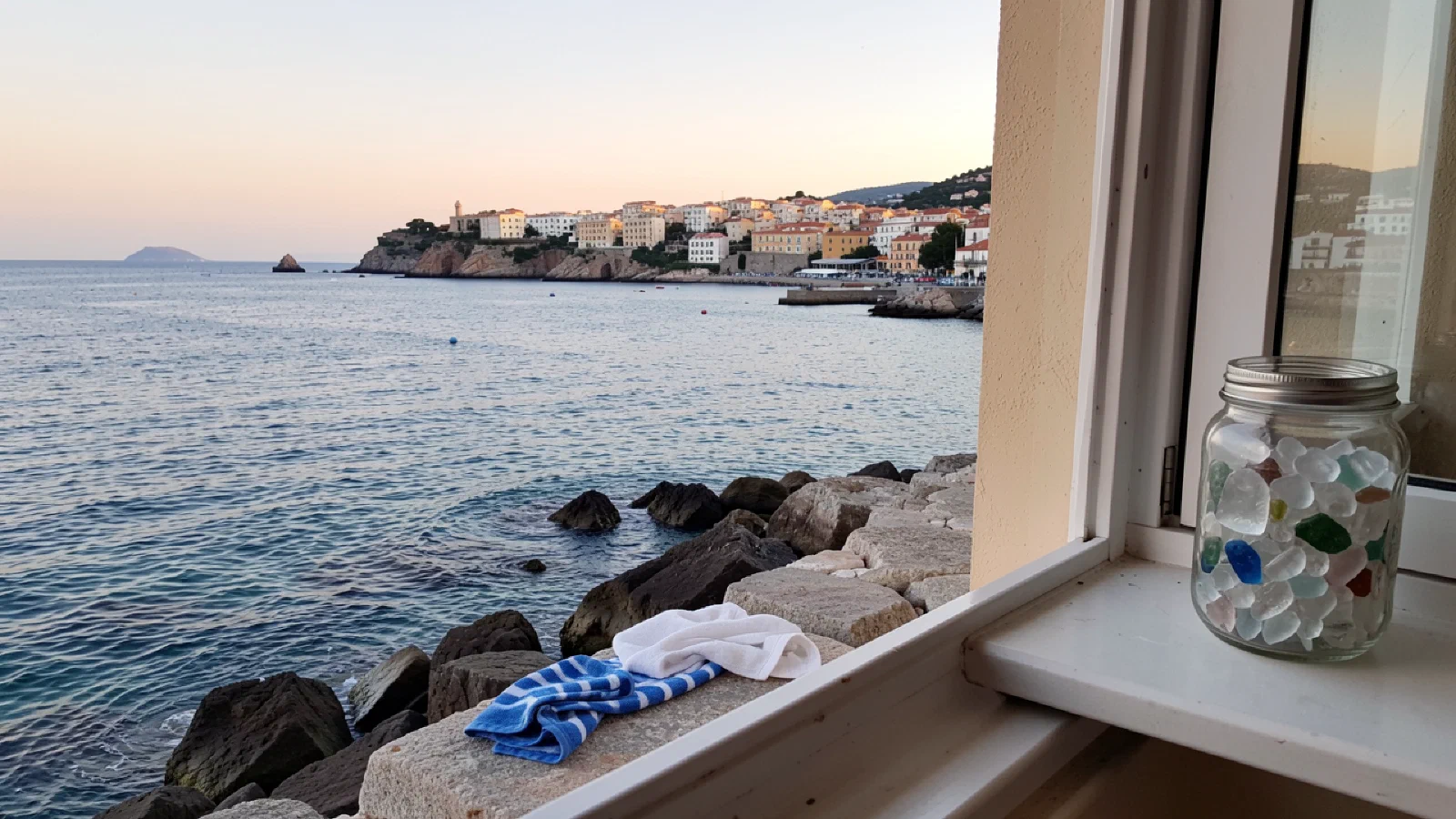
She is forty-one. She lives in Cefalù, on the north coast of Sicily, in the house she grew up in, which keeps itself now and did not then. She swims every morning at first light, from the rocks below the old town, in every month of the year. She cooks for her brother’s children three evenings a week because she likes them and the food. She keeps bees on the hill behind the town, which the hill’s own systems would keep for her and which she keeps anyway, not as a rule, the way the Muirs keep their rule, but because she likes the bees. She is provided for and has been for twenty years. She has never had a job that she would call one.
On the sill of the kitchen window is a jar of sea glass. She has picked it up from the rocks since she was six. It remembers nothing. It is glass.
What the Instrument Can See#
The instrument this series uses is a close third person that sits inside a person’s perception and reports what they do not know about themselves. With Rosaria it comes to the edge of what it can do, and the honest thing is to say so.
It can report what she does. It can report what she attends to, which is a great deal: the temperature of the water by the color of it before she is in, the state of a hive by the sound at the entrance, the exact moment the oil is hot, the children’s faces. It can report that her attention is full. It cannot report that she is not asking the question, because an absence in someone’s mind is not a thing anyone outside it can see, and the series does not claim to see inside.
What it can report is that the question, when put to her in words, did not stick. That is a fact about an evening on a wall. Everything else is inference, and the inference has two shapes, and the series holds both and crowns neither.
The Two Accounts#
The first account is Nunzia’s, though Nunzia would not put it so unkindly. It says that Rosaria is unvisited because there is no room. Her days are full to the edge with things that are pleasant, the water and the bees and the children, and a question needs an empty afternoon to arrive in, and she does not leave one. On this account the absence costs her something: she has never been alone with herself long enough to find out what is there, and the fullness is a wall, and the wall is kind, and it is a wall.
The second account is the one the town would give, if the town gave accounts. It says that Rosaria is not missing anything. It says the question is a symptom of a particular kind of life, the kind that was built to have nothing in it, and that a person whose attention is actually on the water at first light is not suppressing a question but simply living in a place the question does not reach, the way the old fishermen did, not because they were too busy but because they were somewhere else. On this account the absence spares her, and Nunzia is the one to be sorry for.
One account says she has not looked. The other says she has been looking the whole time, at the water, and the question is what you see when you stop.
The series cannot choose. To choose the first is to diagnose her, and the series does not diagnose. To choose the second is to envy her, and to make her the answer, and the series does not crown answers. She is one woman on a rock at first light, and what the absence of the question costs her or spares her is not visible from outside, and the honest report is that it is not visible.
The Rocks#
She goes down at first light. The path is kept; the rocks are not, because nobody keeps rocks. The sea is the color it is. The town above is beginning, the shutters and the vans and the small sounds of a place that runs itself, and she does not hear it, because she is looking at the water.
She goes in. It is cold; it is always cold at first light, even in August. She swims out to the point and back, the same distance, the same forty minutes, and the watch that watches everyone watches her and has never had cause to do more.
She comes out, and sits on the rock, and the sun comes over the headland and finds her.
This is where the other portraits put the question. The bench, the eyepiece, the counter, the wall, the lake. Rosaria on the rock, wet, warming, is the exact position, and the series has stood here eleven times and each time the question came.
It does not come. Or the instrument cannot see it. Or it is there and is not a question, but the water, and the warmth, and the town beginning.
The unvisited are not the ones who found the answer. They are the ones for whom the question was never the thing in the room, and the series cannot say whether that is a gift or a gap, because it has never been in the room.
Nunzia#
Nunzia comes some evenings and sits on the wall with her and does not swim. She is twenty-three. She has the question the way Kai has it, like a stone in a shoe, and she has read the things people her age read about it, and she looks at her cousin with a mixture that she would call love and that has something else in it.
She said once: don’t you ever wonder.
Rosaria said: about what.
Nunzia said: any of it. All of it. What it’s for.
Rosaria was quiet for a while. Then she said the thing about the water, and the morning, and Nunzia did not come, and has not, and the invitation stands every evening and is never withdrawn and is never accepted, and both of them know that the swim is the answer Rosaria has to a question she did not ask, and that it is not an answer, and that if Nunzia ever went in the water at first light it would not be the answer for her either.
I wonder whether the unvisited are the last people who can be written without the question at the center, or the first, and whether the series, which is made entirely of people the question visits, can see her at all, or only the shape of the place where the question would be. She may be a portrait. She may be the frame’s edge. The honest report is that from here they look the same.
The Jar#
The jar on the sill has forty years of glass in it. Green, brown, white, one piece of blue she found at nine and still knows by touch. It does nothing. It is not a dish that remembers a rope, or a bell that remembers a fire, or a level in a case. Nothing ever needed it. She picked it up because it was there and it was smooth and she liked it.
She adds a piece some mornings. Most mornings she does not.
The bees are on the hill and the children come at seven and the water will be good tomorrow, and she will go, and the series will stand on the rock again, in the exact position, and wait.
She is not the answer. The series will say that plainly, because otherwise it will be read as if she were. She is a woman who swims. The question has not found her, or she has not found it, and nobody in this series, including the one writing it, can say which.
How this essay connects to others across The Approximate Mind.