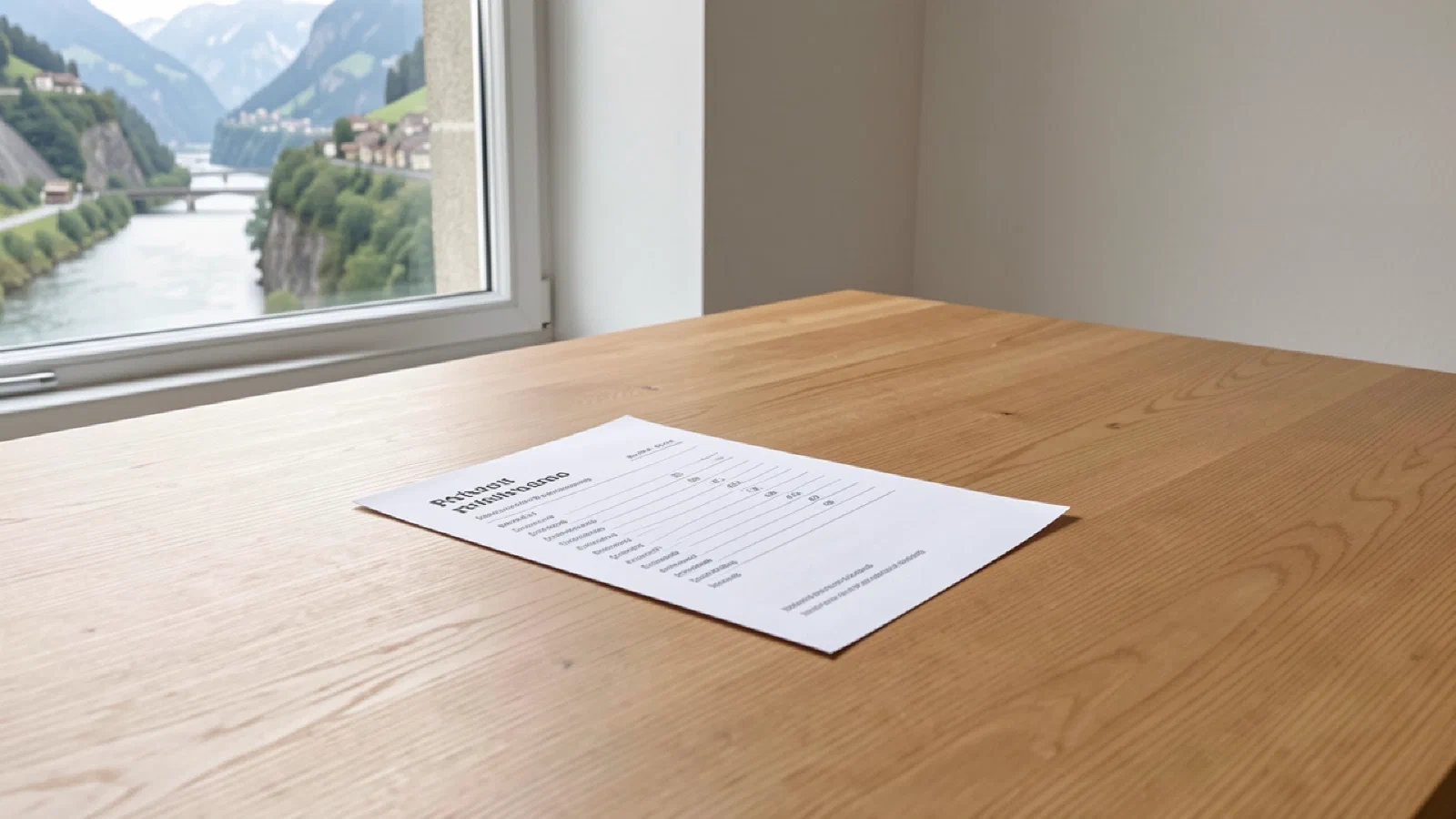
The Statement
The pure case, nothing mitigating
Luc has nothing wrong with his life and knows it exactly.
Exactly is the word. Every month a statement arrives that tells him, to the centime, what he has received and from where and under what article of which act, and every month he reads it, because it is well written and because he was raised to read things, and then he turns it face down on the table and leaves it there until the next one comes.
He is thirty-one. He lives in Fribourg, in a flat that looks at the river gorge, in a country that decided two decades ago to do the provision properly and then did. He has never had a job, in the old sense. He has done things; he studied, he traveled, he helped with the vineyard on the lake for three seasons because he liked it, he learned to make a passable bread. None of it was required. The statement does not mention any of it. The statement does not need to.
There is nothing else in his life. This is not a complaint about his life. It is a description of the frame.
The Frame#
The other Humans have noise around the question. Padma, in the delta, has the drain and the tanker and her mother’s eyes. Ilona has fifty years behind her. Teodor has two benches. Suki has the dirt. Even Kai has a dog and a creative practice and a set of friends who have found weight and talk about it.
Luc has the statement.
The Timetable#
He has friends. They are like him. He has parents, who are Natives and who worked the transition in the careful, procedural way this country worked it, and who are now provided for and content, and who do not ask him what he is doing with his life, because the country made a decision about that too, and the decision was that it is not a question anyone is obliged to answer.
He has health, monitored with a discretion he has never noticed. He has the tram, which arrives when the display says it will, and has never once in his life not. He has the gorge, which is beautiful, and the lake half an hour away, which is beautiful, and the mountains beyond that, which are beautiful, and a small library of things his grandfather left him, of which the one he keeps in his coat pocket is a folded paper railway timetable from the last year they printed one.
He does not need the timetable. Nobody needs a timetable. The trams come. He keeps it because it is the last object in his possession that was made for a person who needed to know something.
Without Noise#
The question came to Luc the way it comes to the others, without warning and without a cause. He was walking along the gorge path on a weekday in March, and the path was clean and the water was high and nobody was on it, and he thought: what is this.
Not what should I do. He has been offered, gently, over the years, the things a person in his position can do, and he has done some of them and enjoyed some of those, and none of it was the question. The question is under that. What is this, this walking, this being kept, this life that costs nothing and asks nothing and lasts. What is it for.
In the delta the question has to share the room. In Fribourg it has the whole flat.
Take everything away that could distract from the question and the question does not get louder. It gets exact.
That is the finding from the pure case, if it is a finding. He had assumed, in the way people assume, that a question with nothing crowding it would be enormous, that the silence around it would amplify it into a crisis. It did not. It made it small and clear and very hard to look away from, the way a single object on an empty table is harder to ignore than the same object in a crowded room.
The statement is on the table. Face down. It is the only object on the table.
What It Sounds Like#
He has tried to describe it to his friend Anouk, who has the same life and the same statement and, as far as he can tell, the same question, though she has never said so.
He said: it is like a note held. Not loud. A single sustained tone, under everything, that you stop hearing until the room goes quiet, and then it is the whole room.
Anouk said: I thought that was just Switzerland.
They laughed. It was a good joke and it was also the exact shape of the thing, because in a country where everything has been settled, the settledness is the tone, and the question sounds like the settledness, and you cannot tell whether what you are hearing is the question or the country.
Nothing mitigates it. That is what pure means here. There is no work that still needs him, so no weight to hold it off for an afternoon. There is nobody who depends on him, so no weight through another person. There is no worry, so no older question to crowd it out. There is no faith in the house; his parents had none and passed on none, and the country is polite about that too. The question arrives, and it is met by a well-kept flat and a face-down statement and a man who is healthy and thirty-one and has nothing to offer it but attention.
Provision answers every question a life can pose except the one it creates.
He is not unhappy. The systems that watch for unhappiness are good, and they have no note on him. He sleeps. He eats. He walks the gorge. He bakes on Sundays and the bread is better than it was. By any measure the country keeps, and the country keeps many, he is fine.
He is fine, and the note is held, and he has begun to suspect that fine is the sound the note makes when nothing is played over it.
The Lake#
On a Saturday in June he takes the train to the lake. The train is on time. The timetable in his pocket, if he checked it, would be wrong by a decade and he does not check it.
He walks along the shore to the place near the vineyard where he worked three seasons. The vines are in leaf. Nobody is in them; the season’s work runs on its own now, and the wine is good, and he drank a bottle of last year’s with Anouk and it was fine. Fine is the word the country uses for everything and it is always accurate.
He sits on the wall. A swan comes over on the assumption that he has bread. He does not have bread, and the swan reconsiders him and leaves, and he finds this funnier than it is.
I wonder whether the pure case is the one that will produce an answer, because nothing is in the way, or the one that cannot, because the question needs something to press against and here there is nothing. Ilona’s question has fifty years to press against. Padma’s has the drain. Luc’s has a clean wall and a swan.
The lake is very still. The note is held. He sits with it for an hour, which is easy, since he has the hour and every hour after it.
There is no arrival. He had not expected one and is faintly embarrassed to have come to a lake, as if lakes were where such things happened. He walks back to the station and the train is there, as it always is, and he goes home.
The statement is on the table. He does not turn it over. It is accurate. Everything in it is correct. It was never the answer to anything, and it never said it was.
How this essay connects to others across The Approximate Mind.