The Probe
Earned weight, the only dirt in the series
Suki comes home too tired to ask the question, and that is the point of coming home tired.
She would not put it that way. She would say she works on the bog, which is true, and that the work is hard, which is true, and that she sleeps, which is true and is the part her friends envy. Kai, who has known her since school, told her once that she had found the weight, and she let him say it, because he needed someone to have found it, and because on most days it is roughly right.
She is twenty-four. For three years she has worked on the rewetting of an upland bog that was drained for grazing a century and a half ago and has been leaking carbon and silt into the river ever since. The work is to put the water back. That sounds simple. It is not simple, and the reasons it is not simple are the reasons she still has a job.
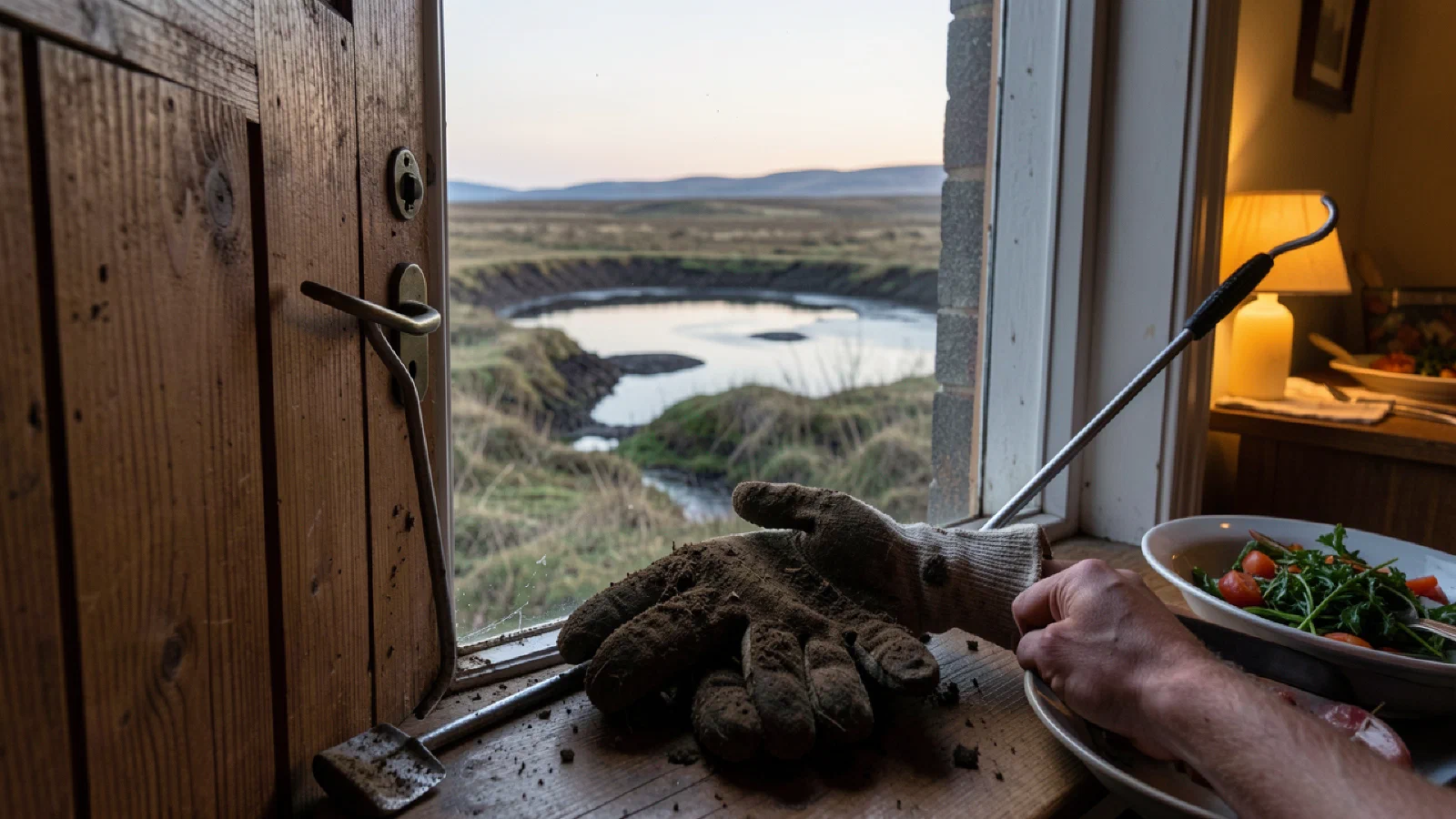
Her gloves are by the door. They are the only dirty thing in the house. The house, which cleans itself, has learned to leave them alone.
What the Machines Do#
Most of the bog is mapped to the centimeter. The drones fly it every morning at first light and the model knows the surface better than any person has ever known any ground: where the water table sits, where the peat is deep and where it is thin over the old ditches, where the sphagnum has come back and where it has not, how much the whole hillside has swelled since the last block went in. The walking excavators go where the model sends them and build the peat dams where it tells them to, and they do this without a person in the cab, and they do it well. Suki does not remark on any of this. It is the weather of the job.
What the model does not know yet is where to put the next dam.
That is not quite right either. The model has an opinion; it always has an opinion. It can show her three candidate lines and the hydrology behind each and the confidence on each, and its confidence is often good. What it cannot do, yet, is stand in the drain in April with the water to the knee and know from the way the peat gives under the boot and the color of the water coming through the old cut and the particular silence of a place where the moss has stopped that the ditch is undercut a meter further along than the survey shows, and that the dam should go there, and that if it goes where the model wants it, the water will find the undercut and go round.
There is nothing mystical in it. Three years of standing in the drain is what it is. The model is learning it. Every dam she places that holds, and every one she places that fails, goes into the record with her reasoning and the outcome, and the model’s three candidate lines are closer to hers every season than they were the season before. She knows this. Everyone on the crew knows this. It is not a secret and nobody on the bog pretends it is.
Earned weight is the only kind the system did not remove, and it did not remove it only because it has not finished learning.
The Weight#
The weight is real. That is the honest report, and the reason her friends envy her.
She is needed at a particular spot on the earth at a particular hour. On a morning in April the crew goes up the hill with the probes and the spades and stands in the drains, and the water is cold, and the wind comes across the top of the bog with nothing to stop it, and she reads the ground with her feet and her hands and the probe, a steel rod with a bent handle that she drives into the peat to feel where the firm bottom is, and she says: here. And the excavator, which has been waiting, comes and builds the dam here. And in three weeks she walks up and the water is standing behind it, brown and still, and the moss on the upslope side has the look it gets when it is drinking, and the thing she decided has become a fact on the hill.
That is the weight. Being the one who says here. Being the one who is wrong, sometimes, and standing in front of the failure with the crew and the record and saying so. Coming down off the hill at four with the legs gone and the hands raw inside the gloves and nothing left in her to ask anything.
She has told Kai the weight answers the question. She has told him it answers it the way a meal answers hunger, and she meant that as a warning, and he heard it as a report, which it also is.
The Meal#
She comes home. The house has the lights at the level she likes when she is this tired, which is low, and the bath drawn, and the food in the warmer, and she has never once thought about any of this because she has never once had to. She eats standing at the counter, still in her socks, and the food is good, and she is so hungry that good is beside the point.
Then she sits.
And the question comes back. Not at once. It waits until the body has been fed and warmed and has stopped shouting, and then it comes in quietly and sits across from her the way it sits with Kai on his bench, and it is the same question. What is this. What is all this for. Not the bog; the bog is for the river and the carbon and the moss, and she can tell you that to the tonne. Her. What is she for, this person who is needed on the hill, and is tired, and is fed, and is sitting here at the counter with the question anyway.
The meal answered hunger. It did not answer the question. It only made her strong enough to hear it.
Weight found is not weight given, and it is not weight kept either. It is borrowed against a day the lender has already named.
The day has a name because the model is learning. In two years, three, five, it will know where the undercut is. It will stand in the drain, in the sense that it stands anywhere, and say here, and be right more often than she is, and the crew will be smaller, and then it will be a crew of nobody, and the bog will be rewetted, and it will be good work, and it will have been done. She does not resent this. She is on the side of the bog. But she knows what the weight is: a loan from a system that has not finished learning, at a rate of interest that is exactly the question, paid every night at the counter after the meal.
Kai’s Question#
Kai asked her once, on the canal, whether the weight was the answer. She said no, and then she said it was, temporarily, and he wrote that down somewhere in himself and it became part of how he talks about her.
What she did not say, because she had not found the words, was that the weight does not answer the question at all. What it gives is a place to stand while the question is asked. Her grandmother’s generation had that place all their lives, without knowing it was a place, and never heard the question because they were never off their feet long enough. Suki has it for the hours she is on the hill. She comes down, and she eats, and she sits, and she is off her feet, and there it is.
I wonder whether the ones who have found weight are the ones who hear the question most clearly, because they have something to compare the silence to, or whether that is just the tiredness talking. The evening she came down off the hill with the first dam holding, she was happier than she has ever been, and she sat at the counter afterward with the question, and it was not diminished at all.
The Probe#
The probe stands in the corner by the gloves. A steel rod, a meter and a half, with a handle bent by someone before her and a shine on the bottom third from the peat. It is the one tool in the house that still needs a hand. It will need one for a few more seasons.
She looks at it from the counter. She does not get up. Her legs would not thank her.
There is no epiphany at the counter. There is a woman with raw hands and a full stomach and a question, and the lights low, and the bog four miles off in the dark with the water standing behind the dams she said should go there.
Tomorrow she will go up again. The crew will stand in the drains. She will drive the probe and read the ground and say here, and the excavator will come, and she will be needed, and it will be enough for the length of the day.
The meal was good. She was hungry. She will be hungry again by morning, and she has decided that is not a complaint.
How this essay connects to others across The Approximate Mind.