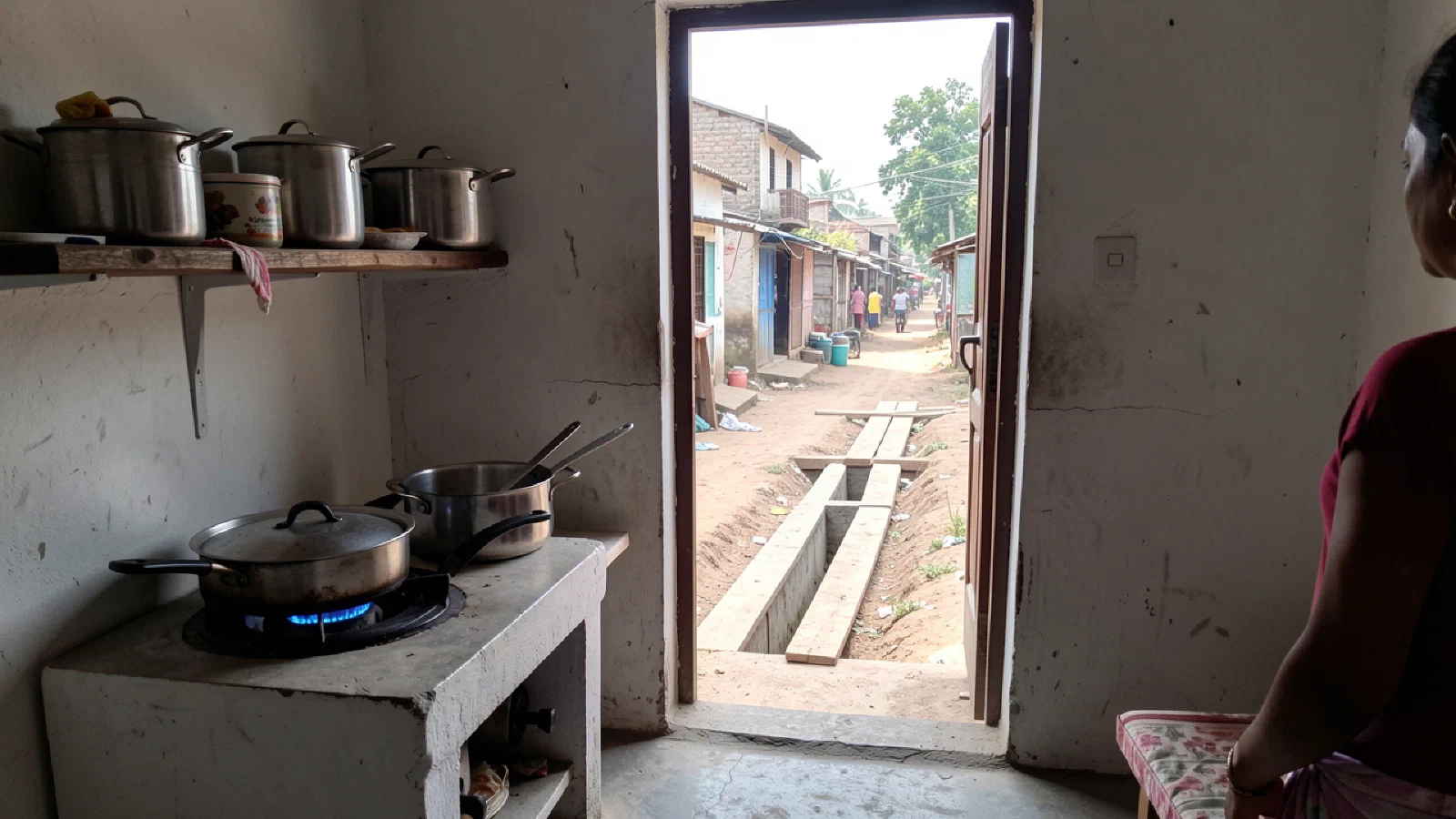
The Open Door
Provision inside, the older questions still in the street
Padma is provided for, in the sense that the money comes.
It comes on the third of the month, to the phone, without her asking, from a scheme that has a name she has stopped using. It is enough. It is enough for rice and dal and oil and the power and the school, and it is enough for the clinic when the clinic has what her mother needs, which is a different question. It is, by the measure of her mother’s life and her grandmother’s, a great deal of money for doing nothing.
She is thirty-four. She worked nine years in the quality lab at the ginning cooperative, testing cotton for staple length and trash content, and then the lab tested itself, and then the cooperative sent the last four technicians home with a month’s pay and a certificate. The provision had already begun by then. It arrived in the delta later than it arrived in the cities, and it arrived smaller, and it arrived.
So the weight came off the work. Nobody in the house has to earn. That part of the floor is under her feet.
The other part is not.
The Street#
The house is sufficient. It has two rooms and a kitchen and a door that opens onto the street, and the door is open most of the day because the house is hot and because that is what doors are for.
Through the door is the street, and the street is unfinished. The drain that was dug three monsoons ago is still a trench with planks across it. The water comes by tanker, and the tanker comes on a schedule that the district’s system sets, and the schedule is good, better than it was, but the tanker is one tanker and the street is one of forty and the schedule knows this better than she does. Her mother’s eyes are on a list for the cataract camp. The list is fair. It is also long.
Inside the door: provision. Outside the door: the older questions, the ones every generation before hers faced, still standing in the street where they have always stood.
Kai, on his bench in a city with clean canals, has one question. Padma has that one, and the drain, and the tanker, and her mother’s eyes, and she cannot always tell which one is asking.
The provision credit arrives on the phone with a small sound she no longer hears. The school’s tutor talks to her son, Chinnu, in the front room every morning in a voice that has learned his accent. Down the road the ginning mill runs through the season with its doors shut and nobody in it. A drone crosses the cotton twice a day at the same hour. None of this is remarkable to anyone on the street. The drain is remarkable. The drain has a plank across it.
Half a Floor#
A floor that has half arrived is not half a floor. It is a floor you cannot stand on with both feet.
She stands on one foot. On the good weeks, when the tanker came on time and her mother slept and the money is not yet thin, she feels the thing Kai’s generation calls lightness. She does not have the word. She has the feeling: a day with nothing in it that has to be done, a morning where she sits at the open door and the street is quiet and she is not waiting for anything.
Then the tanker is late, or Chinnu is feverish and the clinic’s queue says four hours, or her mother stands in the kitchen with her hand out for the wall, and the other foot comes down hard, and the floating stops, and she is her grandmother again, managing.
It goes like that. Weeks of one, days of the other. The floating is intermittent, and because it is intermittent she cannot decide whether it is a condition or a visit.
Her neighbor, Lakshmi, who is older, calls the good weeks rest. Padma does not think that is the word either. Rest is what comes after work, and there is no work. Rest is a pause in something. This is not a pause. On the good weeks it is a whole day with no shape, and on the bad weeks it is the old shape, and she moves between them without any say in which is coming.
The Two Questions#
Her grandmother never asked what her life was for. She had six children and a field that flooded and a husband who drank, and the answer was in the next task, and there was always a next task.
Her mother asked it once, that Padma knows of, after the last child left and before the eyes went. She asked it and then the eyes went and the question was replaced.
Padma asks it on the good weeks. It comes in at the open door with the morning and sits with her. Not what should I do; the system has answers for that, and the answers are for cities, and they arrive on her phone in a language that has learned her accent and still does not know the street. Something under that. What is this, this sitting here, this being provided for, this having nothing to manage for the length of a morning. What is it for.
Then a bad week comes and the older question walks in through the same door and sits down in the same chair. Will there be water. Will the camp reach her mother’s name. And the new question does not leave. It sits there too. The two of them share the room.
The question that no generation faced without necessity has arrived here, on schedule, and found necessity still in the room.
This is the position nobody designed. The people who built the provision built it for a world where the older questions had been answered first, in order, the way they were answered in the cities. The delta got the provision before it got the drain. So the question that was supposed to be the last question is here early, and it has to share the house.
The Weeks It Comes#
Her husband, Srinu, is one of the few men on the street who still works, in the old sense. He is a lineman for the distribution company, kept on because the last kilometer of wire in flood season still needs a person who knows which pole leans. He is needed perhaps forty days a year. On those days he comes home pressed, the way her father used to come home, and she sees on his face something she cannot put a name to and would not want, exactly, and does not have.
The other three hundred days he sits at the door with her.
He does not ask the question. She has watched to see whether he does. She thinks he does not, and she thinks it is because forty days a year of being the man who knows which pole leans is enough weight to hold the question off, the way one meal holds off hunger, and she does not know whether to envy him the forty days or pity him the rest.
I wonder whether the question can be asked at all by someone who is still answering the older ones, or whether it needs the room to itself. In the cities it has the room. Here it has a chair by the door and it shares the house with the drain, and maybe that makes it a different question, or maybe it makes it the same question asked by someone who cannot give it her whole attention, and I do not know which.
The Door#
On a Thursday morning in the dry season the tanker comes on time and her mother is asleep and Chinnu is with the tutor in the front room and the money is not yet thin.
She sits at the open door.
The street is quiet. The plank is across the drain. The drone goes over the cotton at its hour. The question comes in and sits down.
She does not answer it. She has nothing to answer it with; it is not that kind of question, and she knows that without having been told. She sits with it for the length of a morning, which is what the good weeks are, and it is not unpleasant, and it is not peace, and it does not resolve.
At eleven her mother wakes and calls for her, and she gets up, and the question stays in the chair, and the other one comes in past her through the open door.
Her steel tiffin from the lab is on the shelf above the stove, with her initials scratched into the lid by a pin. She has not carried it anywhere in six years. She has not put it away either.
The question waits. So does the drain. She could not tell you which she would rather have finished first, and that is the honest report from a street where the floor is half laid.
How this essay connects to others across The Approximate Mind.