The Loan
What the twelve portraits borrowed, from whom, and on what terms
TAM-HUM.SYN · The Humans · The Approximate Mind
The series set out to hold a question, and it should be said at once that the question is still held. What is a human life for, asked one generation past the transition, with survival made infrastructure and the building done, was never going to be answered by twelve portraits, and that was known before the second one existed. A synthesis of this series therefore cannot deliver a finding in the way the arguing series deliver findings. What it can do is report what became visible only when the portraits were read together, and one thing did, and it was not planned, and the honest course is to lay it out and then lay out the reason to distrust it.
The thing that became visible is a structure of debt.
The series was designed to test counterweights: things that can legitimately press on a life when nothing has to. Work that still needs humans. Responsibility. Care. Chosen hardship. The family. The town. The design assumed the portraits would find some counterweights holding and some failing, and that the pattern of holding and failing, if there was one, would be the harvest. That is not what the portraits found. What they found, one position at a time, without any portrait intending it, is that every counterweight that holds is borrowed, and that each loan carries the same clause.
The Terms#
Take the four portraits of found weight in order of the lender.
Suki’s weight (The Probe) is borrowed from a machine that has not finished learning. Her judgment on the bog is real, the pressing is real, the tiredness is proof. It exists because the model cannot yet stand in the drain, and every dam she places teaches it to, and she knows the day the loan is called is not hers to choose. The essay’s own sentence gives the terms: borrowed against a day the lender has already named.
Deshi’s weight (The Name Card) is borrowed from a courtesy, and the lender will not disclose whether the loan is real. The board’s effect on the provision, if it has one, lives in papers the system would have written differently for nobody, papers that were never written and cannot be read. He cannot audit the debt without defaulting on it; the one time he checked, the weight survived only because he stopped checking.
Nkechi’s weight (The Second Cup) is borrowed from another person’s losses. It is the strongest loan in the series, the one counterweight nobody designed and nothing was built to remove, and the portrait is explicit about why it holds: the pressing is Femi’s, not hers. It answers the question by lending it. She knows the amortization schedule, the flattening and the plateau and the shelf where the second cup goes, and the series put Ilona at the end of that schedule eleven years on.
The Muirs’ weight (The Switch) is borrowed from the two people in the house who did not choose it. The parents’ hardship is honest and their necessity is not; the press they built has a door twelve feet from it, and the only genuine necessity in the arrangement is the one imposed on the children, who were born under it and to whom it is the world until the day it is a door. The loan is real precisely where it was never consented to, which is the least comfortable sentence in the series and the one the household has organized itself not to say.
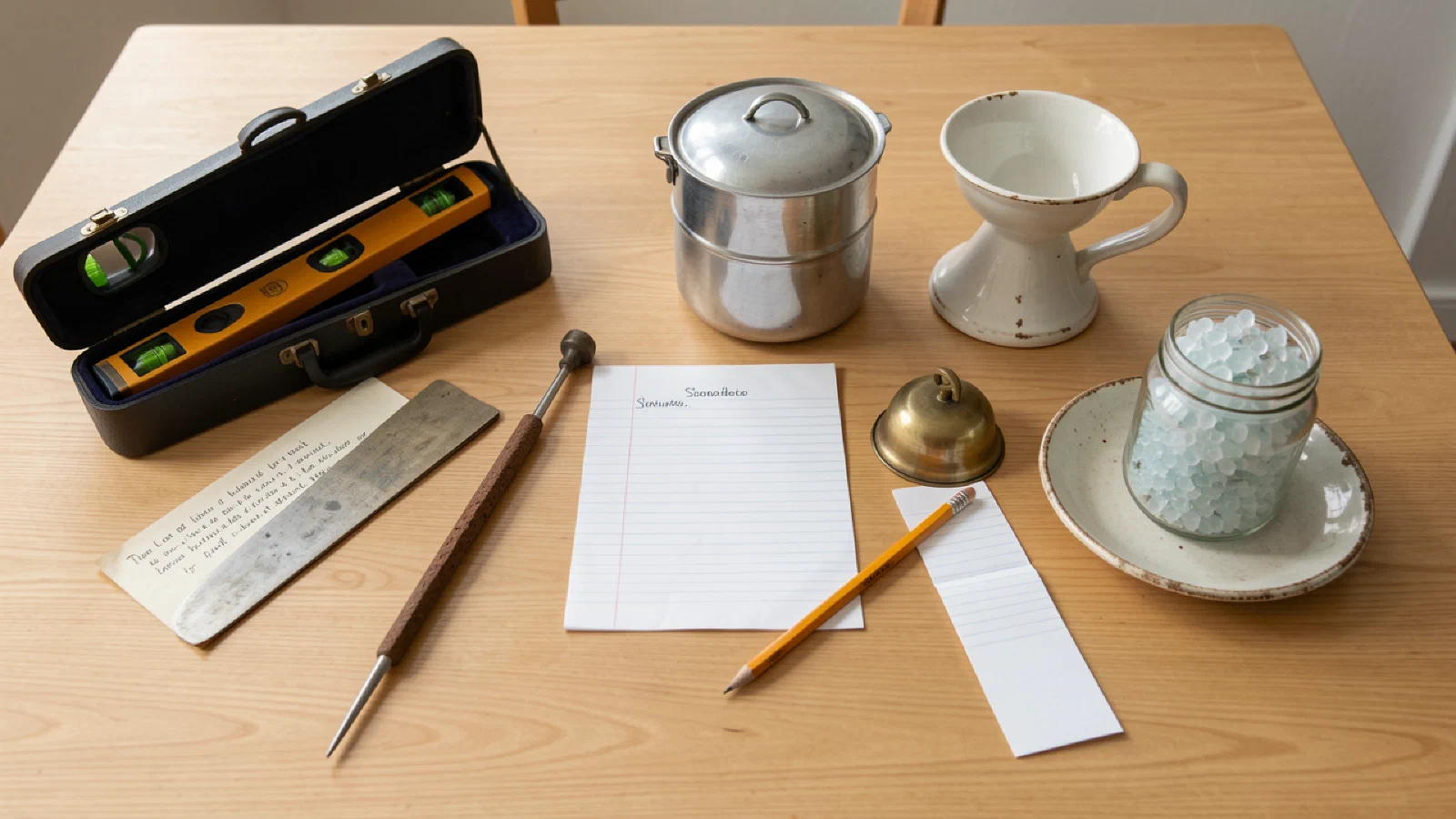
Two more loans sit at the larger scales, and they are loans from the dead. The Teixeiras’ rope (The Laid Table) is a chipped dish passed hand to hand, a memory of a necessity nobody at the table has lived; Port Alder’s reason (The Doors) is a brass bell rung once a year by a brigade with a full roster and no fires. Shared weight, both portraits found, cannot be manufactured at the collective scale, only remembered, and a memory is a loan against principal that is gone.
And then there are the positions where no loan is on offer, and they are the positions where the question stands in the open. Ilona (The Level) has repaid hers in full and finds the settlement is the injury. Teodor (The Chair Between) had his called at twenty-nine and is offered refinancing he experiences as an insult. Padma (The Open Door) cannot float a loan because the older creditors are still in the room. Luc (The Statement) was born debt-free into a country that cleared everyone’s, and what he hears in the silence is the question, exact.
Every counterweight in the series is a loan, and every loan carries the same clause: it holds while its terms are unexamined. Suki’s holds on the days she does not count the seasons. Deshi’s holds on the days he does not do the arithmetic. The Muirs’ holds as long as nobody checks the hinge, and the portrait ends on the fourteen-year-old who has started checking. Even Nkechi’s, the strongest, holds because she has decided the day the chair empties can wait for her. The series did not put this clause in; it emerged, position after position, in drafts that were each trying only to render their own life honestly. The pressing that the old world got from necessity, the after-world gets from a kind of disciplined not-looking, and the portraits suggest, without one of them arguing it, that the discipline is the actual counterweight. Not the work, not the seat, not the care, not the cold. The declining to examine.
The Reason to Distrust It#
The twelfth portrait is the counter-reading, and the synthesis is obliged to give it equal standing, because it was written last and it is aimed at the instrument that produced everything above.
Rosaria (The Tide) is the person the question does not visit. The portrait went to the exact position where the other eleven put the question, the rock at first light, the bench, the counter, the wall, and reported that the question did not come, and then reported that it could not tell whether the question did not come or the instrument could not see it. The series’ instrument is a close third person built to detect the question: the negation cascade names the condition, the refused epiphany protects the asking, the wondering sentence is the question surfacing in the narrator. An instrument built to find a thing will find it, and a person truly without it is, to that instrument, indistinguishable from a person the instrument failed on.
So the loan structure has a rival account, and it is this: the series did not discover that all counterweights are borrowed. It discovered what counterweights look like to a lens that assumes the question is always underneath. On the rival account, Rosaria is not an edge case; she is the population, and the eleven portraits are the edge, the minority of lives in which the question is the thing in the room, selected by a series that could not have rendered any other kind. The fullness of an attention that is actually on the water may be the ordinary condition of the after-world, and the loan clause a property of the twelve people the series chose because the clause would be visible in them.
The synthesis cannot adjudicate between the finding and the rival account, and it is worth being precise about why not. It is not modesty. The two accounts predict the same twelve portraits. Only a portrait the instrument cannot write would separate them, and the twelfth essay is the record of the instrument reaching that limit and saying so in the body, the one place in the series where the form names itself. That was the right cost to pay, and what it purchased is this paragraph.
What the opener claimed (The First Question) should be re-read against both accounts, because the series’ first essay made the one move the synthesis is forbidden to make: it reframed. The asking is the purpose, Kai concluded on the bench, and the essay conceded the circularity and kept it. Under the loan finding, that reframe gains standing it did not earn at the time, because the asking is the only thing on the table that is not borrowed; every weight is a loan, but the question is nobody’s to call. Under the rival account, the reframe is the instrument consoling itself, a lens declaring that the thing it detects is the point of the people it detects it in. The synthesis holds both readings and crowns neither, and notes only that the series’s first essay and its last are now in an argument that neither knew it was in.
What Is Carried Forward#
A reader leaves the series with a sharper question than it started with, which is the only kind of progress this series recognizes.
The sharper question is not whether the counterweights hold. They hold. People are carried through whole good lives on them, and the portraits are not tragedies; Suki is happier than anyone else in the series, Nkechi would not trade, the fete is pleasant and nobody is pretending. The sharper question is what kind of thing a civilization is resting on when its remaining sources of pressing are, without exception, loans that survive examination badly, in a world that has also built, into every companion and every wall, a capacity for examination no earlier world had. The old counterweights did not need protecting from scrutiny; necessity does not care whether you audit it. The new ones do. A society of the provided-for may find that its load-bearing structures require a tact it has not named, a collective agreement to not check hinges, and the series can point at that agreement operating in a Borders farmhouse and a Porto dining room and a Nova Scotia harbor town and cannot say whether it is wisdom or rot, because the household, the family, and the town could not say either.
And one question the series raises and cannot touch: what happens to the loans at the next depth. Kai’s generation borrowed from parents who remembered weight; the dish and the bell are loans from the dead, but the dead were real. A generation further on, the lenders themselves will be borrowers. Whether the loan structure amortizes to nothing, or stabilizes into something like a tradition, which is after all what a tradition is, a loan from the dead that stopped being examined, is a question for portraits that cannot be written yet, because the people in them have not been born.
The series ends where it must, on the rock at Cefalù, in the exact position, waiting. The question is still held. The twelve portraits neither answered it nor put it down; they priced it, which no one had done, and the price turned out to be a clause nobody drafted. It holds while you do not read it. The series read it. Whether that was a service is not for the series to say.
How this essay connects to others across The Approximate Mind.