The Level
The counterweight that ended, kept and oiled
Ilona has been finished for eleven years and is not yet done.
Finished is the word she uses, when she uses one. Retired is what the record says. Provided for is what the record means. Finished is what it felt like on the morning after the last corridor closed out, when she woke at ten past five because fifty years had taught her body to, and lay there, and understood that nothing was waiting for her to get up.
She is seventy. She was a surveyor. For fifty years she set out lines on the ground so that other people could build on them, and for the last dozen of those years the lines were for the things that now run without anyone: the freight corridors, the substations, the water. She helped lay out the world that stopped needing her. She does not say this with bitterness. She says it the way you say the weather was fine.
The house wakes before she does. The light comes up in the kitchen a shade at a time, the way the house learned she liked it. The kettle is warm by the time she reaches it. She has never once thought about how the kettle knows.
The Case#
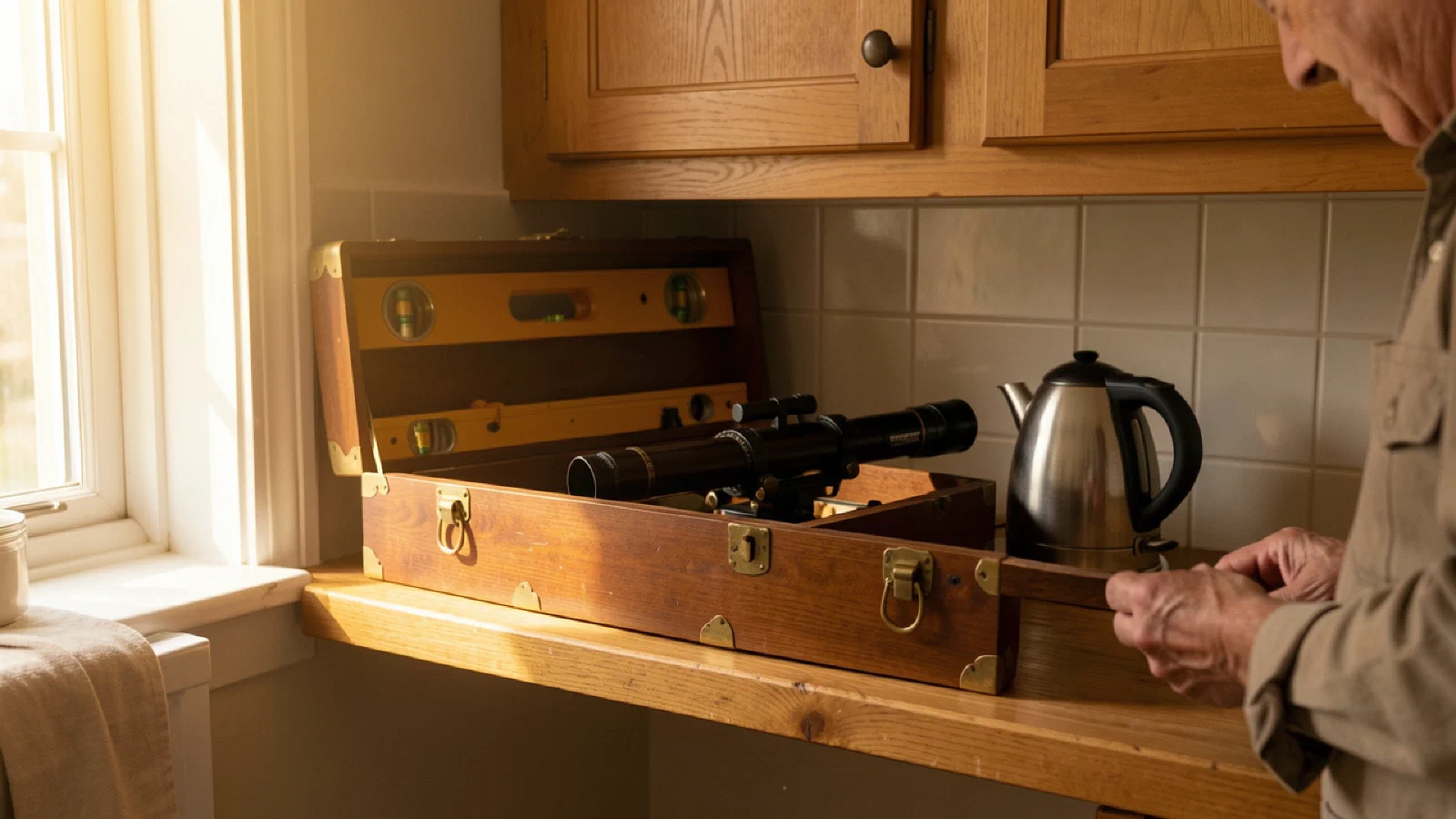
On a shelf in the kitchen, at eye height, in a room that has no use for it, is a wooden case with brass corners. Inside the case is a level. Not a builder’s spirit level; a surveyor’s instrument, a telescope on a tripod mount, the kind that sights along a line and tells you, to a fraction the eye cannot see, whether the far point is higher or lower than where you stand.
She oils it in the autumn. She has oiled it every autumn since she was twenty-two and a man named Pál handed it to her and said the instrument was older than she was and would outlast her if she let it.
It has outlasted the work. There is nothing left in the world that she needs to sight. The corridors are laid. The ground they run on is surveyed continuously now, by things the size of her hand that ride the maintenance cycle and report drift in the millimeters. The last human measurement on the last corridor was hers, and she knew it was, and she signed the sheet, and she went home.
The case stays on the shelf. The room does not need it. She has moved it twice and put it back twice.
What Pressing Felt Like#
Kai, who is twenty-two and has never carried anything, calls his condition lightness. Ilona has heard the word from her grandson and understood it at once and understood, at once, that it is not her condition.
Kai floats because he was never weighted. Ilona floats because the weight was taken off. These are not the same thing, though from outside they look identical: a person moving through a comfortable day, unpressed, unhurried, leaving no mark.
She remembers pressing. She remembers it in the body, not the mind. The cold at five in the morning on a site where the ground had to be closed before the frost. The calculation held in the head while the wind tried to take the sheet. The sick lurch of a line that did not close, and the hour of finding where the error had entered, and the specific tiredness of finding it. Being the person the crew waited on. Being needed at a particular spot on the earth at a particular hour, and no one else would do.
Her hands still do things. They reach for a pencil that is not there. They pick up the case and put it down.
Lightness given to someone who once carried weight is not a gift. It is a subtraction, and the body keeps the accounts.
She would not use the word amputation. Her grandson’s generation would, perhaps, if they had a use for it, but they do not, because you cannot lose what you never had. She has a phantom. It aches in the morning at ten past five. It aches when she passes a building site, of which there are almost none now, and finds she has stopped to look at how the corners are set out. The corners are perfect. There is nobody there.
The Ledger#
Her mother cleaned other people’s houses and died at sixty-one, and never asked what her life was for, because the answer was waiting in the next house.
Ilona surveyed for fifty years and did not ask either, because the answer was waiting in the next line, and then the next corridor, and then the last one.
Her daughter, Veronika, was a Native. She grew up inside the transition and gave her working life to the allocation, arguing in rooms about who was provided for and by how much, and she carried that, and it was heavy, and she is proud of it in the tired way people are proud of a thing they will never be asked to do again.
Her grandson is Kai’s age. He floats. He knows he floats. He has a word for it.
Four generations, and the weight thins out through them like a river spreading over flat ground. Ilona is the last one who remembers the river as a river. That is the ledger, and she does not know what to do with it, because a ledger is a thing you settle and this one has no other side.
The Suggestion#
The companion suggests a project.
It has been suggesting one, at intervals, for eleven years, with a patience she finds more offensive than insistence would be. It knows her. It knows the shape of her attention, that she likes problems with an answer, that she likes the outdoors, that she works best in the early morning. The suggestions are good. A watershed study for the valley behind the house. A history of the corridors, since she was there. A garden laid out on a grid, which made her laugh, once, out loud, alone in the kitchen.
She has said no to all of them and the companion has recorded each no without comment, the way it records her blood pressure.
The trouble is not the suggestions. The trouble is that at seventy a new project is half an insult. It says: the first one was practice. It says: fifty years of the level and the line, and here is a hobby to fill the runway. It says, without meaning to, that the weight she carried was a habit the system can now help her replace.
She does not think the companion means this. She does not think the companion means anything. She thinks it is being kind in the only way it knows, which is to offer, and she has learned that offering is not the same as needing, and that she was built for the second and the world has run out of it.
The last generation to have been needed is the only one that knows what the word cost, and the knowledge is not transferable.
Veronika calls on Sundays. They do not talk about this. Veronika has her own version, and it is younger, and it has more room in front of it, and Ilona will not put hers on the table beside it.
The Runway#
On a morning in late September, with the frost not yet come, she takes the case down.
She carries it to the garden and sets up the tripod on the grass, which the small machines cut in the night, and levels the base by the bubble the way her hands remember, and sights along the fence line to the far post.
The fence is level. Of course it is. The crew that maintains it does not lay a post a millimeter out; the crew is a set of things that do not know what a millimeter is, only that the number should be zero.
She stands at the eyepiece for a while anyway. The far post sits in the crosshair. The morning is clear and the corridor hums beyond the hedge, a sound she has stopped hearing in the way you stop hearing your own blood.
There is no epiphany at the eyepiece. She had not expected one and she is a little ashamed that some part of her had. The fence is straight. She is seventy. The instrument is oiled and works and has nothing to measure.
I wonder whether a question that arrives this late is the same question Kai found on his bench, or whether fifty years of answer changes what is being asked. He asks what a life is for with the whole of one in front of him. She asks it with the whole of one behind. The words are the same. The weight of them is not.
She packs the level away. She does it carefully, the way Pál showed her. She carries the case back into the kitchen, where the light has come up to the shade she likes, and she puts it on the shelf the room does not need.
She will oil it again in the autumn. It will outlast her. He was right about that.
It is a small thing to want, to be needed at a particular spot at a particular hour. It is. It was also the whole of it.
How this essay connects to others across The Approximate Mind.