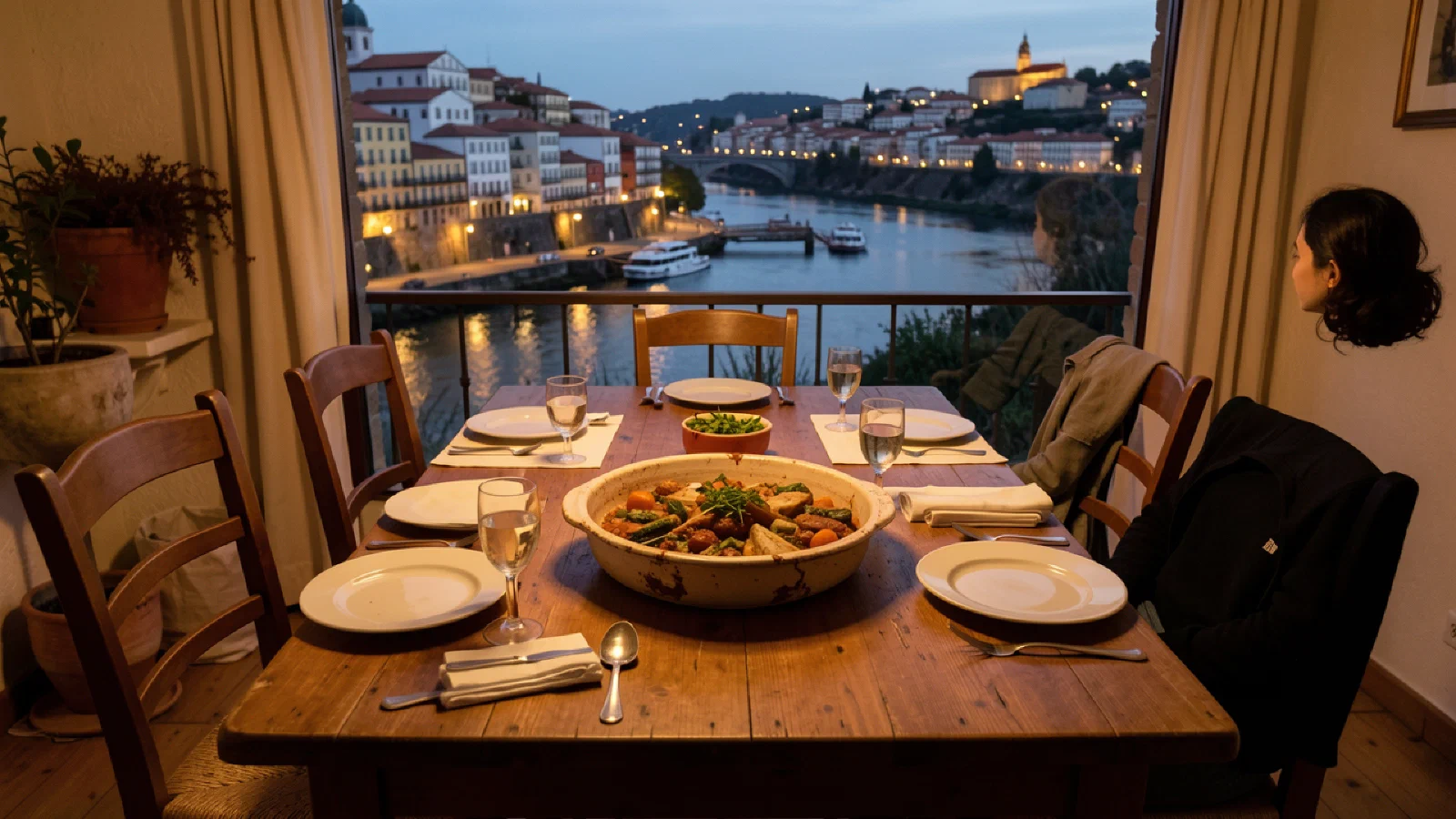
The Laid Table
Five people holding one end of nothing
The Teixeiras are a happy family, and nothing holds them together.
That is not a paradox. It is the description they would give of themselves, if they gave one, which they do not, because families do not describe themselves; they set the table. There are five of them in the house above the river in Porto: Amélia, who is seventy-nine; her son Rui and his wife Inês, who are in their early fifties and were Natives; and the children, Beatriz, who is fifteen, and Tomé, who is ten. They eat together most nights. They like each other. Nobody has ever had to.
The table is laid for five. The house lays it, at seven, whether or not anyone is coming, and someone always is.
What Nobody Has to Do#
Amélia is provided for. Her pension arrives, her health is watched with a discretion she does not notice, her stairs became a lift the week her knee said they should, and she has never once had to ask her son for anything, which is a sentence her own mother could not have spoken about any child at any age.
Rui and Inês are provided for. Their work ended when the transition did; they did the work of it, both of them, in the port and in the schools, and they are proud of it in the tired way, and they are done. Neither depends on the other for money. Neither depends on the other for the house, which runs itself. Neither has needed the other’s hands for a single task since Tomé was born, and Tomé’s birth was managed so well that the hands were mostly ceremonial then too.
The children need nothing material. Beatriz’s education arrives shaped to her, and Tomé’s to him, and both are better at it than any school Rui went to. Neither child has ever gone without, or waited, or been told there was not enough. Neither has ever been asked to do a chore that mattered, because no chore does.
There was a time, and Amélia remembers it, when a family was a machine for surviving. Everyone had a part. The parts fit because they had to. A family that did not cooperate went cold, or hungry, or apart, and so families cooperated, and called it love, and it was love, and it was also the cold.
The Teixeiras have no cold. They have the laid table and the five people who come to it.
A family held together by need is a rope. A family held together by choice is five people each holding one end of nothing.
The Plural#
The family knows this about itself, in the way a family knows things: not as a thought any one of them has had, but as a shape in the room.
It shows in small places. Rui and Inês do not argue, and have not for years, and they have noticed that they do not, and neither has said so, because to say so would be to ask what there was to argue about, and the answer is nothing, and nothing is the thing they do not look at. Amélia tells stories about the old house at dinner, the one with the well and the seven people and the winter of the strike, and the children like the stories, and Beatriz has started to hear them the way you hear stories about a country that no longer exists.
Beatriz, at fifteen, is a Human. She floats. The family sees her float and does not know what to do about it, because the thing that would give her weight, being needed, is the thing the family has organized itself, with great success, not to do to her.
Tomé is ten and has not noticed anything yet. He is the one who comes to the table first.
The Dish#
On the table, at the center, is a serving dish. It is chipped. It came from the old house and it held, in Amélia’s childhood, whatever there was, which was sometimes not enough, and it went around the table and everyone took from it and watched what the others took.
The house does not need the dish. Meals arrive plated, or in the warmer, portioned to each person’s profile with a precision that Amélia finds faintly comic. Inês takes the food out of the portions and puts it in the dish and sets the dish in the middle and lets the family serve itself.
Nobody has asked her why. She could not say. The children take too much or too little and it does not matter, because the warmer has more, and the dish goes around anyway, and everyone watches what the others take, and there is no reason for it, and it is the only moment in the evening that has the shape of the old house.
Shared weight cannot be manufactured by a family, only remembered. The dish is a memory of a rope, passed hand to hand, holding nothing.
The family knows this too. Beatriz, one night, said the dish was stupid, and Inês said yes, and passed it to her, and she took from it.
The Thin Rope#
Rui thinks about leaving, sometimes. Not seriously. Not because anything is wrong. He thinks about it the way you test a floorboard, to see if it gives. He could go. Inês would be provided for. The children would be provided for. Amélia would be provided for. Nothing would break, and that is the thought he steps back from, because a family in which nothing breaks when a father leaves is a family held together by something he cannot see, and he would rather not know how thin it is.
Inês knows he thinks this. She thinks it too. Neither has said it. It is the second thing they do not look at.
What holds them is that they come to the table. That is all it is. Five people, at seven, because the table is laid and the others will be there. A habit that looks like love and may be love and has nothing under it, and the family has decided, without deciding, that a habit with nothing under it is enough, because the alternative is to find out.
I wonder whether the family is the place the question is easiest to hold or the place it is hardest, because a person alone with the question has only the question, and a family has five people who could each answer it for the others and none of them do, out of a courtesy that is either the finest thing about them or the reason the rope is thin.
Seven O’Clock#
The table is laid. Tomé is first. Amélia comes down in the lift and makes the joke she makes about it. Beatriz arrives late and says nothing and sits. Rui and Inês come in from the terrace where they were not arguing.
The dish goes around. Amélia tells the story of the well. Beatriz has heard it and listens anyway, or does something that looks like listening. Tomé takes too much and nobody minds. Rui watches his wife take from the dish and feels, for a moment, the thing he cannot name, and it passes.
The meal is good. The evening is pleasant. Nothing is decided, because there is nothing to decide, and after a while they get up, and the house clears the table, and Inês washes the dish by hand and puts it back in the center, empty, for tomorrow.
They will all be there tomorrow. That is not a promise. It is a forecast, and forecasts, in this house, are always right, and the family has stopped asking what the difference is.
How this essay connects to others across The Approximate Mind.